Quantcast
Connect with us

Music

Exclusive Interview: Alex Skolnick

Published

on

Bloody-Disgusting has scored an exclusive interview with Alex Skolnick (guitarist of Alex Skolnick Trio, Testament). We talk his newest album, ‘Veritas‘ (review here), from his Alex Skolnick Trio project as well as gear used in the studio, his works in Testament and Trans-Siberian Orchestra, and how horror influences him and his work. Check after the jump for the full scoop.

alexskolnicksolo
Make sure to check out Alex’s Top 10 Horror Soundtracks.

1) During my first listen of ‘Veritas’, something that popped out to me was the scope of emotion in the pieces. The title track is a beautiful, melancholic piece while ’99/09′ is as jazz/funk as it comes. Are there any limits to what the three of you come up with for an album?
 
Thank you. The idea was to capture a wide range of emotions, a sense of depth and honesty. All three of us have diverse musical tastes. We try a lot of ideas regardless of style and focus on the ones that feel right.  As musicians we are not easily labeled or placed in neat little boxes. I think that’s true of most people. Yet we live in a world where everything is categorized and people are molded into these cookie cutter types. This pressure, which comes from numerous sources, is unfair, unhealthy and dishonest. This album is a declaration of truth (hence the title ‘Veritas’ Latin for ‘truth) and a reaction against this form of typecasting, in music and in life. 
2) One of the things that I noticed was that even with the multiple tracks, ‘Veritas’ still sounds very intimate, almost like I was sitting in the room with the three of you while you were jamming. Was that something that you were aiming for?
 
The three of us were playing almost everything at the same time. For a few songs, such as Song Of The Open Road, Path Of Least Resistance and Fade To Black, I’d been using a loop pedal to get the extra tracks live.but in the studio, I played these as extra tracks (without the loop pedal) simply for the sake of sound quality. Then there were occasional embellishments, such as my added acoustic guitar and Nathan’s Calimba (thumb piano) on Bollywood Jam. But the majority is just the trio live in the studio.
 
3) Bringing up the title track again, there is a moment towards the end where a guitar note seems to come in a beat late. Rather then see this as an error, I heard it almost as though it were a voice that choked for a moment before being able to continue, caught up in the emotion of the moment. Is this something you try to convey? An almost vocal-like personification to the guitar playing?
 
That’s a very good observation. Too often these days, music is so precise and ‘correct’ that it loses the human element, the very thing that makes music great. That’s one of the purposes of embarking on the journey of becoming a professional improviser, to be able to express on a deeper, more human level.
 
4) A question for our guitar lovers on the site: Some of the tones you achieve sound so natural, woody and warm. What guitars, amps and effects did you use for the recording process?
 
My main instruments are Heritage Guitars, built in the old Gibson plant in Kalamazoo, Michigan. Heritage guitars are a bit harder to acquire than most- you won’t find them in Guitar Center or Sam Ash. But they’re the only new guitars I’m aware of that give you the feeling of shopping in a great vintage guitar shop like Mandolin Bros in New York or Gruhn Guitars in Nashville.  Mostly what you hear is a Heritage H575 archtop, similar to a Gibson 175. There is also my signature ‘Alex Skolnick’ model, which is like a Les Paul- it stands toe to toe with any classic Gibson Les Paul.  There are also a couple of great acoustics on there, both made by Yamaha. One is an LJX steel string and the other is an NCX Nylon string. 
 
For amps, I used my signature Budda, which is my main amp live. It’s a compo amp with one speaker. For effects, I used a bit of delay, the Carbon-Copy, manufactured by Jim Dunlop.  Live, I’m using loop pedals from Line 6 and Boss, but in the studio, we mimicked the loops on actual tracks, for the sake of sound quality.
   
     
5) You’re not only a member of The Alex Skolnick Trio, but also very well known for your work in Testament and Trans-Siberian Orchestra. Considering that each of these groups has a very distinctive musical style, what do you take away from playing in these varying genres?
 
It’s been really interesting. I always hated the concept of having to be exclusive to one musical genre and social scene in order to be accepted. Only at this stage in my life (not quite a ‘veteran’ but no longer ‘new on the scene,’) am I able to comfortably express myself in multiple scenes, verbally and musically. I enjoy taking on the challenge of shattering preconceptions from anyone who thinks otherwise or underestimates. Being a part of these three very different projects has helped make that possible.  Testament has enabled me to communicate in a high energy, high volume situation that runs on ’10’ most of the time. TSO gave me experience playing in sold out concert arenas, including  moments where all focus of the 14,000 or so people was on me. With the special guests, I had the experience of starting the Who’s ‘Pinball Wizard’ with Roger Daltry right next to me and even more challenging, Yes’ ‘Roundabout’ while standing next to Jon Anderson. And finally, AST has enabled me to prove myself as a composer, bandleader, producer, improviser, frontman and everything else that no one would have ever guessed when I was this awkward kid who joined Testament at sixteen years old. 
   
 
6) You submitted a fantastic Top 10 horror movie soundtrack list. How long have you been into horror and what, if any, influences has it had on you, both musically and more in general?
 
As a pre-teen, my friends and I used to love going this movie theater in Berkeley, the UC Theater (which has sadly closed down). They played a different classic movie everyday. Our favorites were the double feature of ‘Pink Floyd:The Wall” and “Heavy Metal,” The Rocky Horror Picture Show (Saturdays at midnight) and of course, horror movies! We got to see movies we’d missed, like ‘Friday The 13th’ and ‘Halloween’ on the big screen.  I still enjoy a good horror flick,  but I don’t pretend to be a horror aficionado like some friends of mine. The drummer from AST, for example, Matt Zebroski, is a walking encyclopedia of horror films- he can tell you where they were made, who the director was and all kinds of other facts.   
 
The soundtracks definitely had a huge influence on my when I was composing for Testament.  The dark mood of the melodies is a prerequisite for the type of metal we were doing and I’ve often looked to these themes for inspiration.  If I wrote a riff,  I’d often ask myself if it would work in a horror movie.  If so, I knew we’d be able to use it.
 
7) Horror and metal have long had a strong association. What do you suppose attracts these two genres to each other?
 
Horror and metal are outside genres, in film and music respectively. They exist as mediums to go where more mainstream creations don’t dare to go. There is a lot of overlapping imagery. That which is expressed visually in horror is expressed verbally in metal. There is extensive use in horror and metal of macabre fantasy and shining a light on the dark side of humanity  Both have occasional successes that manage to invade the mainstream like a knife-wielding Jason or Freddie.
 
I’ve heard it said that the very group that arguably is responsible for metal’s existence began when, after playing gig after gig with little luck drawing a crowd, they noticed a long line down the street for a horror film.  They changed their name, their sound and became the first band directly influenced by horror. In fact, their first album ‘Black Sabbath’ is like a horror film encapsulated in a record, from the cover, to the opening, to the songs.
 
8) Your Top 10 list gave us some of your favorite horror soundtracks. However, I’m curious to know if that list also matches your favorite horror movies. Are there any others that stand out to you? 
 
‘The Amityville Horror’ was really scary, at least when I saw it as a kid. I’m not sure if ‘Alien’ counts as a horror film, as its more Sci-Fi, but that scared me as much as any horror film. I also really like the ones that are more psychologically scary, like ‘Silence Of The Lambs,’ ‘Rosemary’s Baby’ and Stephen King’s ‘Misery.’

Managing editor/music guy/social media fella of Bloody-Disgusting

Click to comment

Music

The Last Dinner Party Talk Horror, Dario Argento, and Why Beauty Makes Terror Stronger

Published

on

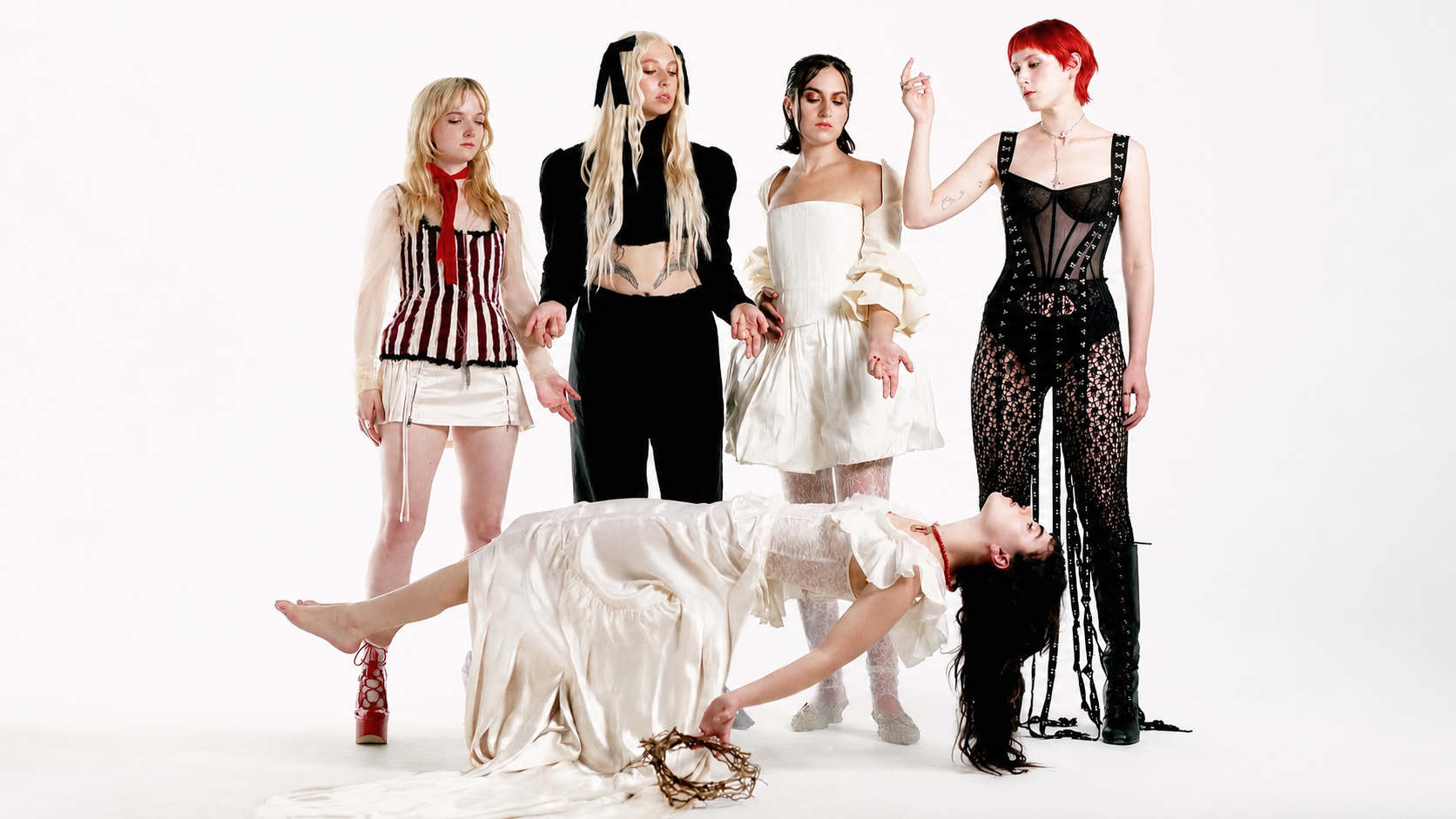
The Last Dinner Party

Multi-award-winning and unapologetically cinematic UK band The Last Dinner Party have always seemed drawn to the places where opposites collide. Beauty and violence. Grief and ecstasy. The sacred and the grotesque. It’s there in their music, performances, and in the worlds they’ve built around themselves since the band’s earliest days.

Their songs often feel less like traditional rock music and more like myths in motion, unfolding somewhere between a dream, a film, and a fevered memory. Perhaps that’s why horror feels so naturally at home within their creative universe. 

For Abigail Morris, the group’s charismatic ringleader, some of horror’s most enduring filmmakers understand that terror becomes more powerful when it exists alongside beauty. 

Discussing the work of Dario Argento, she points to films like Suspiria and Phenomena as perfect examples of that tension. 

I think it’s actually the proximity of those things rather than the distance,Morris explains.The things that are really beautiful and the things that are really terrifying. It’s like the idea of the sublime. The closer that beauty is to terror, the more beautiful it is and the more terrifying it is rather than the juxtaposition. I think that that’s where the sweet spot of fear and tension and intrigue and pure and real beauty is, where it’s almost the other. And I think that’s what Argento does really well with the sort of the beautiful casting and the sets and the lighting and then the buckets of red blood.

She cites Argento’s ability to place stunning imagery directly beside the grotesque or unsettling. The vivid colors, dreamlike sets, and beautiful performers suddenly interrupted by buckets of blood, swarms of insects, or moments of genuine nightmare. 

I love how he plays with that,she says. 

That fascination with contradiction extends far beyond horror films. The Last Dinner Party’s work frequently occupies a similar emotional space, where longing can feel catastrophic, and heartbreak transforms into mythology. Morris brings up one of her favorites, Andrzej Żuławski’s Possession (1981), as another example of horror expressing emotional truths more accurately than realism ever could. 

A divorce is a very human thing that happens,she says.And then to turn that into this psychological body, spiritual, eldritch horror is how it must feel to go through a divorce. And it’s more accurate.” 

Not surprisingly, news of the upcoming Possession remake sparked a passionate response.I’m fucking furious,Morris laughs. While generally skeptical of remakes, she makes an exception for Luca Guadagnino’s Suspiria, praising the filmmaker for creating something entirely his own rather than attempting to recreate Argento’s original. 

He wasn’t trying to capture the energy of Argento’s film. It felt like a story in its own right.She goes on to explain,…if they do that with Possession, then I’m interested.

The conversation also reveals just how deeply cinema has been embedded into The Last Dinner Party from the very beginning. Long before sold-out shows and award nominations, the band envisioned themselves not simply as musicians but as architects of an entire world. 

When we started the band, the visuals were of equal importance to the music,Morris says.Before we played a show, before we shot a music video, we decided that what we wanted this band to be was something that was a complete world.” 

That commitment led to elaborate mood boards, film references, styling concepts, and even a 72-page presentation that helped define the band’s visual identity before many people had ever heard a note of their music. 

For composer, songwriter, and keyboardist Aurora Nishevci, many of those same cinematic instincts have begun finding new outlets. She speaks passionately about the horror scores that continue to inspire her, including the work of Mica Levi and Hildur Guðnadóttir. Rather than relying solely on traditional horror techniques, she is fascinated by artists willing to challenge expectations. 

You can decide to go the traditional route,Nishevci says.Or you can completely go another way and still be terrifying.” 

That fascination has now become something more personal. Nishevci reveals that she is currently working on her first horror feature as a composer, bringing her own musical language into the genre that has influenced her for years. 

The band’s connection to horror has also found an unexpected audience among fans of Yellowjackets. Online, edits pairing The Last Dinner Party’s music with scenes from the series have become increasingly common. At concerts, fans have even begun holding up photos of Jackie during performances ofWoman Is a Tree.” 

At first, Morris couldn’t understand what she was seeing. 

I thought it was someone’s grandma,she says. Only later did she realize the mysterious photographs were actually tributes to one of the show’s most beloved characters.It’s fucking Jackie from Yellowjackets!” 

The band enthusiastically express interest in seeing those worlds collide one day. 

While The Last Dinner Party’s future remains unwritten, horror seems destined to remain part of it. Asked what creative paths still excite them, Morris immediately begins dreaming beyond albums and tours.

We’ll do a horror movie as well.” 

Nishevci quickly adds another possibility that has apparently been living on the band’s mood board for some time.We keep talking about doing a folk horror EP.” “That’s been on the mood board,Morris confirms. 

For a band already obsessed with mythology, ritual, transformation, storytelling, beauty, and terror, both ideas feel less like surprises and more like inevitable next chapters. For much more with Abigail Morris and Aurora Nishevci, including further musings on Argento, Possession, Salò, Hausu, and the future of The Last Dinner Party, check out The Boo Crew Podcast Episode 473 available now on Apple, Spotify, and wherever you get your podcasts.

The band joins Olivia Rodrigo on the road next year for multiple sold-out residencies in New York and LA. Follow the Last Dinner Party on Instagram.


Continue Reading