News
Ghostbusters Developer Diary Part 2, Origin And Making Of

Proving It
Now, and to be completely candid about this, as a game developer Terminal Reality had something to prove. At that time our most recent titles, Aeon Flux and Spy Hunter, each featured some great elements but neither of them exactly set the world on fire.

We had recently undergone extensive management changes and company reorganization. We firmly decided that we no longer want to be known as a developer that ships decent games on time, but instead one that focuses solely on top-quality entertainment. This had been the central message of our ‘reboot’ publisher tour in LA. We had just proven our commitment to quality (to ourselves, anyway) by reluctantly turning down the offer of an extremely high-profile project that we felt just didn’t offer enough development time to really perfect the game.
A few months prior to that we had gone out to pitch an (different) original game IP. We had a strong document, a gameplay concept that everyone was dying to play, and even a development partnership with a high-profile, stellar, and very cool movie director who worked a room like no one I have ever seen. But what we didn’t have was a demo, and thus we never got out of the talking stages.
We learned from that experience that we have to put everything onscreen. Given this opportunity, that’s exactly what we did for Ghostbusters.
We rushed back to Texas and told the team, who was as excited by the news as we had been. Everyone jumped into making the proof-of-concept with full exuberance. This was the first official next-gen effort for the newly combined ‘big team’ at Terminal Reality. We had been dying for the chance to really show off what we can do.
The result was a playable proof-of-concept that felt, almost eerily, just like a pivotal scene in the movie: a Ghostbuster fought and captured Slimer while brutalizing a ballroom in the Hotel Sedgewick. Everything in the room, from the three-tiered cake on the buffet table to the nondescript bottles behind the bar (they’re labeled ‘Bottle’) to the heavy crystal chandelier on the ceiling could be broken, shattered, or incinerated in blazing flames.
Getting the look and functionality of the proton/capture stream right was absolutely crucial to gameplay and authenticity, so that was our first order of business. Properly scarring the walls was the second.
Within three weeks we had implemented both of these elements, as well as a fully breakable ballroom, fully animated Slimer, a ghostbuster character with working proton pack, slime and hurt reactions, a functioning ghost trap, and both blasting and rudimentary ghost-trapping gameplay.
This was the demo that we showed to our publisher, then Sony Pictures, and then to Dan Aykroyd. Everyone that saw it said that while the quality was definitely there, it also showed the team’s passion for Ghostbusters and getting it just right. Once Mark Caplan from SPCP selected a publisher, we had proved to all the parties involved that we were the right developers for this game.
Authenticity
There’s really only been one goal for this game from the very beginning: create and present a 100% authentic Ghostbusters gameplay experience. That meant the perfect Ghostbusters game would have mainstream appeal, would be action-packed, and would need to masterfully blend elements of fun and funny and scary, just like the original movie had done.
“Fun, Funny, Scary,” in fact, became our mantra. Anything that didn’t fit those criteria had to go.
We knew from the outset that lot of people would automatically assume this game was nothing but another licensed cash-in gimmick. This happens a lot, and that’s mostly a result of the fact that good movies are usually made much faster than good games can be, and tie-ins pretty much have to be released within two weeks of each other.
A tie-in rip-off is the exact opposite of anyone’s intent for Ghostbusters. We seized on the idea to embrace the property’s icons, and present them in new, fresh perspectives, as a way to convince the player that we’re on the up and up.
It’s funny, considering that almost every really enduring element from the property comes from just one movie. Ghostbusters is seriously hip-deep in icons. You’ve got the proton pack, Slimer, the Hotel Sedgewick, the PKE meter, the paragoggles, the Ecto-1, the Firehouse Headquarters, The Public Library, the Stay Puft Marshmallow Man, Janine, that incredible logo, and the city of New York itself, which is as important a character in the Ghostbusters universe as any of the others.
For most people, the only really strong memories from the second movie tend to be mood slime, the walking statue of Liberty, and Vigo the Carpathian (we’ve got two out of three in the game).
We hit the ground running. We watched and re-watched and dissected the movies, and endlessly speculated and debated the gameplay-relevant functionality of proton streams and ghost traps and how the PKE meter works and exactly how fast four not-especially-athletic middle-aged men wearing very heavy proton packs should be able to move.
Should the player take the role of one, or any, of the Ghostbusters? We decided early on that tampering with the near-perfect dynamics already established between the Ghostbusters was flirting with disaster, so decided to introduce a cipher player character: a rookie that could both play alongside and be a Ghostbuster while still getting to sit back and enjoy the interplay between the original cast—like playing a movie and watching it at the same time. A few of us (including myself) originally wanted him to talk, but when it came time to manage the dialog for all the characters, we were very relieved there wasn’t an additional voice in the mix!
We knew the story had to be set in New York City. Trying to go anywhere else would have been coloring too far outside the lines for Ghostbusters, especially for our first time out.
We wanted the game to synch with and progress Ghostbusters canon, so we placed it just a few years after the events of the second film.
We all agreed that the sad-sack beginning of GB2, in which the city had abandoned the Ghostbusters, was too much of a downer, and you couldn’t retread that same patch anyway. So when we open the city loves the Ghosbusters, who have become New York’s official, contracted Paranormal Investigations and Eliminations experts (we ended up going heavier on the ‘Elimination’ than the ‘Investigation’, as a result of focus-testing). The new Mayor was even elected as a result of the Ghostbusters’ endorsement.
One really cool thing we’ve heard is that the overwhelming public interest in the game played a pivotal role in prompting the studio and talent to move forward on a Ghostbusters 3 movie! We’ve also heard rumors (completely unfounded allegations, and it’s irresponsible to repeat them here) that some elements from the game, and even some of the ideas we weren’t able to use, may be showing up in Ghostbusters 3, if it comes to pass. It’s hard to imagine anything much more gratifying than that. And if it doesn’t happen, we still have played a part, however small, in helping get the movie made.



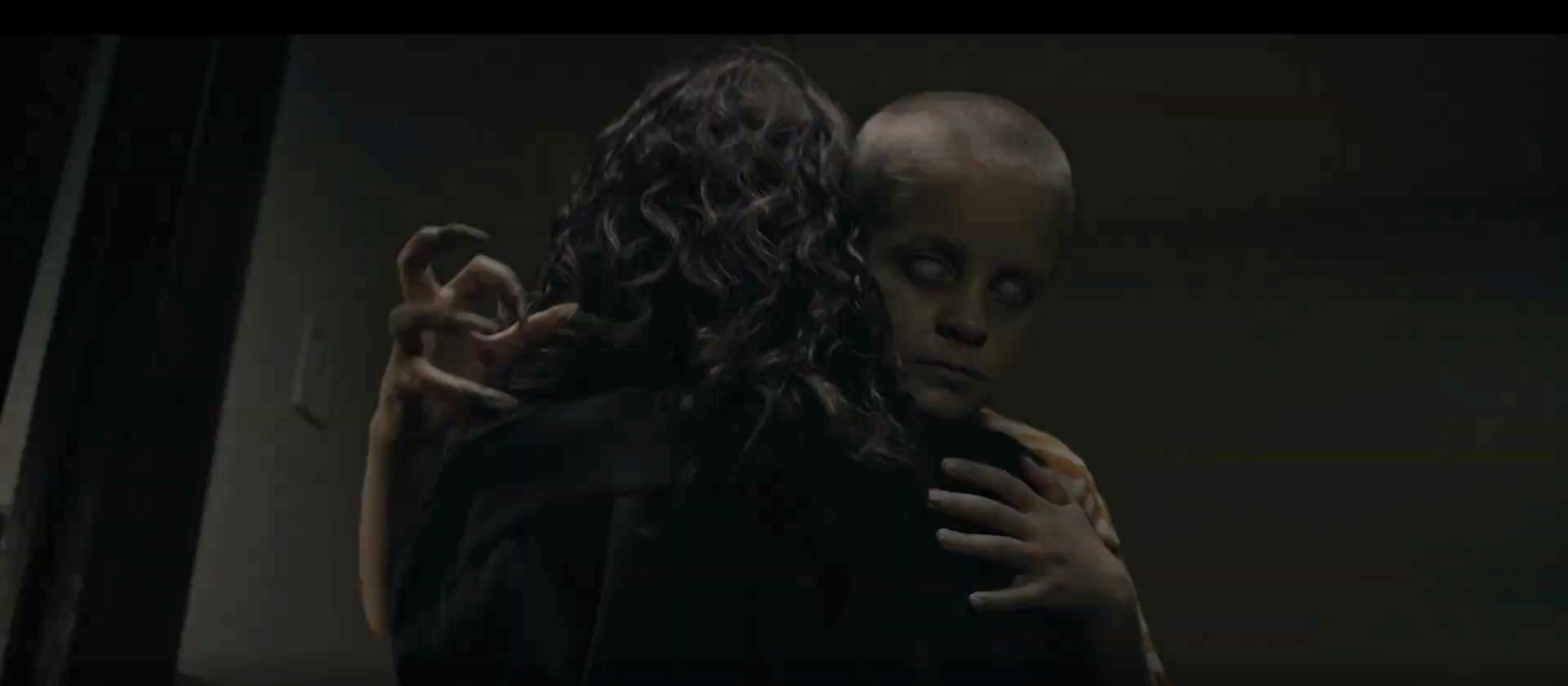
Let’s start with the good news. Lockbox looks far better than its misleading marketing materials suggest, a supernatural horror movie so darkly lit and color graded that you’ll have to squint your way through jump scares. It’s also anchored by reliable genre performers. That’s also about where the good news ends with this rote adaptation of Knifepoint Horror Podcast story “Winthrop.”
The empathetic Carla Gugino gives her all as Ellen, a saint of a woman with boundless patience who takes on life’s hard luck with a kind smile. After giving up her career as a fashion designer to become caretaker for a dying mother, she’s then forced to reinvent herself once more when her caretaker role ends. That catches us up to the events of Lockbox, where Ellen is asked to take in a cousin she hasn’t seen in quite some time who’s dealing with severe PTSD.
Just as Ellen finally establishes a real connection with Winthrop (Lou Taylor Pucci), it’s interrupted by the arrival of peculiar neighbor Vahna (Katharine Isabelle), who spells clear trouble. When Vahna shows up dead, it sets in motion a supernatural battle of possession.

Image Credit: Aura entertainment
Director Daniel Stamm (The Last Exorcism, Prey for the Devil) and screenwriter Justin Yoffe approach Lockbox in the broadest of brushstrokes, dooming it from the start with clunky storytelling and woefully underdeveloped themes of heady topics like PTSD. Winthrop is a character that comes loaded with emotional baggage and trauma that’s piled on throughout his tragic life, but much like its title, his interiority and history are treated like a tightly guarded secret meant to prolong the supernatural mystery.
The problem here, though, is that Lockbox is too sparse to sustain mystery at all, and it instead robs Winthrop of characterization. It winds up trapping the talented Pucci without anywhere to go, toggling between wounded animal and mentally disoriented.
From there, Lockbox bounds through plot developments without any sense of stakes or purpose, peppered by a smattering of haphazard paint-by-numbers jump scares. The only unwavering constant is Ellen’s resolute faith, and Stamm seems to leave it entirely to Gugino to guide confused audiences through this inconsequential story right up until its supernatural climax.

Image Credit: Aura entertainment
To give more credit, Lockbox at least injects an unconventional exorcism here; just don’t expect much in the way of explanation. When the film finally reveals the meaning behind its title, it dangles a fascinating carrot it has zero interest in delivering. More than a severe lack of fleshing out its characters beyond plot drivers or devices, this faith-based flick also seems terrified to offer any worldbuilding whatsoever.
Yoffe’s script stretches the short story beyond its means instead of fleshing it out, and Stamm fills out the gaps with cheap CGI scares and overwrought performances; Isabelle’s Vahna is beyond cartoonish in her villainy. It’s also pretty nonsensical, treating only Ellen’s faith with the utmost sincerity and largely squandering its typically reliable talent. So much so that the final imagery, pure sunkissed saccharine sentimentality, leaves you with the feeling that this horror movie might be better suited as an entry in Chicken Soup for the Soul.
Lockbox releases in select theaters on July 3, 2026.

You must be logged in to post a comment.