Movies
Mimic
“Although this version of ‘Mimic’ is labeled a director’s cut, the same painful inertia infiltrates the proceedings once the bug hunt takes a breather. The reworking is moderately flavorful, yet doesn’t erase the inherent problems of the picture; it’s still a botched pass at creating a distinctive threat in a film landscape that’s seen it all. ‘Mimic’ is something of a bore, but there’s plenty of screen spookery to scrutinize courtesy of Guillermo del Toro, who couldn’t make a visually tedious movie if he tried. Enthralling acts of drama? Those always seems to elude him, but when it comes to imagining monster cockroaches on the prowl in New York City, there’s nobody more qualified for the job.”

Mimic was filmmaker Guillermo del Toro’s Hollywood baptism, his entrance into the complex nature of the industry big leagues. Sure, the Mexican director proved himself an exceptional horror conductor with 1993’s Cronos, but that was hometown kitten play, barely seen by American audiences at the time. 1997’s Mimic was the show, introducing the visionary master of the macabre to his worst nightmare: The Weinstein Brothers. Forget giant cockroaches and Jeremy Northam’s substandard acting, the real fright was found behind the scenes, as Dimension Films attempted to break del Toro’s creative spirit like so many filmmakers before him. They picked on the wrong Mexican. However, Mimic, with its prolonged tedium, came awfully close to tarnishing the creator’s name for good.
A plague has ravaged America’s youth, requiring the services of CDC scientist Dr. Peter Mann (Jeremy Northam) and entomologist Dr. Susan Tyler (Mira Sorvino) to help investigate the spread of doom, searching for a cure. Their effort to decimate the cockroach population of New York City is successful, creating a special “Judas Breed” bug to help obliterate the threat. Built for temporary use, these pesky lab creations begin to show signs of survival long after their intended demise, forcing Susan and Peter back into action, hunting for answers while bodies start to pile up across the city. Assisted by Josh (Josh Brolin), a detective, and Leonard (Charles Dutton), a transit cop, the team heads underground for a bug quest, only to find a threat far greater than imagined, with a terrifying ability to mimic their new source of food: humans.
Despite only being his second directorial effort, Mimic carries all the birthmarks and dark magic that have come to define Guillermo del Toro’s twisted career. There’s a shockingly cohesive visual design to enjoy here, filled with goopy, textured encounters and meticulous insect investigation (rooted in scientific authenticity), set against a grungy cityscape of perpetual menace and infinite subterranean habitats. Mimic is appealing to study in full, which is always the case with a del Toro picture. However, this darkly gorgeous effort is especially compelling, playing as both a monster movie featuring the wrath of human-sized cockroaches and a journey of movie science, with furrow-browed actors hunched over amber lighting, examining creepy creatures to ascertain the trouble clicking ahead. It’s a brilliantly produced movie, extending to the successful mix of practical critters with crude CGI, kept in the dark long enough to pass. The effort is all there on the screen.
While the film’s visual scope is always intriguing, the performances nearly sink the entire production. Handed a cast of Weinstein-approved actors, del Toro slips into survival mode, permitting the lackluster talent plenty of room to clomp around undisturbed while he works on the insane background details of the piece. It’s directorial apathy a blind man could perceive, especially with Northam, who’s completely vacant here as the voice of science, never conveying a drop of a personality behind his bookish glasses. Sorvino is almost as painfully blank, showing awkwardness with the film’s overt genre intensity, looking more confused by the director’s attention to scares then enlivened by the horror potential of the piece. The acting is dreadful at times, a cancer that spreads to the script, which stops the movie dead midway through the descent to simplify the scale of the picture, pitting our heroes against the Judas legion inside a cramped subway car, turning the second half of the movie into a routine survival event with a hefty grip on irony (humans turned into insects) but offering surprisingly little tension.
THE BLU-RAY
Visual:
The AVC encoded image (2.39:1 aspect ratio) presentation displays a substantial urgency with crush issues, solidifying blacks during low-lit sequences, puling details out of set design and hair density. This is part of del Toro’s vision for the Director’s Cut, but there’s surplus impenetrability happening here. Clarity is quite good when lit, displaying a hearty sense of emotion from the cast, with appealing textures on faces, while the creature moist nuances are also well preserved. Color is impressive, offering confident greens and amber glow, though the film basically holsters its hues for the second half showdown.
Audio:
The 7.1 DTS-HD MA sound mix contains insane directional activity, utilizing the soundstage wonderfully as the bugs crawl around the room, upping in sonic intensity as the violence increases. Dialogue is well maintained and heavy, feeling out an echoed quality when matters dive underground. Scoring is hearty but rarely disruptive, finding a nice balance with verbal interactions. Atmospherics are generous, while low-end is responsive, kicking up in during attack sequences.
Subtitles:
English, English SDH, and Spanish subtitles are offered.
Extras:
Video Prologue with Director Guillermo del Toro (1:05) is brief introduction to the BD contents, with the filmmaker promising to share all he legally can about the process.
Audio Commentary with Guillermo del Toro is a corker of a conversation, a perfect opportunity for the creator to explain his complex feelings about his “imperfect child.” Balancing screen-specific study with considerable BTS recollections, del Toro paints a portrait of creative frustration, where his place in the film’s production was reduced to meet the demands of the producers. It’s not a mopey track of woe-is-me worry, but a refreshingly truthful (within certain legal boundaries), headfirst journey into the reality of a young filmmaker rubbing the moneymen the wrong way. The commentary is sharp, focused, and hungry to illuminate the struggles and pleasures of Mimic, with del Toro refusing sourpuss invitations to remain positive about his impediments.
Reclaiming Mimic (14:31) returns to the director, who clarifies his feelings about the work and the opportunity he had to fine-tune a feature he made as a young man. There’s an explanation of screen changes, pointing out their thematic intentions, but this conversation is primarily devoted to del Toro’s feelings about the creation of horror, finding his flowing sensibilities blocked by a studio that demanded he play by “the rules” of the genre.
A Leap in Evolution: The Creatures of Mimic (9:35) captures the effort to blend science with realism, interviewing the creature design team to better understand how the bugs were created and manipulated on-set.
Back into the Tunnels (5:22) returns to 1996, observing a baby-faced del Toro guide his cast and crew on the set of Mimic. It’s a promotional featurette, but there’s tremendous entertainment value in seeing BTS footage and pre-release conversations.
Deleted Scenes (5:11) offer a direct revelation of pregnancy for Susan and Peter, supply an unfinished bug attack on Susan, and serve up a slight variation on the ending.
Storyboard Animatics (6:04) provide the planning stages for six major action and suspense sequences.
Gag Reel (2:20) is a slickly edited assembly of mix-em-ups, highlighting a lip-licking montage that finds most of the cast in need of Blistex.
A Theatrical Trailer has not been included.
FINAL THOUGHTS
Although this version of Mimic is labeled a director’s cut, the same painful inertia infiltrates the proceedings once the bug hunt takes a breather. The reworking is moderately flavorful, yet doesn’t erase the inherent problems of the picture; it’s still a botched pass at creating a distinctive threat in a film landscape that’s seen it all. Mimic is something of a bore, but there’s plenty of screen spookery to scrutinize courtesy of Guillermo del Toro, who couldn’t make a visually tedious movie if he tried. Enthralling acts of drama? Those always seems to elude him, but when it comes to imagining monster cockroaches on the prowl in New York City, there’s nobody more qualified for the job.



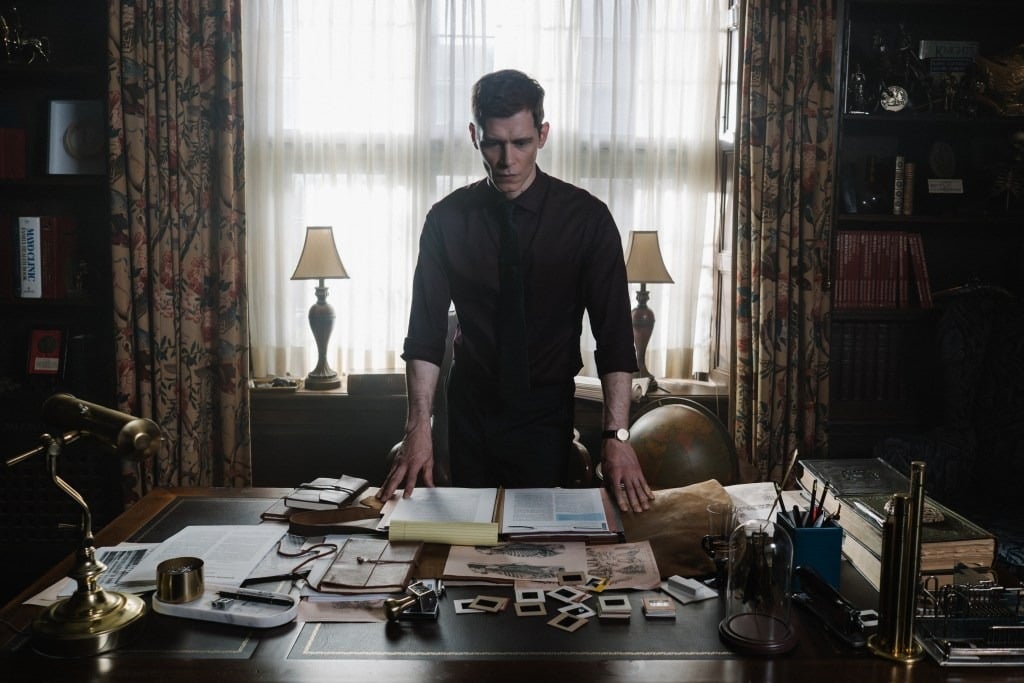
A contemporary reimagining of H.P. Lovecraft’s short story Herbert West: Reanimator is on the way, and Deadline has unveiled the first look at the new Herbert West and the pathologist drawn to his orbit.
Adam Simon (The Haunting in Connecticut, “Salem”) and Tim Metcalfe (The Haunting in Connecticut, Kalifornia) penned the script. The original screenplay and storyline come from Jade Sandberg Wallace.
Michael Grossman (“The Originals”, “Pretty Little Liars”) directs.
The new images introduce star Joseph Morgan (“Vampire Diaries“), who plays “brilliant surgeon and scientist Herbert West, who is obsessed with creating a serum to reanimate the dead.” Katie Cassidy (Speed Demon) stars opposite as the pathologist with a troubled past who joins his efforts.
Together, they prove that conquering death may be the ultimate sin against life itself.
The film’s official synopsis: “As a child, Herbert West watches his father Peter reanimate his dead mother Judith in a secret basement lab — only for Judith to mortally wound Peter and nearly kill Herbert before Peter shoots her. The trauma leaves its mark on Herbert, but so does one final image: his mother’s finger, twitching after death. Thirty years later, Herbert West is a brilliant, secretive surgeon still chasing his father’s obsession.
“Pathologist Kate Locke arrives in town and is drawn into his orbit — first through a spark at a hospital fundraiser, then through his secret lab, where he reveals a serum capable of reanimating severed tissue. Kate, hiding a dark past of her own, is thrilled rather than horrified, and moves into West’s mansion to work alongside him. Their early experiments on a cadaver succeed only briefly. West concludes that dead tissue is the problem — they need something fresher.”
Supporting cast includes Scott Aiello, Ira J Amyx, Randall Newsome, Emma Reinagal, James D. Bryce, Kathryn A Bentley, Jack Lancaster, Amy Holland Pennell, John Pierson, Mindy Shaw, Eric Dean White, Tristan Wilder Hallet, Adrienne Lamping, Aaron Crippen, and Drew Patterson.
Makeup artist Jeff Lewis (“Star Trek: Voyager,” “Star Trek: Enterprise”) and cousin Roger Lewis are heading the production via their newly established Woodlake Entertainment.
Lovecraft’s short story, first serialized in Home Brew magazine in 1922, is the first among his works to mention the fictional Miskatonic University. It was most famously adapted into a 1985 horror movie from Stuart Gordon, starring Jeffrey Combs as Herbert West.
Herbert West: Reanimator is set in Alton, Illinois, where production is now underway.

Herbert West: Reanimator. Photo credit: Matt Lief Anderson
You must be logged in to post a comment.