Editorials
From H-to-A: Movie Stars Who Got Their Start in Horror

A lot of movie stars make derogatory remarks about the horror genre, all while failing to mention that before they were raking in the dough and starring in period dramas they might’ve actually acted in one or two of them. Which is why B-D reporter Chris Eggertsen headed over to IMDB to uncover some of the more notable examples of this phenomenon. Read on for his list of ten celebs who made their screen debuts in horror films (and no, Jamie Lee Curtis isn’t one of them).

Role: Jennifer Corvino
Long before she won an Oscar for her role in the overrated melodrama A Beautiful Mind, Connelly made her starring debut in Dario Argento’s 1985 horror/mystery Phenomena, playing a teenage girl able to communicate with insects. When she goes to live at a Swiss boarding school, she becomes caught up in the search for a vicious serial killer. Interesting bit of IMDB trivia: after going on to star in studio films like Labyrinth, Career Opportunities, and The Rocketeer, she would next return to horror in her role as…an extra in Witchcraft V? I guess everybody suffers from low points in their career.
Related Quote: [talking about the films she did in the beginning of her career]: “You don’t want to get rid of your experiences, because they’re your experiences – good or bad – and you need them, but it would be great if they weren’t on the video shelf!”
Role: Glen Lantz
He commands $20 million a picture and is one of the biggest movie stars in the world, but horror fans will always remember Depp for playing Heather Langenkamp’s boyfriend in Wes Craven’s ’84 classic A Nightmare on Elm Street. Interestingly, the friend he rode to the audition with was none other than Jackie Earle Haley, the new Freddy in Warner Bros.’ upcoming remake. Hey, I don’t know if it’s true, but it makes for a damn good story.
Related Quote: [about a scene in A Nightmare on Elm Street (1984)] “I love this stuff. The kid falls asleep and it’s all over, he’s sucked right into the bed and spit out as blood. His bloody body rises straight out and then topples over, too. I heard somebody talk about having a dummy shot out of the bed, but I said, `Hey, I want to do this! It’ll be fun! Lemme do it!'”
Role: Claudia
Ok, so this adaptation of the 1976 Anne Rice novel isn’t exactly a small little horror movie, but nevertheless it was Dunst’s first major role, in a pretty great performance as Claudia, a 30-something-year-old vampire stuck in the body of a child. Arguably it’s still her best performance in a career that’s seen her transform from eerily mature child actor to object of fanboy ridicule, but regardless she’s gone on to have an illustrious career – and Interview served as a pretty colossal launching pad.
Related Quote: (On kissing Brad Pitt in Interview with the Vampire: The Vampire Chronicles (1994) ): “It was horrible, I hated it. Brad and Tom were like my big brothers on the set, so it was like kissing your big brother – totally gross.”
Role: Elliot
Hanks’ role in this Halloween-influenced slasher directed by Armando Mastroianni is relatively small, but large enough for the purposes of this article. The double Oscar winner here appears as Elliot, a college student who goes all meta, Jamie Kennedy in Scream style, when he explains to his costars the reasons why people are afraid of horror movies. As for the plot, it’s about a bride-murdering psychopath stalking a soon-to-be-married young woman and her two friends. Apparently, Hanks proved so charismatic on-screen that the director rewrote the script to keep his character alive. Far from the astronomical salaries he would later command, according to IMDB he was paid $800 for his work on the movie.
Related Quote: [from earlier in his career] “I’ve made over 20 movies, and 5 of them are good.” (Let’s just assume He Knows You’re Alone wasn’t one of the five he was talking about.)
Role: Kir
She may be a glamorous sexpot and leading lady now, but in 1998 Eva Mendes was “Kir”, a beautiful teenager who falls in with the titular deranged kiddie cult in Children of the Corn V after getting stranded with her friends. Later on in the film, her character sacrifices herself by jumping off a silo into a raging fire lit by the little delinquents. (No, crybaby, that did not merit a “spoiler alert”. It’s fucking Children of the Corn V.)
Related Quote: “I love horror movies. The Shining is my favorite.”
Role: Lana Marcus
She had a blink-and-you’ll-miss-it part in Woody Allen’s Stardust Memories the previous year, but Stone didn’t enjoy her first starring role until Wes Craven’s little-seen 1981 horror flick Deadly Blessing, about three women caught up in a series of murders perpetrated by an Amish cult known as the Hittites. Stone plays Lana, one of the three women forced to fight off the religious fanatics in a battle to the death that includes a dream sequence where Stone’s character has a spider dropped into her mouth. Unfortunately for the actress it was one of Craven’s lesser efforts, and after toiling in relative obscurity for years, she finally broke through 11 years later as the femme fatale in Paul Verhoeven’s Basic Instinct.
Related Quote: [from a 1990 interview]”I was this cute young girl with a nice ass who was a terrible actress. But I’ve worked real hard to become a good actress and now I think I’m starting to reap the benefits of that hard work.”
Role: Kimberly
Nearly ten years prior to winning her first Oscar, golden girl Swank appeared in the film that was supposed to make Kristy Swanson a big star (whatever happened with that, anyway?) as Kimberly, one of Buffy’s one-liner spouting high school friends (“Get out of my facial!”). Unlike its later incarnation as a TV show, the film underperformed both critically and commercially, but after a few false starts (remember The Next Karate Kid?) Swank’s career later took off and she ended up winning Oscars for both Boys Don’t Cry and Million Dollar Baby.
Related Quote: [on walking around nude in front of her boyfriend’s six-year-old son] “You wonder at what age you should stop walking around nude. But he doesn’t look twice. He doesn’t think about it yet.” (Ok, I’ll admit this has nothing to do with Buffy the Vampire Slayer.)
Role: Billy Nolan
Although in his early career he’s most closely associated with his role as Tony Manero in Saturday Night Fever, Travolta made his big debut (after a bit part in another horror film, The Devil’s Rain) in director Brian de Palma’s Carrie at age 22. In the film he plays Billy Nolan, the dumbshit boyfriend of teen-queen Chris Hargensen (Nancy Allen) who helps orchestrate the climactic prank on telekinetic loner Carrie White (Sissy Spacek), leading to famously disastrous results. It’s merely a footnote in his megastar career, but a memorable one.
Related Quote: “I wanted to work with Brian De Palma. I knew the film would be interesting and attract a lot of attention.”
Role: `Professor’ Bennett
Some things never change: Paul Walker was making crap movies then, and he’s making crap movies now. Although to be fair, Monster in the Closet is a low-budget Troma production that at least has a sense of humor about itself, which instantly raises it a notch or two above those retarded Fast and the Furious movies. In the film Walker has a small role as `Professor’ Bennett, a nerdy kid tormented by – what else? – the monster in the closet. Oh yeah, Fergie is in it too – before she got all that face work and joined some stupid hip-hop group.
Related Quote: “It’s not about working anymore, its about doing work I can be proud of.” (You mean like Snow Dogs?)
In this made-for-TV movie starring Tom Skerritt and JoBeth Williams, Wood plays Luke, a young boy who holds the key to solving a series of grisly murders perpetrated by a rain slicker-wearing killer wielding a hook (sound familiar?). The only problem is, he’s blocked out the details of the murder he witnessed – that of his own father – and now a child psychologist (Williams) must force him to remember before the killer claims his next victim – her! Following this little gem there’d be no looking back for Mr. Wood, and eleven years later he’d go on to score his biggest career coup to date by winning the role of Frodo the Gay Hobbit in Peter Jackson’s Lord of the Rings.
Related Quote: “I think God gave me a talent to use for the positive and to do a horror movie would be, like, overstepping my bounds. If I was to do a horror film, I wouldn’t want to be paid. It would be like a vacation, because you don’t really have to use your acting skills.”

Comics
‘Spider-Noir’ Comic Changes Explained: How the TV Series Reinvents Marvel’s Darkest Spider-Man

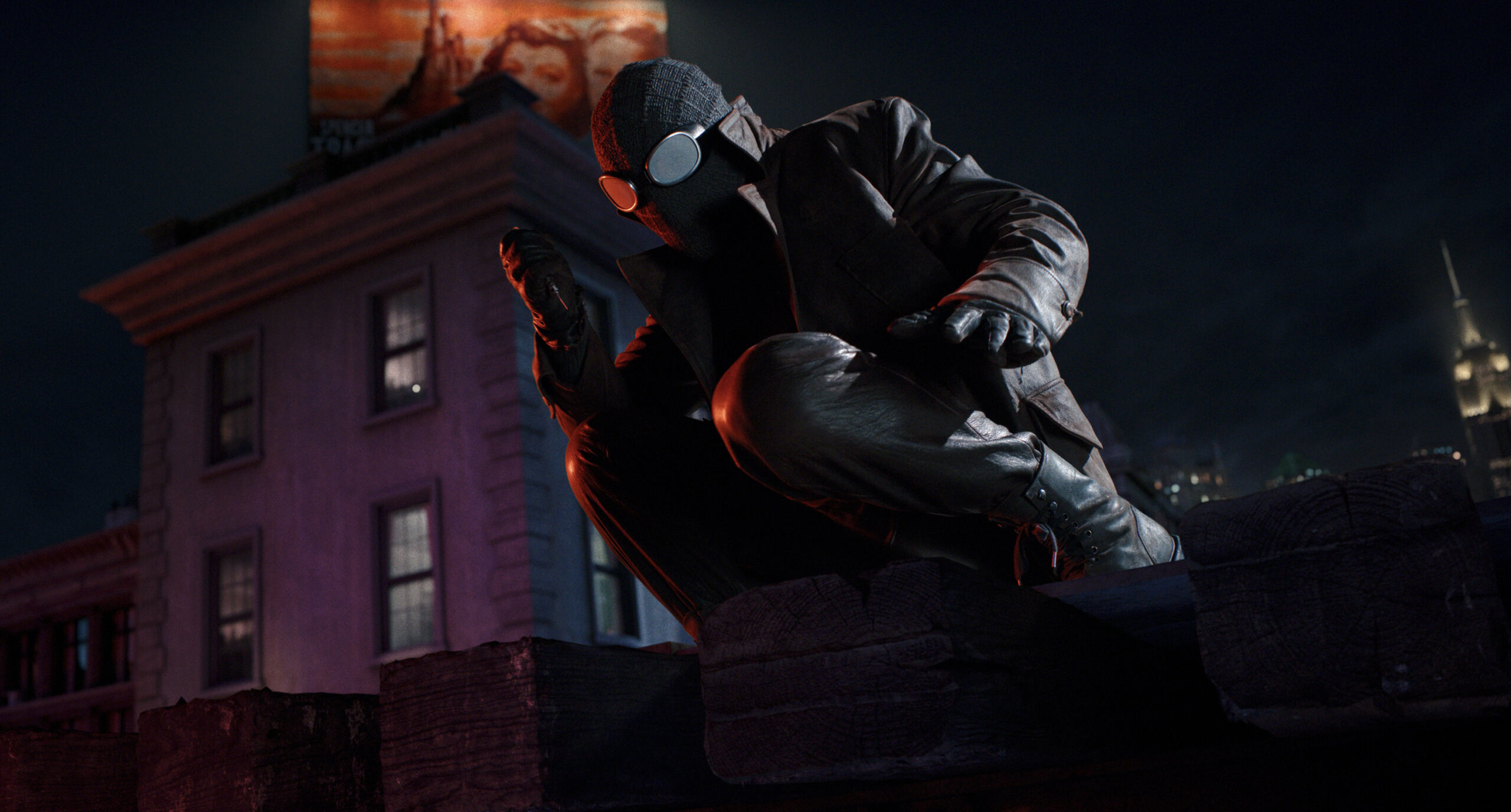
A little while back, I wrote an article chronicling the Hellraiser franchise’s affinity for Film Noir and touched on how that genre has, historically, always been connected to horror.
This connection can be observed in everything from the cannibalistic serial killers of Frank Miller’s Sin City to the disturbing criminal plots fueling neo-noir thrillers like Stuart Gordon’s underrated King of the Ants. That’s why it came as no surprise when I finally sat down to watch all eight episodes of Prime Video’s recently released Spider-Noir series and was confronted with plenty of classic horror tropes.
What did come as a surprise, however, was how showrunners Oren Uziel and Steve Lightfoot approached these horror elements when compared to the 2009 comic book that the show is based on. From the heavily altered rogue’s gallery to an equally terrifying yet completely different origin story for Nicolas Cage’s take on the webslinger, there are plenty of changes here that I feel might be of interest to genre fans.
With that in mind, I’d like to invite readers to take a closer look at all the adjustments that Spider-Noir made to the story in order to bring this incarnation of Spider-Man to life in all of its monochromatic glory (unless you watched the True-Hue color version of the show, in which case you’ll be treated to a surprisingly comic-booky palette that you don’t usually see on television).
The Dark Origins of Marvel’s Spider-Man Noir

Our first order of business should be to examine the origins of the Noir comics themselves. Originally published as part of the Marvel Noir alternate universe that reimagined several characters as hard-boiled crime-fighters, Spider-Man Noir became the most successful book in the entire run. This highly politicized story about Peter Parker coming to terms with the capitalist evils of the Great Depression seemed to have struck a nerve with audiences looking for a darker take on the wall-crawler, which is likely why we’d soon see several sequel stories as well as a video game adaptation of the character in 2010’s underrated Spider-Man: Shattered Dimensions.
Of course, it wasn’t just Spider-Man’s darker disposition that made this version of the character a hit, as 1930s New York City was depicted as being much more hostile than what we generally see in the standard Marvel Universe. From Peter’s powers coming from an Eldritch Spider God that spawns man-eating arachnids to Vulture being an ex-Freak-Show Gimp with a taste for human flesh, you can definitely understand why this Web-Head isn’t pulling his punches.
Unfortunately, this alternate universe was a little too popular for its own good, with each subsequent sequel/adaptation further diluting the political anger and classic horror influences that fueled the original comic-book run in order to appeal to a wider audience. Spider-Man Noir was nearly unrecognizable once we got to the Spider-Verse crossover that turned the character into a household name, though this would at least lead to an interesting adaptation in 2018.
The Classic Horror Influences Hidden Throughout Spider-Noir

Jack Huston as Sandman in ‘Spider-Noir’
When Phil Lord and Chris Miller finally translated Spider-Man Noir to the big screen, with Nicolas Cage bringing the character to life in an unexpected case of pitch-perfect casting, he was still mostly relegated to comic relief as his nazi-punching antics and over-the-top edginess were played for laughs. However, while this version of the character had little to do with the comics that spawned him, Spider-Noir’s newfound popularity eventually resulted in the announcement of a darker live-action spin-off – a spin-off that I was cautiously optimistic about.
While the showrunners ultimately decided to go in a completely different direction than the 2009 comic, the new team of writers appeared to understand Noir as a genre in ways that even the folks at Marvel Noir couldn’t quite grasp. That’s likely why 2026’s Spider-Noir boasts plenty of horror elements, just not in ways we’ve seen them before.
The series is obviously borrowing tropes and aesthetics from period-accurate monster movies, with Universal’s 1930s output being a particularly big influence. From the re-imagining of Sandman and Tombstone as tragic figures to The Spider even being operated on by a mad scientist with hilariously antiquated techniques, this bizarre collection of super-powered freaks could have easily shown up in a classic creature feature.
The scares aren’t all retro, however, as the showrunners also injected plenty of body-horror into the mix during their attempt at unifying the origin stories for all these larger-than-life characters. Hell, the Spider himself is now revealed to have gained his powers after being bitten by a half-mutated Man-Spider during World War I, and the aforementioned mad scientist keeps a disturbing collection of failed experiments in her basement, proving that not all of her patients were lucky enough to simply gain superpowers after being experimented on.
Nicolas Cage Reinvents Spider-Man Noir for Television

Ben Reilly/Spiderman (Nicolas Cage) in SPIDER-NOIR
Photo: Aaron Epstein/Prime
© Amazon Content Services LLC
I also really appreciate how Cage insists on depicting Ben Reilly as an arachnid trapped inside of a human body, with his uncanny physical performance and classic Hollywood impressions keeping your eyes glued to the screen while also providing some of the show’s funniest moments.
I still think it’s a shame that the character is no longer politically motivated, and I miss the detail about Uncle Ben having been cannibalized by Vulture after his social activism ruffled too many feathers, but at least this time our protagonist actually feels like someone who could have been written by Raymond Chandler if he were a fan of Superheroes.
In fact, the writers nailed the snappy back-and-forth that Noir authors like Dashiel Hammett used to refer to as the “riposte”, and it’s fun to see supervillains being depicted as horrific movie monsters instead of specialized henchmen – with The Spider feeling like just as much of a Freak Show attraction as the rest of them. Purists might be put off by the lack of reverence for the source material, but I think that’s a small price to pay when even the show’s most clichéd moments intentionally harken back to the golden age of Hollywood.
That’s why I’d argue that Amazon’s Spider-Noir isn’t really an adaptation, but rather an equally valid take on the same premise that inspired Marvel back in 2009. And in a world filled with recycled storylines that only serve to advertise future releases, I’d rather have two completely different visions of the same character than a straight-up retelling of the same handful of ideas.
At the end of the day, there’s enough space inside this comic fan’s heart for both man-eating Vultures and a Cronenberg-inspired Man-Spider. And if you’re also a fan of nostalgic creature features with comic book flair, I’d highly recommend this street-level superhero story with a spooky twist.

You must be logged in to post a comment.