Editorials
Special Feature: EPIC FAIL! Major Horror Failures of 2010!

The term “epic fail” gets thrown around a lot here on B-D (many in response to my articles!), and I think we can all agree it’s a little over-utilized. That being said, every year there are some things that happen that really, truly live up to the description, and 2010 was no exception. Though we still have a couple of months left to be disappointed by the powers-that-be, I figured it was late enough in the year to take a look back over some of the most egregious disasters in horror 2010 that have left me shaking my head, rolling my eyes and slapping my forehead in disbelief – the “epic fails”.

There are fails, and then there are “epic fails”. The definition of the admittedly over-utilized term varies slightly depending on who you talk to, but it generally connotes something that falls short on essentially every recognized measure of success. It’s a term that’s thrown around a lot here on Bloody-Disgusting, sometimes unfairly, but there are those instances where it truly and readily applies. You don’t need to look far – this year alone has seen several legitimate epic fails rock the world of horror with utter crap-tasticness, and below I’ve listed some of the most notable. After all – when things suck this hard, they deserve to be called out.
Audiences turning out to see Friedberg/Seltzer spoof “Vampires Suck”
Ok, this is starting to piss me off. Masters of suckery Friedberg and Seltzer release another lazy film, this one spoofing Twilight, and people actually go and see it, to the tune of a $36 million domestic gross. This is AFTER Date Movie, Epic Movie, Meet the Spartans, Disaster Movie…need I go on? Now, whose cock exactly do I have to suck to make a fortune off of making complete horseshit like these dudes? You may be thinking to yourself, “Well, $36 million doesn’t actually sound like a lot, Chris”, to which I would say you’d first have to consider another $40 million in international box-office, DVD/Blu-ray sales and rentals, and the fact that the movie only cost a reported $20 million. In other words, you can be damn sure this isn’t the last we’ll be hearing from those no-talent fucks. Thanks a lot, America. EPIC FAIL
How much did Fox pay these motherfuckers?:
Ali Larter’s acting in Resident Evil: Afterlife
How does an actress actually get less talented the more movies she makes? I have no idea; ask Ali Larter. While I’ve seen her do a serviceable job in a couple of films (Final Destination and House on Haunted Hill immediately spring to mind), she was absolutely horrendous in this year’s Resident Evil sequel. Like, senior year drama class bad (“Let me get this off you…”). She’s gorgeous, sure, but she can’t look good forever, and with younger and more talented actresses knocking down Hollywood’s door it’s practically a miracle she’s still getting work in studio films at all. At this rate I predict she’ll he hocking jewelry on QVC within the next five years. EPIC FAIL

Almost everything in Legion
How bad can big-studio movies get? Look no further than this year’s Legion, released in the wasteland of January for good reason. This was the first horror film I screened for B-D in 2010 and it started my year off with a whimper. If you didn’t see it, congratulations; as for me, I’ll never get that 90 minutes of my life back. While it kinda sounded good on paper and had a pretty good trailer, actual movie was god-awful, with one of the worst, most nonsensical, laughably bad scripts in recent memory. Um…if God really wanted to punish us, wouldn’t he just flood the earth or send an asteroid hurtling into us instead of sending a spindly ice cream man to murder us one by one? EPIC FAIL

Audiences failing to turn out for Let Me In
I know a lot of you hate remakes, but that’s mostly because we’re used to them being so bad. Which makes it inexcusable that so many should turn out for crap like A Nightmare on Elm Street and almost completely ignore a quality piece of filmmaking like Let Me In. We vote with our wallets, remember? Sadly no one voted for Let Me In, despite its “critical darling” status (our own Mr. Disgusting called it better than the original) – a rare feat for a horror film. As a result it grossed a meager $5.1 million its first weekend, on its way to a paltry $11.9 million total. People can bitch all they want about the despicable state of the movie industry, but as long as audiences fail to support quality cinema we’ll just continue to be fed more middle-of-the-road bullshit. EPIC FAIL
Trailer:
3-D post-conversion
By this point most of us seem to be in agreement that post-converted 3-D just isn’t the same – even a fun movie like Pirahna, which was actually designed for 3-D, suffered from a somewhat underwhelming transition. Sure, Clash of the Titans could’ve been cool if initially conceptualized and shot as a 3-D movie (let’s just forget that it was far too CG-heavy for its own good and suffered from a terrible script), but it wasn’t, and trying to piggyback on a trend just to squeeze a few more dollars out of the movie-going public is shameful. No matter what line the studios try to feed us, the fact remains that post-converting a standard horror film like My Soul to Take into the 3-D format makes absolutely no creative sense. Luckily, audiences seem to finally be catching on – My Soul made a forehead-slapping $14 million domestic since its release (let’s hope that trend continues). The message? Stop trying to rape our pocketbooks, Hollywood – the stench of greed has reached overpowering proportions. EPIC FAIL

Producers on “Giallo” don’t pay Adrien Brody what he’s owed
As much as I love Dario Argento as a filmmaker, this is pretty ridiculous. Did he and his producers actually think they’d be able to get away with cheating a major actor like Adrien Brody out of what he was rightfully owed? If so, they were seriously short-sighted, and there’s no getting around that what they did – keeping Broday from walking off the movie by lying about securing extra funding to pay his salary – is pretty disgusting. Now the thesp is rightfully suing them, and Argento and his cronies have egg on their faces. Even worse, fans now may never get a chance to see the film – Brody is requesting a permanent injunction against its release, all thanks to their tomfoolery.

Kristen Stewart and Taylor Lautner presenting the horror tribute at the Oscars
So horror fans finally get some recognition for their favorite genre at Hollywood’s snobbiest awards ceremony, and who do they pick to introduce it? Two of the dopey kids from Twilight, who wouldn’t know horror if it bit them straight in the ass. In yet another sign of how tone-deaf the Academy is when it comes to the genre, they failed to realize that Kristen Stewart and Taylor Lautner introducing the tribute to a genre that has produced some of the greatest film artists in the history of cinema was an insult not only to fans, but to the creatives who have been working in the genre for decades. Couldn’t they have asked a couple of true-blue horror veterans instead? Do they have any respect for the genre at all? The sad answer to that question was pretty apparent on Oscar night. EPIC FAIL
Clip:
The unrated horror “revolution”
In all honesty I like the idea of sticking it to the unaccountable shadow organization also known as the MPAA, but the fact that both horror films released unrated within a week of each other – Adam Green’s Hatchet II and Jason R. Monroe’s I Spit on Your Grave remake – were seen by a total of about three people combined made the idea that they could somehow change the way in which horror films were distributed completely laughable. Yeah, anarchy! Except…oh, uh, nevermind. As much as I like Green, his film was unfortunately lacking a key ingredient that would’ve allowed it to catch on with its target audience – quality. (I Spit on Your Grave was scarcely better) See, for change to occur the people leading the charge need the proper fuel to stoke the flames of dissent; alas, this fire died out scarcely before it had the opportunity to burn. EPIC FAIL

Jonah Hex
I have a confession to make: I haven’t actually seen Jonah Hex, which is sure to go down as one of the year’s most notorious flops. Neither have most of you, I’d gather, based on the film’s dismal box-office numbers. But the marketplace isn’t the only place it failed – it also received a meager 13% score on Rotten Tomatoes, apparently wasted a perfectly solid cast – Josh Brolin, John Malkovich, Will Arnett, Megan, uh…ok maybe not her – and royally pissed off fans of the comics (yeah, I didn’t know they existed until the film was announced either). What went wrong, you ask? Everything. EPIC FAIL

Lionsgate’s handling of the Buried release
I’m not quite sure I understand what happened here. After coming off enormous buzz following its Sundance debut earlier this year, both for Rodrigo Cortes’ ability to wring maximum tension out of a film taking place entirely inside a coffin and a harrowing portrayal by lead actor Ryan Reynolds, Lionsgate picked up the film for an amount estimated between $3 and $4 million. It’s the kind of money that indicates a studio has quite a bit of faith in a film, and yet Lionsgate fumbled by not, you know, marketing the thing. And that’s unfortunate; with a buzz-worthy premise, a “name” lead actor and good critical notices, it should have done – and deserved to do – better. EPIC FAIL
Trailer:
The A Nightmare on Elm Street remake
What did any of us expect, really? While I actually kind of enjoyed 2003’s Texas Chainsaw Massacre, the quality of the Platinum Dunes “reimaginings” since then has been pretty dismal. Nevertheless, I hoped against hope that A Nightmare on Elm Street would turn out differently, and once again those hopes were stomped the fuck out. I wouldn’t actually say it was as bad as Friday the 13th, which was awful in more of a go-for-broke kind of way; no, A Nightmare on Elm Street‘s greatest offense was that it was incredibly fucking dull. For starters: the dream sequences were uninspired; much of the acting was subpar; and Jackie Earle Haley never had a chance to make an impression underneath all that cat-like makeup. At the end of the day, it’s simply inexcusable that the reboot of a franchise with such an intriguing premise and boundless visual possibilities should be so forgettable. EPIC FAIL

My Soul to Take Premiere “Stabbing”
I’ve seen some pretty fucking retarded publicity stunts, but this one really takes the cake. What to do when your film is tracking poorly and you’re desperate to drum up some extra business? Why, you hire a really bad actor and then have him pretend to get stabbed to death on the red carpet, duh! See, the American public is made up of a bunch of morons, who can’t tell the difference between what’s real and what’s complete fabrication (remember the way they ate up that “the Blair Witch is real” nonsense? Stupid!) We, as savvy publicists with genius-level IQs, should have no problem getting butts in seats to watch our shit movie once this baby goes viral. Sure, people will catch on that it wasn’t a real stabbing soon enough (their brains are tiny, mind you, so it may take a couple of days), but by that point they’ll be so enamored of the awesome power of our intellect that they’ll happily pay $15 to watch our horrible movie! Wes may not like it, you say? Don’t worry, we have him in the palm of our hands. Remember how easily he was duped into the 3-D post-conversion?


College kids, strippers and vampires—those were Donald P. Borchers’ only requirements when he approached Richard Wenk about writing and directing a movie for New World Pictures. As requested, Wenk cooked up Vamp (1986), a tailor-made blend of the decade’s teen movie craze as well as its horror boom.
Grim and earnest stories were still very much a part of the ’80s horror landscape, yet Vamp is something of a comedy. One difference between it and, say, Saturday the 14th, though, is the former avoids using schtick. Wenk’s movie proves that horror comedies also don’t have to subtract thrills from their recipes. Of course, it takes a minute before reaching that point; college antics and culture shocks preface this one macabre misadventure.
Vamp‘s initial setup is apt for a typical college-set, sex-driven comedy; to bribe their way into a fraternity house, two pledges (Chris Makepeace, Robert Rusler) go looking for some adult entertainment. Without wasting time on any further exposition, the characters embark on an all-in-one-night trip that quickly detours into terror.
To procure their elusive MacGuffin—a stripper willing to gyrate for some frat boys—Keith (Makepeace) and AJ (Rusler), plus a third wheel named Duncan (Gedee Watanabe), trade the safety of their remote college campus for the seediness of some unnamed city. The setting is recognizably L.A. by day, but as soon as night falls, downtown, along with the characters, slips into a kind of surreal universe. Director of photography Elliot Davis gave this early entry on his prolific résumé an unusual yet distinctive look; that Mario Bava-esque, magenta-green lighting is omnipresent, so much so that it’s almost its own character.

Chris Makepeace and Robert Rusler in Vamp
The faint comparisons to Martin Scorsese’s After Hours are merited, although not just because of Vamp’s distinguishing nighttime aesthetic. Save for the primary characters, the supporting roles in Wenk’s movie are also quite colorful and transactional in their behavior. The difference here, though, is the additional urge to ruin Keith and his friends at every turn. Some of that harm is humorous and tolerable enough, whereas the moment Vamp dishes out its first fatality, it’s abundantly clear how this movie qualifies as horror.
Vamp falls into that category of horror movie that reveals its genre with a scream rather than a series of whispers. The opening scene can function as a hint of what lies ahead—things are not at all what they appear to be—but otherwise, Wenk is more than happy to hold off on the horror. When that time does come, though, it catches the viewer off guard. In addition to the pure shock value is that sudden decision to upend the movie’s foremost feature. Or so it would seem.
If afraid of major spoilage, those new to Vamp would be wise to stop reading here. There’s just no skirting around the fact that the central fellowship in this buddy movie hits a serious snag when AJ is killed. That development causes the story to become more of a “long, bad night” journey for Keith and his romantic interest. So while Wenk scores points for subverting expectations, there is also a touch of sadness in his decision. Because if Vamp does anything well, it’s making the characters likable.
Something that comes easily to Vamp—and other teen horror movies from this same era—is its ability to invent young characters worth caring about, or at the very least, are interesting and not so immediately off-putting. More impressive is how Wenk did all this without actually fleshing out those characters. Still and all, Keith and his kind are a grade above cookie-cutter, and in some cases, aren’t completely devoid of growth.

Grace Jones in Vamp
Vamp appeals with an assorted cast of characters. No two are the same, nor are they operating on the same wavelength. The cinematically extroverted AJ, whose actor conveyed charm and vulnerability in near equal amounts, comes alive when he’s at his most undead. Makepeace then makes the chronically cautious Keith a sympathetic fellow, even as he’s more and more affected by the night’s bizarre events. Meanwhile, Duncan is indeed the designated loser of the whole bunch, but Watanabe still manages to humanize him. As a bonus, the role didn’t require him to pull a Long Duk Dong.
As for Dedee Pfeiffer, she is plain adorable as the mysterious After Dark server nicknamed “Amaretto”. She spends all night fixing her dress strap while at the same time trying to get Keith to remember how he knows her. As their offbeat romance grows, it becomes another highlight of this movie. Whether or not Pfeiffer’s character is really a vampire also creates some welcome tension in the story.
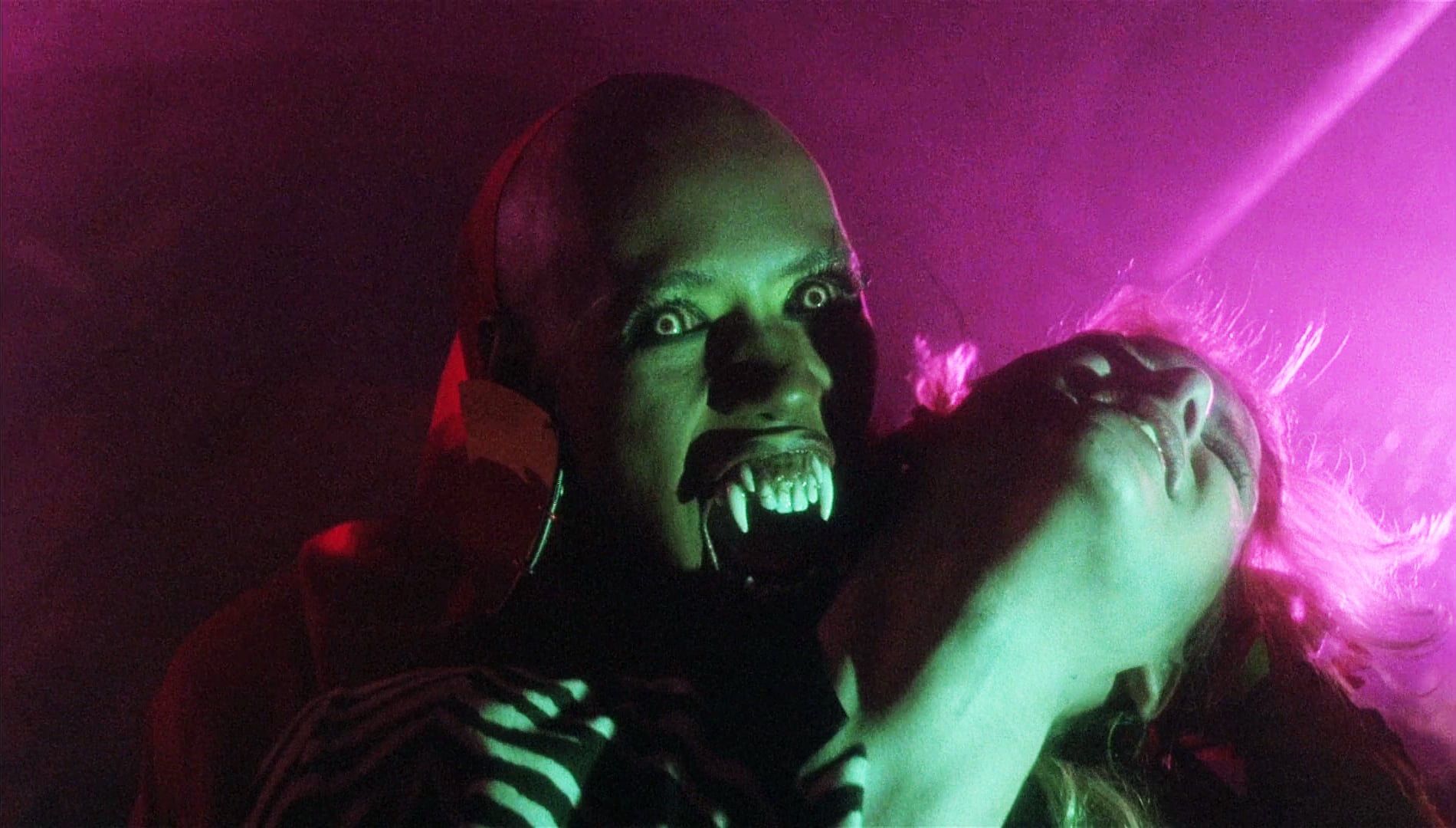
Like a lot of its contemporaries, Vamp went on to become a bit of a cult classic. That current status is determined by several factors, but without a doubt, the casting of Grace Jones is the most considerable. The image of her writhing on that unique-looking chair, a Keith Haring original, springs to mind whenever this movie is brought up.

Chris Makepeace, Billy Drago and Paunita Nichols in Vamp
Prior to that first display of unequivocal horror, local vampire queen Katrina (Jones) took to the stage and delivered a strip show like no other. One would expect nothing less from that renowned model and performance artist. By now reports of Jones’ tardiness on set are no secret, yet it’s also hard to deny her commitment to the part of Katrina. It was, in fact, Jones who took charge of her character’s appearance—on top of Haring painting her body and that now-iconic chair, she had Andy Warhol handle her costuming. And not too many actors could seize a room’s attention without saying a single line of dialogue.
In 2022, Vamp received a retrospective novelization from Encyclopocalypse. This literary union of preexisting source material—Wenk’s original screenplay—and new ideas from author Christian Francis amounts to a more comprehensive visit to the After Dark Club. The basic story there is no different than what’s shown on screen; however, Francis gets creative with the characters’ origins and designs, and he enhances a number of key scenes.
The novelization expands on the urban and social decay of the main setting, and supplies a background for the After Dark Club. Sandy Baron’s character, Katrina’s emcee and familiar, is given ample motivation for sticking around; up until the fiery end, he is loyal to his friend and former business partner “Squeak”, who looks like he was “fed through a combine harvester, and left as nothing more than a heap of mangled remains”. Then there is Billy Drago’s character Snow, the leader of a street gang called The Dragons. His reason for menacing Keith and AJ is more altruistic than in the movie; he and his peers act tough to scare off any potential food for the vampires.

Lisa Lyon in Vamp
If not for all the backstories, Francis’ Vamp would be a hell of a lot shorter. Instead, this tie-in read dives into how AJ met Keith—the orphaned Anthony Joseph hailed from a broken home back in Brooklyn—and how their friendship flourished over the years. Keith’s archership is no longer just an assumed part of his entire being; it’s a confidence-building extracurricular for a boy who got picked on before coming into the protection of the new kid in town. These supplemental, in-depth looks at the protagonists, plus their close connection, are maybe unnecessary. The movie already did a fair and concise job of addressing their platonic intimacy without the need for flashbacks and insights, specifically in that scene where AJ lays it all out as he sacrifices himself.
Where the novelization gets off course is its approach to the minor characters. Intermittently backstorying the likes of Katrina’s indentured servants, Seko (Leila Hee Olsen) and Vlad (Brad Logan), ends up disturbing the flow of the writing. Was it absolutely essential that readers know Vlad was the Grand Duke of the House of Romanov, or how Snow’s accomplice Maven (Paunita Nichols) became so dentally challenged? No, not really. However, one’s mileage with these random biographies may vary.
The novelization is a more substantial experience, but for a movie like Vamp, less is more. And as plentiful as they are, it never simply coasts on its campy charms, either. The character work sits comfortably in that realm between cursory and meticulous, the script is sharper than first realized, and Greg Cannom’s vampire makeup is straightforward yet effective. Most of all, the movie didn’t squander its out-of-the-box concept. Richard Wenk made his vision of a “comic nightmare in which just about anything that can go wrong does” come true, and it is very enjoyable.

You must be logged in to post a comment.