Editorials
100 Years in Horror: Snubbed by Oscars

Tired of your favorite horror movies being denied Oscar nominations year after year? Sick of the genre being derided as inferior to “important” films like stuffy costume dramas and overblown, melodramatic weep-fests? Then check out B-D contributor Chris Eggertsen’s list of some of the greatest horror films through the years that did not receive proper recognition from the Academy of Motion Picture Arts & Sciences, in this fourth entry in the “100 Years in Horror” series. From the early talkies to the 21st century, the Academy has a long history of turning up their noses at quality horror films simply because they’re…well, horror films, and it’s high time they were brought to account for their ignorance. Read inside to check out the full list.

With those statistics in mind, I’m taking a look back at some of the biggest (“major” category) genre snubs in Oscar history, in Part Four of B-D’s “100 Years in Horror” series. To qualify, the films needed to meet the following criteria:
1) They must have received a significant amount of critical praise in their day;
2) They must have been high-profile and performed at least moderately at the box-office;
3) They must be generally accepted as classics (or at least near-classics) by modern-day film critics.
The reasoning behind these criteria is to illustrate the point that, had films of this level of artistic quality, critical admiration, and healthy box-office been a part of nearly any other genre (with the exceptions of sci-fi and, to a lesser extent, comedy), chances are much, much better that they would have garnered more recognition at the Oscars. Keep in mind that this is not a list of the best horror films ever made (although they are some of the best, as generally accepted by the greater film community), but rather the horror films that were passed over for inferior non-genre pictures that just happened to line up better with Academy voters’ largely conservative tastes.
Pretty much the original horror classic to be wholeheartedly snubbed at the Oscars – and a sad omen of things to come – James Whale’s Frankenstein failed to score a single Academy Award nomination, despite enjoying rave reviews and huge box-office at the time of its release. It was an injustice all the more egregious given that there were a total of eight films nominated for Best Picture that year, and that none of those – including big winner Grand Hotel – enjoy the same level of modern-day artistic credibility as Frankenstein. Sadly, the one category where Frankenstein would’ve virtually been assured a nomination – “Best Makeup” – didn’t even exist yet; if it had, Jack Pierce would have surely been recognized for his extraordinary work creating the Monster. Or would he?

Though producer David O. Selznick lobbied the Academy to give out a special award to Willis O’Brien for his then-groundbreaking stop-motion effects, he didn’t get his wish (the “Best Special Effects” category wouldn’t come to fruition until 1939). This meant that King Kong, generally regarded as one of the greatest horror (and adventure) films of all time, and the best “giant monster” film ever made, failed to receive any nominations at that year’s Academy Awards – though when you look at the field of sub-par Best Picture nominees, it certainly merited a slot. Those nominees included such minor, largely forgotten efforts as romantic drama Smilin’ Through; period piece The Private Life of Henry VIII, and stuffy “class” drama Cavalcade (which ended up winning the award).

Unlike its predecessor, Bride of Frankenstein did actually receive an Academy Award nomination…for Best Sound (it lost). But when you consider the film’s classic status, and the fact that it is generally regarded even more highly than the first film, its snubs in all the major categories seems downright shameful. Adding insult to injury, the field of Best Picture nominees was expanded to twelve films that year – yes, twelve – meaning it was crowded out of its rightful slot by such head-scratching choices as comedy-western Ruggles of Red Gap, glossy musical Broadway Melody of 1936, and musical romance Naughty Marietta. Needless to say, none of those films can hold a candle to Whale’s masterpiece.

The first of influential producer/screenwriter Val Lewton’s string of low-key horror classics (though it was directed by Jacques Tourneur, Lewton had a heavy hand in every production he oversaw), Cat People is also regarded by many as his best. Predictably, the subtle, intelligent film went right over the heads of the Academy’s voting members, who failed to recognize the film in any categories. At the very least it deserved nominations in some of the technical fields, most especially for its gorgeous black-and-white cinematography by Nicholas Musuraca – but its status as a “B-picture” (it was produced for around $140,000) likely hurt its chances with the spectacle-loving Academy, who chose to recognize films like WWII propaganda piece Wake Island instead. Yeah, I’d never heard of it either.

Not only is 1956’s Don Siegel-directed Invasion of the Body Snatchers generally considered the greatest of the four (so far) adaptations of the Jack Finney book, it’s also regularly cited as one of the greatest horror (and sci-fi) films ever made. And yet it received not a single Academy Award nomination, in an embarrassing year that saw the bloated, star-studded Around the World in 80 Days go home with the Best Picture statuette. Body Snatchers at least warranted a nomination for Best Adapted Screenplay…but then it was just a horror film. One can only wonder whether the Academy was simply too moronic to recognize how intelligent the film was…though the more likely scenario is that they were too afraid of backlash for rewarding a film with such strong anti-McCarthyism themes.

Alfred Hitchock’s horror masterpiece was nominated for four Academy Awards, including Best Director and Best Supporting Actress (Janet Leigh), but the fact remains that it was completely robbed of a Best Picture nomination, in a field of five nominees that included dry literary adaptation Sons and Lovers; overblown John Wayne historical epic The Alamo; and a film adaptation of the novel Elmer Gantry starring Burt Lancaster. The conservative Academy likely saw the film as too edgy and violent to merit a Best Picture nod, with their nomination of Hitchcock for Best Director (which he lost) functioning as something of a consolation prize. It was an early example of a tactic the Academy still uses today when faced with a film that doesn’t fit the normal Oscar mold – give the director a nod so they don’t look totally out of it, but ignore the film in the Best Picture category.

This 1963 adaptation of the brilliant 1959 novel The Haunting of Hill House by Shirley Jackson had all the trappings of an Oscar-worthy film – an esteemed literary source, an Oscar-winning director (Robert Wise), an artistic sense of restraint – except for that whole horror thing. And so it goes that possibly the greatest haunted house film ever made garnered not a single Oscar nomination – not for Wise’s elegant direction; not for Julie Harris’ disturbing turn; not for Claire Bloom’s seductive performance; not even for those spine-tingling, expertly calculated sound effects. Nope, not for any of it. Instead, the Academy chose to reward the distended mess that was Cleopatra (a film that practically bankrupted Twentieth Century Fox) with nine nominations, including Best Picture of the year. For shame!

Roman Polanski’s Rosemary’s Baby seemed to straddle the line between the old Hollywood films of the previous generation and the new auteur-driven cinema of the late 1960s and early 1970s; shot in elegant strokes, it also boasted genuinely disturbing elements that were decidedly not of the old-school variety (think the startling, dreamlike scene where a drugged Rosemary is raped by the Devil). In the Academy’s eyes it probably erred too much on the side of the latter sensibility, for while Polanski was nominated for best Adapted Screenplay and Ruth Gordon won an Oscar for her supporting performance as nosy, Satan-worshipping neighbor Minnie Castevet, as a film it apparently it skewed too close to the generational borderline to be considered for Best Picture, or even Director. But it should have been nominated in at least one of those categories – especially when you consider that over-praised musical Oliver! was the film that went home with the big prize that year.

Artistic filmmaking, critical acclaim, big box-office, intelligent scripts – so what was the problem with Ridley Scott’s Alien and George A. Romero’s Dawn of the Dead that both films were shut out of every major category? Sure, Alien was justifiably nominated for Art Direction (it lost) and Best Visual Effects (it won), but Alien wasn’t just a great-looking film, it was a great film, period. So was Romero’s sequel, which unlike its predecessor broke out of the midnight-movie circuit on its release to become a genuine mainstream success. Leave it to the shortsighted, eternally cautious Academy members to find themselves unable to look past both films’ grislier qualities and see the true masterpieces they had before them. Sure, tearjerking Best Picture winner Kramer vs. Kramer was a very good movie, but is it really better than either of these films? Has it been inducted into the National Film Registry of the Library of Congress for being “culturally, historically, or aesthetically significant” (as Alien has)? Is it half as memorable as Dawn‘s potent brew of black comedy, social critique, and visceral horror? I think not – on both counts.


The Fly, a remake of the rather cheesy 1958 Vincent Price film, probably didn’t sound like a shoo-in for Oscar contention in its development stages, but director David Cronenberg managed to transform the original story into an emotionally poignant, genuinely disturbing film featuring top-notch performances from stars Jeff Goldblum and Geena Davis. Similarly, James Cameron’s Aliens, a sequel to Ridley Scott’s 1979 horror/sci-fi classic, surpassed expectations by also becoming one of the year’s most critically acclaimed films, with some even calling it superior to its predecessor. Ironically though, while both films’ grisly effects would win awards at that year’s Oscars – Aliens in the “Visual Effects” category and The Fly in “Best Makeup” – they are also what probably kept them from achieving nominations in any of the major categories, save for Sigourney Weaver’s shocking (given that she received it for a blockbuster action/sci-fi/horror film) but well-deserved Best Actress nod. The fact is that both films proved major critical successes and box-office hits, and yet the Academy was clearly unwilling to look past their gruesome surface aesthetics.


Apparently AMPAS felt they’d fulfilled their serial killer-movie quota four years earlier by showering The Silence of the Lambs with Oscar gold, seeing as Seven was snubbed in all the major categories despite New Line’s re-release of the film right around Christmas 1995 to give it an awards-season push. While Richard Francis Bruce was rightly nominated for Best Film Editing (he lost), none of the actors – not even Academy favorite Morgan Freeman (who perhaps would have been nominated for his performance had the film itself been a tad less grim, i.e. more to the Academy’s liking) – received any recognition. Nor did Fincher, who’d managed the impressive feat of winning over critics and audiences after helming the rather poorly-received, studio-butchered Alien 3 three years earlier. Instead, the Academy chose to shine a spotlight on more predictable fare like Ron Howard’s feel-good Apollo 13 and Ang Lee’s glossy adaptation of Sense and Sensibility. The fact that Seven was an even darker film than The Silence of the Lambs, though, is what really killed its Oscar chances.

After winning across-the-board raves for his previous film Trainspotting, director Danny Boyle must have surprised many in the stuffier contingent when his next project turned out to be (gasp!) a horror movie. In a year in which the highly overrated musical Chicago took home Best Picture, it’s practically a crime that Danny Boyle’s instant classic 28 Days Later wasn’t nominated for a single Oscar, given that the film had more depth, nuance and genuine human feeling in a frame of film than Rob Marshall’s movie had in its entire running time. At the very least, it deserved nominations in technical categories such as Best Sound Editing/Mixing, Cinematography (Boyle and director of photography Anthony Dod Mantle made stunning use of their digital camera), or its amazing and heartrending score. But no matter; whereas a film like Chicago has probably already slipped the minds of most cinema-lovers, the stature of 28 Days Later has continued to grow in the intervening years.

In conclusion, I’d like to address a couple of things that I feel might come up in the comments (just thinking ahead):
1) Dawn of the Dead is generally cited as a 1978 film, but it was not actually released in the U.S. until April 1979. Therefore, it would have qualified for the Oscars in 1980, the same year as Alien.
2) Stanley Kubrick’s The Shining might seem like a glaring omission, and I originally planned on including it before realizing it was, in fact, not a big critical success on its initial release.
3) I left foreign horror films off the list because they do not generally enjoy the same level of cache with Academy members as American-made movies.
All of that being said, if you feel I left a film off the list that genuinely merited a spot – or if you think one of the films here does not qualify for whatever reason – by all means, call me out.


College kids, strippers and vampires—those were Donald P. Borchers’ only requirements when he approached Richard Wenk about writing and directing a movie for New World Pictures. As requested, Wenk cooked up Vamp (1986), a tailor-made blend of the decade’s teen movie craze as well as its horror boom.
Grim and earnest stories were still very much a part of the ’80s horror landscape, yet Vamp is something of a comedy. One difference between it and, say, Saturday the 14th, though, is the former avoids using schtick. Wenk’s movie proves that horror comedies also don’t have to subtract thrills from their recipes. Of course, it takes a minute before reaching that point; college antics and culture shocks preface this one macabre misadventure.
Vamp‘s initial setup is apt for a typical college-set, sex-driven comedy; to bribe their way into a fraternity house, two pledges (Chris Makepeace, Robert Rusler) go looking for some adult entertainment. Without wasting time on any further exposition, the characters embark on an all-in-one-night trip that quickly detours into terror.
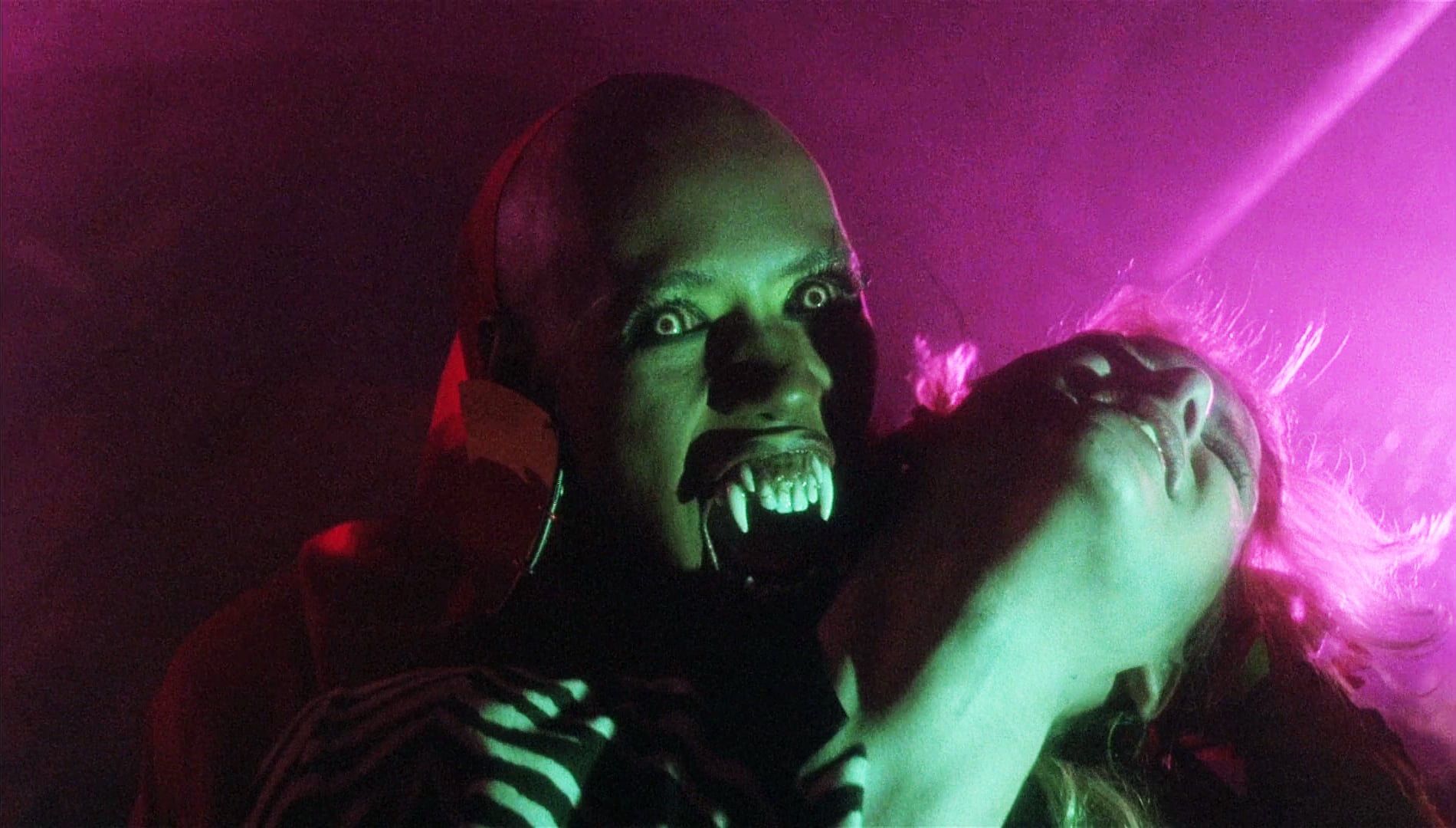
To procure their elusive MacGuffin—a stripper willing to gyrate for some frat boys—Keith (Makepeace) and AJ (Rusler), plus a third wheel named Duncan (Gedee Watanabe), trade the safety of their remote college campus for the seediness of some unnamed city. The setting is recognizably L.A. by day, but as soon as night falls, downtown, along with the characters, slips into a kind of surreal universe. Director of photography Elliot Davis gave this early entry on his prolific résumé an unusual yet distinctive look; that Mario Bava-esque, magenta-green lighting is omnipresent, so much so that it’s almost its own character.

Chris Makepeace and Robert Rusler in Vamp
The faint comparisons to Martin Scorsese’s After Hours are merited, although not just because of Vamp’s distinguishing nighttime aesthetic. Save for the primary characters, the supporting roles in Wenk’s movie are also quite colorful and transactional in their behavior. The difference here, though, is the additional urge to ruin Keith and his friends at every turn. Some of that harm is humorous and tolerable enough, whereas the moment Vamp dishes out its first fatality, it’s abundantly clear how this movie qualifies as horror.
Vamp falls into that category of horror movie that reveals its genre with a scream rather than a series of whispers. The opening scene can function as a hint of what lies ahead—things are not at all what they appear to be—but otherwise, Wenk is more than happy to hold off on the horror. When that time does come, though, it catches the viewer off guard. In addition to the pure shock value is that sudden decision to upend the movie’s foremost feature. Or so it would seem.
If afraid of major spoilage, those new to Vamp would be wise to stop reading here. There’s just no skirting around the fact that the central fellowship in this buddy movie hits a serious snag when AJ is killed. That development causes the story to become more of a “long, bad night” journey for Keith and his romantic interest. So while Wenk scores points for subverting expectations, there is also a touch of sadness in his decision. Because if Vamp does anything well, it’s making the characters likable.
Something that comes easily to Vamp—and other teen horror movies from this same era—is its ability to invent young characters worth caring about, or at the very least, are interesting and not so immediately off-putting. More impressive is how Wenk did all this without actually fleshing out those characters. Still and all, Keith and his kind are a grade above cookie-cutter, and in some cases, aren’t completely devoid of growth.

Grace Jones in Vamp
Vamp appeals with an assorted cast of characters. No two are the same, nor are they operating on the same wavelength. The cinematically extroverted AJ, whose actor conveyed charm and vulnerability in near equal amounts, comes alive when he’s at his most undead. Makepeace then makes the chronically cautious Keith a sympathetic fellow, even as he’s more and more affected by the night’s bizarre events. Meanwhile, Duncan is indeed the designated loser of the whole bunch, but Watanabe still manages to humanize him. As a bonus, the role didn’t require him to pull a Long Duk Dong.
As for Dedee Pfeiffer, she is plain adorable as the mysterious After Dark server nicknamed “Amaretto”. She spends all night fixing her dress strap while at the same time trying to get Keith to remember how he knows her. As their offbeat romance grows, it becomes another highlight of this movie. Whether or not Pfeiffer’s character is really a vampire also creates some welcome tension in the story.
Like a lot of its contemporaries, Vamp went on to become a bit of a cult classic. That current status is determined by several factors, but without a doubt, the casting of Grace Jones is the most considerable. The image of her writhing on that unique-looking chair, a Keith Haring original, springs to mind whenever this movie is brought up.

Chris Makepeace, Billy Drago and Paunita Nichols in Vamp
Prior to that first display of unequivocal horror, local vampire queen Katrina (Jones) took to the stage and delivered a strip show like no other. One would expect nothing less from that renowned model and performance artist. By now reports of Jones’ tardiness on set are no secret, yet it’s also hard to deny her commitment to the part of Katrina. It was, in fact, Jones who took charge of her character’s appearance—on top of Haring painting her body and that now-iconic chair, she had Andy Warhol handle her costuming. And not too many actors could seize a room’s attention without saying a single line of dialogue.
In 2022, Vamp received a retrospective novelization from Encyclopocalypse. This literary union of preexisting source material—Wenk’s original screenplay—and new ideas from author Christian Francis amounts to a more comprehensive visit to the After Dark Club. The basic story there is no different than what’s shown on screen; however, Francis gets creative with the characters’ origins and designs, and he enhances a number of key scenes.
The novelization expands on the urban and social decay of the main setting, and supplies a background for the After Dark Club. Sandy Baron’s character, Katrina’s emcee and familiar, is given ample motivation for sticking around; up until the fiery end, he is loyal to his friend and former business partner “Squeak”, who looks like he was “fed through a combine harvester, and left as nothing more than a heap of mangled remains”. Then there is Billy Drago’s character Snow, the leader of a street gang called The Dragons. His reason for menacing Keith and AJ is more altruistic than in the movie; he and his peers act tough to scare off any potential food for the vampires.

Lisa Lyon in Vamp
If not for all the backstories, Francis’ Vamp would be a hell of a lot shorter. Instead, this tie-in read dives into how AJ met Keith—the orphaned Anthony Joseph hailed from a broken home back in Brooklyn—and how their friendship flourished over the years. Keith’s archership is no longer just an assumed part of his entire being; it’s a confidence-building extracurricular for a boy who got picked on before coming into the protection of the new kid in town. These supplemental, in-depth looks at the protagonists, plus their close connection, are maybe unnecessary. The movie already did a fair and concise job of addressing their platonic intimacy without the need for flashbacks and insights, specifically in that scene where AJ lays it all out as he sacrifices himself.
Where the novelization gets off course is its approach to the minor characters. Intermittently backstorying the likes of Katrina’s indentured servants, Seko (Leila Hee Olsen) and Vlad (Brad Logan), ends up disturbing the flow of the writing. Was it absolutely essential that readers know Vlad was the Grand Duke of the House of Romanov, or how Snow’s accomplice Maven (Paunita Nichols) became so dentally challenged? No, not really. However, one’s mileage with these random biographies may vary.
The novelization is a more substantial experience, but for a movie like Vamp, less is more. And as plentiful as they are, it never simply coasts on its campy charms, either. The character work sits comfortably in that realm between cursory and meticulous, the script is sharper than first realized, and Greg Cannom’s vampire makeup is straightforward yet effective. Most of all, the movie didn’t squander its out-of-the-box concept. Richard Wenk made his vision of a “comic nightmare in which just about anything that can go wrong does” come true, and it is very enjoyable.

You must be logged in to post a comment.