Editorials
‘Priest’: Bloody-Disgusting Set Visit Report

Just when you thought there was nowhere else Hollywood could take vampires, they pop up in the wild west – and an alternate universe to boot. Based on the Tokyo manga graphic novel series by Min-Woo Hyung, Priest takes place in a post-apocalyptic world decimated by years of warring between vampires and humans. A group of elite warriors of the church, known only as Priests, last defeated the vampires at an enormous cost, leaving the warrior Priests as outcasts living in hiding. The city that remains exists in darkness, shrouded from the sunlight by smokestack soot lining the sky as far as the eye can see. Meanwhile, the vampires are starting to resurface, happily feeding on the unsuspecting inhabitants of a city where it is always night.
Bloody-Disgusting tackled the dusty sets of Priest way back in late 2009 on day 31 of the 60-day shoot. Originally slated for release in late 2010, Priest will now make its way to theaters May 13th, 2011. Directed by Scott Charles Stewart (Legion), Priest stars Paul Bettany as Priest; Maggie Q as Priestess; Cam Gigandet as Sheriff Hicks; Lily Collins as Lucy; Karl Urban as Black Hat and Brad Douriff as The Salesman.
 The slightly modernized western backlot sets in Newhall, California are best remembered from HBO’s “Deadwood” – yes, the very sets where Ian McShane set the Guinness record for utterances of the word “cocksucker” over his three seasons as Al Swearengen. To accommodate the cyberpunk-esque settings of Priest‘s alternate universe, the western town sets have been enhanced with touches of minimalist steel architecture.
Priest is a blenderized mash-up of Sergio Leone’s spaghetti westerns, post-apocalyptic classics like Bladerunner and The Road Warrior and a dose of Kurosawa thrown into the mix for good measure. It also pays a less than subtle homage to the John Wayne classic, The Searchers. “There are some direct visual homages to `Searchers,’ ” director Scott Stewart tells press. “Instead of a woman opening a door and looking out on a valley, she looks out onto the apocalyptic desert landscape. There’s some `Bladerunner’ in it too. It’s a hyper-industrial city. The world is very Orwellian, so there’s a lot of `1984′ and `THX 1138′. It’s a religious industrial theocracy, so there’s a city that’s all industry and even the cathedral at the center is all smokestacks.”
The story begins with the kidnapping of the Sheriff Hicks’ (Gigandet) girlfriend Lucy (Collins) by a band of vampires. Hicks braves his way into the walled-in city to find Lucy’s uncle, Priest (Bettany), once a legendary warrior renowned as a killing machine. Reluctantly, Priest breaks his sacred vow, hops on a motorcycle and sets out to rescue Lucy. The band of vampires is lead by a former warrior Priest, Black Hat (Urban), now a human/vampire hybrid.
The Searchers-esque storyline isn’t based on a specific portion of the manga nor is Bettany’s character based on a single Priest character from the series, but Min-Woo was involved with the production and wrote a new book to connect the two properties. “He’s working on another book that bridges the movie and where he left off his story,” says Stewart. “So I hope that’s something that fans will see, that they will recognize that he’s a fan of this and supporting it.”
The first scene we observe is the classic cool-as-ice western shot: The three leads – Bettany, Gigandet and Maggie Q – walk into town with wind machines blowing their robes and hair; a moment that you can only imagine will be shown in slow motion during the final cut.
This takes place roughly halfway through the story. Priest, Priestess and Hicks ride into the frontier town on their bikes just after a vampire attack led by Black Hat. Nearly everyone in town is dead, including three warrior Priests hanging from crosses.
Brad Douriff is a Snake Oil Salesman, of sorts, who comes into town offering crucifixes and holy water which, in this world, have no affect at all on the vamps. Sheriff Hicks runs him out of town, but we are told Douriff’s character will play a part in the story later on.
The western town sets helped the crew get in the proper spirit for the sequence, reminiscent of Unforgiven with a Road Warrior makeover. The only negative is the dust constantly blowing into everyone’s face from the wind machines.
“I think I’ve built up a resistance to the dust,” says Bettany with a laugh. “This is the dustiest film ever shot.”
“What’s cool for me is, as part of an ethnic minority group, I would never be considered for a western,” says Maggie Q. “So this is kind of unprecedented. I would love to be in a movie like `Unforgiven’, but this is as close as I’m gonna get.”
“It takes 15 minutes just to get on my entire wardrobe,” Gigandet tells press during an interview conducted in a faux barn. “By that time, you kind of get into it.”
These days, it’s difficult to says the words “vampire” and “movie” in the same sentence without being met with a certain sense of skepticism. Between the seemingly boundless success of the Twilight series and vamps showing up on both cable and network television, bloodsuckers are constantly teetering on the edge of overexposure. With that said, films like 30 Days of Night and Let Me In continue to prove there is always room for a new interpretation with the right mix of originality and good storytelling.
“It is a vampire movie, although our vampires are very different,” explains Stewart. “They are actual creatures, so they are a Darwinian divergence from man. Vampires have evolved without eyes. There’s a lot of visual motifs about sight and blindness. The church believes the vampires are soulless and can be eradicated.”
The movie opens with a 2D animated history sequence, which helps to explain the world audiences are being brought into. “It’s kind of an homage to the manga itself,” says Stewart, “that tells the history. Man and vampire have been warring for centuries. It’s kind of an alternate history – the crusades, World War I – we were fighting vampires.”
“The vampires of Priest, said to be close to 100 percent CG, are animals, plain and simple. “I didn’t think I could out-sexy `Underworld’ and `Twilight’ and `True Blood,’ ” says Stewart. “They’re just a totally different thing. I wanted to make something that was more feral and violent and more disturbing about a war that’s been fought [between] two sides that don’t even really know why they’re fighting each other. There are a lot of shades of gray to the movie.”
“When a vampire in our world bites you, they’ll either kill you and eat you or they’ll turn you into a familiar and you become, basically, a slave. The familiars are like the lunatics running the asylum. They run the front office while their masters sleep during the day. They take care of things, they feed them.”

To add a dose of irony to the vampire tale, two actors perhaps best known for their roles as vampires, “True Blood“‘s Stephen Moyer and Twilight‘s Gigandet, portray non-vamps in Priest.
“ `Twilight’ was a blast and everything,” says Gigandet, “but I like playing this side of it. I’ve played the bad guy a lot over my young career and this is a good change.”
“These days it’s actually hard to find someone who hasn’t played a vampire,” admits Stewart. “Stephen Moyer plays Aaron, Paul’s brother. We just looked for the actors we thought would fit best in the roles and those were the guys we liked the most.”
The Priests themselves are the other unique element to this adaptation of the manga, hardly the hail Mary and holy water types. “The Priests are the foot soldiers of the church, the Jedi Knights,” says Stewart. “They have an ability beyond normal human beings to fight vampires, which are very hard to kill because they move so fast and so erratically and so unpredictably.”
“[Priest] was found by the clergy when he was a little older than usual,” Bettany says of his character. “He left a life and went to fight the war. He’s come back since the war has been over, back into the real world, and I guess the war has rendered him unfit for normal life. He’s working a shitty job, nobody wants to talk to him. He’s frightening looking and nobody wants to be reminded of that era. That’s where the movie starts.”
“This takes place a generation after the war,” says Stewart. “Priests had won the war and captured vampires had been put in internment camps. The Priests were decommissioned and reintegrated into society. Like Vietnam vets, they became societal outcasts. They have no names. They are just known as Priests. People stay away from them, so they’re very, very isolated.”
Each of the Priests has a different ability and weapon of choice. “I favor a knife.” Bettany tells press. “None of them use firearms at all. They all have the ability to sort of slow down time. We’re shooting on the Phantom Camera at times and objects can just slow. That’s how Scott tells the story of just how fast Priest can move when he wants to. It’s nearly superhuman, but somehow remains believable.”
“Mine’s a rope dart,” says Maggie Q. It looks like a Rosary. It’s bad-ass, but it’s still a little feminine.”
Hicks, on the other hand, not being a servant of the church, yields a less than subtle firearm. “It’s a monster of a gun,” says Gigandet. “They have three different phases of the gun. I have one that’s two pounds and one that’s three or four pounds and then the real ones, I’m not kidding, they are at least ten pounds. There are scenes where I’m holding it up and we have to split the scenes in half because I literally cannot do it any more. My hand is shaking and, slowly, my arm goes down and by take four I’m aiming at their feet.” (Laughs)
The overall impression during our day spent on set was that everyone was having a blast making the movie. Besides getting to step into the bizarre mix of genres, Gigandet, Bettany and Maggie Q formed a strong bond during the shoot, particularly in the case of the two men.
“We have a lot of fun and give each other a hard time,” says Gigandet. “Paul really taken me under his wing and, you know, no judgment.”
“They’re complete homosexuals, those two,” jokes Maggie Q of Bettany and Gigandet’s newfound friendship. “It’s a camaraderie. I want to make you better, make me better. I love that. You so rarely see that.”
Priest opens in theaters nationwide May 13th, 2011.


Auteur Filmmaking is a term that gets thrown around a lot these days in reference to big name directors like Quentin Tarantino and even Wes Anderson, but the truth is that film is a collective medium, and no one person can be responsible for every single aspect of a particular production. However, the smaller a film’s budget, the bigger the individual impact of every creative decision behind it – and the easier it becomes to identify a genuine auteur.
This isn’t necessarily a judgement of value, as blockbuster filmmaking comes with its own challenges and a good movie remains a miracle regardless of how big the crew is, but I’ve always been more interested in soulful b-movies produced by handfuls of passionate artists than blockbusters backed by creative armies.
That’s why I love exploring low-budget franchises that never left the hands of their original creators, as you really get to know the artists involved with these flicks and can accompany their evolution over a period of time. With that in mind, I’d like to invite readers to join me in this multi-part series as we look into a vampire saga helmed by one of the most fascinating auteurs of the 1990s. Naturally, I’m referring to Ted Nicolaou’s criminally underrated Subspecies!
The Birth of an Unlikely Horror Franchise

A proud graduate of the University of Texas’ Film program, Nicolaou got his start in the industry as a sound technician working on Tobe Hooper’s original Texas Chain Saw Massacre. From there, the filmmaker would go on to work for notorious indie producer Charles Band, the founder of both Empire Pictures and Full Moon Productions. According to Nicolaou, Band would usually contact him with an offer to direct a feature after more prominent filmmakers, such as the late, great Stuart Gordon, had already refused, meaning that his projects tended to have lower budgets and more inexperienced crew members.
The plans for Subspecies began almost immediately after the fall of Romanian dictator Nicolae Ceaușescu, with screenwriter David Pabian turning in an initial draft of the film after a Romanian producer contacted Band and explained that Romanian tax incentives could cover the cost of film production there so long as Full Moon took care of the post-production process. Since Stuart Gordon was unwilling to travel to Romania, Ted Nicolaou ended up taking over the picture.
However, while the financial incentives meant that this Romanian-American co-production could look and feel much more expensive than it really was, with Nicolaou scouting for locations in advance and selecting real castle ruins to be featured in the movie, the director was soon faced with an incredibly difficult shooting process. In interviews, Nicolaou would later describe the experience as something of a nightmare, with language barriers and the generalized distrust of capitalist outsiders sabotaging many of the team’s plans for the film.
In fact, the script, which had already been altered by Band, ultimately had portions of it rewritten by both Jack Canson and Nicolaou himself in an attempt to adapt the story to their unique limitations.
Radu Is One of Horror’s Greatest Underrated Villains

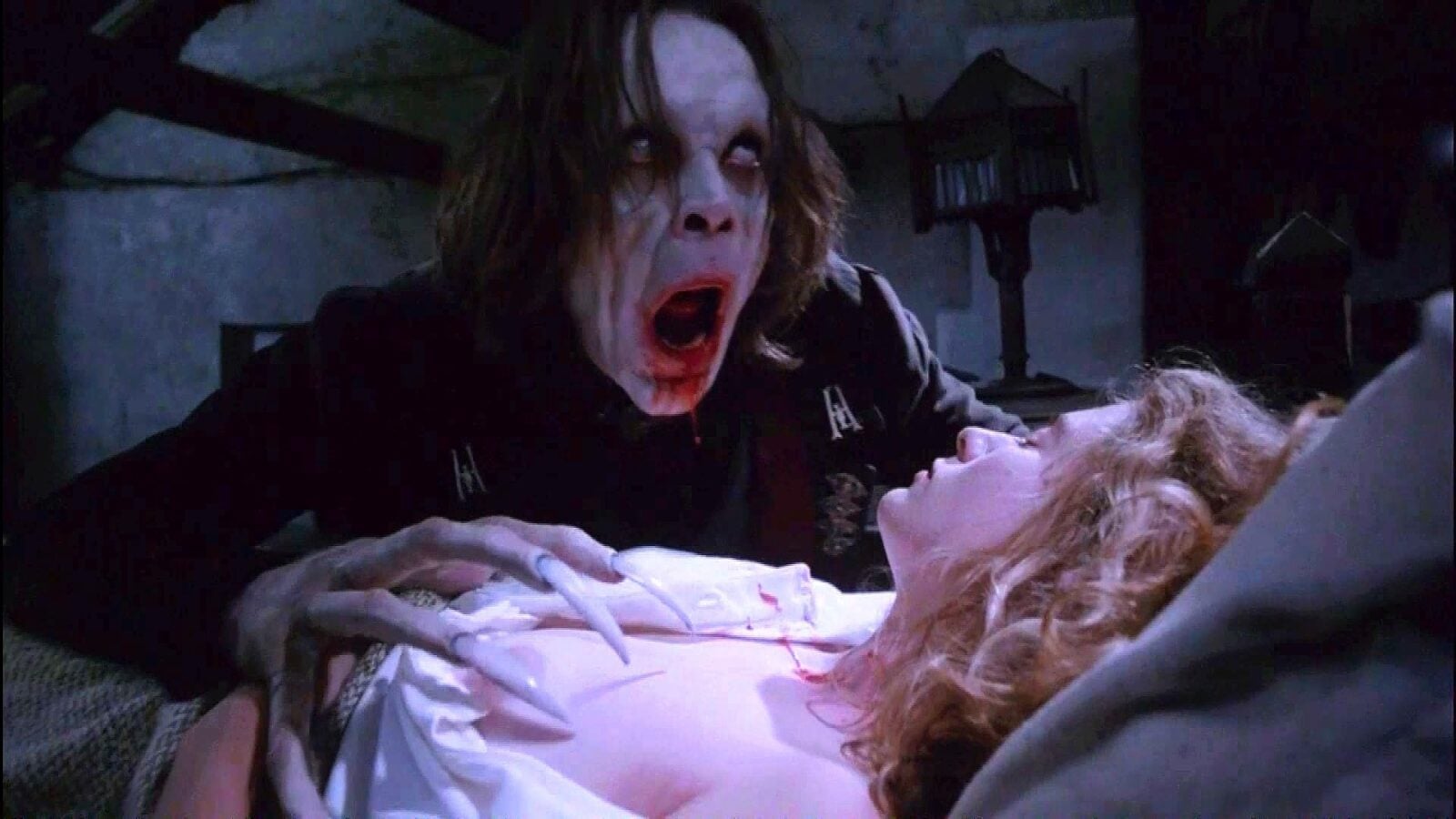
In the finished film, which was released directly to video in 1991, we follow a pair of American anthropology students, Michelle (Laura Mae Tate) and Lillian (Michelle McBride), as they reunite with their Romanian colleague Mara (Irina Movila) in her native land. The group intends to study the folklore surrounding the secluded town of Prejmer, but their research is cut short by the return of Radu Vladislas (Anders Hove) – the evil son of a vampire king (Angus Scrimm) who had previously established a truce with the region’s human residents. It’s now up to Radu’s human-loving half-brother Stefan (Michael Watson) to protect the girls from a fate worse than death as the power-hungry vampire seeks to control a magical artifact known as the Bloodstone.
Right off the bat, you may have noticed that the film’s premise sounds decidedly old-fashioned when compared to other vampire movies from around the same time. While the 1990s saw the rise of cool-looking bloodsuckers with badass elements borrowed from Westerns, as well as the sexy aristocrats of Anne Rice’s stories, Subspecies has a lot more in common with Nosferatu and the Hammer Horror series than any of its contemporaries.
This is both a blessing and a curse, as the film falls victim to overly familiar genre tropes while also standing out as a rare example of a ’90s vampire flick that isn’t afraid to flex its muscles as a Creature Feature. In fact, I’d argue that the presence of age-old clichés is a small price to pay when confronted with one of the most compelling vampire antagonists in all of cinema.
Named after Vlad the Impaler’s real-life brother, Anders Hove’s Radu is such a fascinating character and the main reason why Subspecies is still worth watching 35 years later. From his animalistic mannerisms to the joy he feels in simply existing as a chaotic creature of the night, and that’s not even mentioning the iconic makeup that almost certainly inspired the undead from Buffy the Vampire Slayer. Radu is a hypnotic presence harkening back to a time when audiences didn’t mind purely evil villains that couldn’t be redeemed through tragic backstories or sex appeal.
Gothic Atmosphere on an Indie Budget

Of course, the film’s Romanian setting and authentic art direction do a lot of the heavy lifting whenever Radu isn’t around. From the masked festivals of the village to the visually interesting selection of local extras, Subspecies’ multicultural elements help it to stand out when compared to similar flicks from the ’90s.
That being said, Nicolaou’s unique eye for special effects and exciting action sequences – as well as Vlad Paunescu’s excellent cinematography – make the movie a delight for fans of expressionist cinema and old-timey gothic horror. While the crew is obviously dealing with limited resources, many of the flick’s blemishes (such as the odd stop-motion demons that serve Radu) end up feeling more like charming idiosyncrasies than actual flaws.
I’d argue that the only real issue here is pacing, as there are long stretches of film where the protagonists are simply bumbling around without realizing what’s really going on around them. Thankfully, the gorgeous visuals and surprisingly effective soundtrack usually make up for this. Besides, how can you dislike a movie where shotgun shells are loaded with rosary beads and our lead vampires duke it out in a dramatic swordfight that would feel out of place during the golden age of Hollywood?
Your overall enjoyment of Subspecies will mostly depend on whether or not you find low-budget corner-cutting and janky practical effects charming rather than distracting, but I know I’ll keep coming back to this Full Moon feature again and again in the future.
That being said, while this first movie is worth revisiting by its own merits as the birth of an indie horror icon, I’d like to invite you to join us as we look into the cult sequel Bloodstone: Subspecies II soon.
You must be logged in to post a comment.