Editorials
[Special Feature] Music As Rebellion In The Youth Feat. Corey Taylor


Written by Bloody-Disgusting music contributor Sammy Key
Music is kind of like Four Loko. There are a bunch of different flavors and teenagers love it. It also shares the tendency to evoke this sort of statement out of people; “It was better back in the day though, when I first had it,” (you know, before they took out all the caffeine). It’s true, these days it seems like music, or at least popular music, has lost its edge entirely. Gone are the days of sneaking records with “Parental Advisory/Explicit Content” plastered across the cover into your room and the days of mindlessly singing along to the latest saccharine sweet single while your mom drives you home from school are in full swing. Where is all the door slamming? Where are all the secret shows? It used to be that songs on the radio carried some sort of message, but now all I hear are lyrics about whips, b*tches, peacocks and all other sorts of bizarre metaphors for genitalia. And that’s if there are even words at all! Half of that sh*t is all “wobble” these days (whatever that is). Rebellion seems to have fizzled out, and in its place a taste for countless remixes, “womps”, and repetitive, dirty lyrics has grown. But no one bats an eyelash. It just seems like the passion, the demand for excellence has died. It’s like the teen masses have lost their will to act out, at least when it comes to music. These days, we sure as hell aren’t your stepping stone. But we’re not likely to make a hit single out of that sentiment either.
Unfortunately, as a teenager with both impeccable taste (har-har) and a certain affection for breaking the rules, I have begun to doubt that the endless array of sh*t that has crossed my path recently with the moniker “music” attached to it is even art at all. And with album sales dropping every year, record companies promoting musicians that sound like robots, and this bizarre, highly questionable “dubstep renaissance” taking youth culture by storm, sometimes it’s all a girl can do not to vomit. Sort of like the feeling you might get after the last (or even the first) sip of that aforementioned devil liquid. Yet kids still keep listening to it. Just like they keep drinking Four Loko. It’s sh*t, and they gulp it right down. So what’s the deal? What happened to the relationship between teens and (good) music?
I say kids got lazy. Somewhere over the past few years, the idea that music is easy poisoned the well of new artists so to speak, and not only did that spoil a lot of new pop music, but also the group of kids listening to it. Of course, you can always blame “the man”. Big record companies seem to have a penchant for peddling crap, and it’s logical to point the finger at the industry when it comes to the question of why this music has become so popular.
“It’s more of a f*cking factory at this point,” says Corey Taylor of Slipknot and Stone Sour. “They keep cranking out these mediocre f*ck heads , shoving them into the studio for ten seconds and then they basically autocorrect everything.” He adds, “I think this generation that’s growing up really enjoying this pop music is gonna be the same as the people who grew up really liking Rick Astley. It’s passing fancy, as far as music goes.”
Which is hopefully the case. When asked about this generation of teenagers and their music, Taylor speculates on what’s to come. “I think you’re always gonna have half the generation that’s lazy. But I think it makes the other half work that much harder… I think because technology is so badly ruining music, it just breeds a generation that’s going to be completely 180 from that. I think we’re gonna have a lot more home grown rock n roll coming out soon. I’m hoping.”
Those are pretty optimistic words from a guy who describes himself as a “cynical f*ck” in that same interview. But Taylor is a man with many years of making music under his belt, and if anyone knows about music and its effect on teenagers, it’s him.
“When I was growing up in the 80s, a lot of that pop sh*t was just like, “What IS this?”” Taylor laughs. “And then I found my music in the thrash scene, in the hardcore punk scene, so I had that background and that made me want to make the sort of music I make today. So I think that half of the generation is going to come to the surface in the next five years.”
The thing is, he might be right. After I analyzed a survey I conducted amongst teenagers in my area and online, I’m beginning to see the possibility for change. 85% of those surveyed claimed the statement “I love music. I don’t know what I would do if music wasn’t a part of my life.” most accurately describes their relationship with music. In that same survey, 47% of participants said music became a big part of their life in middle school, closely followed by 32% who claim elementary school was the start of their relationship with music. Which is good news! That means that all those little youngsters still eating paste in class might have the potential to be the founding fathers of the next generation’s big, musical “f*ck you!” Additionally, when asked to list what genres of music they listened to most, survey participants used the words “punk” “hardcore” “rock” and “pop” (including in the term “pop punk”) most frequently, with the words “indie” “metal” “alternative” and “rap” receiving a high number of tallies as well.” Admittedly, there were a lot less instances of the word “dubstep” than I originally anticipated. Even more surprising was the number of respondents who claimed to consider music a form of rebellion or as a tool they used to purposely piss off their parents. Although only a meager thirteen participants responded this way, it was about eleven more people than I expected to hear that from. I assumed that sort of teenage moxie had dried up long ago (even I had found other ways to get myself grounded during high school). Until a friend of mine, Annika (18), responded to my state of surprise by saying, “Music aids you toward whatever rebellion you want. When I’m one person, I’m listening to different music than when I am another. It [music] encourages you to fight,”
Hmmm. She drives a pretty strong and poignant point. Even though I’ve never really argued with my parents over what I’m listening to, I couldn’t count on ten hands the number of times I have turned to music to get me pissed off enough to confront someone, to encourage me to do something difficult, or to empower me to say “F*ck it!” and take that first clandestine step out the front door at 2 AM. That’s magic, kids. And it doesn’t matter if you get that feeling from Deez Nuts or Lil Kim. It’s still prompting action. It’s still making kids want to rebel. So maybe it’s not about overt rebellion. Maybe the key to music’s relationship to teens and rebellion is a little more subtle.
“You know, rage can be a positive thing,” states Taylor. “Feeling something like that can really not only empower you, but it can also [help] you let go of sh*t. If it’s too bleak, then what’s the f*cking point?” That’s a good question. And it’s an idea that not only challenges the commonly held vision of rage and rebellion, but also my own vision of what my generation is doing in relationship to music these days. I wanted to write this article because I thought I could feel the rebellion waning amongst my fellow youth. I wanted to know why it disappeared, and where it had gotten off to. What I found was that I may not have had it quite right. Rebellion isn’t going anywhere. Sure, it seems to be hidden between hit singles and bullsh*t Grammy awards (I mean come on, Chris Brown actually WON something). But it’s there. It’s under the fingernails of every kid who uses their laptop to download music illegally; it’s in the headphones of every kid who’s listening to their sh*t so loud that they can’t hear their mother yelling from downstairs. It’s even in my 12-year-old sister’s eyes as she asks facetiously, “Do you mind if I turn this One Direction song up?” Of course I do. But at least she’s pissing someone off.
Banner Photo Credit: GuttaWorld
Follow Sammy Key on Twitter




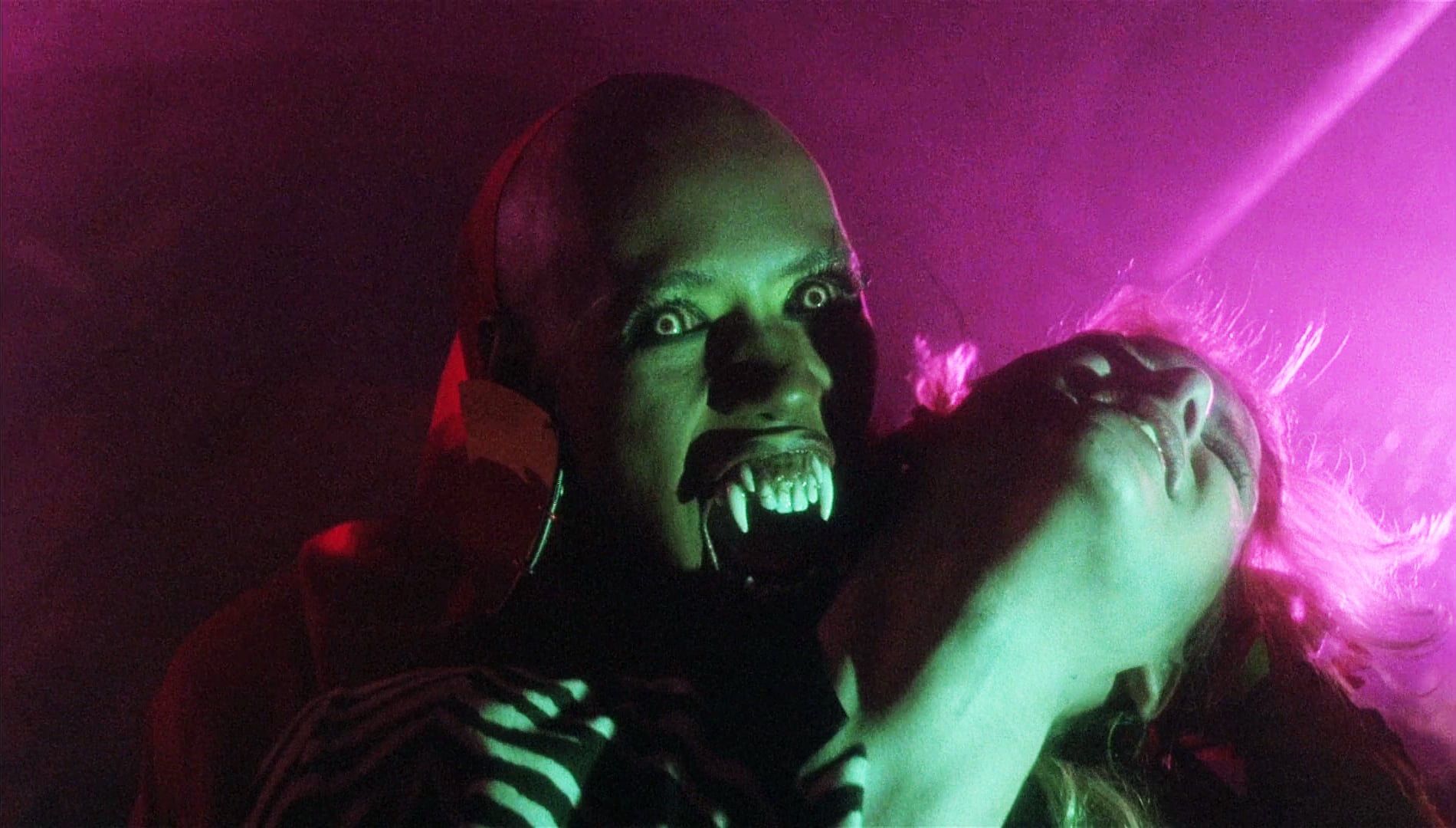
College kids, strippers and vampires—those were Donald P. Borchers’ only requirements when he approached Richard Wenk about writing and directing a movie for New World Pictures. As requested, Wenk cooked up Vamp (1986), a tailor-made blend of the decade’s teen movie craze as well as its horror boom.
Grim and earnest stories were still very much a part of the ’80s horror landscape, yet Vamp is something of a comedy. One difference between it and, say, Saturday the 14th, though, is the former avoids using schtick. Wenk’s movie proves that horror comedies also don’t have to subtract thrills from their recipes. Of course, it takes a minute before reaching that point; college antics and culture shocks preface this one macabre misadventure.
Vamp‘s initial setup is apt for a typical college-set, sex-driven comedy; to bribe their way into a fraternity house, two pledges (Chris Makepeace, Robert Rusler) go looking for some adult entertainment. Without wasting time on any further exposition, the characters embark on an all-in-one-night trip that quickly detours into terror.
To procure their elusive MacGuffin—a stripper willing to gyrate for some frat boys—Keith (Makepeace) and AJ (Rusler), plus a third wheel named Duncan (Gedee Watanabe), trade the safety of their remote college campus for the seediness of some unnamed city. The setting is recognizably L.A. by day, but as soon as night falls, downtown, along with the characters, slips into a kind of surreal universe. Director of photography Elliot Davis gave this early entry on his prolific résumé an unusual yet distinctive look; that Mario Bava-esque, magenta-green lighting is omnipresent, so much so that it’s almost its own character.

Chris Makepeace and Robert Rusler in Vamp
The faint comparisons to Martin Scorsese’s After Hours are merited, although not just because of Vamp’s distinguishing nighttime aesthetic. Save for the primary characters, the supporting roles in Wenk’s movie are also quite colorful and transactional in their behavior. The difference here, though, is the additional urge to ruin Keith and his friends at every turn. Some of that harm is humorous and tolerable enough, whereas the moment Vamp dishes out its first fatality, it’s abundantly clear how this movie qualifies as horror.
Vamp falls into that category of horror movie that reveals its genre with a scream rather than a series of whispers. The opening scene can function as a hint of what lies ahead—things are not at all what they appear to be—but otherwise, Wenk is more than happy to hold off on the horror. When that time does come, though, it catches the viewer off guard. In addition to the pure shock value is that sudden decision to upend the movie’s foremost feature. Or so it would seem.
If afraid of major spoilage, those new to Vamp would be wise to stop reading here. There’s just no skirting around the fact that the central fellowship in this buddy movie hits a serious snag when AJ is killed. That development causes the story to become more of a “long, bad night” journey for Keith and his romantic interest. So while Wenk scores points for subverting expectations, there is also a touch of sadness in his decision. Because if Vamp does anything well, it’s making the characters likable.
Something that comes easily to Vamp—and other teen horror movies from this same era—is its ability to invent young characters worth caring about, or at the very least, are interesting and not so immediately off-putting. More impressive is how Wenk did all this without actually fleshing out those characters. Still and all, Keith and his kind are a grade above cookie-cutter, and in some cases, aren’t completely devoid of growth.

Grace Jones in Vamp
Vamp appeals with an assorted cast of characters. No two are the same, nor are they operating on the same wavelength. The cinematically extroverted AJ, whose actor conveyed charm and vulnerability in near equal amounts, comes alive when he’s at his most undead. Makepeace then makes the chronically cautious Keith a sympathetic fellow, even as he’s more and more affected by the night’s bizarre events. Meanwhile, Duncan is indeed the designated loser of the whole bunch, but Watanabe still manages to humanize him. As a bonus, the role didn’t require him to pull a Long Duk Dong.
As for Dedee Pfeiffer, she is plain adorable as the mysterious After Dark server nicknamed “Amaretto”. She spends all night fixing her dress strap while at the same time trying to get Keith to remember how he knows her. As their offbeat romance grows, it becomes another highlight of this movie. Whether or not Pfeiffer’s character is really a vampire also creates some welcome tension in the story.
Like a lot of its contemporaries, Vamp went on to become a bit of a cult classic. That current status is determined by several factors, but without a doubt, the casting of Grace Jones is the most considerable. The image of her writhing on that unique-looking chair, a Keith Haring original, springs to mind whenever this movie is brought up.

Chris Makepeace, Billy Drago and Paunita Nichols in Vamp
Prior to that first display of unequivocal horror, local vampire queen Katrina (Jones) took to the stage and delivered a strip show like no other. One would expect nothing less from that renowned model and performance artist. By now reports of Jones’ tardiness on set are no secret, yet it’s also hard to deny her commitment to the part of Katrina. It was, in fact, Jones who took charge of her character’s appearance—on top of Haring painting her body and that now-iconic chair, she had Andy Warhol handle her costuming. And not too many actors could seize a room’s attention without saying a single line of dialogue.
In 2022, Vamp received a retrospective novelization from Encyclopocalypse. This literary union of preexisting source material—Wenk’s original screenplay—and new ideas from author Christian Francis amounts to a more comprehensive visit to the After Dark Club. The basic story there is no different than what’s shown on screen; however, Francis gets creative with the characters’ origins and designs, and he enhances a number of key scenes.
The novelization expands on the urban and social decay of the main setting, and supplies a background for the After Dark Club. Sandy Baron’s character, Katrina’s emcee and familiar, is given ample motivation for sticking around; up until the fiery end, he is loyal to his friend and former business partner “Squeak”, who looks like he was “fed through a combine harvester, and left as nothing more than a heap of mangled remains”. Then there is Billy Drago’s character Snow, the leader of a street gang called The Dragons. His reason for menacing Keith and AJ is more altruistic than in the movie; he and his peers act tough to scare off any potential food for the vampires.

Lisa Lyon in Vamp
If not for all the backstories, Francis’ Vamp would be a hell of a lot shorter. Instead, this tie-in read dives into how AJ met Keith—the orphaned Anthony Joseph hailed from a broken home back in Brooklyn—and how their friendship flourished over the years. Keith’s archership is no longer just an assumed part of his entire being; it’s a confidence-building extracurricular for a boy who got picked on before coming into the protection of the new kid in town. These supplemental, in-depth looks at the protagonists, plus their close connection, are maybe unnecessary. The movie already did a fair and concise job of addressing their platonic intimacy without the need for flashbacks and insights, specifically in that scene where AJ lays it all out as he sacrifices himself.
Where the novelization gets off course is its approach to the minor characters. Intermittently backstorying the likes of Katrina’s indentured servants, Seko (Leila Hee Olsen) and Vlad (Brad Logan), ends up disturbing the flow of the writing. Was it absolutely essential that readers know Vlad was the Grand Duke of the House of Romanov, or how Snow’s accomplice Maven (Paunita Nichols) became so dentally challenged? No, not really. However, one’s mileage with these random biographies may vary.
The novelization is a more substantial experience, but for a movie like Vamp, less is more. And as plentiful as they are, it never simply coasts on its campy charms, either. The character work sits comfortably in that realm between cursory and meticulous, the script is sharper than first realized, and Greg Cannom’s vampire makeup is straightforward yet effective. Most of all, the movie didn’t squander its out-of-the-box concept. Richard Wenk made his vision of a “comic nightmare in which just about anything that can go wrong does” come true, and it is very enjoyable.

You must be logged in to post a comment.