Movies
Interview: ‘Super 8’ Director J.J. Abrams!

One of the most anticipated films of the summer is writer/director J.J. Abrams’ Super 8 (review), about a small Ohio town in 1979 that suffers a rash of bizarre occurrences following an explosive train crash nearby.
In anticipation of the release of the movie – which was produced by Steven Spielberg’s Amblin Entertainment and in many ways harkens back to the likes of early Amblin-backed films like E.T. and The Goonies – B-D’s Chris Eggertsen recently had the opportunity to attend a press roundtable with Abrams to get his take on the film, which comes out in theaters everywhere this Friday. Check out the full story inside.

 Many in my age range and older look back with fondness on the Amblin films of yore – a collection of ‘80s classics that are touchstones of the collective Gen X memory bank. Classic titles like “E.T.“, “Gremlins“, “The Goonies“, and “Back to the Future” were released by the company within only a few short years of each other, leading the production shingle that was founded in 1981 by Steven Spielberg, Kathleen Kennedy, and Frank Marshall to become known as the” premiere purveyor of quality family entertainment during the first decade of its existence.
Though there hasn’t been a classic, old school-style Amblin film released in many a moon now, the upcoming “Super 8“, written and directed by Spielberg friend and powerhouse-in-his-own-right J.J. Abrams, is a film that in some ways attempts to recapture some of that bygone Amblin magic, right down to a classic formula that sees a ragtag group of kids in late ‘70s suburbia experiencing an otherworldly series of events while they’re in the midst of shooting their very own Super 8 movie.
I and a few other eager journalists sat down with Abrams in a small room at the Four Seasons Hotel on Sunday afternoon to chat about the soon-to-be-released film, which surprisingly – at least given the ubiquity of the Abrams brand (mostly due to his role as creator of smash hit television series like “Alias” and “Lost“) – is only his third feature film as director – his two previous efforts being 2005’s “Mission: Impossible III” and 2009’s critically-acclaimed “Star Trek” reboot.
Wearing his trademark horn-rimmed glasses and sporting a full head of wavy dark brown hair, Abrams was an immediately warm presence as he entered the hotel suite and shook each of our hands in turn (a rare move for industry vets at his level of influence) before seating himself in front of a row of red-and-blue microphones at the head of the table.
Born in 1966, which would have made him a teenager during Amblin’s early-mid ‘80s heyday, Abrams – an engaging, lightning-fast speaker whose words often run into each other in his eagerness to get them out – admitted that the idea of Amblin homage didn’t occur to him until later in the development process, when he came to the realization that the brass tacks of his story shared quite a bit in common with the company’s earliest cinematic efforts.
“The thing about ‘Super 8′ is it was inspired initially by just the desire to go back in time and tell a story about being a kid and making those…movies on Super 8 [cameras]“, he said of the formative childhood activity he shares in common with Spielberg, who famously shot his first films on 8mm as a young teenager.
“And working on the story as it developed over time, it was clear that it…fell under the umbrella of those kinds of [Amblin] movies…they all sort of share DNA. They’re all about like, you know, suburban American, sort of ordinary people going through something that was hyper-real, whether it was otherworldly or supernatural or whatever it was.”
Of course, successfully paying homage to those early Amblin films is about more than just following a prescribed formula, but rather capturing the genuine humanity that made them so successful in the first place and that, even more importantly, makes them endure in the popular imagination to this day.
“In these films, was there was a big heart“, he said. “There was just something about those movies where, you know, I would feel that they weren’t afraid to kind of combine that kind of spectacle and drama with emotion. And that to me was something that was really important. The ambition, at least, was that you feel something.”
Amblin’s early output also consisted of films that, unlike the mostly unoriginal, pre-packaged event movies of today, actually felt inspired by something other than market value. Their trailers also held back – a marked contrast to the “show ‘em everything in two minutes” advertising sensibility that unfortunately pervades the majority of mainstream film campaigns today.
“I just feel like you…see a trailer, and the trailer’s over and you feel like ‘I’ve just seen the movie’“, said Abrams when one journo brought up the relatively mysterious nature of Paramount’s “Super 8” ad campaign. “So part of [the campaign here] was just about trying to allow people to have a sense of discovery the way…at least in ’79 [when] I went to the movies, I didn’t feel like I’d seen every single detail of the film.”
One key gift that Spielberg, a filmmaker Abrams obviously aspires to emulate in some way, has always possessed as a director is the level of on-screen naturalism he’s able to coax out of his child actors – a gift that somehow seemed, either directly or indirectly, to extend to other early films in the Amblin canon (likely a product of the hands-on approach Spielberg was known to take with films he served as producer on). Much of this began in the casting process, with Spielberg notably preferring to cast children that lacked the “actor-y” mannerisms of more polished kiddie thesps – a quality that Abrams felt was important for the core group of young actors in “Super 8” as well.
“The truth [is], we saw thousands of kids over months and months and months, and Joel [Courtney] was great, and Riley [Griffiths] as well, because they weren’t like professional people who were young enough to be that age and then acted that age, they were just those kids“, said Abrams of casting two of the film’s young leads. “They’d never been on the set on anything.
“So Joel, like the first…the week before we were shooting there was a script, and there were these, you know, when you make revisions you have the little asterisks on the side of the script to show you where the changes were“, he continued.
“And I remember he looked…[and] was like, ‘are these stars for decoration, on the side of the script?’ And I was like, ‘oh my god, no no no no, these are lines you have to go memorize!’ He didn’t know what a boom was, he was scared of the boom, like, ‘what the?’ And you know, the dolly tracks…nothing made sense [to him] at the beginning.”
As for the monster, which has been carefully (and thankfully) concealed in the film’s trailer, it was important to Abrams that it not exist merely for the purposes of showcasing state-of-the-art special effects but that it also hold some metaphorical heft as well.

“The idea of the creature was cool for me, but just because [of] the idea that it would be a way to externalize and make physical this thing that this kid was going through internally, the idea of the loss of his mother“, he said of Joe Lamb, the main boy in the film who is played by newcomer Courtney. “This creature sort of represented the thing that was the most frightening to him, which is the idea of never getting past it…the loss of this person.
“Physically and technically how to [realize the creature] is one thing, but I’m more interested in the idea of why there’s something there, you know?” he continued. “Like what does it represent, or what does it mean for a character?…I remember seeing ‘The Hunchback of Notre Dame’ when I was a kid, the Charles Laughton, version, and just like sobbing at this movie and realizing ‘oh my god, they used makeup effects and I was [also] completely into the story, and, you know, heartsick over it.’”
Abram’s dedication to building “Super 8“‘s more fantastical elements around a core of genuine human feeling was also evident in the way he described putting together the first-act train wreck, which is witnessed by the film’ adolescent characters.
“All that stuff with the train, I tried to not have three shots go by before you were with the kids again“, he said. “Because it was very easy to go God’s-eye, crazy big wide, crazy shots, but…it was more important to me to do shots that connected the people to the event as much as possible than it was just [constructing] shots that you’d never seen before…
“I wanted it to be what [the kids] would remember the train crash being as opposed to technically how did the train crash? You know what I mean? So that if they would tell the story of what the train crash was, that’s what it looked like, as opposed to it being exactly that.”
Speaking as someone who feels alienated by the majority of studio blockbusters today – films with technical merits to burn but no real heart – it’s nice to know there are still a few action directors out there who genuinely care about infusing their effects-heavy films with a poignant human element.
In that regard, “Super 8” is an alluring jewel in a summer that stretches on ahead of us like a desert wasteland of Michael Bay sequels and soulless comic-book adaptations. Indeed, if there’s any director right now who seems intent on bringing quality popcorn cinema to the masses, it’s J.J. Abrams
Near the end of the discussion, Abrams offered up a small-scale observation that felt rather off-hand at first, until I began to realize that he was actually summing up his sensibilities as a filmmaker. It’s a simple idea, but nevertheless one that holds incredible value and is a testament to what, in my opinion, separates a film like “Transformers” from one like “E.T.“:
“There’s a stupid thing that I do sometimes when I’m doodling, which I’m always doing, which [is] I draw like a circle, and then I…shade it, and draw a little horizon line so it goes from just being this circle to being a…three-dimensional [object]“, he began.
“But then…whenever I draw a little figure next to it of a certain size, maybe very small, suddenly that circle…becomes this thing of scale. It’s weird how suddenly… there’s an importance to it, only because of the person, the figure that’s standing there. There’s a weird thing that happens, when you connect a person to an event…Suddenly the event has [a] different meaning.”
Super 8 arrives in theaters this Friday.




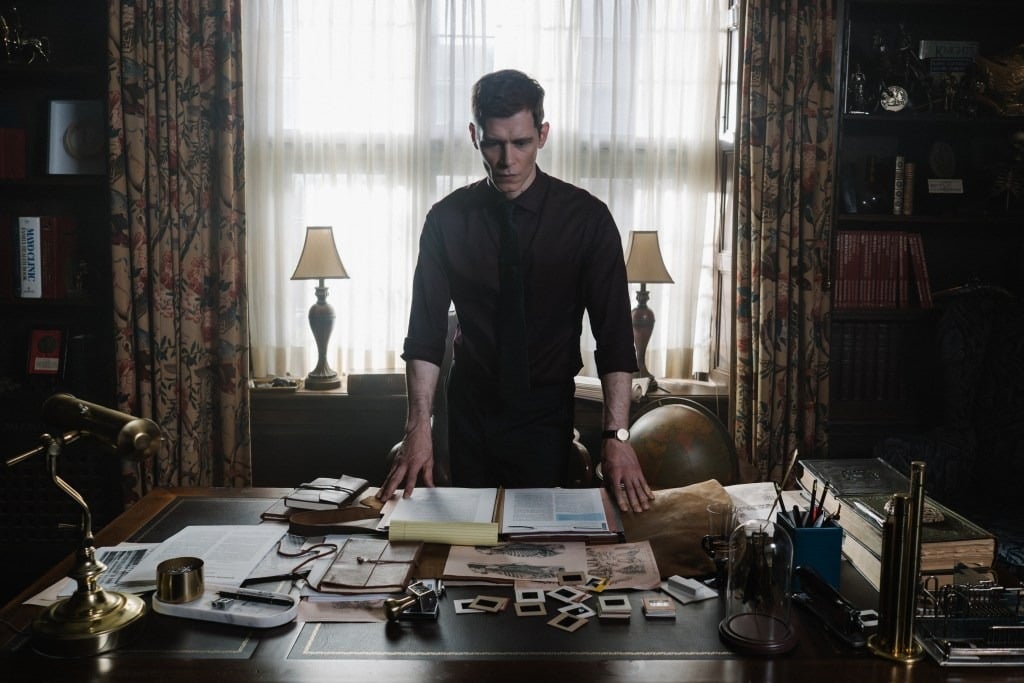
A contemporary reimagining of H.P. Lovecraft’s short story Herbert West: Reanimator is on the way, and Deadline has unveiled the first look at the new Herbert West and the pathologist drawn to his orbit.
Adam Simon (The Haunting in Connecticut, “Salem”) and Tim Metcalfe (The Haunting in Connecticut, Kalifornia) penned the script. The original screenplay and storyline come from Jade Sandberg Wallace.
Michael Grossman (“The Originals”, “Pretty Little Liars”) directs.
The new images introduce star Joseph Morgan (“Vampire Diaries“), who plays “brilliant surgeon and scientist Herbert West, who is obsessed with creating a serum to reanimate the dead.” Katie Cassidy (Speed Demon) stars opposite as the pathologist with a troubled past who joins his efforts.
Together, they prove that conquering death may be the ultimate sin against life itself.
The film’s official synopsis: “As a child, Herbert West watches his father Peter reanimate his dead mother Judith in a secret basement lab — only for Judith to mortally wound Peter and nearly kill Herbert before Peter shoots her. The trauma leaves its mark on Herbert, but so does one final image: his mother’s finger, twitching after death. Thirty years later, Herbert West is a brilliant, secretive surgeon still chasing his father’s obsession.
“Pathologist Kate Locke arrives in town and is drawn into his orbit — first through a spark at a hospital fundraiser, then through his secret lab, where he reveals a serum capable of reanimating severed tissue. Kate, hiding a dark past of her own, is thrilled rather than horrified, and moves into West’s mansion to work alongside him. Their early experiments on a cadaver succeed only briefly. West concludes that dead tissue is the problem — they need something fresher.”
Supporting cast includes Scott Aiello, Ira J Amyx, Randall Newsome, Emma Reinagal, James D. Bryce, Kathryn A Bentley, Jack Lancaster, Amy Holland Pennell, John Pierson, Mindy Shaw, Eric Dean White, Tristan Wilder Hallet, Adrienne Lamping, Aaron Crippen, and Drew Patterson.
Makeup artist Jeff Lewis (“Star Trek: Voyager,” “Star Trek: Enterprise”) and cousin Roger Lewis are heading the production via their newly established Woodlake Entertainment.
Lovecraft’s short story, first serialized in Home Brew magazine in 1922, is the first among his works to mention the fictional Miskatonic University. It was most famously adapted into a 1985 horror movie from Stuart Gordon, starring Jeffrey Combs as Herbert West.
Herbert West: Reanimator is set in Alton, Illinois, where production is now underway.

Herbert West: Reanimator. Photo credit: Matt Lief Anderson
You must be logged in to post a comment.