Movies
The Rite
“The Rite is nothing short of being a slice of stale white bread. It’s a poor imitation of a classic [‘The Exorcist’] that doesn’t attempt a single risk and never strives to do anything original.”

Mikael Håfström’s religious thriller The Rite was so uninspired that I had to handcuff myself to my chair in order to write this review. When a movie begins the development process, every single person involved should be asking the simple question: “what makes this better than…?” Because, what’s the point in attempting to make a movie that’s “less than” one of its predecessors? Such the case with The Rite, Warners and New Line Cinema’s take on the exorcism subgenre that never can find its own voice in comparison to the legendary 1973 film The Exorcist.
The Rite appears to be more interested in imitating The Exorcist than attempting something fresh and original. Very loosely inspired by the book “The Making of a Modern Exorcist” by Matt Baglio, Michael Petroni delivers a screenplay void of scares and heavy on the exposition. To a fault, nearly every facet of the script focuses on building Michael Kovak’s (Colin O’Donoghue) “lack of faith”. It’s as if Petroni honed in on the “eventual point” of The Exorcist, and couldn’t take his eyes off of it. Seriously, how many freakin’ times does the audience need to be reminded that Kovak has lost his faith in God? How much sh*t does he really have to see to believe? As a theatergoer, I would have become a believer the second one of the girls starts puking up rusty nails. But no, not Kovak, he apparently needs to die to believe anything. After the nearly two-hours of yippity-yap, Kovak finally comes face to face with his faith and is thus enlightened by one of the most logical aspects of any religious theorist (I’ll refrain from mentioning because apparently this would be the “twist” to some). Suffice to say, even the climax had me bored to tears.
In terms of scares, Håfström, who directed the pretty-good psychological thriller 1408, should be absolutely ashamed of what landed on the screen. The first time the audience gets a jolt is in the form of a f*cking “cat scare” (shocking note: isn’t that also the first scare in The Exorcist?), filling the rest of the film with loud noises, nails scratching on the wall, FX-heavy facial transformations, and the most eye-popping of all: literally ripping-off the breathing techniques used in The Exorcist. I’m sorry, but this is not an homage; it borders on plagiarism.
The Exorcist did it ALL right the first time; it presented the challenge of faith in a real way, it utilized sound as an actual scare tactic, and also applied some of the most disturbing practical effects work every caught on film. So why attempt to remake what’s essential PERFECTION? It makes no sense.
Even with a stellar performance by Sir. Anthony Hopkins, a few sprinkles of cool sequences (the red-eyed horse was awesome), and gorgeous cinematography, The Rite is nothing short of being a slice of stale white bread. It’s a poor imitation of a classic that doesn’t attempt a single risk and never strives to do anything original. If you like your cheeseburger plain, without cheese, The Rite might excite at least a tiny fart out of you.



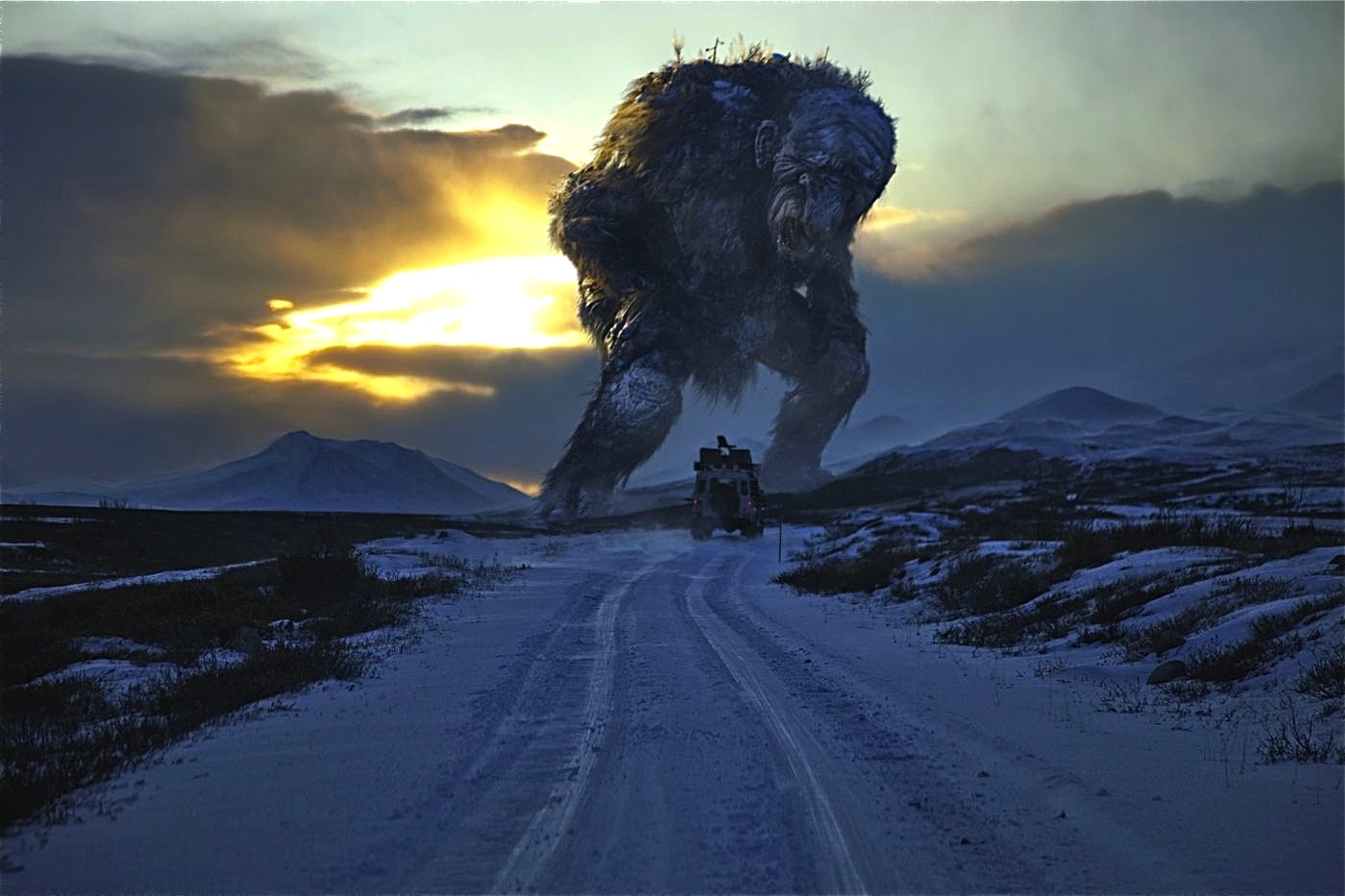
In this day and age, the word “troll” is often used to describe various online nuisances. Yet as abundant and irksome as the modern troll can be, they aren’t usually as fearsome as their mythological counterparts. I’m not talking about the small and gentler versions that have become more common to see in media. No, there are much bigger and scarier trolls out there—and André Øvredal’s movie Troll Hunter is one of the best places to find them.
It doesn’t take long for Troll Hunter (or Trolljegeren) to dump the Blair Witch Project-esque setup and aim for something a lot fresher. The trajectory of the story is augmented by Otto Jespersen’s character Hans, the titular Troll Hunter. The second he comes barreling out of the deep, dark woods and shouts “troll” at the camera, this movie takes a turn into what feels like uncharted territory. Not only subject-wise, but also conceptually.
For fantastical and made-up subject matter in cinema, found footage is a fast way to add a guise of believability. After all, what we accept to be the most crucial aspect of documentaries—the truth—rubs off on pseudo-documentaries, despite our understanding of the pretense involved. That is what Øvredal delivered with Troll Hunter: a movie so convincing that some viewers wondered if trolls really do exist. So, had this been straightforwardly made, it likely wouldn’t have been as effective. Conventional narratives would be more inclined to treat something like trolls as flat out unreal, and never try to convince the audience to think otherwise.

Hans petrifies the three-headed Tusseladd troll.
The viewers, like the characters trailing Hans, are quickly thrown into the deeper end of that extraordinary story. They have to process all this new information while staying on the go. So, although there is no significant amount of meandering, narratively or physically, there is still a good amount of atmosphere, not to mention tension building. It’s never anything frightful, but then again, Troll Hunter isn’t your standard offering of horror; it’s more on the low end of the dark fantasy spectrum. We aren’t ever spirited away to a faraway world—we stay in rather familiar surroundings, as well as dip into those less so. The outcome is a movie where you’re constantly more in awe than in terror.
As fantasy fiction might do, Troll Hunter prefers not to deal with incredulity. There is no time to waste on doubt, as interviewer Thomas (Glenn Erland Tosterud), soundperson Johanna (Johanna Mørck), and cameraman Kalle (Tomas Alf Larsen) all follow Hans around, recording whatever this character is willing to reveal about his bizarre job. Of course, the Troll Hunter himself is not an open book; in that respect, the diegetic documentary fails to fully capture and unpack the more interesting of its two subjects. Yes, all those giant, monstrous trolls are indeed incredible, but understandably, your mind wanders to their pursuer. What kind of person signs up for this gig and then chooses to stick with it for so long?
Reviews have called out Troll Hunter for its lack of character development. In regard to Thomas and his fellow documentarians, that criticism is valid, but bear in mind, they aren’t the focus of the story, either. Meanwhile, Hans is a well-crafted character. At least better than first realized. Before he was introduced, Hans had already grown tired of the troll grind. Fed up with that low compensation for his services, resentful of the bureaucracy, and wanting to expose his employer on a large scale, Hans’ discontent is glaring.
Then there are those finer details about the Troll Hunter, such as that indifference to both the natural splendor of his everyday surroundings and the affections of an obviously smitten colleague, that also suggest some level of despondency. So it is fair to say this movie doesn’t feature any sizable growth for its characters; however, the namesake isn’t underwritten. No doubt, putting a real-life character like Otto Jespersen in that role is partly why Hans is so fascinating—maybe even relatable.

Otto Jespersen as Hans the Troll Hunter.
There is always a small risk whenever using the term “mockumentary” to describe a found-footage movie, as the word could imply humor where there is none. In the case of Troll Hunter, the term’s usage is appropriate. Some folks have claimed the English-dubbed version has the more comedic tone, however, the Norwegian cut isn’t exactly humorless. Apart from the trolls’ absurd appearances, this is a movie where the characters nearly choke on the monsters’ farts, and Christians are like walking targets. Hans’ complete apathy towards everything is another cause of laughter. Overall, the comedy is intentionally dry and inconsistent. Unfunny, though? Absolutely not.
In a movie where endemic creatures are maltreated, as well as disavowed from living freely and peacefully, it’s hard not to notice the ecological message buried beneath the story. In addition to that is the unmistakable political satire. There is this whole business about intrusive and unsightly power lines—like trolls, they’re big blemishes on the land—that leads to what is perhaps the movie’s funniest moment. The scene in question is that one where certain electric lines, the ones secretly being used to keep the trolls at bay, go in a loop and don’t actually send power to any residents. Yet the monitors of said lines don’t find this at all weird. So it stands to reason that Øvredal was having a go at those who accept the government’s doings without question.
Looking past the fact that trolls aren’t actually real, this movie is an enlightening source of information. And not just for international audiences; Norwegians, too, get schooled about their homeland’s own mythology. It’s also evident from everything on screen that Øvredal and his crew were enthusiastic about the topic. The creature designs are the most indicative of that zeal; those imaginative yet myth-accurate manifestations are equally amusing and grotesque. One second you’re laughing at their phallic noses, the next you’re white-knuckling during a hairy sequence. Most surprisingly is how well the trolls’ visual effects hold up after fifteen years. It’s not all spotless, but on the whole, they remain impressive.
Vouching for a mockumentary about trolls isn’t easy, but those who do come around and give it a shot will more than likely be grateful for the recommendation. For Troll Hunter is a real find in that vast and varied genre we call “found footage“.

A bridge troll reaches up for food and finds Hans decked out in armor.
You must be logged in to post a comment.