
Editorials
How ‘Nosferatu’ Became a Feminist Retelling of a Horror Classic


WARNING: The following contains major spoilers for Nosferatu (2024).
Bram Stoker’s Dracula is arguably the most important and well-known horror text in modern history. Originally published in 1897, this epistolary novel follows a young solicitor and his wife as they’re attacked by an ancient vampire attempting to move from his isolated castle to the bustling UK. Stoker’s gothic story was itself adapted from centuries of folklore describing a night-dwelling beast who seduces then sucks the blood of innocent victims. Twenty-five years after publication, F.W. Murnau brought Stoker’s novel to the screen in the 1922 silent film Nosferatu: A Symphony of Horror. Set in 1838, this loose and unauthorized retelling chronicles a similar vampiric plague in the fictional town of Wisborg, Germany. More than a century later, Robert Eggers tackles these two classic texts while adding his particular brand of feminist mysticism. Rather than a helpless victim corrupted by darkness, his version of the vampire’s bride is a sensitive heroine with transcendental talents who gives her life to vanquish the bloodthirsty beast.
Both Dracula and Nosferatu center a damsel in distress with varying levels of agency. Stoker’s Mina Harker is a young and dutiful wife sent to stay with a wealthy friend named Lucy while her husband Jonathan travels to the castle of a Transylvanian nobleman called Count Dracula. Revealed to be an ancient vampire, Dracula follows Mina to the seaside town of Whitby and begins transforming Lucy into a creature of the night. While she does have some agency, Mina’s life revolves around caring for others. A former teacher’s assistant, the idealistic young woman has given up her own career and learned to type with plans of serving as secretary for her husband’s ambitions. Stoker’s Mina is a traditional woman of the time, valued for her purity and content to dedicate her time and energy to her husband.

Her 1922 counterpart has even less humanity. Ellen (Greta Schröder) is the new wife of Hutter (Gustav von Wangenheim) who spends her time playing with kittens and mourning the death of freshly cut flowers. She’s devastated when her husband embarks on a business trip to the castle of Count Orlok and whiles away the hours staring at the sea. Like Mina, the corruption of this virtuous woman becomes the vampire’s true threat and the men in her life will do anything to prevent this offensive defilement. Thus both wives become extensions of their husbands rather than characters themselves. They are punished for simply existing in the orbit of these wreckless men and fall into the undead creature’s sights by mistake.
Unlike Murnau’s original ingénue, Eggers’ Ellen (Lily-Rose Depp) is a complex character unto herself. Born with second sight, she has established a psychic connection with the ancient Count Orlok (Bill Skarsgård) who appears as a spectre in the open window of her childhood bedroom. Describing her mysterious powers, she remembers accurately predicting the contents of her Christmas presents and foreseeing her mother’s untimely death. Though born into relative privilege, Ellen knows the hell that would befall her should anyone discover her unique talents and call her a witch. She expresses a vague fear of being sent to a sanitarium and recalls her father’s shame and scorn after discovering his daughter in the midst of a mystical trance. Longing for connection, she reaches out to the darkness and catches the attention of Nosferatu.
This subtle shift in origin presents Ellen as the more powerful character. Though Orlok is a dreadful beast, his evil did not spark her supernatural abilities and they do not revolve solely around him. Over the years this dark being has haunted her dreams, occasionally taking control of her body to cause terrible outbursts and seizures, but she has found a way to resist his attacks. Her marriage to the virtuous Thomas (Nicholas Hoult) has brightened her days and given her the strength to pull away from the vampire’s grip. Unfortunately, it seems that Orlok has discovered their union and orchestrated a way to bring Thomas to his castle. Not only will a trip to the Carpathian Mountains place him in mortal danger, Ellen fears this contact will plunge her back into Orlok’s otherworldly realm. Rather than a byproduct of a business deal gone horrifically wrong, Eggers’ Ellen lies at the heart of the horror.

A work of post-Enlightenment fiction, Dracula features a male fixation with innovation and technology. As Lucy’s life hangs in the balance, a doctor named Abraham Van Helsing arrives to perform a dazzling blood transfusion designed to save her from the undead curse. This academic warrior has become known throughout the literary world as a vampire hunter skilled at using new technology to battle centuries-old folklore. Murnau’s variant is Professor Bulwer (John Gottowt), a Swiss Paracelsian who specializes in parasitic plants and demonstrates the predatory nature of phantom-like organisms. Both credentialled men take charge of the paranormal mission and use scientific knowledge to defeat an occult figure, dismissing ancient traditions as regressive barbarism.
Eggers’ Swiss doctor, Professor Albin Eberhart von Franz (Willem Dafoe), has a more charitable view of the natural world. Though still a Paracelsian, he’s been ejected from the medical community for studying occult practices and naturopathy. By opening himself up to the feminized wisdom of ages past and embracing the more mystical side of the world, he’s able to pinpoint the monster’s weakness and find a way to defeat him. In Ellen, he recognizes a kindred spirit and sees her disturbing trances as a method for communicating with the forces that plague the city rather than the demented ravings of a madwoman. By embracing her telepathic powers, he devises a plan to distract the foolhardy Thomas and battle Count Orlok on the demon’s own terms.
Other than Franz, the men of Eggers’ story prove to be quite ineffective. Should Thomas heed his wife’s warnings about this ill-advised trip, Orlok’s plague would never befall their family or the city at large. But the young house agent is consumed with earning a respectable position in his employer’s firm. He not only ignores his wife’s pleas to stay, but presses on in spite of grave local legends about the vampire’s castle. Thomas claims a desire to provide for Ellen and give her the finer things in life, likely idolizing his wealthy former schoolmate Friedrich (Aaron Tayloe-Johnson). Seeing the strength of his friend’s marriage to Anna (Emma Corrin), Thomas believes he can replicate it through financial stability. He’s also in debt to the prosperous shipbuilder and longs to see himself as above taking charity. Ellen insists she only wants her husband to stay and delivers dire warnings about the horrors to come. But Thomas ignores her strenuous pleas and sends her to stay with Friedrich and Anna, promising to return after securing his fortune.

For his part, Friedrich provides Ellen with a warm and loving home, but never fails to mention his own generosity. He calls on Dr. Sievers (Ralph Ineson) to treat her mysterious malady, but endorses controlling treatment that leaves her drugged and tied to the bed to prevent her seizures from damaging his property. Friedrich is a loving husband and father but clearly views women as subservient. When Ellen dares to have an honest conversation about the dark curse headed their way, he viciously chides her for speaking above her station and insists she adopt manners when addressing a man of his importance. Despite his outward strength, Friedrich falls victim to Orlok’s spell and sleeps through the massacre of his children and wife. Their deaths tear the fragile man apart and he sneaks into the crypt to lay with Anna’s body. For all his wealth and bluster, Friedrich cannot stop the plague from destroying his family and crumbles under the weight of his own emotion.
Rather than a dehumanized female prize or leverage in a sinister struggle for power, Eggers allows Ellen to be a complete human being. Even in the grips of his depravity, Orlok needs her willing consent to consummate their unholy union. No longer an extension of her husband’s house and a tangible measurement of his injury, Ellen is the key to Orlok’s undoing. The hideous Count gives her three nights to renounce her love for Thomas and return to their dark compact, threatening her loved ones if she will not agree. Desperate to save Thomas, Ellen conspires with Franz to offer herself to the beast then distract him with her blood until first morning’s light.
Both versions of this conclusion require a female sacrifice, but Eggers gives his heroine agency and empowerment. In a book she’s been forbidden to read, Murnau’s Ellen learns that it must be “a maiden wholly without sin” who can defeat the monster. By contrast, Eggers’ Ellen is “a pure-hearted woman,” leaving important space for her humanity. She’s allowed to transcend the unrealistic ideals for Victorian women and sacrifice herself regardless of the fact that she is not perfect. Questioning her own virtue, Ellen asks Franz, “if evil comes from within or beyond,” implying feelings of guilt and responsibility for Orlok’s attack. However, Franz assures her that whether man or woman, we all have darkness lurking in the recesses of our hearts. It’s only by confronting our sins and imperfections that we can find the strength to drive them out and combat evil from a place of understanding.

In fact it’s because of Ellen’s rare gift that she is able to become the city’s ultimate savior. The brave woman calls out to Orlok and invites him into her bedchamber where she willingly agrees to be his dark bride. Consumed with feeding, he forgets to return to his ornate sarcophagus. As the sun rises, Orlok lifts his head, but Ellen issues a dreadful invitation. “More,” she whispers, directing the monster back to her breast where he continues draining her life’s blood. This simple addition implies choice and empowerment while elevating the character to a position of strength. Whereas Murnau’s Ellen simply succumbs to the vampire’s attack, Eggers’ heroine has willingly given her life to save the man she loves and a city plagued with the vampire’s curse. But not because she is without sin. In fact, it’s because she has command of witchlike powers that she is able to defeat this powerful entity. Eggers’ Ellen is not vilified for her connection to darkness, but becomes a hero because of her supernatural skill.
We’re introduced to the doomed young woman as she prays for absolution, mirroring a moment from the director’s debut film The Witch. This dark story follows another young woman tempted by darkness who ultimately finds salvation by rejecting the shackles of a patriarchal world. Eggars concludes his fourth film with a grim depiction of victorious death. Lying underneath Count Orlok’s bleeding corpse, Ellen’s ruined body is honored by a scattering of lilacs. This image recalls Murnau’s introduction to his arguably reductive character. When Hutter presents his young wife with a bouquet of flowers, she’s shocked that the delicate blossoms will die as a result of being clipped from the earth. A relic of its time, Murnau’s film gives Ellen little more humanity than the flowers she holds. Valued only for her purity, she is a beautiful specimen who dies as a symbol of feminine grace. Eggers’ Ellen is a multifaceted woman, likely a witch, who is only made stronger because of her flaws.


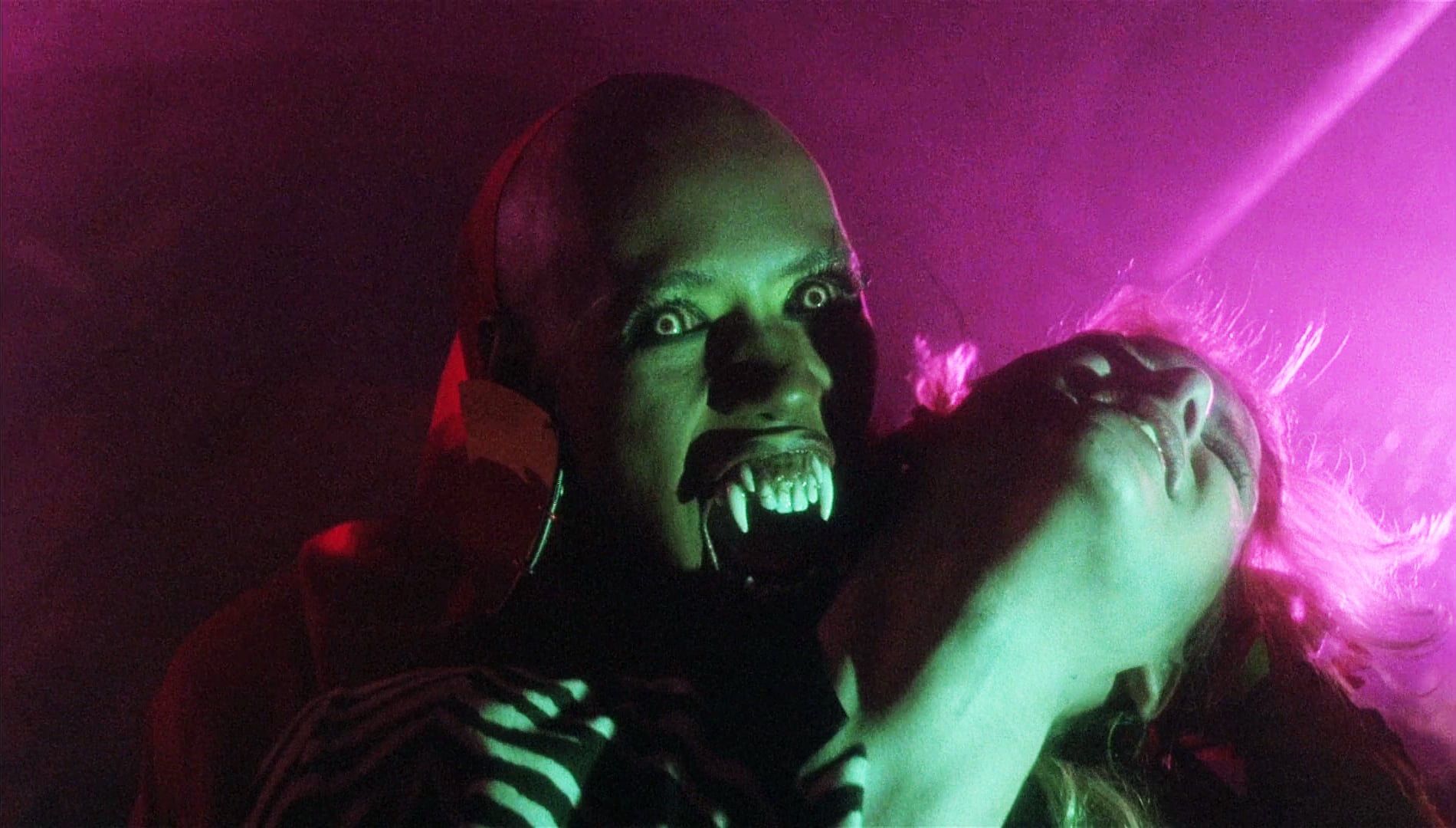
College kids, strippers and vampires—those were Donald P. Borchers’ only requirements when he approached Richard Wenk about writing and directing a movie for New World Pictures. As requested, Wenk cooked up Vamp (1986), a tailor-made blend of the decade’s teen movie craze as well as its horror boom.
Grim and earnest stories were still very much a part of the ’80s horror landscape, yet Vamp is something of a comedy. One difference between it and, say, Saturday the 14th, though, is the former avoids using schtick. Wenk’s movie proves that horror comedies also don’t have to subtract thrills from their recipes. Of course, it takes a minute before reaching that point; college antics and culture shocks preface this one macabre misadventure.
Vamp‘s initial setup is apt for a typical college-set, sex-driven comedy; to bribe their way into a fraternity house, two pledges (Chris Makepeace, Robert Rusler) go looking for some adult entertainment. Without wasting time on any further exposition, the characters embark on an all-in-one-night trip that quickly detours into terror.
To procure their elusive MacGuffin—a stripper willing to gyrate for some frat boys—Keith (Makepeace) and AJ (Rusler), plus a third wheel named Duncan (Gedee Watanabe), trade the safety of their remote college campus for the seediness of some unnamed city. The setting is recognizably L.A. by day, but as soon as night falls, downtown, along with the characters, slips into a kind of surreal universe. Director of photography Elliot Davis gave this early entry on his prolific résumé an unusual yet distinctive look; that Mario Bava-esque, magenta-green lighting is omnipresent, so much so that it’s almost its own character.

Chris Makepeace and Robert Rusler in Vamp
The faint comparisons to Martin Scorsese’s After Hours are merited, although not just because of Vamp’s distinguishing nighttime aesthetic. Save for the primary characters, the supporting roles in Wenk’s movie are also quite colorful and transactional in their behavior. The difference here, though, is the additional urge to ruin Keith and his friends at every turn. Some of that harm is humorous and tolerable enough, whereas the moment Vamp dishes out its first fatality, it’s abundantly clear how this movie qualifies as horror.
Vamp falls into that category of horror movie that reveals its genre with a scream rather than a series of whispers. The opening scene can function as a hint of what lies ahead—things are not at all what they appear to be—but otherwise, Wenk is more than happy to hold off on the horror. When that time does come, though, it catches the viewer off guard. In addition to the pure shock value is that sudden decision to upend the movie’s foremost feature. Or so it would seem.
If afraid of major spoilage, those new to Vamp would be wise to stop reading here. There’s just no skirting around the fact that the central fellowship in this buddy movie hits a serious snag when AJ is killed. That development causes the story to become more of a “long, bad night” journey for Keith and his romantic interest. So while Wenk scores points for subverting expectations, there is also a touch of sadness in his decision. Because if Vamp does anything well, it’s making the characters likable.
Something that comes easily to Vamp—and other teen horror movies from this same era—is its ability to invent young characters worth caring about, or at the very least, are interesting and not so immediately off-putting. More impressive is how Wenk did all this without actually fleshing out those characters. Still and all, Keith and his kind are a grade above cookie-cutter, and in some cases, aren’t completely devoid of growth.

Grace Jones in Vamp
Vamp appeals with an assorted cast of characters. No two are the same, nor are they operating on the same wavelength. The cinematically extroverted AJ, whose actor conveyed charm and vulnerability in near equal amounts, comes alive when he’s at his most undead. Makepeace then makes the chronically cautious Keith a sympathetic fellow, even as he’s more and more affected by the night’s bizarre events. Meanwhile, Duncan is indeed the designated loser of the whole bunch, but Watanabe still manages to humanize him. As a bonus, the role didn’t require him to pull a Long Duk Dong.
As for Dedee Pfeiffer, she is plain adorable as the mysterious After Dark server nicknamed “Amaretto”. She spends all night fixing her dress strap while at the same time trying to get Keith to remember how he knows her. As their offbeat romance grows, it becomes another highlight of this movie. Whether or not Pfeiffer’s character is really a vampire also creates some welcome tension in the story.
Like a lot of its contemporaries, Vamp went on to become a bit of a cult classic. That current status is determined by several factors, but without a doubt, the casting of Grace Jones is the most considerable. The image of her writhing on that unique-looking chair, a Keith Haring original, springs to mind whenever this movie is brought up.

Chris Makepeace, Billy Drago and Paunita Nichols in Vamp
Prior to that first display of unequivocal horror, local vampire queen Katrina (Jones) took to the stage and delivered a strip show like no other. One would expect nothing less from that renowned model and performance artist. By now reports of Jones’ tardiness on set are no secret, yet it’s also hard to deny her commitment to the part of Katrina. It was, in fact, Jones who took charge of her character’s appearance—on top of Haring painting her body and that now-iconic chair, she had Andy Warhol handle her costuming. And not too many actors could seize a room’s attention without saying a single line of dialogue.
In 2022, Vamp received a retrospective novelization from Encyclopocalypse. This literary union of preexisting source material—Wenk’s original screenplay—and new ideas from author Christian Francis amounts to a more comprehensive visit to the After Dark Club. The basic story there is no different than what’s shown on screen; however, Francis gets creative with the characters’ origins and designs, and he enhances a number of key scenes.
The novelization expands on the urban and social decay of the main setting, and supplies a background for the After Dark Club. Sandy Baron’s character, Katrina’s emcee and familiar, is given ample motivation for sticking around; up until the fiery end, he is loyal to his friend and former business partner “Squeak”, who looks like he was “fed through a combine harvester, and left as nothing more than a heap of mangled remains”. Then there is Billy Drago’s character Snow, the leader of a street gang called The Dragons. His reason for menacing Keith and AJ is more altruistic than in the movie; he and his peers act tough to scare off any potential food for the vampires.

Lisa Lyon in Vamp
If not for all the backstories, Francis’ Vamp would be a hell of a lot shorter. Instead, this tie-in read dives into how AJ met Keith—the orphaned Anthony Joseph hailed from a broken home back in Brooklyn—and how their friendship flourished over the years. Keith’s archership is no longer just an assumed part of his entire being; it’s a confidence-building extracurricular for a boy who got picked on before coming into the protection of the new kid in town. These supplemental, in-depth looks at the protagonists, plus their close connection, are maybe unnecessary. The movie already did a fair and concise job of addressing their platonic intimacy without the need for flashbacks and insights, specifically in that scene where AJ lays it all out as he sacrifices himself.
Where the novelization gets off course is its approach to the minor characters. Intermittently backstorying the likes of Katrina’s indentured servants, Seko (Leila Hee Olsen) and Vlad (Brad Logan), ends up disturbing the flow of the writing. Was it absolutely essential that readers know Vlad was the Grand Duke of the House of Romanov, or how Snow’s accomplice Maven (Paunita Nichols) became so dentally challenged? No, not really. However, one’s mileage with these random biographies may vary.
The novelization is a more substantial experience, but for a movie like Vamp, less is more. And as plentiful as they are, it never simply coasts on its campy charms, either. The character work sits comfortably in that realm between cursory and meticulous, the script is sharper than first realized, and Greg Cannom’s vampire makeup is straightforward yet effective. Most of all, the movie didn’t squander its out-of-the-box concept. Richard Wenk made his vision of a “comic nightmare in which just about anything that can go wrong does” come true, and it is very enjoyable.

You must be logged in to post a comment.