

Consider this an open letter to every cliche that’s ever made us laugh with its predictability, or weep at its implausibility. While I realize cliches are what makes the world go round, I’m pretty sure they’re right up there with other vital things like Jolly Ranchers and fossil fuels; the horror genre in particular tends to be plagued by these the most. More often than not the problem lies with just how extraordinarily difficult it is to scare someone who’s sitting on their couch, safely hidden deep under a mound of Cheetos, in their locked home surrounded by other homes. Other times this epidemic can by blamed on the film’s creator who, whether by a lack of imagination or money, wasn’t able to think of (or create) something startling and unpredictable. Here are some of the more annoyingly prevalent cliches out there that I really, really want to leave the horror genre and go back into Michael Bay’s films where they belong.


Sure kids are beautiful, the symbol of life, or whatever. But you never know exactly what’s going on behind those wee beady eyes. Sometimes, whether by alien mind manipulation or a renegade virus, kids get out of control and the only way to solve the problem is by grabbing a shovel and taking them out back with promises of candy. These children are a nuisance, but there are times when the kid could’ve solved the crisis long before it got out of hand. The problem is, no one ever believes the kid. Of course, if you’ve seen films like Village of the Damned or The Omen, can you really blame adults for fearing their offspring? Most of the time kids haven’t a clue as to what they’re on about, they just ramble on with their hand halfway up their nose, but on rare occasions they can also be helpful in surviving against what you’re being hunted by, whether it’s ghosts, psychopathic killers, aliens, or whatever this film is about.

It seems like in half the zombie flicks I watch the people in them refuse to recognize what it is they’re up against. Someone barges into the Town Hall covered in blood, mumbling about people dying and coming back to life before shuffling over to the nearest life form and taking a big bite out of them. That person, now infected, turns into another flesh hungry, moaning soul. The frightened townsfolk in the Town Hall gasp at the terrifying words this blood soaked individual keeps sputtering on about and after much contemplation they decide that “whatever these things are”, we can’t stay here. They’re zombies. Sever their spinal column or shoot them in the brain and they die. There. Now you’re adequately prepared for the coming zombie apocalypse.

What started as a fairly clever and easy scare for the filmmaker quickly spiraled out of control when every other movie threw in the same ploy. Now this cliché has evolved, though not entirely, into something else. We’re so used to jumping at the sight of something scary in the mirror that when nothing’s there we breathe a sigh of relief, and sometimes, the thing staring back at you in the mirror is a harmless friend or family member. That way we still get startled but we also feel a little dorky for it. Thanks for that.

Small towns have it rough. I mean, come on, whenever something big and scary visits the world it never trots on over to New York, right? Wait, that was an awful example. I should’ve said Houston. Yeah, Houston. My point is that when the shit hits the fan the small town sheriff and his army of two to three recently hired cops is the only defense standing between said big and scary thing and the town’s helpless citizens. This plot has worked for a plethora of films including The Mist, The Fog (like The Mist, it’s just harder to see), and 30 Days of Night. It’s pretty successful in ensuring only a few people will survive whatever it is that’s making all the noise, but I fear this plot has been rode hard and put away wet, so I think it’s time we come up with something a little more original.

Otherwise known as ‘Let’s Split Up and Investigate’ Syndrome where the teens get a little too cocky and/or stupid and/or horny so they decide they’re better off in easier to pick off groups. This has never worked and it’s one of the most annoying clichés on this list (and that’s saying something for any list that includes children). But the problem doesn’t necessarily lie with horny teens and their shenanigans, as really any group of people in a horrifying scenario have the chance of splitting up to get something done. Stick together people!

I could take some examples from the ever-growing list of `Americans going to another country for fun just to get killed’ but do I really need to? I do? You’re so needy. What about: Hostel, Texas Chainsaw Massacre, I Still Know What You Did Last Summer, The Descent, Turistas, Cabin Fever, House of Wax, The Hills Have Eyes, sadly, I could go on and on. I should also mention that this epidemic isn’t limited to Americans (like in Wolf’s Creek, Welcome to the Jungle, and Eden Lake).
Fortunately, this cliché can be easily solved through a few easy steps. Step One: When choosing your destination, pick somewhere heavily populated and preferably within your home country. Step Two: When choosing which friends to take with you, pick people you can count on and, if at all possible, those who know how to kick some serious ass should the need arise. Step Three: While packing your bags, throw in some survival gear, just in case. Step Four: No matter where you go, always respect the locals. If something bad happens you might need their help, and if you’re an ass to them they just might become the bad thing that’s happening to you.

Otherwise known as Denial, (hence the orange, in case you were wondering), people in horror films tend to think there’s nothing after them when its blatantly obvious something is. This cliché usually calls slasher flicks its home, but really any other subgenre can house this annoyance. If you’re wondering whether or not something’s trying to kill you, here are some hints that could prove your life is in danger: are the bodies of your friends turning up maimed and beaten? Did the power recently go out? Were you recently explaining to people the rules to survive a horror film? If you answered yes to any of these there’s a small to moderate, to possibly severe (or 100%) chance that someone’s about to make a pretty pretty dress out of your spleen.

No need to clarify here, Psycho started it and since then it seems every horror movie is following suit by throwing a hot chick in a shower (baths work too) to please the legions of prepubescent boys out there. Yes, sex sells, but it can also make the movie, or at least the scene very predictable (predictable = not scary).

Before I get into how annoying this cliché is I feel we should take a moment to really soak in just how disturbing the above image is. A creepy old man with a grin on his face and a remarkable resemblance to our last president holds a giant key whose sole purpose is to be jammed into the crotch of the young, almost completely naked boy’s crotch to unlock his virginity? That’s a damn scary plot for a horror film right there.
Every Jason film has taken the sex hungry teens approach until it became a running joke in the series, but to any teens aspiring to survive a horror film I’ll give you a bit of advice: if your life is in peril, don’t have sex. Unfortunately, like the previous cliché this too survives simply to satiate the seemingly bottomless sexual appetites of teen boys, which means I don’t predict it going anywhere anytime soon.

It was surprisingly difficult to find the above image; after spending way too much time in Google Image Search I gave up, threw in my copy of the movie, and took a picture of it. I hope this dedication pleases you. This is probably the only cliché to match (or come close to matching) the Sex Sells approach in number of times seen in a horror film. On too many occasions, after having stabbed or shot the killer/monster, the survivor gets too complacent in their victory. They think, wrongly, that they’ve beaten their predator only to find the guy they thought was dead missing, or coming back to kill them. If you find yourself in the self-satisfying position of just having `beaten’ the killer, go by this motto: If in doubt, empty it out. Granted, this only makes sense if you have a gun, but the same rule applies no matter what weapon you’ve armed yourself with.
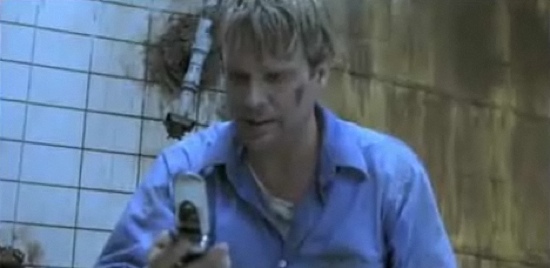
Ok, I lied. This cliché probably outnumbers them all if you consider how many times the lights/phone/car/flashlight fail during horror films. If you’re visiting BFE (Bum Fuck, Egypt) for a weekend, your cell phone probably won’t be getting reception. And whether or not you just filled up your brand new car’s tank, it’s going to die on you. Oh, and whether or not you recently inserted new batteries into your heavy-duty survival flashlight, it’s going to die on you too, and you know what? You will soon follow. We could chock this up to a series of technology related coincidences, or the frustratingly shallow imagination of the film’s creator. This cliché will be here for the long run.

Did you hear that thing in the distance? Did you see that shadow out of the corner of your eye? Did you feel that thing brush up against your leg? Instead of moving away from the thing that’s moving in the darkness or getting frisky with their legs, people in horror films tend to migrate towards the disturbance to investigate. They also tend to do this in small, easy to pick off groups (See: `Horny Teens Get Picked Off One by One’). This cliché is annoying because it’s unrealistic. I don’t know about you but if I heard a far off scream, saw something lurking in the shadows, or noticed something making babies with my leg, I would haul ass in the opposite direction, and then get some new pants. I’m guessing there are a lot of whiny baby faces like myself who would agree, and while you might laugh at the girly way in which we run, at least we’ll survive longer than you. Until we sign up for the sequel, of course.

This one isn’t a terribly common cliché, at least compared to most of those listed above, but it’s certainly one of the more infuriating ones. Luckily, there’s a way to tell when this is about to show its ugly face. If something insanely unpredictable happens (like someone important gets killed off) and we’re all on the edge of our seats waiting to find out what will happen next, then you know this is probably a dream. Because then they wake up and it was all a dream. What starts off as a sigh of relief as we realize one of our favorite characters is still alive quickly transforms into anger when we realize we’ve been duped, again.
But that’s not all, no sir! Filmmakers are an unpredictably clever bunch so they’ve found a way to fool us yet again! How, you ask? With the `Dream within a Dream’ approach, where something crazy happens, they wake up, then another crazy thing happens, then they wake up again! Woah, Mr. Conductor, how about you let me off this crazy train of unpredictability! The unstoppable evolution of this technique? The dream within a dream within a dream within a dream. Most likely to perfect said technique? Michael Bay.