


While they were always present in my life as a small child, particularly the Creature from the Black Lagoon, the Universal Monsters didn’t fully come creeping into my life like a sinister fog until the early 1990s. In 1991, Universal Studios began to reissue all of their classic monster movies on VHS and my wonderful family slowly bought them all for me as they came out. I would have been 7 years old at the time.
Mind you I had already been exposed to the horror genre years earlier, but most of the films I had watched with my father back then had been science fiction-tinged. I was exposed to the likes of Alien, Aliens, The Terminator, Robocop, Predator, John Carpenter’s The Thing, and David Cronenberg’s The Fly steadily since I was a toddler. Some were more traumatizing at the time than others, but I loved them all. For the most part, however, that’s where my initial exposure to horror had come from. I’m sure there were other films I had seen with him at the time, but the sci-fi horror/sci-fi action hybrids are the ones I remember most from that period in my life.
If memory serves, my first exposure to the “classic monsters” actually came in the form of Fred Dekker’s loving 1987 ode to them, The Monster Squad. I sadly didn’t get to see the film in theaters. I was only 3 when it came out, although my father probably would have taken me if my mother had let him. Mind you she never got up in arms about what I watched with him in the privacy of our home. It was just theatrical outings that she objected to, either because she thought I couldn’t handle it or because she just didn’t want someone to see her child in public watching something of the sort. Her objections to such theatrical viewings for her firstborn child ultimately didn’t last long, however, with my father ultimately taking me to see my first R-rated outing two years later (Jean-Claude Van Damme’s Cyborg).
Dekker’s film became a childhood staple from then on out and still remains a favorite of mine to this day. Back then, I took to the monsters within like a fish to water and spent time with them as often as I could manage, ultimately wearing out 5 different VHS copies of it as a kid. Still, while the monsters themselves are almost no different from their original counterparts from the ‘30s, ‘40s, and ‘50s, the setting was a modern one. I was not being transported into their world, for they had been brought into mine.

I love all kinds of horror and there is nary a subgenre that I do not hold dear, at least to some degree, but my true love lies with monster movies. Among this creature-filled subgenre, there is no set of films that films my soul with love and wonder more than the run that the classic Universal Monsters comprise. When those early ‘90s reissues were steadily rolling into my home, I was seeing most of them for the first time. I suspect I had caught one or two on TV in the years prior, along with some Hammer films, but I hadn’t had much exposure to the lot of them outside of The Monster Squad and an older VHS copy of Creature from the Black Lagoon.
Some of my friends were all that into the films and I suspect the black and white nature of their look was part of the problem there. Having been raised in a movie-loving environment, particularly when it came to my father and my grandmother (on my mother’s side), I had long since been used to B&W films. They never bothered me then and certainly don’t now. In a way, I think the B&W photography of Dracula, Frankenstein, The Wolf Man, The Mummy, etc. actually further lent to the effect they had on me. All already seemed otherworldly in their styles, production design, and characterization and having the extra gap due to the lack of color drove things home even further. Unlike with The Monster Squad, it was I who was being transported into their world. It simply washed over me and I bathed in it regularly, soaking in all of the details and atmosphere at every opportune moment.
I’ve chased that same feeling ever since and while I’ve found it in other forms with other types of film (both within horror and outside of it), it’s never really quite the same. Even the Hammer films, which are great, never quite give me the same feeling, although they do have their own equally-great style and appeal. I can still tap into that old feeling when I pop one of my favorite Universal Monster movies into the blu-ray player, turn off the lights, and bask in their glory on our biggest TV, but the original power that they held over me when I first watched them has waned (though only a tiny bit).
Because of this, I relished at the chance to see Frankenstein and Bride of Frankenstein on the big screen a few years back when Turner Classic Movies had their Fathom events double-feature presentation of them. What little power had been lost with repeated viewings at home returned in full force, perhaps even more than ever before, and I was gleefully lost within that world again. I had hoped ever since then that it would be the first of many such events and while it has yet to become an annual thing, I finally got my wish this year. On Sunday, October 25th, I was lucky enough to sneak away and catch their double-feature event of Tod Browning’s Dracula (1931) and its Spanish-language sister film, George Melford’s Dracula (1931). I was in heaven.

Pulling back a bit, I have always loved Dracula as a character and Bela Lugosi has always remained my favorite take on the malevolent vampire king (though some others come close). That said, Browning’s film was never one of my top favorites from these films. I still watched it regularly and always appreciated the style and atmosphere, as well as its immense contributions to the horror genre, but it always felt cold and distancing to me.
The film always managed to keep me at arms-length, in spite of the fact that it contains three marvelous turns by Lugosi, Edward Van Sloan, and Dwight Frye. I think another reason its power over me wasn’t as strong had to do with the fact that Lugosi never really continued in the role, unlike Boris Karloff with the Frankenstein Monster or Lon Chaney Jr. with the Wolf Man (as well as other roles). Grant he did finally reprise the count in Abbott & Costello Meet Frankenstein, but there was always a bit of a disconnect there. A void that, despite their best efforts, neither Lon Chaney Jr. nor John Carradine could film in their own turns as Dracula.
I came into this double-feature excited, but also a bit hesitant. After all, I had an absolute blast with the Frankenstein double-feature a few years ago, but I had always loved those films. This double-dose, however, contained one film that I really liked, but didn’t love, and a second film that I had only seen once (Spanish Dracula), which had also always struck me as more of a curiosity than a good film. We’ll save discussion on the Spanish-language remake…which is EXACTLY what it is, as Melford was able to see Browning’s dailies each evening before shooting his own version, thus allowing for any adjustments he wanted to make…for a later date. I did really enjoy it this time, however, and it’s well worth seeking out if you are interested.
So how did Dracula play with me this time? I loved absolutely every last minute of it. Seeing Browning’s film on the big screen for the first time finally drove home how magnificent it really is and I finally fully understood why audiences fell in love with it back then and have remained enamored with it ever since. At a mere 85 minutes, the film is beautifully efficient in its simplicity, moving along at a great clip from its bouncing carriage introduction as Renfield plunges into the darkness of Transylvania to its return to the light as Mina & Jonathan ascend the stairs within the broken walls of Carfax Abby at the film’s end.

I could go on and on, as countless have before me, about the superb production design and all the weird little details within the film (the Transylvania armadillos always come to mind). I could also delve deeply into the making of the film, both in relation to the above-mentioned Spanish-language version and the fact that cinematographer Karl Freund practically co-directed the film with Browning. Instead, I will simply focus on the three performances that anchor the film, beginning with our initial audience surrogate, Dwight Frye’s Renfield.
All business and no-nonsense at first, Renfield is a man out of his depth from the very first frame. Frye deftly portrays the man’s weak attempts at taking everything in stride as things get weirder and weirder for him during his somewhat phantasmagorical journey to his sit down with Dracula at the Count’s castle. This part of his performance is generally overshadowed by the iconic madness of his take on the character in the latter two acts, but it’s just as great and equally important to the film. Poor Renfield just tries to make the best of his situation as he journeys to meet the Count and things just continuously get weirder and worse for him as he does so. It’s really no wonder that Frye became a staple in the genre, especially at Universal, appearing in quite a few other films in the “monster cycle”, from the first four Frankenstein films to The Invisible Man to even Abbott & Costello Meet Frankenstein.
Bela Lugosi is the main reason that most seek this film out, however, and he is every bit as iconic as you expect him to be. Having been able to hone the role for over three solid years on Broadway (via the Hamilton Deane/John Balderston play version) prior to production on the film, Lugosi already had ultimate command of the character before even a frame of film was shot. We’ve lived through decade after decade full of Dracula adaptations and riffs, some of which are absolutely wonderful, but there’s a good reason that Bela’s take is still looked upon by most as THE definitive version of the character (outside of the one contained in the novel itself, of course).
Every line. Every look. Every gesture. Everything that Lugosi does on screen with the character is perfected and nothing is without purpose. Lugosi isn’t playing Count Dracula. He IS Dracula. Mysterious, deadly, and otherworldly, he is infinitely patient and meticulously efficient. His mad dash at the end to get away from Van Helsing and Harker aside, nothing Dracula does is every rushed. He is never in a hurry. He never overexerts himself, even when he is slaying his weak-willed servant at the end.
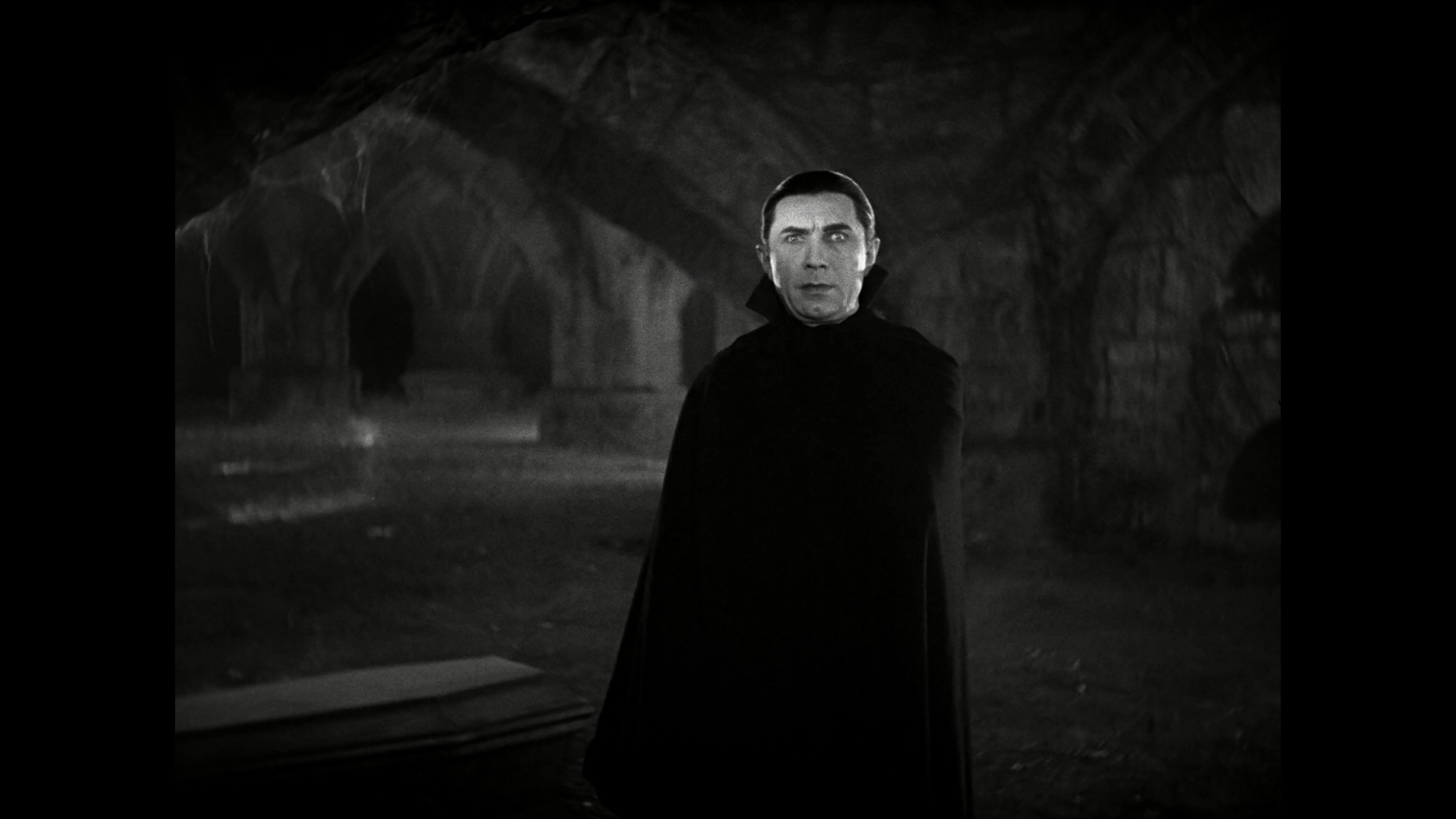
Every movement is a calm, efficient one. He is slow, steady, and confident in everything he does, whether it is simply walking across a room to closer converse with someone or murdering the flower girl on the street. When it comes to the latter, he doesn’t even flee the scene of his exsanguinating crime with any sense of urgency. Dracula simply strolls away as though he had merely stopped for a moment to admire the moon and decided to continue along his path. He would almost have a machine-like way about him if it were for the fluidity of it all. Everything comes off as though it were a dance for him, practiced over and over again. Granted the scenes themselves likely were, but that doesn’t matter.
Things should come off that way in regards to Dracula, as he truly has done it all over and over again for centuries. Nothing that occurs in the film, at least until his ultimate demise, is out of the ordinary for Dracula. He has seen it all before and appears mostly amused (and occasionally bored) by it all. His life is repetition and ritual, with his arrival in England merely the next chapter. This is why his line “To die, to be really dead, that must be glorious!” rings so true. For Dracula, death may be the only real adventure left. Anything else is just a rehash of what he has already experienced through his long, supernaturally-extended life.
Only things that are out-of-the-ordinary seem to surprise Dracula, which is where Edward Van Sloan’s Professor Van Helsing comes in. I have never gotten the impression that Dracula is afraid of Van Helsing here, instead coming off as more annoyed by the man’s minor victories against the Count’s machinations, but I do think that he respects his resolve. There’s little doubt that the Count has encountered others like Van Helsing before in his life and his victories over such people have only served to boost his ego. In his own mind, Dracula seems himself as invincible. He’s an unstoppable malevolent force walking the Earth and doing as he sees fit. Some people might arise from time to time and cause him to alter his course a bit, but he has outlived them all and has no reason to think that it will not happen again here. Pride cometh before the fall, however, and that deadly sin is the vampire’s final undoing.
Van Sloan works magnificently in bringing Van Helsing to life as the yin to Dracula’s yang. He is the immovable object to Dracula’s unstoppable force; a strong-willed man of vast wisdom and uncompromisable morals. Other incarnations of the character, including the one found within the 1931 Spanish-language redo, have taken a less black and white look at him, giving him character flaws and doubts. While there is always room for such interpretations, I have always preferred the clear cut hero route with the character. In the face of such unfathomable evil, the world needs men like Van Helsing that are willing to stand up to put a stop to it. The iteration of the character seen here is such a man and he is just as efficient in his mortal life as Dracula is in his seemingly-immortal one. Ultimate villains sometimes require ultimate heroes, and in the case of this film, Edward Van Sloan is our man.

Tod Browning’s Dracula, when witnessed on the big screen as originally intended, has finally proved to be just as powerful as its cohorts in my eyes. At home I may have fidgeted around in my seat a bit at times, but it fully held my gaze from the moment the film fired up yesterday and I was instantly sucked into the film in a way I had never been before. It is every bit the masterpiece that it has been lauded to be for the past 84 years of its existence and for the first time in 24 years, I am fully, deeply in love with it.
If you get the chance to catch it on the big screen someday, I suggest that you do so. Even if you ultimately don’t find yourself as in awe of it as I am right now, you owe it to yourself as a horror fan to experience it that way at least once. Here’s hoping we get similar chances for other Universal Monster films in the future. I, for one, would love to experience Creature from the Black Lagoon (especially in 3D!) or The Wolf Man on the silver screen at some point. After all, they are of the creatures of the night and what sweet, sweet cinema they make…especially on the big screen!


