Editorials
Sincerest Form of Flattery: 5 Horror Knockoffs
The term “mockbuster” is defined by Wikipedia (the only source for accurate information…right?) as follows:
“…a movie created with the intention of piggy-backing on the publicity of a major movie with a similar title or subject or both.”
The term has clawed its way into the popular lexicon thanks in most part to The Asylum and their blatant “confuse the consumer” products such as Snakes on a Train, The Da Vinci Treasure, and When a Killer Calls. The Asylum’s first mockbuster, The War of the Worlds, wasn’t released until ’05; naturally, it coincided with the release of Stephen Spielberg’s mega-budget adaptation.
The Italians created a boon industry in the late 70s/early 80s of rehashed plots, soundalike titles, and “unofficial” sequels. There’s an upcoming doc called Remake, Remix, Rip-off (which I’m dying to see) that covers numerous Turkish “remakes” such as Turkish Star Wars. Cheap knock offs have been around as long as producers realized they could get away with it, and there are no signs of the trend slowing down. It even appears that big ol’ Hollywood could be getting into the act.
Recently, Brad took the new film, Life, to task for appearing to be an Alien clone. I’m not sure I agree with that sentiment just yet, but I also happen to be a huge fan of Alien knockoffs. B-grade riffs on Ridley Scott’s terrifying “old dark house in space” have turned in some of my favorite Corman pictures. Life is far from low budget, however. Instead, the upcoming film announced from Michael Bay sounds like a far stronger contender for this particular list: Little America is a “if they sued that other movie, they’re certainly coming for you” level take off of Escape from New York.
Now that the mini history lesson is out the way, let’s get to it. Here are 5 horrific horror ripoffs (in no particular order) that have no shame in their copycat game. (NOTE: Being labeled a “ripoff of” does not inherently make a movie bad in my opinion. I actually enjoy some of these films on a purely, brainless, B-movie level. Take of that what you will. Cheers!)
1. Offerings (1989)

First, there was Michael Myers. Now, there is John Radley. The plot of this low budget 1989 slasher flick is…well…it’s Halloween with a few absurd additions. John is a mute who suffers verbal and possible physical abuse at home. He tortures his pets out of frustration (perhaps Rob Zombie was confused and actually thought he was remaking this film). In a terrible accident brought on by local bullies, John falls to the bottom of a well, leaving him terribly burned(?). After ten years in a comatose state, he escapes from the mental hospital to begin seeking his revenge.
Right from the jump, Offerings knows what it is and is totally okay with it. The score alternates between interesting original synth to a complete copy of Carpenter’s daunting piano notes. There’s a local professor who was “involved in the case”, but it’s never really explained what his connection is to the killer. He exists solely because, well, they needed their own Dr. Loomis. Johnny doesn’t wear a mask but sports some spiffy blue overalls to silently stalk his victims, occasionally popping out of the shadows to attack.
As cheapy-cheap as this movie is, the pace moves quickly, the kills are inventive if not terribly gory, and the finale is one big chase scene. When it comes to passable, low-grade, 80’s slasher cheese – that’s about all I could ask for.
2. Creature (1985)

Creature tells the tale of space geologists who make the fatal mistake of responding to a distress signal from a rival German ship. It turns out they’ve just landed themselves smack dab in the feeding grounds of a viscous, slimy, black skinned alien being. Insanity ensues! William Malone (House on Haunted Hill, Feardotcom) directs his second feature, utilizing leftover sets and props from Roger Corman’s Forbidden World (also an Alien impostor).
The truth is there are a ton of movies whose inspiration could be traced back to Ridley Scott’s seminal film (itself reportedly inspired by Bava’s Planet of the Vampires). Creature takes the intergalactic cake for one reason alone, the actual “creature” design. One look at this thing and there is no question Giger and the Xenomorph were being, let’s say, re-interpreted here.
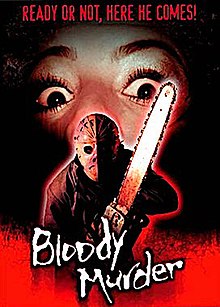
3. Bloody Murder (2000)

You need only look at the cover for this early 2000’s video store mainstay, which somehow spawned two sequels, to tell exactly what’s getting the rip-off treatment. Yes, Friday the 13th is hardly the most original film to begin with and countless other flicks have dared to venture into a secluded campground with a masked murderer on the loose (Joe D’Amato’s Bodycount is a fun Italian take on the subgenre), but none have ever been so egregious as this. Bloody Murder‘s legendary killer is a scrawny dweeb by the name of Trevor Moorehouse who wears a hockey mask!
The filmmakers weren’t even trying on this one. I really hate to say that as no one sets out to make a terrible film, but sometimes “terrible” does happen. It’s just that in this instance, it’s hard to imagine director Ralph Potillo was really trying to create anything beyond a paycheck. Considering this came out in the post-Scream era there’s still some knowing winks and poor attempts at humor sprinkled throughout. Once the credits have rolled, the gravest sin of all, however, is Bloody Murder is bloody boring. Ay, see what I did there?
4. Demon Wind (1990)

Do you love The Evil Dead? So do the filmmakers of Demon Wind! Okay, maybe that’s not entirely fair. They also seem to really love Night of the Demons, but…mostly The Evil Dead. This is a super cheese-ball flick about a group of friends who escape for a weekend away to a decrepit cabin in the middle of nowhere. They unknowingly unleash an ancient evil, a barrage of body jumping demons.
Lest you think “demons” and “cabin” are the only ED connection, may I point out a big book o’ magic and an ancient blade that may be the only saving grace for our hapless group? Demon Wind will try the patience of some while for others it may prove an amazing movie night flick to share with a group of pals. The effects are generally abysmal, but they’re gooey and repulsive enough to elicit the desired effect.
What’s better is that once you think the main cast has been whittled down, leaving scant opportunity for further bloodshed, along come another group of friends to join the party. This happens TWO TIMES! It’s as if the the writer/directer was on page 30 of his script (and subsequently page 60) and thought, “Damn. I need more people to kill. I’ve got an idea!” You’ll know if this is your bag from the trailer. If so, I highly recommend you track it down!
5. Shocking Dark/AKA Terminator II (1989)

Wow. With this movie we get a twofer. Not only is Shocking Dark a complete rip-off of James Cameron’s Aliens, it’s also an unofficial sequel to James Cameron’s Terminator. That’s right, this film was released as Terminator II in several countries. While the plot itself is pretty much all “bad ass military types must infiltrate a colony where all communications have been lost, only to discover rabid monsters dead-set on their demise.” The final act does shift gears into Terminator mode, just in time to justify that alternate title. And, boy howdy, when it does! It’s an insane amalgam of explosions, surprise robot reveals, and time travel.
The military grunts are all tough as nails archetypes copied from Cameron’s original film. For our heroine, we’re given a “scientist” as Bo-bo Ripley whose maternal instincts kick in upon discovering Bo-bo Newt. Unfortunately, she doesn’t elicit much in the way of confidence. She appears utterly perplexed and aimless in every close-up. In other words – you’ve got to see this movie!
This freshly grated Romano cheese is another Italian import from knockoff king, Bruno Mattei. This man has brought us such classics as Cruel Jaws, Hell of the Living Dead (which actually uses Dawn of the Dead’s score in places without any permission what-so-ever), and Robowar (AKA Robocop No. 2). Robowar is interesting in that, much like Shocking Dark, it’s a mashup of two different pre-existing films: it’s obvious namesake and Predator.
FYI: That terrifying, half naked, screaming man was a legit bumper. Variations of this were added to trailers released by the Japanese company, Caution Video.
Have you seen any of the knockoffs on this list? Did I not include your favorite copycat? Sound off below!
Also, I quickly wanted to thank those of you who have welcomed me to BD. I appreciate it and hope you’ve been enjoying my stuff. Feel free to share your thoughts and opinions below or you can always hit me up on Twitter here.
Editorials
Neon-Soaked Cult Classic ‘Vamp’ Starring Grace Jones Still Has Bite 40 Years Later
College kids, strippers and vampires—those were Donald P. Borchers’ only requirements when he approached Richard Wenk about writing and directing a movie for New World Pictures. As requested, Wenk cooked up Vamp (1986), a tailor-made blend of the decade’s teen movie craze as well as its horror boom.
Grim and earnest stories were still very much a part of the ’80s horror landscape, yet Vamp is something of a comedy. One difference between it and, say, Saturday the 14th, though, is the former avoids using schtick. Wenk’s movie proves that horror comedies also don’t have to subtract thrills from their recipes. Of course, it takes a minute before reaching that point; college antics and culture shocks preface this one macabre misadventure.
Vamp‘s initial setup is apt for a typical college-set, sex-driven comedy; to bribe their way into a fraternity house, two pledges (Chris Makepeace, Robert Rusler) go looking for some adult entertainment. Without wasting time on any further exposition, the characters embark on an all-in-one-night trip that quickly detours into terror.
To procure their elusive MacGuffin—a stripper willing to gyrate for some frat boys—Keith (Makepeace) and AJ (Rusler), plus a third wheel named Duncan (Gedee Watanabe), trade the safety of their remote college campus for the seediness of some unnamed city. The setting is recognizably L.A. by day, but as soon as night falls, downtown, along with the characters, slips into a kind of surreal universe. Director of photography Elliot Davis gave this early entry on his prolific résumé an unusual yet distinctive look; that Mario Bava-esque, magenta-green lighting is omnipresent, so much so that it’s almost its own character.

Chris Makepeace and Robert Rusler in Vamp
The faint comparisons to Martin Scorsese’s After Hours are merited, although not just because of Vamp’s distinguishing nighttime aesthetic. Save for the primary characters, the supporting roles in Wenk’s movie are also quite colorful and transactional in their behavior. The difference here, though, is the additional urge to ruin Keith and his friends at every turn. Some of that harm is humorous and tolerable enough, whereas the moment Vamp dishes out its first fatality, it’s abundantly clear how this movie qualifies as horror.
Vamp falls into that category of horror movie that reveals its genre with a scream rather than a series of whispers. The opening scene can function as a hint of what lies ahead—things are not at all what they appear to be—but otherwise, Wenk is more than happy to hold off on the horror. When that time does come, though, it catches the viewer off guard. In addition to the pure shock value is that sudden decision to upend the movie’s foremost feature. Or so it would seem.
If afraid of major spoilage, those new to Vamp would be wise to stop reading here. There’s just no skirting around the fact that the central fellowship in this buddy movie hits a serious snag when AJ is killed. That development causes the story to become more of a “long, bad night” journey for Keith and his romantic interest. So while Wenk scores points for subverting expectations, there is also a touch of sadness in his decision. Because if Vamp does anything well, it’s making the characters likable.
Something that comes easily to Vamp—and other teen horror movies from this same era—is its ability to invent young characters worth caring about, or at the very least, are interesting and not so immediately off-putting. More impressive is how Wenk did all this without actually fleshing out those characters. Still and all, Keith and his kind are a grade above cookie-cutter, and in some cases, aren’t completely devoid of growth.

Grace Jones in Vamp
Vamp appeals with an assorted cast of characters. No two are the same, nor are they operating on the same wavelength. The cinematically extroverted AJ, whose actor conveyed charm and vulnerability in near equal amounts, comes alive when he’s at his most undead. Makepeace then makes the chronically cautious Keith a sympathetic fellow, even as he’s more and more affected by the night’s bizarre events. Meanwhile, Duncan is indeed the designated loser of the whole bunch, but Watanabe still manages to humanize him. As a bonus, the role didn’t require him to pull a Long Duk Dong.
As for Dedee Pfeiffer, she is plain adorable as the mysterious After Dark server nicknamed “Amaretto”. She spends all night fixing her dress strap while at the same time trying to get Keith to remember how he knows her. As their offbeat romance grows, it becomes another highlight of this movie. Whether or not Pfeiffer’s character is really a vampire also creates some welcome tension in the story.
Like a lot of its contemporaries, Vamp went on to become a bit of a cult classic. That current status is determined by several factors, but without a doubt, the casting of Grace Jones is the most considerable. The image of her writhing on that unique-looking chair, a Keith Haring original, springs to mind whenever this movie is brought up.

Chris Makepeace, Billy Drago and Paunita Nichols in Vamp
Prior to that first display of unequivocal horror, local vampire queen Katrina (Jones) took to the stage and delivered a strip show like no other. One would expect nothing less from that renowned model and performance artist. By now reports of Jones’ tardiness on set are no secret, yet it’s also hard to deny her commitment to the part of Katrina. It was, in fact, Jones who took charge of her character’s appearance—on top of Haring painting her body and that now-iconic chair, she had Andy Warhol handle her costuming. And not too many actors could seize a room’s attention without saying a single line of dialogue.
In 2022, Vamp received a retrospective novelization from Encyclopocalypse. This literary union of preexisting source material—Wenk’s original screenplay—and new ideas from author Christian Francis amounts to a more comprehensive visit to the After Dark Club. The basic story there is no different than what’s shown on screen; however, Francis gets creative with the characters’ origins and designs, and he enhances a number of key scenes.
The novelization expands on the urban and social decay of the main setting, and supplies a background for the After Dark Club. Sandy Baron’s character, Katrina’s emcee and familiar, is given ample motivation for sticking around; up until the fiery end, he is loyal to his friend and former business partner “Squeak”, who looks like he was “fed through a combine harvester, and left as nothing more than a heap of mangled remains”. Then there is Billy Drago’s character Snow, the leader of a street gang called The Dragons. His reason for menacing Keith and AJ is more altruistic than in the movie; he and his peers act tough to scare off any potential food for the vampires.

Lisa Lyon in Vamp
If not for all the backstories, Francis’ Vamp would be a hell of a lot shorter. Instead, this tie-in read dives into how AJ met Keith—the orphaned Anthony Joseph hailed from a broken home back in Brooklyn—and how their friendship flourished over the years. Keith’s archership is no longer just an assumed part of his entire being; it’s a confidence-building extracurricular for a boy who got picked on before coming into the protection of the new kid in town. These supplemental, in-depth looks at the protagonists, plus their close connection, are maybe unnecessary. The movie already did a fair and concise job of addressing their platonic intimacy without the need for flashbacks and insights, specifically in that scene where AJ lays it all out as he sacrifices himself.
Where the novelization gets off course is its approach to the minor characters. Intermittently backstorying the likes of Katrina’s indentured servants, Seko (Leila Hee Olsen) and Vlad (Brad Logan), ends up disturbing the flow of the writing. Was it absolutely essential that readers know Vlad was the Grand Duke of the House of Romanov, or how Snow’s accomplice Maven (Paunita Nichols) became so dentally challenged? No, not really. However, one’s mileage with these random biographies may vary.
The novelization is a more substantial experience, but for a movie like Vamp, less is more. And as plentiful as they are, it never simply coasts on its campy charms, either. The character work sits comfortably in that realm between cursory and meticulous, the script is sharper than first realized, and Greg Cannom’s vampire makeup is straightforward yet effective. Most of all, the movie didn’t squander its out-of-the-box concept. Richard Wenk made his vision of a “comic nightmare in which just about anything that can go wrong does” come true, and it is very enjoyable.

You must be logged in to post a comment.