Quantcast
Connect with us

Editorials

Generation Hex: 5 Reasons ‘The Craft’ Still Kicks Ass

Published

on

The Craft

The Craft is over twenty years old. It’s still a little crazy to think about that. I was really young when it came out and probably didn’t see it for the first time until about a year or two later, but when I did manage to see it, I was captivated. There was a witty, ironic flair about late ‘90s horror that I gravitated to even as a kid. I watched Scream, The Faculty and The Craft in rapid succession and I loved them all. All three of those, in particular, have stuck with me for two decades and counting. But out of the three of them, The Craft was the one that I started to love more and more as I got older.

That’s because when I was a kid, I could understand slashers and I could understand aliens. Sure, I understood the witchcraft going on in that movie and thought it was cool, but at that age, I couldn’t understand why these characters would need it.

The movie is more popular now than it has ever been. There’s something about it that almost begs for rediscovery. It’s not a lost relic of its era by any means, but it’s a relic all the same. The Craft is dated and it should be. Great art—and let’s just say that’s what this is—is representative of its era.

A lot of people might say “That is so nineties” as a sort of insult, but I think The Craft is a time capsule. And even though it’s entirely of its era, there are core elements that are just as relevant today.

It really does kick ass. With its growing popularity and apparent remake/sequel on the horizon, it might be kicking more ass than ever. So let’s take a look at the major reasons as to why it still works as well as it does.


The Soundtrack

I’ll admit, this could be the nostalgia talking, but the music of The Craft really holds up. A lot of other nineties soundtracks get into trouble with weird, forced-in pop hits, but Craft has a distinctive sound all its own. Covers of “Tomorrow Never Knows” and “I Have the Touch,” performed by Our Lady Peace and Heather Nova, respectively, are standouts among a soundtrack that already stands out from so many teen horror films of the era.

Something about the music of The Craft only helps to build up the film’s mystical sensibilities. It’s unique. It’s ethereal teenage angst, more punk in spirit than in sound. On top of that, there’s Graeme Revell’s incredibly underrated score. He brings a bit of the same, almost meditative quality to The Craft that he did so well for The Crow. But The Crow is a very melancholy score overall, and this one is definitely not. 

The Craft


The Mythology 

The movie might not be an accurate representation of the Wiccan religion, but that’s mostly because this is not set in the real world, this is still a teenage fantasy epic of best and worst case scenarios when it comes to magic. My favorite bit of mythology in The Craft, though, is the notion that some people are born with a natural inclination toward magic and others have to work twice as hard to basically be half as good.

On paper, that doesn’t sound too different from the world of muggles and pure-bloods in Harry Potter. The concept is basically the same, but The Craft doesn’t give it a name. I also like the idea that, at the end of the day, power might just come from within. Sarah’s been able to do things to some degree her whole life.

She retains her power at the end, but the others do not. They were using their powers for self-serving reasons—well, Rochelle’s actually seemed justified—and while that could easily be taken as a bit too moralistic of a message, I think it works for a film that is fundamentally about manipulative high school relationships.


The Style  

For me, the style of The Craft comes down to a mixture of aesthetic and thematic elements. Visually, the movie is kind of fascinating because it feels entrenched in the nineties but, at the same time, is sort of separated from it. The style, music and overall sensibilities of the decade are there. But the girls themselves are mostly depicted in their school uniforms, which allows them to occupy their own neat space where they can be entrenched in the ‘90s, yet still almost exist outside of it.

The overall look and tone of The Craft feel almost effortlessly good. It’s not as overtly stylized as other goth classics like The Crow. I think part of what makes The Craft so interesting is that it’s set in the here and now. It’s fantasy based in an otherwise realistic world and that’s what allows these girls to stand apart as outsiders.


The Characters 

The character work in The Craft is terrific. This is the point that the success of the entire film hangs on because if we don’t buy the relationships between the four girls, nobody’s going to care about any of the crazy witchcraft. My favorite thing about this movie is that each of the characters approaches witchcraft for their own, clearly defined reasons. Sarah, more than simply wanting a boy to like her, wants to be noticed. Bonnie wants to heal her scars. Rochelle wants to not have to deal with racist crap all the time. And Nancy just wants some control over her life.

None of these are selfish goals at the onset. For Rochelle, Bonnie and especially Nancy, they simply want more and more power, probably due to the fact that it doesn’t come as naturally to them.

I would hesitate to call The Craft a feminist movie, but I don’t think it’s trying to be one. It’s simply a film about looking at the relationships and power struggles of teenage girls and exploring that concept through magic.
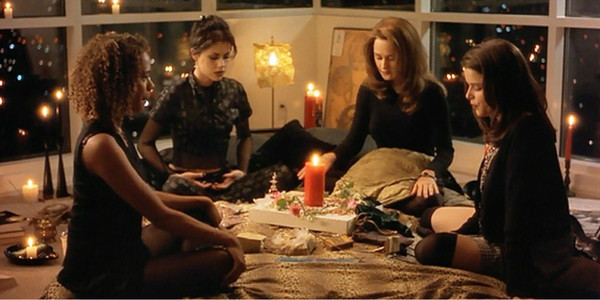
The Craft 1996


Fairuza Balk

The whole cast of The Craft does a great job with the material they’re given, but even among such a strong core group of girls, Fairuza Balk’s performance stands out. Heather Langenkamp does an amazing job in the original Nightmare on Elm Street, but Robert Englund’s performance is just transcendent. That’s what’s happening here. Balk’s on a whole other level and it’s amazing to watch.

What I love in particular is how many different kinds of things Balk is able to do in this single performance. Nancy is always creepy, but she’s never creepy the same way twice. There will be times when she’s just casually bitchy and times when she’s quietly unsettling. There are moments toward the middle where she’s clearly becoming unhinged but is almost disturbingly calm about it. And then there’s the whole third act in which she just goes for it. She dials it up to 11. She swallows the scenery in one bite.

But she’s easily one of the main reasons we’re still talking about the movie, if not the main reason. The Craft holds a nostalgic place in the hearts of so many horror fans, but if there’s one reason that could be singled out as to what makes it so great, it’s that Fairuza Balk’s performance is purely and simply magic.

The Craft 1996

22 Comments

Editorials

André Øvredal’s ‘Troll Hunter’ Remains One of the Best Found Footage Movies

Published

on

André Øvredal's Troll Hunter

In this day and age, the wordtrollis often used to describe various online nuisances. Yet as abundant and irksome as the modern troll can be, they aren’t usually as fearsome as their mythological counterparts. I’m not talking about the small and gentler versions that have become more common to see in media. No, there are much bigger and scarier trolls out there—and André Øvredal’s movie Troll Hunter is one of the best places to find them.

It doesn’t take long for Troll Hunter (or Trolljegeren) to dump the Blair Witch Project-esque setup and aim for something a lot fresher. The trajectory of the story is augmented by Otto Jespersen’s character Hans, the titular Troll Hunter. The second he comes barreling out of the deep, dark woods and shoutstrollat the camera, this movie takes a turn into what feels like uncharted territory. Not only subject-wise, but also conceptually.

For fantastical and made-up subject matter in cinema, found footage is a fast way to add a guise of believability. After all, what we accept to be the most crucial aspect of documentaries—the truth—rubs off on pseudo-documentaries, despite our understanding of the pretense involved. That is what Øvredal delivered with Troll Hunter: a movie so convincing that some viewers wondered if trolls really do exist. So, had this been straightforwardly made, it likely wouldn’t have been as effective. Conventional narratives would be more inclined to treat something like trolls as flat out unreal, and never try to convince the audience to think otherwise.

troll hunter

Hans petrifies the three-headed Tusseladd troll.

The viewers, like the characters trailing Hans, are quickly thrown into the deeper end of that extraordinary story. They have to process all this new information while staying on the go. So, although there is no significant amount of meandering, narratively or physically, there is still a good amount of atmosphere, not to mention tension building. It’s never anything frightful, but then again, Troll Hunter isn’t your standard offering of horror; it’s more on the low end of the dark fantasy spectrum. We aren’t ever spirited away to a faraway world—we stay in rather familiar surroundings, as well as dip into those less so. The outcome is a movie where you’re constantly more in awe than in terror.

As fantasy fiction might do, Troll Hunter prefers not to deal with incredulity. There is no time to waste on doubt, as interviewer Thomas (Glenn Erland Tosterud), soundperson Johanna (Johanna Mørck), and cameraman Kalle (Tomas Alf Larsen) all follow Hans around, recording whatever this character is willing to reveal about his bizarre job. Of course, the Troll Hunter himself is not an open book; in that respect, the diegetic documentary fails to fully capture and unpack the more interesting of its two subjects. Yes, all those giant, monstrous trolls are indeed incredible, but understandably, your mind wanders to their pursuer. What kind of person signs up for this gig and then chooses to stick with it for so long?

Reviews have called out Troll Hunter for its lack of character development. In regard to Thomas and his fellow documentarians, that criticism is valid, but bear in mind, they aren’t the focus of the story, either. Meanwhile, Hans is a well-crafted character. At least better than first realized. Before he was introduced, Hans had already grown tired of the troll grind. Fed up with that low compensation for his services, resentful of the bureaucracy, and wanting to expose his employer on a large scale, Hans’ discontent is glaring.

Then there are those finer details about the Troll Hunter, such as that indifference to both the natural splendor of his everyday surroundings and the affections of an obviously smitten colleague, that also suggest some level of despondency. So it is fair to say this movie doesn’t feature any sizable growth for its characters; however, the namesake isn’t underwritten. No doubt, putting a real-life character like Otto Jespersen in that role is partly why Hans is so fascinating—maybe even relatable.

Troll Hunter

Otto Jespersen as Hans the Troll Hunter.

There is always a small risk whenever using the termmockumentaryto describe a found-footage movie, as the word could imply humor where there is none. In the case of Troll Hunter, the term’s usage is appropriate. Some folks have claimed the English-dubbed version has the more comedic tone, however, the Norwegian cut isn’t exactly humorless. Apart from the trolls’ absurd appearances, this is a movie where the characters nearly choke on the monsters’ farts, and Christians are like walking targets. Hans’ complete apathy towards everything is another cause of laughter. Overall, the comedy is intentionally dry and inconsistent. Unfunny, though? Absolutely not.

In a movie where endemic creatures are maltreated, as well as disavowed from living freely and peacefully, it’s hard not to notice the ecological message buried beneath the story. In addition to that is the unmistakable political satire. There is this whole business about intrusive and unsightly power lines—like trolls, they’re big blemishes on the land—that leads to what is perhaps the movie’s funniest moment. The scene in question is that one where certain electric lines, the ones secretly being used to keep the trolls at bay, go in a loop and don’t actually send power to any residents. Yet the monitors of said lines don’t find this at all weird. So it stands to reason that Øvredal was having a go at those who accept the government’s doings without question.

Looking past the fact that trolls aren’t actually real, this movie is an enlightening source of information. And not just for international audiences; Norwegians, too, get schooled about their homeland’s own mythology. It’s also evident from everything on screen that Øvredal and his crew were enthusiastic about the topic. The creature designs are the most indicative of that zeal; those imaginative yet myth-accurate manifestations are equally amusing and grotesque. One second you’re laughing at their phallic noses, the next you’re white-knuckling during a hairy sequence. Most surprisingly is how well the trolls’ visual effects hold up after fifteen years. It’s not all spotless, but on the whole, they remain impressive.

Vouching for a mockumentary about trolls isn’t easy, but those who do come around and give it a shot will more than likely be grateful for the recommendation. For Troll Hunter is a real find in that vast and varied genre we callfound footage.

troll hunter

A bridge troll reaches up for food and finds Hans decked out in armor.

Continue Reading