Editorials
Ranking the Clive Barker Adaptations!
Clive Barker should be a household name to anyone even remotely familiar with the horror genre. For the longest time, he was the only storyteller to ever manage to rival Stephen King as the so-called “master of horror”, though they’re both good friends in real life. He’s also one of my favorite authors, consistently producing hauntingly creative tales that both frighten and entertain.
Although he rose to fame with the release of his short story collection “Books of Blood” (which is also the wonderful source of most of these adaptations), Barker has helped shape the face of horror with his terrifying work in film, television, painting and even videogames! So, with all this talk about cinematic universes, why not take a look back at some of the horror genre’s best (loosely) interconnected stories?
That’s why I’ve decided to rank all of the cinematic adaptations of Barker’s writing! I actually enjoy every single one of these movies, but it’s quite clear that some are vastly superior to others. Hell, some of them are even directed by the infamous author himself, and he fares better than King in his attempts at mastering celluloid.
That being said, I’ll be excluding films he wrote specifically for the big screen, and mainstream television adaptations as well. Now, let’s get to it!
10. Rawhead Rex

While I still have lots of fun with this trashy monster movie, it’s quite clear that this is the worst of all the Clive Barker adaptations. Barker’s original story was a somber tale of an ancient phallic-looking evil being unearthed and giving the contemporary British countryside a taste of Old-Testament wrath.
George Pavlou managed to turn that story into a schlocky gore-fest of a film, complete with a heavy-metal-inspired demeanor for the titular creature. While it’s an entertaining romp on its own, it’s obvious that Rawhead Rex completely misses the point of its originally disturbing story.
9. Book of Blood

Inspired by the two-parter tale that frames Barker’s original collection of short stories, John Harrison’s Book of Blood isn’t necessarily a bad movie, it’s just not the most entertaining one on this list.
While it maintains the somber tone and overall plot of the story it’s based on, the movie is bogged down by uninteresting characters and an uneven structure. When the story does pick up, however, be prepared for some amazingly gruesome sequences that will remind you why Barker’s work is so successful.
8. Quicksilver Highway (The Body Politic)

Not a lot of people remember this darkly funny Mick Garris film featuring two incredibly memorable stories from both Stephen King and Clive Barker (not to mention Christopher Lloyd having loads of fun in one of his most entertaining roles to date).
Qucksilver Highway is more of a dark comedy than a straight-up horror film, but it does showcase some of Barker’s fantastical creativity in the segment concerning a man whose own hands turn against him. To say more would spoil the fun.
7. Dread

It may not be in the upper ranks of this list, but Anthony DiBlasi’s Dread might very well be my favorite of these adaptations. Based on one of Barker’s most down-to-earth tales, this film is a disturbing psychological thriller that plays with audience expectations.
Although Dread is weighed down by a few moments of low production value and some questionable changes to the source material, it’s undeniably one of the scariest and most brutal films on this list.
6. Lord of Illusions (Director’s Cut)

Many moviegoers consider Lord of Illusions to be a love it or hate it sort of affair, and while I fall into the former category, I entirely understand why some might not enjoy this peculiar little film like I do (though watching the director’s cut certainly improves the experience).
Directed by Clive Barker himself, this film is the only time we’ve seen the signature protagonist of the “Barker mythos”, Harry D’amour, on the big screen, and it’s a blast! Featuring eldritch conspiracies and noir undertones, you really shouldn’t miss out on this supernatural detective story.
5. Hellbound: Hellraiser II

While it was directed by Tony Randel instead of Barker, Hellbound: Hellraiser 2 was the last film in the franchise to feature major involvement from the mastermind behind the cenobites and the cursed puzzle box, and it shows.
The insane plot, a detailed attempt at world-building and disturbing sexual undertones easily make this the best of the Hellraiser sequels so far, and a great film in its own right.
4. The Midnight Meat Train

The brainchild of a partnership between Japanese director Ryuhei Kitamura and Barker, The Midnight Meat Train is one of the strangest (and best) slasher movies ever made.
Starring a (mostly) pre-fame Bradley Cooper, this gory yet surprisingly suspenseful thriller chronicles a photographer’s descent into madness as he pursues a horrific subway-based serial killer. The less you know about this one going in the better, so all I’ll say is that it’s a must watch for fans of the genre.
3. Nightbreed (Director’s Cut)

Although we’ve only recently been able to watch Barker’s original vision of this peculiar movie, the wait was definitely worth it! Another one of Barker’s adaptations of his own work, this is also one of the best.
Featuring an epic tale of men and monsters (not to mention legendary director David Cronenberg acting as one of the creepiest killers ever put to film), Nightbreed is one of those rare movies that dares to be its own thing, defying genre and audience expectations with its nightmarishly beautiful effects and bizarre yet compelling plot.
2. Hellraiser
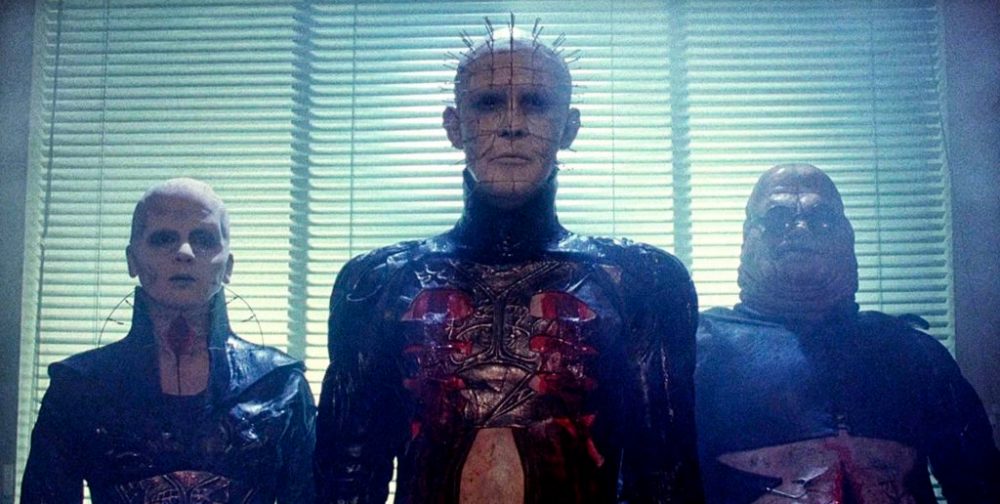
There isn’t much more to be said about this genuine horror classic. Directed by Barker, adapted from his novella The Hellbound Heart, this film cemented the writer as a legend in the world of horror movies, spawning a long-running franchise featuring one of the most memorable horror antagonists of all time.
While some of the effects haven’t aged very well, and the film does drag a bit in the second act, Hellraiser is without a doubt Clive’s best cinematic work to date and an essential part of horror movie history.
1. Candyman

More than a few people will disagree with this choice, but I maintain that no other film has captured the ethereal beauty and intense terror of a Clive Barker story like Bernard Rose’s Candyman.
Based on The Forbidden, another Books of Blood story, Candyman is a dreamlike look at the effects that myths can have on real life, and what happens when the boundaries between legend and reality are shattered. Featuring an amazing performance from Tony Todd as the titular Candyman, a terrifying yet subtle script, memorable visuals and a haunting score by Phillip Glass, this horror movie, along with Barker, will go down in legend like Candyman himself.
Editorials
How ‘Weapons’, ‘Hokum’, and ‘Widow’s Bay’ Continue Stephen King’s Horror Legacy
After fifty years of continuous writing, Stephen King has become a genre unto himself.
The unrivaled Master of Horror made a splash in 1974 with his debut novel Carrie and has been terrifying readers ever since. Two years later, Brian De Palma brought this shocking story to the screen with an equally electrifying horror film that remains a genre classic and a prototypical example of “Good For Her” horror. This dual debut seemed to open the floodgates, unleashing endless waves of Stephen King films.
From the highs of Misery, Cujo, and The Shawshank Redemption to the schlocky fun of Cat’s Eye, Creepshow, and Children of the Corn, the last five decades have seen just about every notable horror creator take a stab at the author’s massive collection.
In recent years, this singular subgenre has begun to burst at the seams, expanding to include Stephen King-esque fare. In 2016, brothers Matt and Ross Duffer debuted Stranger Things, a sci-fi series heavily inspired by two of King’s most famous books. The Netflix series remixes Firestarter and It by following a little girl with psychic powers and an intrepid group of kids on bikes who must battle an otherworldly foe and a sinister government agency. With its clever blend of modern effects and comforting nostalgia, this gateway horror series paved the way for Andy Muschietti’s It adaptation which remains the highest grossing horror film of all time.
Four years later, Mike Flanagan would create Midnight Mass, a spiritual adaptation of King’s second novel Salem’s Lot. Published in 1975, the book sees a tiny New England town torn apart by a centuries-old vampire. Though Flanagan’s story is perhaps more tender, both iterations of the classic horror tale follow close-knit communities shaken to their core by the presence of an ancient evil.
In addition to these recent hits, 2025 was a banner year for the Master of Horror. Audiences delighted in six mainstream adaptations, including the massively popular It: Welcome to Derry which chronicles earlier cycles of the titular clown’s reign. With this boost to King’s cultural cache, it’s no surprise that we’ve begun to see more unofficial adaptations of the author’s work and horror creators who build their own unique castles in King’s creative sandbox.
So what defines a Stephen King-esque story?
For the past fifty years, the prolific author has dipped his toes in nearly every subgenre from supernatural stories and grisly gore to western fantasy and science fiction. Including his vast catalogue of short fiction, King has tackled ghosts, demons, werewolves, zombies, aliens, mutants, and self-driving cars, not to mention bizarre monsters of his own creation. But what truly unites this vast array of horror is King’s focus on relatable characters. In his 2000 memoir/instructional text On Writing, the prolific author describes the amusement he finds in writing disparate characters, placing them in horrific scenarios, then exploring the ways they try to survive.
An unofficial Stephen King adaptation may take place in the author’s native New England — bonus points if it’s set in Maine — and reference his well-known heroes and villains. But what makes the King connection unbreakable is a character-driven story about average people who band together in the face of abject terror.
Weapons Captures Small Town Stephen King

Following his 2022 shocker Barbarian, Zach Cregger returned with Weapons, a sprawling story that begins in a doomed elementary school. On an otherwise ordinary day, Justine (Julia Garner) arrives at her desk to find that all but one of her students have disappeared. As the mystery grows increasingly violent, Justine and Archer (Josh Brolin), the father of a missing boy, find their way to the home of Alex (Cary Christopher), the class’ only surviving student. In some ways reminiscent of Salem’s Lot, Weapons swings wildly through the unfortunate town, introducing us to its flawed inhabitants as we watch their lives fall apart.
Cregger’s setup nods to a pair of King short stories. Both “Suffer the Little Children” and “Here There Be Tygers” tackle monstrous presences in elementary schools, but as Weapons reaches its final act, Constant Readers may remember another Stephen King tale. Featured in his 1985 collection Skeleton Crew, “Gramma” introduces us to George, a little boy tormented by an aging witch. On an afternoon alone with his sickly grandmother, the frightened child gradually realizes that the imposing old woman has been waiting for an opportunity to cast a spell that will extend her own life by possessing his body.
Alex finds himself similarly tortured by his aunt Gladys (Amy Madigan), a garish witch who orchestrates a desperate plot to sustain her own strength. Transforming humans into mindless weapons, Gladys has taken over Alex’s family home and lured his classmates to the basement. Holding them in a comatose state, she syphons off their energy to extend her own supernatural life.
Vastly different in many ways, both “Gramma” and Weapons hinge on a sinister witch who uses horrific magical spells to sacrifice the bodies of her vulnerable prey.
Hokum Echoes The Shining and 1408

It’s nearly impossible to watch a film about a haunted hotel without thinking of King’s third novel, The Shining. This icy story follows Jack Torrance, an angry writer struggling with his sobriety and a shameful incident haunting his past. Accompanied by his wife and young son, Jack has taken a job as the winter caretaker for the Overlook, a haunted hotel situated high in the Rocky Mountains. Snowed in, Jack finds himself tormented by dangerous ghosts who amplify his greatest fears.
Damian McCarthy’s Hokum follows a similarly troubled figure. Ohm Bauman (Adam Scott) is a surly writer who travels to the Bilberry Woods Hotel in rural Ireland to spread his parents’ ashes. Haunted by his own tragic past, Ohm finds himself trapped in the honeymoon suite, a decaying room that’s been permanently closed to protect visitors from a dangerous witch trapped within its walls. Visual nods to King’s text abound with woodcut figurines and an animated clock, mirroring ominous descriptions found in King’s text.
Another terrifying sequence sees Ohm staring with horror at a closed door, the only thing separating him from the approaching witch. As the door knob slowly turns, Constant Readers remember Jack’s narrow escape from the ghostly woman in room 217. And Ohm’s popular Conquistador books directly reference King’s long-running fantasy series The Dark Tower which follows a gunslinger named Roland Deschain tasked with protecting the nexus of the universe.
In addition to these thematic comparisons, Hokum bears striking resemblance to King’s terrifying short story “1408.” Collected in 2002’s Everything’s Eventual, the terrifying story follows Mike Enslin, a dejected writer who’s risen to fame penning essays about his adventures in haunted locations. Mike arrives at the Hotel Dolphin and bullies his way into the titular room, despite the manager’s dire warnings. McCarthy nods to this story with an ominously misplaced hotel room door, reminiscent of King’s entry to 1408, an unsuspecting portal that appears to move each time Mike looks away.
However, McCarthy’s most direct reference lies in a minicorder Ohm uses to capture notes. Trapped inside the dreaded honeymoon suite, this device offers well-timed messages while sitting next to a decomposing corpse. Mike records his time in 1408 with his own trusty minicorder. Described for the reader, his tape has captured the man’s slow descent into madness as the room prepares to swallow him whole. With conclusions that differ wildly in tone, both Ohm and Mike find their lives irrevocably changed by encounters with the supernatural realm.
Widow’s Bay Builds Its Own Version of Castle Rock

Katie Dippold’s Widow’s Bay has taken the idea of an unofficial King adaptation and turned it into an art form. The Apple TV series sees the residents of the titular island plagued by a curse that dates back centuries. Not only does the picturesque hamlet not accommodate wifi connections, those born on the island face certain death should they ever try to leave. Desperate to modernize the tiny town, Mayor Tom Loftis (Matthew Rhys) draws in waves of tourists just as a new cycle of terror begins.
Blending horror with deft comedy, Dippold makes cheeky references to King’s body of work. Tom warns that, “there’s something in the fog,” reminding readers of King’s 1980 novella The Mist. And Loftis’ own stay in the town’s haunted hotel sees him tormented by the ghost of a murderous clown. We even spy a vintage King hardback peeking out of a local book trade box.
In many ways Widow’s Bay feels like a new iteration of the author’s Little Tall Island, a tiny village off the coast of Maine. In addition to the 1992 novel Dolores Claiborne and a handful of harrowing short stories, this quaint fishing village is also the setting for King’s 1999 teleplay Storm of the Century. Premiering on ABC primetime, this tragic tale follows a terrified group of islanders who batten down the hatches for a dangerous Nor’easter only to find a more sinister threat lurking within.
Constant Readers may also be reminded of Castle Rock, the author’s favorite fictional town.
First introduced in the 1981 novel Cujo, the charming village becomes the star of Needful Things, King’s satire about consumerism. After several Castle Rock stories, we’re reintroduced to its residents as they gossip about the arrival of Leland Gaunt and the grand opening of his curio shop. Anything their hearts desire can be found in his varied inventory, so long as they’re willing to pay the price. Pitting cantankerous neighbors against each other, Gaunt ignites a wave of grisly violence by exploiting long-held resentments and feuds.
The town’s only defense against this supernatural threat is beleaguered sheriff Alan Pangborn. Still grieving the deaths of his wife and younger son, Alan struggles to connect with his older child and pick up the pieces of his shattered life. Also a widower, Loftis struggles to raise his own restless son and explain the strange details of his wife’s tragic death. Attempting to unravel the island’s dark secrets, Tom is aided by quirky residents including a surly fisherman named Wyck (Stephen Root) and Patricia (Kate O’Flynn), an earnest Town Hall employee. King’s own novels feature many of these proactive alliances with disparate characters combining their strengths to overcome insurmountable odds.
With Widow’s Bay renewed for a second season and Mike Flanagan’s Carrie series on the horizon, the future seems bright for new King adaptations, both spiritual and directly pulled from his catalogue. The prolific author also shows no signs of slowing down with two publications nearing release. His upcoming novel, Other Worlds Than These, is the long-awaited third Talisman book which teases direct ties to his Dark Tower world. Holly Forever will be a new installment of his crime series, offering a different kind of genre fare.
This embarrassment of riches spawning multiple worlds seems ripe for spiritual adaptation and will likely inspire horror creators for decades to come.

Kate O’Flynn, Stephen Root and Matthew Rhys in “Widow’s Bay,” now streaming on Apple TV.
You must be logged in to post a comment.