


1 room, 2 incredible performances, and a director who just became a master. Gerald’s Game, an adaptation of the Stephen King novel, is the best horror movie of the year.
If you haven’t seen it, watch it immediately. If you have, let’s dig deep into it.
Speaking with director Mike Flanagan (Oculus, Hush) this week, our own Trace Thurman touched upon the most controversial aspect of Gerald’s Game: the conclusion. As Trace noted, Stephen King fans have had gripes with the ending of the story ever since the novel was published back in 1992, and many are none too pleased that Flanagan did not alter it for his Netflix adaptation.
As Flanagan explained to Trace, he wouldn’t have made the film any other way.
“It was something when I read the book that I loved,” said Flanagan, when Trace asked about the final 10 minutes. “I know it was polarizing with fans of the book, so the people that hated that epilogue in the book are going to hate it in the movie. I fully expect that [the epilogue is] going to be the lightning rod for people to be like ‘Oh I was so into it and then (groans) that ending.’ But that’s what happened in the book. There was never a time where it felt right to do the film without that ending, for better or worse.”
Of course, if you’ve seen the film, you know that the last 10 minutes take place some time after Jessie (a transcendent Carla Gugino) has escaped from her nightmare situation; in one of the hardest-to-watch sequences in recent horror history, she gruesomely mutilates her hand to break free from the handcuffs her (dead) husband put on her.
And then, in the final 10 minutes of Gerald’s Game, which King wrote out in the last 50 pages of the novel, Jessie writes a letter to her own self as a child. Through this letter, we learn that Jessie has still been having nightmares about the Moonlight Man, a humanoid creature that she had nightly visions of during her extended stay on the bed that almost became her final resting place.
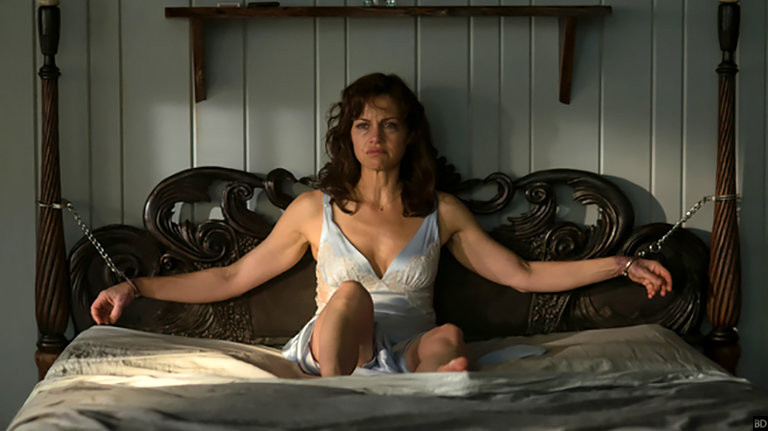
But what we learn next really takes the story to another level. As it turns out, the Moonlight Man was *not* a delusion inside of Jessie’s mind, as we (and she) had assumed up until that point. Rather, the perceived manifestation of death was an actual man named Raymond Andrew Joubert, a graveyard vandalist and necrophiliac who really did make nightly visits to Jessie’s bedside.
If you’re asking me, that makes those visits infinitely more bone-chilling. Seriously. Watch the film again, armed with the knowledge that he’s real. Yikes.
In the very final moments of Flanagan’s Gerald’s Game, Jessie confronts Joubert in court. She bravely approaches him, delivering a single, powerful line before turning her back on the monster in much the same way Nancy did to Freddy at the end of A Nightmare on Elm Street: “You’re so much smaller than I remember,” Jessie says to her Moonlight Man.
It’s in this moment that Gerald’s Game becomes so much more than a survival horror story about a woman chained to a bed. In these final 10 minutes, Gerald’s Game transforms from terrifying horror film into a truly powerful piece of drama, much the same way Jessie transforms from terrified victim into powerful survivor.
The Moonlight Man looks so much smaller because Jessie is now so much bigger.
“Her last line, ‘you’re so much smaller than I remember,’ is also a callback to the very first line we ever hear Young Jessie say in the first flashback, about the lakehouse,” Flanagan noted to me when I talked to him about the meaning of the film. “She says ‘It’s so much smaller than I remember…’ and her father articulates the point of the film: ‘That’s ‘cuz you’re bigger.’ THAT was always the point of this film to me, and that symmetry — which a lot of people miss — summed up the whole film for me.”
We learn throughout the course of Gerald’s Game that Jessie’s father sexually abused her as a child, long before her husband insisted on calling himself daddy and asserting his physical dominance over her. As Flanagan himself noted in the aforementioned chat with Trace, Jessie has been dealing with “male perversion” in “various forms from various people throughout her life,” all of which is embodied in Raymond Andrew Joubert – a man every bit as ugly as all who abuse women truly are on the inside.
When Jessie turns her back on Joubert, she’s turning her back on her father. On her husband. On all of the abuse that she’s been subjected to throughout her entire life. She’s made the decision to no longer run away from or bury her trauma deep within herself. She literally faces it head on, robbing everyone who’s ever hurt her of the power of harming her any further.
And that’s the story being told in Gerald’s Game, from the very beginning. The entire movie, past and present, masterfully builds to that transformative moment of catharsis. It’s a story about a traumatized little girl who grew up to be a scared woman. It’s the story of that woman overcoming the demons of her past to take back her life by choosing to no longer live under the oppression that’s been an ever-present aspect of her being since she was a child.
That decades-spanning story/character arc, seen through to a pitch-perfect conclusion, is one of the most powerful and emotional that Stephen King has ever written. And it’s because Mike Flanagan and co-writer Jeff Howard stick true to King’s ending, despite 25 years of readers complaining about it, that Gerald’s Game is one of the most impactful horror films in many years.
Gerald’s Game is important, masterful horror cinema. And I’d personally hate to imagine the film without the final 10 minutes that have proven to be so polarizing. Without those 10 minutes, the film, while it may be a terrifying and intense horror movie up to that point, doesn’t actually mean anything. It’s merely a scary story. And Gerald’s Game excels by being so much more than that.
It’s much bigger than one woman’s story. And Flanagan hits that out of the park.
