


It’s almost time for Halloween which means it’s time to watch a crap ton of horror flicks! This year with my 31 films in 31 days of October I wanted to branch out a bit. I realized that most of the films I watch are generally from the 80s (with a sprinkling of late 70s). To push myself outside my norm, I’m donning this year’s adventure “31 for 31: Through the Decades Challenge”. Simply put, each day will correlate to a specific decade, and I must watch at least one film a day. No exceptions! Of course, I couldn’t leave well enough alone. I had to make a further set of rules for myself to ensure I’m getting lots of variety. Those rules as follows:
- One film must be watched from each decade (50s – 10’s)
- One film must be watched from a major horror franchise.
- One film must be watched from one of our late-great masters (Craven, Romero, or Hooper).
- One film must be watched that deals with witches or witchcraft.
- One film must be watched that deals with the undead.
- One film must be watched that stars either Christopher Lee or Vincent Price.
- One film must be watched that contains sci-fi/horror elements.
- One film must be watched that is a remake.
- One film must be watched that is from Italy.
- One film must be watched that takes place during Halloween.
After last week I was worried that I might have made my rules for this year’s challenge a tad too restrictive. Thankfully, that doesn’t seem to be the case. I’ve still crammed in plenty of classics, films that I’ve always loved and simply needed a good reason to rewatch, and and an undiscovered gem or two.
October 15th – House on Haunted Hill (1959)

Rules Met: 1, 6
“A millionaire offers $10,000 to five people who agree to be locked in a large, spooky, rented house overnight with him and his wife.”
After revisiting the remake last week, I realized I’d never seen the original House on Haunted Hill in its entirety. While William Castle was a true genius in the various ways he hocked his films, the gimmick attached to Haunted Hill is one of the best. During one of the climactic scenes, a plastic skeleton would go flying across the theater audience, suspended by a string. The film itself is cheeky fun, but manages to shoot itself in the foot by explaining away every supernatural occurrence while still expecting the audience to buy into the mythos, unlike the remake which balances both fairly well. Of course, Vincent Price is his always delightful self as the hateful millionaire offering up thousands of dollars to total strangers.
October 16th – Horror Castle (1963)

Rules Met: 1, 9, Bonus 6
“Women are being tortured to death with various torture devices in the dungeon of an old castle by a deformed, hooded, holocaust survivor.”
Knowing I needed to fit in an Italian flick, I was very close to rewatching one of Mario Bava’s classics, The Whip and the Body. Instead, I decided to dive deeper into the gothic horror cycle of the 60s. While I’ve pretty much torn through a majority of the Gialli from the 70s and most of the gore-fests of the 80s, I didn’t realize how many Italian directors were tackling the genre in the 60s outside of Bava. Director Antonio Margheriti is one such filmmaker. Horror Castle starts slow but quickly escalates with one intense set piece after the other. The gore is surprisingly brutal for a film made at this time with one set-piece involving an ancient torture device and ravenous rat being particularly revolting. It’s hard to go wrong with this Italian gothic horror film with Christopher Lee playing a possibly gay ex-Nazi, a “living skeleton”, and some truly wicked effects work.
October 17th – Season of the Witch (1972)

Rules Met: 1, 3, 4
“A bored, unhappy suburban housewife gets mixed up in witchcraft and murder.”
Season of the Witch began Romero’s foray into placing social commentary at the forefront of his narrative. It’s not subtle in the slightest. The opening scene is a trippy dream sequence where Joan (or Jack’s Wife, the original title of the film) is led carelessly by her husband through a park. He eventually leashes her up like a dog, swats at her with the newspaper, and boards her up in a kennel. This housewife is not living life to her fullest potential. Thankfully, a little bit of hoodoo voodoo might be the key to setting her free. This is certainly an overlooked film in Romero’s oeuvre. It’s a strong dramatic piece that toes the line with the supernatural. Season of the Witch is a captivating film that tackles witchcraft in the same grounded way that Romero did with vampires in Martin.
October 18th – Halloween 2 (1981)

Rules Met: 1, 2, 10
“While Sheriff Brackett and Dr. Loomis hunt for Michael Myers, a traumatized Laurie is rushed to hospital, and the serial killer is not far behind her.”
With recent news that everything beyond the original would be discarded in the forthcoming reboot of John Carpenter’s seminal slasher flick, I thought it a great time to revisit Halloween 2. There was a lot stacked against this follow up to one of the greatest horror films of all time. Carpenter didn’t really want to be involved, the production was rushed, and Jamie Lee Curtis’s wig is far more frightful than any of Michael’s shenanigans. Nonetheless, it’s an enjoyable slasher sequel that mixes things up with the hospital setting and familial ties reveal. It’s hard to imagine a Halloween film at this point without the Myers-Strode blood relation looming overhead, we’ll just have to wait for next October to see if the gamble pays off.
October 19th – Village of the Damned (1995)

Rules Met: 1, 7, 8
“A small town’s women give birth to unfriendly alien children posing as humans.”
Many consider this remake to be one of John Carpenter’s worst films. Truthfully, it’s not that bad. The main issue with Village of the Damned is in the casting of Christopher Reeve and Kirstie Alley. One alone may have worked against a different actor but together – they just feel off. The first half of the film is successfully eerie as the entire town falls under a mysterious fainting spell, only for the women to wake up pregnant hours later. Once our glowy eyed, killer tots show up the groundwork gets shaky under the weight of cheese filled moments and puzzling government conspiracies. There are huge leaps in logic and narrative that are surely the fault of studio meddling: an out of nowhere romance, possible alien connections, etc. While at first glance, this may seem like a strange choice for Carpenter, echoes of the director’s “Apocalypse Trilogy” become evident by the final reel.
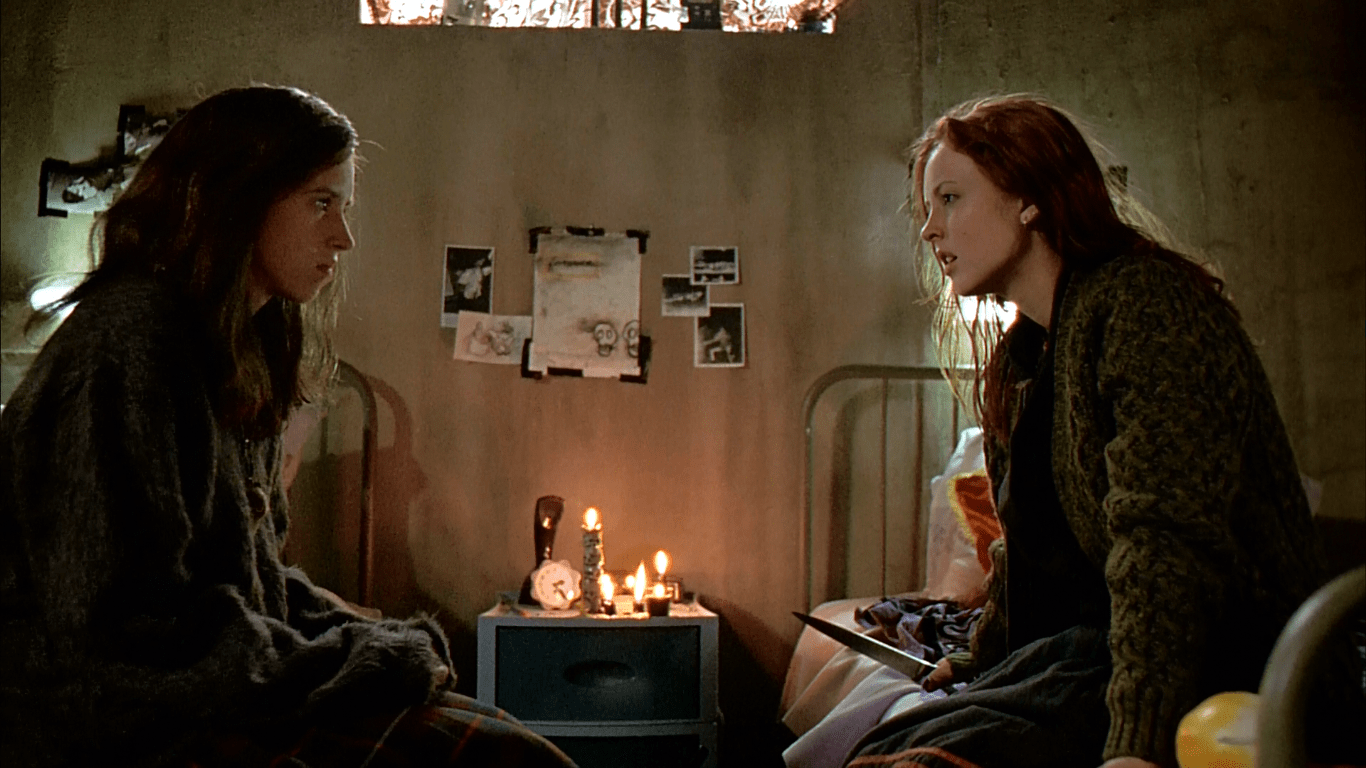
October 20th – Ginger Snaps (2000)
Rules Met: 1, Bonus 10
“Two death-obsessed sisters, outcasts in their suburban neighborhood, must deal with the tragic consequences when one of them is bitten by a deadly werewolf.”
Ginger Snaps has always been one of my favorite films. It’s dementedly funny at times and heartbreaking at others, all building to a true wham bang finale amidst a rowdy Halloween party. While the effects and creature work are top notch, the true shining stars are Emily Perkins and Katharine Isabelle. As sisters who have always been attached at the hip whose relationship becomes strained over an unfortunate mixture of puberty, jealousy, and lycanthropy – the duo draw the viewer in almost immediately. Ginger Snaps is a perfect feminist, coming of age horror film that doesn’t skimp on the “horror”.
October 21st – Scout’s Guide to the Zombie Apocalypse (2015)

Rules Met: 1, 5
“Three scouts, on the eve of their last camp-out, discover the true meaning of friendship when they attempt to save their town from a zombie outbreak.”
From the opening moments featuring a slacker janitor singing Charli XCX and Iggy Azalea’s Black Widow into the handle of his mop, I had a good inclination this movie might just be for me. The scene culminates in fun product placement for both Takis and Tic-Tacs while giving a gory nod to one of the best moments in John Carpenter’s The Thing. Christopher Landon, you get me. Beyond the insane opening, Scouts Guide to the Zombie Apocalypse succeeds at being a cute throwback to films of the 80s. However, it never truly elevates itself beyond amusing pastiche, but there are far worse ways (especially within the modern zombie subgenre) of spending 90 minutes. Landon has a colorful and zany approach to horror that hasn’t been seen from modern genre directors in quite some time. I haven’t had a chance to check out Happy Death Day yet, but here’s hoping he continues to grow this POV with each film.
BONUS WATCH: I recently started a local horror pop-up cinema in my hometown, and we held our first screening this past Saturday. We started with a double feature of two black and white classics, Night of the Living Dead and City of the Dead. Obviously, we should all know how amazing NOTLD is. City of the Dead, on the other hand, is terribly underrated! Also known as Horror Hotel, it’s an early effort from the producers who went on to create the Amicus studio. It’s filled with gorgeous cinematography and chilling atmosphere. Seek it out, pronto!


