


As elated as love can make one feel, it can be hell for others. Characters in horror can attest to that. So often in the genre, love is fettered by all things outré. Sometimes, that nearly indescribable state of mind drives one to unspeakable acts. Or, love is challenged by forces beyond our comprehension.
This collection of episodes from various television anthologies is proof that romance isn’t entirely dead. Or living, in some cases. These self-contained stories revolve around love, infatuation, and lust. Regardless, it all ends on a frightful note. In honor of the days leading up to Valentine’s, here are fourteen macabre tales of romance that will leave you utterly lovesick.
Alfred Hitchcock Presents (1955): Lamb to the Slaughter

In addition to directing movies for the big screen, Alfred Hitchcock lent his name to this anthology. The series accumulated over three hundred episodes during its ten-season run, but its namesake only directed a few. In this adaptation of Roald Dahl’s short story of the same name, a pregnant housewife (Barbara Bel Geddes) learns of her husband’s affair one night. Her reaction? Bludgeon him to death with a frozen leg of mutton, of course. As the lamb then cooks in the oven, the homemaker stages the crime scene to look like someone else killed her husband.
While the episode owes much of its success to Dahl’s morbid sense of humor, Hitchcock’s direction plays a large part just as well. He balances thrills with black comedy without ever effacing suspense. Though in this case, the excitement comes from whether or not the culprit will get away with the murder. Secretly, we hope she does. An episode of Tales of the Unexpected was also based on Dahl’s short.
Tales from the Darkside (1984): Florence Bravo

Tales from the Darkside cranked out oddball stories on the regular. Writer Edithe Swensen was likely behind some of the weirdest ones, too. Yet, she offered something more conventional in “Florence Bravo”. Here, a strained couple moves into a house with a dark history—a woman named Florence Bravo (Lauren Klein) shot her adulterous husband there. Now, Florence’s lonely ghost has found herself a potential friend. By convincing the wife (Lori Cardille) her own husband is having an affair with the real estate agent, Florence effectively recreates the murder.
The episode ends according to plan. There’s no shocking twist involved, but the journey to reach that fatal conclusion is eerie. Watching the eponymous spirit rationalize her crime while preying on a likeness of herself — Cardille’s character is understandably fragile and already paranoid after her husband cheated on her — is the most unsettling aspect here. A far more psychological item than we’re used to in the Darkside.
Fear Itself (2008): New Years Day

Love finds a way in this zombie entry from Mick Garris’ continuation of Masters of Horror. It might be New Year’s Eve, but Helen (Briana Evigan) is in no celebratory mood. Her brother passed away, and her fair-weather boyfriend (Cory Monteith) is avoiding her. Nevertheless, she agrees to go to a party in a bid to see said guy. The evening takes a sudden turn, though, as a chemical explosion nearby turns people into undead flesh-eaters. Helen finally treks alone across a chaotic city in hopes of reaching her friends.
Steve Niles’ script for “New Years Day” is indicative of the zombie furor at the time. Cushioned in between the dimly lit, survival-horror action is a set of flashbacks that explain how our protagonist ended up by herself during an apocalypse. What saves this one from feeling wholly ready-made is a surprising twist ending.
Monsters (1988): Pillow Talk

This quirky episode from Monsters is all about the one that got away. Horror author Miles Magnus (John Diehl) lures women in with his fame and then immediately gets them into bed. Although not for the reasons one would expect. Rather, Miles’ bunk is a living, flesh-eating creature so old that it “remembers the dinosaurs and the ice age.” When Miles’ most recent victim, a romance author named Viki (Mary Woronov), escapes unscathed with his manuscript in tow, he himself is seduced without ever realizing it.
A puzzling sense of attraction is vital in an episode that is equally sensuous and kooky. The leads, both of whom convey passion but for different purposes, are expressive. What is more, the mythos of the bed monster — not unlike the villainous piece of furniture found in Death Bed: The Bed That Eats — is intriguing.
Thriller (1973): One Deadly Owner

A woman’s desire for independence leads to an appalling discovery in “One Deadly Owner”. Donna Mills plays Helen, a fashion model who can’t help herself when she sees a striking, pre-owned Rolls Royce for sale. Her impulse doesn’t sit well with her boyfriend and photographer Peter (Jeremy Brett), who fears Helen is taking on more than she can handle. This concern is warranted as the car appears to be haunted—whenever Helen goes for a drive, she hears a disembodied, bloodcurdling scream from within the vehicle. Is she imagining it, or is someone from the other side asking for help?
Mills’ character is patronized by various men throughout the entirety of “One Deadly Owner”, a tense plea for justice. From buying the car to solving the mystery of her whim’s past, Helen is treated like she doesn’t know what’s best for her. Ultimately, Helen learns to trust herself while upholding the notion that we have to look out for each other even when advised not to. For a rather on-the-nose companion piece, please check out the under-seen 1984 New Zealand movie Mr. Wrong.
Night Visions (2001): My So-Called Life and Death

Adults tend to forget how powerful crushes can feel when you’re a teenager. Battling all the imminent changes brought on by puberty is hard enough. Add in an air of forbidden romance and you’ve got “My So-Called Life and Death”. Julia (Marla Sokoloff) is your average, moody teen who despises her little brother and resents her predisposed parents. From afar, she finds solace in the family’s handyman (Steve Bacic).
When told through the eyes of horror, adolescent pangs are more tangible than ever. The genre visualizes stress that’s frequently disregarded as unimportant. Julia’s longing ends up having less to do with the handsome Mr. Fixit and more about her own existence. When that big plot reveal comes along, it begs the question—can we handle the harsh truths of life, or are we better off dead?
R.L. Stine’s The Haunting Hour (2010): The Red Dress

In this youthful anthology inspired by the works of R.L. Stine, children and young adults meet grisly demises at the hands of various evils. In “The Red Dress”, a country club employee named Jamie (Linda Tomassone) is enamored with Zack (Ryan McDonell), a member at the club. Believing she has to change herself to date someone like Zack, Jamie steals the titular garment from a blind shopkeeper (Emmanuelle Vaugier).
A lapse in judgment fuels this mean-spirited cautionary tale. In a supernatural take on capital theft, our protagonist is taught a very painful lesson that could have been prevented at several points. Be that as it may, “The Red Dress” is a parable of how people need to be true to themselves. In this case, pretending to be someone you’re not comes at a high price.
The Outer Limits (1995): Caught in the Act
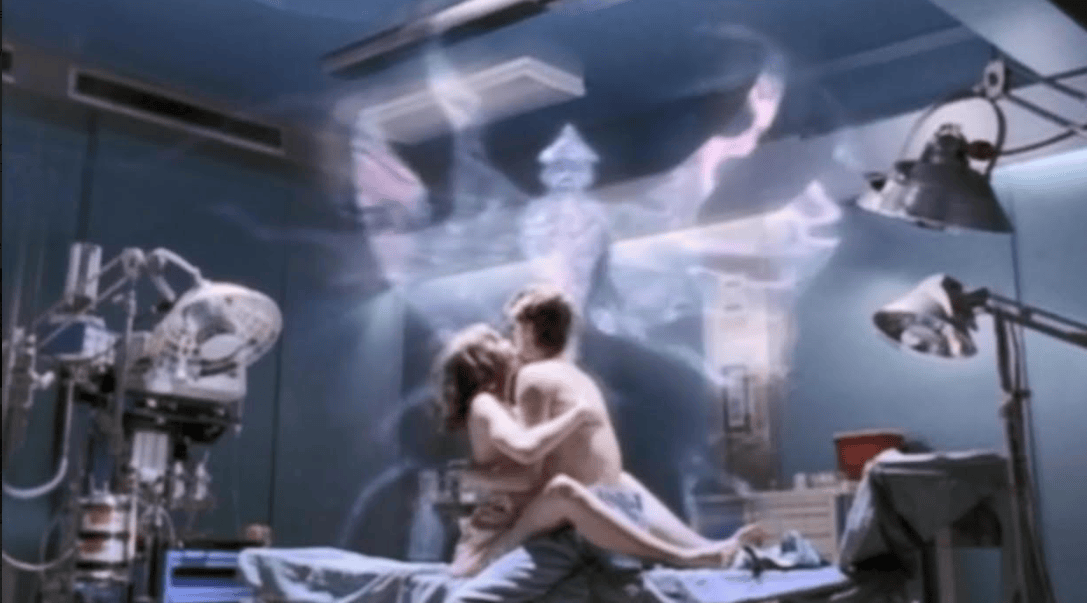
Classic depictions of aliens are threatening in appearance and behavior. They can also be amorous, according to films like Species and Decoys. Somewhere along the way, the Outer Limits reboot entered the extraterrestrial sex arena with “Caught in the Act”. Alyssa Milano plays a college student, Hannah, who is possessed by an otherworldly lifeform who forces her to feed on men. The eating is more like bodily absorption, and it only comes from copulation. To save Hannah, her boyfriend (Jason London) works with his professor before it’s all too late.
With its reliance on thought experiments, The Outer Limits was similar in execution to The Twilight Zone. Though episodes like “Caught in the Act” could be heavy-handed. The alien operates on a basic, carnal need that turns the chaste into sex-starved killers. Luckily, the entity is no match for pure love. It’s a saccharine ending to an otherwise memorable episode rife with elements resembling psychotronic horror.
Tales from the Crypt (1989): Four-Sided Triangle

This curious ‘scary tale’ is centered around a young farmhand named Mary Jo (Patricia Arquette) and the fantasy she conceives after a head injury; at least, we think it’s all part of her imagination. Mary Jo is mistreated by both Luisa (Susan Blommaert) and her lascivious husband George (Chelcie Ross). The latter strikes Mary Jo when she resists his advances. The blow to the head then triggers a delusion where Mary Jo believes a scarecrow is her lover.
Tales from the Crypt has always teetered between low and highbrow horror. A perfect example is this gutsy, erotic thriller. “Four-Sided Triangle” is a peculiar scandal where the performances absolutely matter. No matter what we believe, it’s the actors’ conviction that makes this one so unforgettable.
Amazing Stories (1985): Go to the Head of the Class

Powered by Robert Zemeckis’ energetic direction and Mick Garris’ waggish writing, “Go to the Head of the Class” stands out as one of the best episodes in Amazing Stories. Peter (Scott Coffey) is an avid horror fan with a propensity for tardiness. His most recent offense lands him in the hot seat with his cruel teacher, Mr. Beanes (Christopher Lloyd). To get back at him, Peter and his crush, Cynthia (Mary Stuart Masterson), cast a spell that, needless to say, goes terribly awry.
Amazing Stories boasts cinematic visuals and effects as well as top names both behind and in front of the camera. “Go to the Head of the Class” is a tad too kitchen-sink when it comes to its own horror — a foggy graveyard, a thunderous night, and a creepy, old house — but that’s why it’s such a fun episode.
Are You Afraid of the Dark? (1990): The Tale of the Dream Girl

Heartbreak comes about in a very different way in this forlorn episode of the classic Nickelodeon anthology. Johnny (Fab Filippo) is being haunted by a girl after finding her ring in his locker. With his sister Erica’s (Andrea Nemeth) help, he uncovers the truth behind the beautiful apparition (Shanya Vaughan) that follows him wherever he goes.
As children, we were all drawn to episodes of Are You Afraid of the Dark? where the threats are overt. Upon rewatching, it’s stories like “The Tale of the Dream Girl” that stick with us as adults. There’s nothing frightening here. In actuality, it’s a scare-less drama that banks more on its ability to move you. Some of the show’s best music and acting can be found here.
The Twilight Zone (1959): Jess-Belle

This episode is a treat for fans of folk horror. Set in a small community in the Blue Ridge Mountains, Jess-Belle (Anne Francis) looks to a witch for help when she wants to win back her ex Billy-Ben (James Best). She has nothing of value to pay the witch with, but they strike a deal anyway. The magic immediately breaks up Billy-Ben’s engagement. On top of that, Jess-Belle becomes a leopard every midnight until dawn. The transformations aren’t purely physical either as Jess-Belle’s humanity slips away each and every time.
The Twilight Zone experienced a transition period starting in its fourth season. Not only had the show dropped the “The” from its title, episodes were now an hour long. The extended length caused some issues from a storyteller’s perspective, and viewers can feel that very struggle as they watch. Even so, episodes like “Jess-Belle” are diamonds in the rough saved by stellar writing. Earl Hamner, Jr.’s background injects impeccable cultural authenticity.
Masters of Horror (2005): Sick Girl

Angela Bettis and director Lucky McKee reunited for this delightfully weird episode of Masters of Horror. In “Sick Girl”, an entomologist named Ida is down on her luck when it comes to dating. The women she typically meets are repulsed by her job. Things change, however, when she’s introduced to Misty Falls (Erin Brown), a woman who has no qualms about bugs. However, neither of them are prepared when an anonymous party sends Ida a dangerous specimen.
The gravity of McKee’s dreamy horror is inescapable in “Sick Girl”. In one of his most individualistic works to date, the director’s brand is on full display. The episode may not be to everyone’s liking, but it’s a personable one rounded off with grotesque body horror. Using insects in a metaphor for homophobia is also unique.
Inside No. 9 (2014): To Have and to Hold

Trouble in paradise doesn’t even describe what lies ahead in “To Have and to Hold”. Co-creator Steve Pemberton plays a wedding photographer, Adrian, who spends more time in his basement darkroom than with his wife, Harriet (Nicola Walker). No matter what she does, though, Harriet can’t put the spark back in her own marriage. She believes the problem stems from her unfaithful history, but the truth is far more sinister.
Early on, you’re not quite sure what to make of “To Have and to Hold”. It seems like a somber account of two people trying to rekindle a dead flame. Before you know it, things take a deviant turn. Episodes like this are why Inside No. 9 is a daring anthology that more people should be watching.


