Editorials
Why Indonesian Horror Films ‘Satan’s Slave’ and Remake ‘Satan’s Slaves’ Should Be Watched Together on Shudder
In 2017, Satan’s Slaves topped the list of highest-grossing films in Indonesia. After receiving strong buzz during its festival run, the film found a perfect home on Shudder, where it’s continued its reputation as one of the streaming platform’s most frightening offerings. The international success of Satan’s Slaves seems fitting, considering it’s a remake of 1980’s Satan’s Slave, an influential entry in horror for Indonesia. Though it might’ve rocked the nation to its core upon release, Satan’s Slave proved to be a rare find elsewhere for decades. Until now, that is. Recently, Shudder made Satan’s Slave available to watch on their platform, serving up two distinct generations of vital Indonesian horror.
Touted as a remake of 1979’s Phantasm, 1980’s Satan’s Slave transformed Indonesian horror. Before its release, the genre was dominated by special effects-driven movies heavy on the gore. Satan’s Slave relied on eerie atmosphere and unsettling imagery. Directed by horror director Sisworo Gautama Putra, the film opens to a family in mourning. Mawarti succumbed to a mysterious illness, leaving behind her two children, Tomi and Rita, and husband Munarto. Munarto is mostly an absent father, preoccupied with work, and accumulating wealth. That leaves Rita struggling to figure out what’s happening with her younger brother Tomi, who insists the ghost of his mother is haunting him. Things get even stranger after the arrival of new housekeeper Darminah, an occultist woman with nefarious intentions.
Satan’s Slave goes to great lengths to show that this family’s life is devoid of religion, in turn making them susceptible to evil. They’re too occupied with the material or hedonistic things in life to practice. Rita enjoys disco parties and spending time with her boyfriend, Herman. It’s safe to assume mom Mawarti enjoyed the wealth provided by her workaholic and ambitious husband. Tomi seems interested in spirituality, but being left on his own without guidance means he’s prone to getting into trouble with his dabbling. Only the family’s sickly servant Mr. Karto is in tune with religion, though it can’t save him from the encroaching evil. Darminah systematically removes those closest to the family and uses them as undead slaves to wreak havoc. Only the help of a shaman and religion can spare them from becoming slaves of Satan.
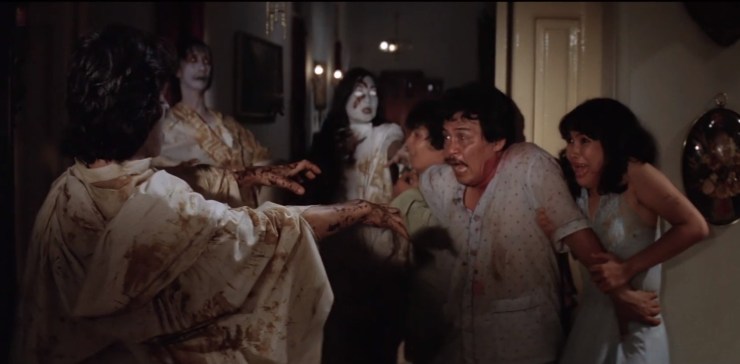
It’s interesting to watch this film alongside its remake. To a modern audience, Satan’s Slave can read as camp, a product of its era. It’s clear that Sisworo Gautama Putra intended serious horror, though, and it proved massively effective on audiences in 1980. That includes Joko Anwar, who couldn’t get the film out of his head after being traumatized by fear in his first exposure to it—remaking a formative movie, the lifelong horror fan adhered to the essence of Satan’s Slave, the eerie atmosphere. While the original retained a simple good vs. evil plot, Anwar added complexity. In the remake, the death of the mother unleashes a curse birthed from a Satanic pact. How that unfolds proves far more complicated than before, but more importantly, it’s far scarier. Anwar employs every tool in his arsenal amassed from a lifelong affinity for the genre to deliver potent scares that come at a consistent pace.
Having access to Satan’s Slave on the same streaming platform as its remake doesn’t just work as an examination of cultural horror through generations. It provides the necessary context for the ending of Anwar’s film. Until this point, Satan’s Slaves offered a cryptic coda only insiders could interpret. In it, the surviving family members have fled their home and moved into a flat in the city. A neighbor brings them food before returning to her apartment, where she conspires with her partner to keep the family close. Their ill-intent makes it clear for any viewer that the family remains in danger, but it’s still a strange tease for a potential sequel. The mysterious woman’s lover then calls her by her name: Darminah. As in, the primary antagonist of the original film.

Applying the context of Satan’s Slave suddenly makes a seemingly benign ending to Satan’s Slaves more menacing. There’s now a face for the cult that tormented our protagonists. Being able to see the 1980 film expands on why this is an exciting tease for a sequel. Or at least, there’d better be a sequel. Thanks to streaming services like Shudder, or boutique labels like Severin (who’s releasing Satan’s Slave on Blu-ray soon), obscure horror films are being unearthed and made readily available to fans. It gives us a chance to see cinematic history on an international scale. In this case, it allows us to see how Indonesia loosely interpreted Phantasm, turned it into a groundbreaking horror film in its native country. Then that film inspired a modern retelling so successful at terrifying audiences that it’s ensured Joko Anwar is a genre filmmaker to watch on an international scale.
In terms of access to international horror, it’s a great time to be a fan.
Editorials
Here’s Johnny! 5 Unexpected Homages to ‘The Shining’ in Non-Horror Media
Some movies are just so beloved that you can experience them through cultural osmosis without ever sitting down to actually watch them. From loving parodies to meticulous recreations of iconic scenes, memorable filmmaking lives on even after the curtains close on the silver screen. And when it comes to horror, few films can compete with the massive impact that Stanley Kubrick’s The Shining had on popular culture as a whole.
Whether or not you think the flick is a good adaptation of Stephen King’s seminal novel, 1980’s The Shining slowly but surely grew into one of the most influential genre movies ever made, inspiring everything from surprisingly heartfelt sequels to classic episodes of The Simpsons. However, not all The Shining references are created equal, and today I’d like to shine a light on six unexpected homages to Kubrick’s iconic film.
In this list, we’ll be focusing on references and Easter eggs that either came out of the blue or came from creators that you wouldn’t expect to be fans of this classic ghost story. That being said, don’t forget to comment below with your own favorite references to the Torrance family and the Overlook Hotel if you think we missed a particularly memorable one.
With that out of the way, onto the list!
5. A Nightmare on FaceTime – South Park (2012)

Regardless of the brand’s iffy reputation among former employees, the death of Blockbuster Video was a serious blow to fans of physical media. Of course, some folks were more affected by this than others, and South Park’s Randy Marsh definitely took things a little too far in the twelfth episode of the show’s sixteenth season.
Titled A Nightmare on FaceTime, the main plot of this 2012 story is a surprisingly faithful recreation of The Shining where Randy purchases an empty Blockbuster store and begins to go mad once he realizes that his investment may not have been a very good idea due to the rise of streaming and the now-defunct RedBox storefronts.
4. The Overlook Hotel Level – Ready Player One (2018)

I was never really a fan of Ernest Cline’s Ready Player One, so I viewed Stephen Spielberg’s divisive adaptation of the novel as an improvement over the source material despite having its own narrative issues. In fact, I actually prefer how Spielberg changed the story by removing several references to his own work and replacing a lengthy Blade Runner detour with an over-the-top homage to The Shining.
A CGI-heavy recreation of the film’s most iconic moments that feels like a big-budget ghost train ride set within the Overlook Hotel, this intense sequence is more of a recreation of the freaky aesthetics of The Shining rather than its mind-bending narrative. However, it’s still fun to see Spielberg make a heartfelt tribute to a filmmaker that was once his close personal friend.
3. IKEA Singapore Halloween Ad (2014)

It makes sense that commercials don’t typically borrow from the horror genre, as it might be a bad idea to scare away potential customers, but some references are just too much fun to pass up.
That’s probably why the publicists behind this Ikea ad from Singapore were allowed to turn their commercial into a genuinely unsettling recreation of Danny’s tricycle scene from The Shining. After all, nobody cares if your store is haunted so long as it offers late-night shopping hours and a large selection of merchandise that you can become lost in forever and ever…
2. The End of ‘Bondage and Beta Male Sexuality’ – Community (2014)

Community is no stranger to recreating iconic movie moments within the show, and the series had previously tackled horror tropes in episodes like the fan-favorite Epidemiology. However, the most laugh-out-loud moment on this particular list comes from a brief gag towards the end of the season five episode ‘Bondage and Beta Male Sexuality’.
The majority of this episode has nothing to do with scary movies, but there’s a brief subplot involving supporting character Chang and a possible encounter with ghosts that leads him to question his own existence. This subplot culminates in the episode’s hilarious ending where the camera zooms in on a black-and-white photograph of Chang in period clothing at some kind of celebration, just like Jack Nicholson at the end of The Shining.
However, the picture’s subtitle eventually reveals that it’s merely a conveniently placed keepsake from the ‘Old Timey Photo Club’.
1. The Overlook Hedge Maze Sequence – Zootopia 2 (2025)

Disney movies are pretty far removed from both the gruesome horror of Stephen King and the heady filmmaking of Stanley Kubrick, so I don’t think anyone was expecting the climax of last year’s Zootopia sequel to take place in an animated version of the snowy hedge maze from The Shining.
In this unexpectedly intense sequence, friend-turned-villain Pawbert Lynxley (an unhinged lynx cat played by Andy Samberg) chases our protagonists through a creepy labyrinth in a loving recreation of Jack Nicholson’s icy demise outside the Overlook Hotel. The actual ending here might be a little more child-friendly than what’s being referenced, but it’s amazing that the filmmakers were able to push the horror elements as far as they did – especially since the scene doesn’t really have anything to do with the rest of the movie.
You must be logged in to post a comment.