


As the Halloween Season rolls in, a lot of people ask why we love to celebrate the dark and macabre when the real world is already such a frightful place. While that’s a complex issue that I’m not really equipped to handle, I do think that one of the most admirable aspects of horror is its ability to transform terror and tragedy into something positive. After all, at the end of even the bleakest and most brutal of horror films, we’re still standing, having survived whatever dreadful scenario was thrown at us.
This unique form of catharsis is likely the reason why we keep returning to a genre that does its best to keep us up at night, and it’s also why one of my favorite Halloween stories doesn’t come from a slasher franchise or a Lovecraftian tome, but an indie Comic-Book.
Batman may have his own horror influences and there are characters like Ghost Rider and Spawn with outright demonic origins, but I don’t think any other Comic-Book creation manifests the spirit of Halloween as deeply as James O’Barr’s The Crow.
For the uninitiated, The Crow was a 1989 Graphic Novel published by Caliber Comics. It was a dark and emotionally resonant take on classic revenge stories, focusing on the tragedy that befalls a young couple after their car breaks down on a deserted road. Assaulted by a band of ravenous criminals, Eric and Shelley’s lives are cut short, with Eric forced to watch as the love of his life is beaten and raped in front of him before finally succumbing to his wounds. Death is not the end of this story, however, as Eric is revived as an undead super-human by a mystical Crow, allowing him to seek revenge against Shelley’s murderers.
While there have been numerous adaptations, sequels and spin-offs, these basic plot elements recur in nearly every version of the story, with the universe attempting to restore balance by allowing this one act of supernatural revenge. In O’Barr’s original tale, however, Eric’s retaliation doesn’t really bring him any solace, making the narrative a unique exploration of grief and loss without the usual Superhero bravado.

That’s not to say that the comic doesn’t make use of classic Superhero tropes, but these are also joined by elements that we usually associate with horror. If you think about it, the story is structured a lot like a slasher movie where the unstoppable killer is meant to be justified in his brutality. This is all accompanied by gloomy visuals, eerie poetry and even a dark soundtrack (titled Fear and Bullets, it was released in 1994 in conjunction with the comic’s hardcover rerelease), making this an extremely atmospheric experience.
This may all seem absurdly dark and depressing (and the subject matter would admittedly be tackled more tastefully in the future by other creators), but there’s an undeniable earnestness to the storytelling here that makes it easy to forgive most of the adolescent excess. This is probably due to The Crow having been birthed in tragedy, as O’Barr began writing it as way of processing his own grief, having lost his girlfriend to a drunk driver back when he was 18.
Of course, you’d be forgiven for not having read or even heard of the original graphic novel, as The Crow‘s mainstream popularity only really took off with the release of Alex Proyas’ 1994 cult-classic film starring the late Brandon Lee. While the film had its own share of tragedy behind-the-scenes with the senseless death of its leading actor, it was a surprisingly hopeful tale when compared to the source material, while simultaneously doubling down on the spooky aesthetics.
Don’t get me wrong, Proyas’ vision of the story is still dark and gritty, but it’s stylized quite differently from O’Barr’s monochrome nightmares, featuring a more uplifting message about love and loss. Eric was changed into a musician in order to justify the rock’n’roll soundtrack and overall theatricality, with some of the mythology also being altered in order to make for a more compelling feature. Even the initial double-homicide is different, motivated by greed rather than pure happenstance.
Proyas’ The Crow is also an extremely Halloween-friendly picture, with the traditional “Devil’s Night” (the night preceding Halloween, when urban youths used to conduct rampant acts of fiery vandalism) playing a big part in the plot. Hell, even the legendary Tony Todd is present as one of several memorable members of Top Dollar’s (Michael Wincott) homicidal crew, with veteran Ghostbuster Ernie Hudson hot on their trail as Sergeant Albrecht.
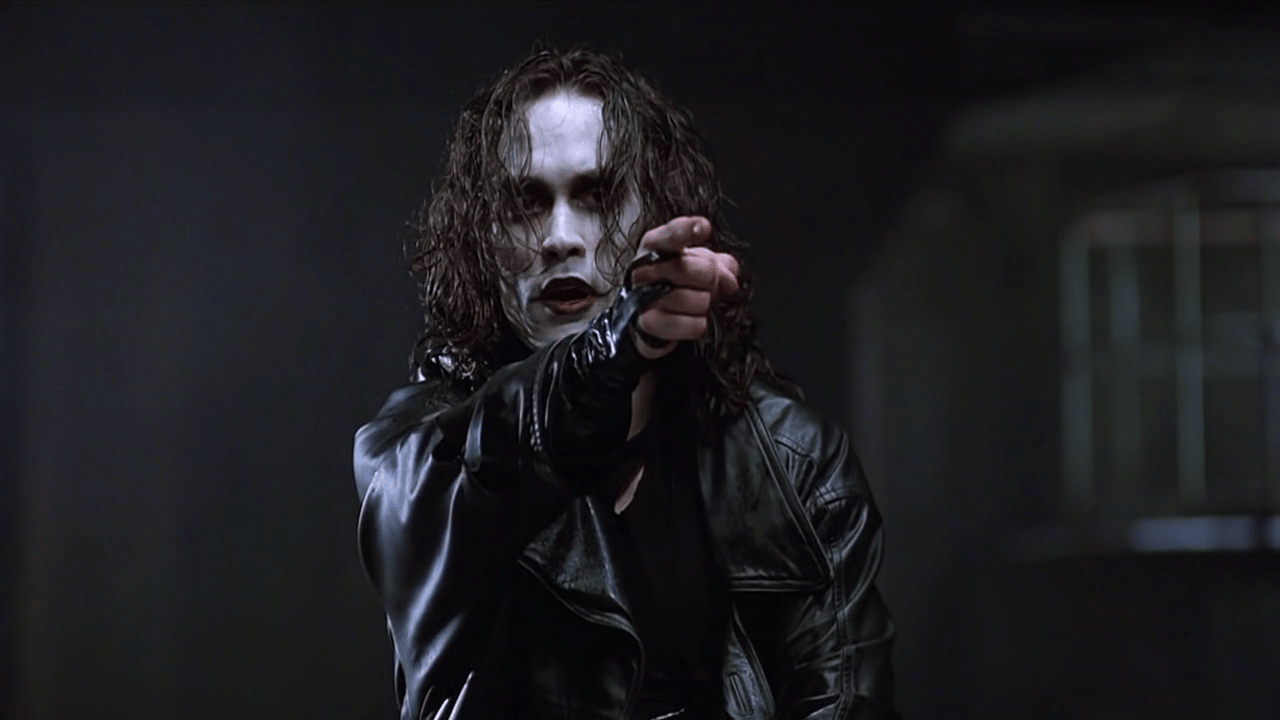
While not all of the film’s changes were for the better (as an adult, I prefer the more ambiguous ending of O’Barr’s version), there’s no denying that Proyas tapped into a general feeling of disillusion that would became a staple of 90s culture. After all, the film was a hit with what we now call the Dark Alternative scene, connecting with disenfranchised youth much like other unique filmmakers and musicians from that decade. It was also my first R-Rated movie experience (alongside the original Child’s Play) after an unsupervised visit to Blockbuster. While I was way too young to appreciate the nuance behind the narrative, even a young me was thoroughly entertained by the style and artistry permeating the picture.
Much like the Graphic Novel, the film’s impeccable art direction would end up having a substantial impact on Goth culture, and so would its kick-ass soundtrack. With bangers from Nine-Inch-Nails, The Cure and even Joy Division, it’s one of the most memorable playlists to come out of the 90s. For the longest time, it was also commonplace to see at least a handful of Eric Draven costumes at every Halloween party, so it’s safe to say that the movie left a noticeable legacy even if its sequels and spin-offs weren’t quite as memorable.
This legacy is even more impressive once you realize that Brandon Lee’s shocking death totally destabilized production. Proyas and his team were forced to rewrite and reshoot entire sequences in order to tell a coherent story, experimenting with eerie flashbacks and body-doubles in an attempt to get around unfilmable character moments. This resulted in a miraculously heartfelt and innovative comic-book movie that also serves as a beautiful homage to its leading performer.

Sure, both the film and the original comic have their flaws as somewhat juvenile power fantasies, but they’re also both compelling stories for completely different reasons. All these dark and spooky influences from the 80s and 90s culiminated into a single pop-culture monolith which is still highly influential today, even if the Crow himself has been absent from mainstream media for a while now.
While there’s something universally compelling about this dark premise, the several failed attempts at reviving this tale on the big screen serve as a reminder that you can easily reproduce a story’s iconography and plot, but not the genuine spirit behind it. Some may point to Brandon’s death and O’Barr’s personal tragedy as key elements of The Crow‘s success, but I’m not so sure. This was lightning in a bottle, a tale of horrific catharsis made possible by unique talents and a specific cultural zeitgeist, and it’s unlikely that a studio could tap into that again.
I was lucky enough to meet James O’Barr at a local convention last year, and without prior knowledge of his work or troubled upbringing, you’d be hard-pressed to guess that this kind and good-natured figure was behind some of the darkest material in pop-culture history. Although, I guess that’s the point of horror. You’re supposed to dive into these terrifying tales and come out alive and well on the other side, dealing with your own real-life monsters in the process.
After all, it can’t rain all the time, and I can’t think of a better way to celebrate the spirit of the season than by revisiting The Crow.


