


Horrors Elsewhere is a recurring column that spotlights a variety of movies from all around the globe, particularly those not from the United States. Fears may not be universal, but one thing is for sure — a scream is understood, always and everywhere.
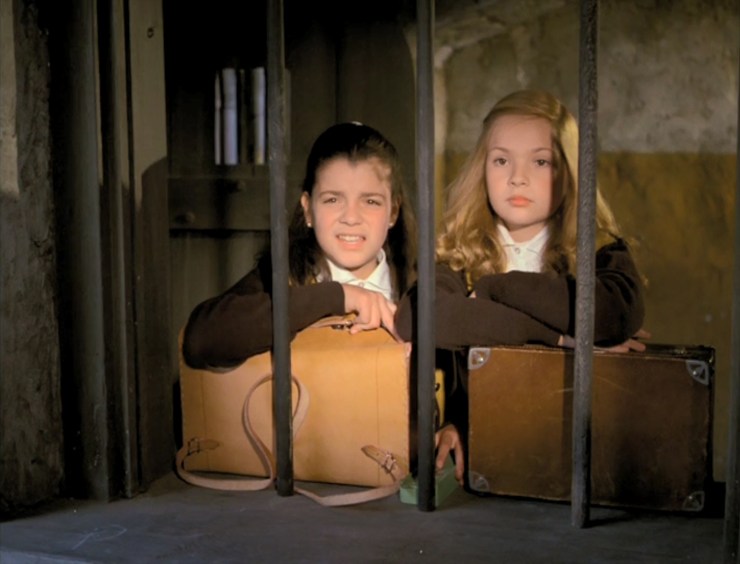
Making new friends does not come easy for one of the two young protagonists in Carlos Enrique Taboada’s 1984 movie, Poison for the Fairies (Veneno para las hadas). Verónica (Ana Patricia Rojo) is a precocious 10-year-old without anyone her age to call a friend; her avowed strangeness is why the other children steer clear of her. However, when a new student is more intrigued than fearful, she and Verónica embark on a perilous journey that tests the limits of their friendship. Set during the 1960s, and echoing the Gothic atmosphere and styled aesthetic of Taboada’s other famous Mexican horror movie, Even the Wind is Afraid, Poison for the Fairies is a dark and engrossing period piece.
The story adeptly negotiates its opposite tones; charming, coming-of-age moments awashed in pure light are offset by the more sinister scenes using a chiaroscuro-esque technique of filming. How the adults are depicted on screen — they are outlying shadows, or their faces are hidden from the camera à la Charlie Brown — keeps the focus on the children. Regardless of the perceived target audience or the age of the central characters, this is by no means a kid’s movie. The two girls look to fairy tales when navigating their childhoods and challenging the world around them.
The blurring of reality and fantasy is reinforced each time Verónica indulges her nanny’s superstitions. In a story visualized at the film’s start, a murderous girl turns out to be an old bruja who has glamoured herself. The caregiver explains, “witches can do anything.” Curious rather than horrified by what she hears, Verónica then imagines herself physically transforming into a cackling, withered witch as the opening credits commence. This sudden and newfound fascination with witches is later revealed to be less about sick novelty and more about seeking power. Orphaned at a young age, Verónica now lives with her wizened, sedentary grandmother and Carmen, the nanny responsible for filling her head with these macabre and fey stories. To someone who has felt vulnerable for a good part of her life, the chance of gaining control over others — maybe even fate itself — is too tempting to pass up.
Verónica soon takes up with the new transfer student at her parochial school, Flavia (Elsa María Gutiérrez), who is caught off guard by a comment about her name; Verónica states “Flavia” is a name designated for spiders, not people. Like a fly foolishly attracted to a spider’s sticky and charged web, Flavia is then lured into Veronica’s fantasy. At first, Gutiérrez’s naïve character is naturally skeptical of Verónica’s claim of being a witch; her father tells her those days of ignorance and burning women at the stake are long gone. Everything changes, though, once the hex the girls cast on Flavia’s piano teacher, Madam Rickard, comes to fruition. Rather than sending her somewhere far away, the woman dies. This is when Flavia starts to believe — and fear — Verónica.

Those with power can only exert it if someone is willing to submit. Luckily for Verónica, Flavia is a pliant subject all thanks to her inquiring mind and gullibility. Although, Poison for the Fairies is an oddity of a witch movie because there are no actual witches in it. As far as anyone can tell, little Verónica only thinks she is a witch. Whether or not she is one does not matter in the long run because after the piano teacher’s death, Flavia completely succumbs to Verónica’s spell, and in turn, Verónica feels validated about her own delusions.
Class has a lot to do with why each girl is drawn to the dark arts. Verónica believes in tales of witches because of her low upbringing and status; there is a parallel between her superstitiousness and social class. Even if Verónica is not exactly poor — the fact that she attends a private school suggests her family has some money — she lacks the spoils of her friend. Meanwhile, Flavia’s parents are highly secular; they are too rich to believe in anything but capitalism. They do not celebrate Christmas or heed old wives’ tales. Flavia not growing up in any religion or not being taught to wonder feed into her fascination with Verónica and her world. Needless to say, it is also that same cocktail of questioning and innocence that makes her vulnerable.
Verónica’s mistreatment of Flavia is fueled by entitlement, resentment, and an overwhelming desire to be in control. Flavia not only brings out Verónica’s worst insecurities, she is also a reminder of everything she lacks; parents, worldly possessions, and stability. Flavia’s house is warm in both spirit and environment, whereas Verónica’s always seems cold and empty in spite of its furnishings and occupants. When confronted by these feelings of inadequacy, Verónica encroaches on her friend’s life and systematically takes what she believes should be hers. Verónica goes out of her way to dismantle Flavia’s normality, which is of course her life of comfort.

The film’s title refers to a concoction witches apparently use to destroy their most dangerous enemy. According to Carmen, fairies kill witches. The two girls seek out the ingredients — including a snake’s skin, a toad, a lizard, a spider, a wooden cross reduced to ashes, and dirt from a cemetery — while at Flavia’s vacation home. When she later feels betrayed by Flavia for confessing to her parents what they have been doing all this time, Verónica unveils yet another heartless test of loyalty; she demands Flavia’s dog, Hippie. Afraid of having her eyes out pulled out by witches, Flavia relinquishes her beloved pet. The hold Verónica has over Flavia has reached a critical point, but there is still time to break it.
Verónica is a complicated character whose wretched behavior overshadows her pathos. She would rather have others think she is an evil witch than let them get close to her. The same technique does not work as well on Flavia, who is by default more open-minded than her fellow elites. Rather than appreciating that facet and taking this as a sign she needs to change, Verónica exploits Flavia and gradually appropriates all she holds dear. Taking things too far by going after Hippie, Flavia’s most prized possession, Verónica seals her fate. She is now the witch she set out to be.
Unfortunately for Verónica, neither fairies nor the panicked rich have ever cared much for her kind.

