Editorials
Screaming Live on Snapchat: 6 of the Most Unique Found Footage Movies!
I’ve always admired how Found Footage gives indie filmmakers the opportunity to craft legitimately scary movies without breaking the bank. Not only does this underappreciated sub-genre allow for experimentation and intimate thrills, but it also stands out by constantly reinventing itself as modern media continues to evolve.
Mockumentaries and simulated home movies can still be an effective way of framing horror stories, but we’ve seen quite a few Found Footage oddities since The Blair Witch Project first came on the scene. From faux livestreams to fake Reality TV shows and social media recordings, the sky is the limit when it comes to these movies, and that’s why we’ve come up with this list of Six of the Most Unique Found Footage Films.
The movies on this list aren’t all masterpieces, but they all engage with Found Footage in an innovative way, either through a unique approach to storytelling or with how they justify why these events are being recorded in the first place. As usual, this isn’t a comprehensive list of all the strangest Found Footage flicks out there, so don’t forget to share your own favorites with us in the comments below.
Now, onto the list…
6. My Little Eye (2002)

Featuring an online game show that challenges contestants to isolate themselves for six months in order to win a million dollars, My Little Eye‘s premise admittedly feels a little quaint in a Covid world. However, the movie stands out by telling an alarmingly prescient story about the moral implications of Reality entertainment and how far people would go for a prize.
With Big-Brother-inspired camera placement and an eerie, voyeuristic narrative, My Little Eye is an underseen early 2000s gem that only works so well because of its commitment to the Reality format. The home video release even includes interactive cameras, making you feel like you’re actually spying on these ill-fated contestants.
On a side note, the film also features one of Bradley Cooper’s first movie roles. His appearance is a little immersion-breaking, but you can’t fault the filmmakers for failing to predict the actor’s eventual rise to stardom. If you feel like tackling more Reality TV horrors, I’d also recommend Daniel Minahan’s underrated Series 7: The Contenders!
5. Livescream (2018)

With the insane amount of internet urban legends describing cursed videogames, I find it surprising that they don’t show up very often in horror movies. Michelle Iannantuono’s Livescream is one of the few exceptions, taking a dive into the world of livestreaming as one unlucky player is forced to complete a supposedly haunted game.
Brilliantly taking advantage of modern gaming conventions and internet urban legends, the movie also boasts some brisk pacing and a short but sweet runtime. This guarantees that you won’t get tired of watching what amounts to an extended let’s play, though the low budget keeps the film from reaching the heights of other famous desktop thrillers.
Even so, Livescream earns its place on this list by proving that Found Footage can work even in cyberspace, though I’d still love to see a sequel expand on its spooky ideas.
4. Sickhouse (2016)

George Romero once compared Found Footage to live theater when discussing Diary of the Dead‘s long, uninterrupted takes. While there’s a lot of truth in that comparison, Hannah Macpherson’s Sickhouse takes this concept to the next level by being the first horror film shot live on Snapchat, with the actors improvising most of their lines in an unusual haunted-house flick.
The story itself may be a little bare-bones, following a group of teenagers as they document their spooky exploration of the titular haunted cabin, but it’s the film’s innovative production that really sets it apart from other Found Footage movies.
Shot in the vertical aspect ratio inherent to most mobile devices, this is one scary movie that would probably be best enjoyed on a smartphone while hiding under the bedcovers. Just don’t let David Lynch catch you watching it like that.
3. August Underground (2001)

Horror media has always been fascinated with Snuff films, with some creators even attempting to simulate these supposedly real depictions of graphic violence. While this extreme kind of horror isn’t for everyone, there’s no denying the visceral scares of films like Fred Vogel’s controversial August Underground.
Shot on VHS for added grittiness, this neo-exploitation flick chronicles the depraved exploits of a serial killer and his anonymous accomplice. The film may be light on story, but its realistic tone and nonchalant depictions of horrific imagery make it one of the most disturbing movies of all-time. The director was even arrested when bringing copies of the film to a Canadian horror convention, with authorities suspecting that the tapes contained “real” obscene material.
If lo-fi simulated murder sounds like your thing, Vogel also produced two sequels, though I wouldn’t be surprised if viewers are put on some kind of government watchlist after purchasing them.
2. The Dirties (2013)

From the cartoony antics of Nirvanna the Band the Show to the conspiratorial rabbit hole of Operation Avalanche, Matt Johnson is one of the most versatile filmmakers of the Great White North. In 2013, he directed and starred in The Dirties, a controversial high-school flick about a couple of film-obsessed friends who want to strike back at the students who bullied them.
School shootings may be a sensitive subject when it comes to North-American media, but The Dirties somehow manages to be both a sincere coming-of-age story as well as a horrific look at how societal neglect can create monsters where we least expect them. The film is also notable for its unorthodox production, forgoing a traditional script and using real documentary techniques to create a realistic High-School environment.
It may be tough to watch at times, but I think The Dirties is a rare example of a Found Footage movie that balances both its dramatic and horrific elements perfectly.
1. WNUF Halloween Special (2013)
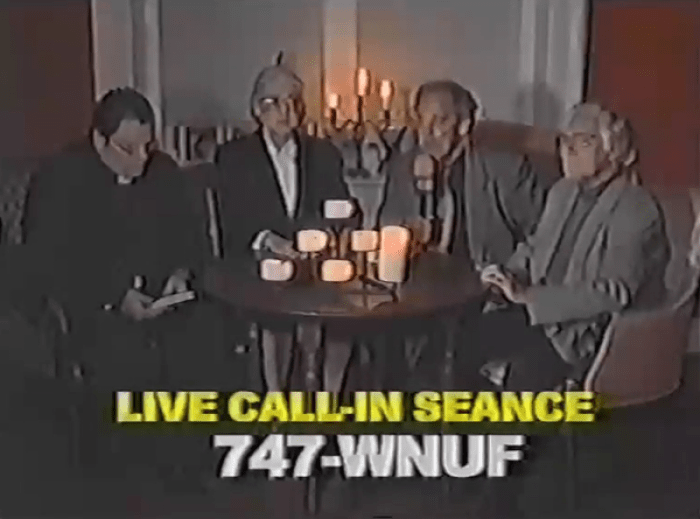
Found Footage films usually attempt to simulate reality in order to make their scares hit closer to home. Presenting itself as a bootleg recording of a “real” 1987 TV broadcast, the infamous WNUF Halloween Special is an incredibly entertaining exception to this rule. While it’s still fairly creepy, this odd little production focuses more on recreating a nostalgic collage of 80s television than being a proper scary movie.
Mostly directed by Chris LaMartina (there are actually six more directing credits, plus 11 writing ones), the Special is exceptionally convincing in its simulation of retro programming. From the Satanic Panic to sensationalist journalism and silly commercials, the film doesn’t just feel authentic, it also feels strangely comforting.
With the Halloween season finally upon us, I think it’s time for more horror fans to dig up this highly unorthodox take on Found Footage storytelling. Even if you’ve already seen it, the WNUF Halloween Special also makes for great background programming during seasonal celebrations.
Editorials
Neon-Soaked Cult Classic ‘Vamp’ Starring Grace Jones Still Has Bite 40 Years Later
College kids, strippers and vampires—those were Donald P. Borchers’ only requirements when he approached Richard Wenk about writing and directing a movie for New World Pictures. As requested, Wenk cooked up Vamp (1986), a tailor-made blend of the decade’s teen movie craze as well as its horror boom.
Grim and earnest stories were still very much a part of the ’80s horror landscape, yet Vamp is something of a comedy. One difference between it and, say, Saturday the 14th, though, is the former avoids using schtick. Wenk’s movie proves that horror comedies also don’t have to subtract thrills from their recipes. Of course, it takes a minute before reaching that point; college antics and culture shocks preface this one macabre misadventure.
Vamp‘s initial setup is apt for a typical college-set, sex-driven comedy; to bribe their way into a fraternity house, two pledges (Chris Makepeace, Robert Rusler) go looking for some adult entertainment. Without wasting time on any further exposition, the characters embark on an all-in-one-night trip that quickly detours into terror.
To procure their elusive MacGuffin—a stripper willing to gyrate for some frat boys—Keith (Makepeace) and AJ (Rusler), plus a third wheel named Duncan (Gedee Watanabe), trade the safety of their remote college campus for the seediness of some unnamed city. The setting is recognizably L.A. by day, but as soon as night falls, downtown, along with the characters, slips into a kind of surreal universe. Director of photography Elliot Davis gave this early entry on his prolific résumé an unusual yet distinctive look; that Mario Bava-esque, magenta-green lighting is omnipresent, so much so that it’s almost its own character.

Chris Makepeace and Robert Rusler in Vamp
The faint comparisons to Martin Scorsese’s After Hours are merited, although not just because of Vamp’s distinguishing nighttime aesthetic. Save for the primary characters, the supporting roles in Wenk’s movie are also quite colorful and transactional in their behavior. The difference here, though, is the additional urge to ruin Keith and his friends at every turn. Some of that harm is humorous and tolerable enough, whereas the moment Vamp dishes out its first fatality, it’s abundantly clear how this movie qualifies as horror.
Vamp falls into that category of horror movie that reveals its genre with a scream rather than a series of whispers. The opening scene can function as a hint of what lies ahead—things are not at all what they appear to be—but otherwise, Wenk is more than happy to hold off on the horror. When that time does come, though, it catches the viewer off guard. In addition to the pure shock value is that sudden decision to upend the movie’s foremost feature. Or so it would seem.
If afraid of major spoilage, those new to Vamp would be wise to stop reading here. There’s just no skirting around the fact that the central fellowship in this buddy movie hits a serious snag when AJ is killed. That development causes the story to become more of a “long, bad night” journey for Keith and his romantic interest. So while Wenk scores points for subverting expectations, there is also a touch of sadness in his decision. Because if Vamp does anything well, it’s making the characters likable.
Something that comes easily to Vamp—and other teen horror movies from this same era—is its ability to invent young characters worth caring about, or at the very least, are interesting and not so immediately off-putting. More impressive is how Wenk did all this without actually fleshing out those characters. Still and all, Keith and his kind are a grade above cookie-cutter, and in some cases, aren’t completely devoid of growth.

Grace Jones in Vamp
Vamp appeals with an assorted cast of characters. No two are the same, nor are they operating on the same wavelength. The cinematically extroverted AJ, whose actor conveyed charm and vulnerability in near equal amounts, comes alive when he’s at his most undead. Makepeace then makes the chronically cautious Keith a sympathetic fellow, even as he’s more and more affected by the night’s bizarre events. Meanwhile, Duncan is indeed the designated loser of the whole bunch, but Watanabe still manages to humanize him. As a bonus, the role didn’t require him to pull a Long Duk Dong.
As for Dedee Pfeiffer, she is plain adorable as the mysterious After Dark server nicknamed “Amaretto”. She spends all night fixing her dress strap while at the same time trying to get Keith to remember how he knows her. As their offbeat romance grows, it becomes another highlight of this movie. Whether or not Pfeiffer’s character is really a vampire also creates some welcome tension in the story.
Like a lot of its contemporaries, Vamp went on to become a bit of a cult classic. That current status is determined by several factors, but without a doubt, the casting of Grace Jones is the most considerable. The image of her writhing on that unique-looking chair, a Keith Haring original, springs to mind whenever this movie is brought up.

Chris Makepeace, Billy Drago and Paunita Nichols in Vamp
Prior to that first display of unequivocal horror, local vampire queen Katrina (Jones) took to the stage and delivered a strip show like no other. One would expect nothing less from that renowned model and performance artist. By now reports of Jones’ tardiness on set are no secret, yet it’s also hard to deny her commitment to the part of Katrina. It was, in fact, Jones who took charge of her character’s appearance—on top of Haring painting her body and that now-iconic chair, she had Andy Warhol handle her costuming. And not too many actors could seize a room’s attention without saying a single line of dialogue.
In 2022, Vamp received a retrospective novelization from Encyclopocalypse. This literary union of preexisting source material—Wenk’s original screenplay—and new ideas from author Christian Francis amounts to a more comprehensive visit to the After Dark Club. The basic story there is no different than what’s shown on screen; however, Francis gets creative with the characters’ origins and designs, and he enhances a number of key scenes.
The novelization expands on the urban and social decay of the main setting, and supplies a background for the After Dark Club. Sandy Baron’s character, Katrina’s emcee and familiar, is given ample motivation for sticking around; up until the fiery end, he is loyal to his friend and former business partner “Squeak”, who looks like he was “fed through a combine harvester, and left as nothing more than a heap of mangled remains”. Then there is Billy Drago’s character Snow, the leader of a street gang called The Dragons. His reason for menacing Keith and AJ is more altruistic than in the movie; he and his peers act tough to scare off any potential food for the vampires.

Lisa Lyon in Vamp
If not for all the backstories, Francis’ Vamp would be a hell of a lot shorter. Instead, this tie-in read dives into how AJ met Keith—the orphaned Anthony Joseph hailed from a broken home back in Brooklyn—and how their friendship flourished over the years. Keith’s archership is no longer just an assumed part of his entire being; it’s a confidence-building extracurricular for a boy who got picked on before coming into the protection of the new kid in town. These supplemental, in-depth looks at the protagonists, plus their close connection, are maybe unnecessary. The movie already did a fair and concise job of addressing their platonic intimacy without the need for flashbacks and insights, specifically in that scene where AJ lays it all out as he sacrifices himself.
Where the novelization gets off course is its approach to the minor characters. Intermittently backstorying the likes of Katrina’s indentured servants, Seko (Leila Hee Olsen) and Vlad (Brad Logan), ends up disturbing the flow of the writing. Was it absolutely essential that readers know Vlad was the Grand Duke of the House of Romanov, or how Snow’s accomplice Maven (Paunita Nichols) became so dentally challenged? No, not really. However, one’s mileage with these random biographies may vary.
The novelization is a more substantial experience, but for a movie like Vamp, less is more. And as plentiful as they are, it never simply coasts on its campy charms, either. The character work sits comfortably in that realm between cursory and meticulous, the script is sharper than first realized, and Greg Cannom’s vampire makeup is straightforward yet effective. Most of all, the movie didn’t squander its out-of-the-box concept. Richard Wenk made his vision of a “comic nightmare in which just about anything that can go wrong does” come true, and it is very enjoyable.

You must be logged in to post a comment.