


Being a Silent Hill fan can be pretty rough. While fellow survival horror franchises like Resident Evil never stopped releasing sequels, remakes and adaptations, it’s been a decade since the last official Silent Hill game. And even then, most of the games released after the original Team Silent disbanded weren’t exactly masterpieces to begin with. There was a glimmer of hope back in 2014 with the surprise announcement of Hideo Kojima’s Silent Hills, but that project was cancelled faster than a series protagonist can chug down a Health Drink.
Fortunately for fans, Konami’s Silent Hill Transmission appears to indicate that the dog days are over, with a staggering four unique entries currently in development. While this is the best horror news I’ve heard all year, there’s always a risk that not all of these projects will make it to the finish line. After all, Konami has a history of mishandling their flagship horror franchise, and several interesting takes on the Silent Hill IP have been cancelled in the past.
So as we wait for the new entries in the series, I thought that this might be a good time to look back on the weird world of cancelled Silent Hill games to see if there are any compelling ideas that might be worth revisiting in the future. After all, those who ignore the past are doomed to repeat it, and I think there’s plenty to learn from the foggy streets of that cursed town.
Obviously, we aren’t privy to everything that goes on at Konami, so there are likely more than a few cancelled entries that we’ve never heard about. That means this article is limited to projects that have been leaked by developers and Konami itself, though we’ll mostly be focusing on the ones that at least got past the conceptual stage.
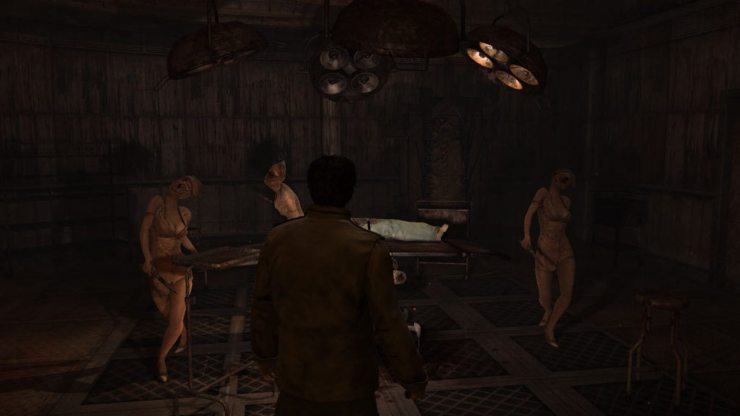
The earliest known cancelled Silent Hill title comes in the form of Team Silent’s Silent Hill 5, which was meant to be a standalone story in the vein of SH2. As revealed during interviews with series veterans Akihiro Imamura and Akira Yamaoka, this unfinished game supposedly contained the darkest narrative that the Team had ever come up with. There were even rumors that the protagonist was meant to recall the events of the story while being locked up in a psychiatric hospital.
Imamura also claimed that the Team wanted to try their hand at daylight horror, with the game featuring our first look at Silent Hill as a real town with ordinary citizens going about their business. During the course of the campaign, gamers would see the town slowly become corrupted by the encroaching Otherworld, with the director even citing films like The Texas Chainsaw Massacre and Jacob’s Ladder as major influences on development.
Unfortunately, Konami didn’t like the direction that the game was headed in and decided to disband Team Silent once and for all, shifting the development of the title to a western studio. This ultimately resulted in the underwhelming Silent Hill: Homecoming, which many claimed to be the beginning of the end for the franchise. That being said, a few elements of the cancelled game did make it into Homecoming, such as the dramatic Otherworld transitions (which were meant to capitalize on the PS3’s upgraded hardware) as well as several references to Jacob’s Ladder.
After the end of Team Silent, several western developers attempted to pitch their own Silent Hill games to Konami, usually with little to no success. Renegade Kid (known for Dementium) and WayForward Technologies (who later developed the controversial SH: Book of Memories) both tried to get SH games on the Nintendo DS, and Climax Studios pitched the ambitious Silent Hill: Cold Heart for the Wii.

While that last game would evolve into the underrated SH: Shattered Memories, Climax Studios had another interesting cancelled project in the form of Silent Hill: Original Sin. A portable precursor to what would eventually become SH: Origins, the game was meant to be an action-packed third-person shooter influenced by comedy shows like Scrubs. A sizable chunk of this bizarre title was completed before Climax shifted development to their UK studios, where the game was reworked into a more traditional prequel.
Original Sin was quite close to completion when it was transferred overseas, and Origins ended up re-using a lot of the game’s assets. While I’m curious about how the title intended to implement its horror-comedy and base-building elements, I think discarding these ideas in favor of a more traditional SH experience was the right move.
Another mysterious unmade project from this era is Silent Hill: The Box. Developed by Silicon Knights, the creators of Eternal Darkness: Sanity’s Requiem and Blood Omen: The Legacy of Kain, this entry was meant to be an open world survival horror experience with a focus on exploration. While it’s unclear if Konami was ever actually involved with the game, Silicon Knights eventually managed to transfer the project to THQ, who rebranded the title as an original IP dubbed The Ritualyst.
Unfortunately, financial struggles at THQ resulted in the game never being finished despite years of secretive work. Since then, quite a few ambiguous screenshots from early stages of the game’s development have leaked online, but none of these show what gameplay would have been like. An interesting detail about this early material is that most of the images appear to have been rendered in Unreal Engine 3 despite Silicon Knights’ then-ongoing lawsuit against Epic Games.

After a few more years of aborted sequels like Masahiro Ito’s proposed follow-up to Downpour, which was meant to kill off Pyramid Head (Ito is quite vocal about his distaste for the character’s continued use after SH2), it seemed like Konami was finally getting their act together with the development of a then-rumored reboot involving Hideo Kojima, Guillermo del Toro and Junji Ito.
Naturally, I’m referring to the ill-fated Silent Hills, which has become something of a cautionary tale in the gaming industry. While not much is known about the inner workings of this unfinished title, Kojima made it clear that P.T. was meant to be more of an atmospheric mood piece than a literal representation of the finished game’s mechanics. From what little details can be gathered online, it appears that the team’s main goal was to focus on abject terror instead of Survival Horror as an established genre, with several rumors indicating that the game would rely on creepy gimmicks and online functionality to personalize its scares.
It’s also clear that the game was supposed to be more cinematic than previous outings in the series, with Guillermo del Toro going even comparing some of the game’s qualities with The Last of Us, going so far as to note that it made no sense that such a remarkable game wasn’t going to be completed after so much work had gone into it.
Fortunately, the development time wasn’t completely wasted, as several concepts from the cancelled game would later show up again in Death Stranding, and P.T. wound up inspiring a whole generation of indie horror titles. That being said, it’s still a shame that the greatest living auteur in the industry never got to show us his unique vision for the series, though I’m glad that Konami appears to be embracing several different voices with their new announcements.
After all, Silent Hill has always worked best as an anthological series, with each entry exploring a completely different facet of the franchise. So if at least a couple of these newly announced games make it to their release dates, I know I’ll be there waiting for them in the fog with my trusty flashlight and radio.
