Editorials
‘Arachnid’ – Revisiting the 2001 Spider Horror Movie Featuring Massive Practical Effects

A new breed of creature-features was unleashed in the 1990s and continued well into the next decade. Shaking off the ecological messaging of the past, these monsters existed for the sake of pure mayhem. Just to name a few: Tremors, The Relic, Anaconda, Godzilla, Deep Rising and Lake Placid all showcased this trend of irreverent creature chaos. Reptiles and other scaly beasts proved to be a popular source of inspiration for these films, but for that extra crawly experience, bugs were the best and quickest route. Spiders, in particular, led some of the worst infestations on screen in the early 2000s. And on the underbelly of this creeping new wave — specifically the direct-to-video sector — hangs an overlooked offering of spider horror: Arachnid.
In 2000, Brian Yuzna and Julio Fernández launched the Spanish production company Fantastic Factory. The Filmax banner’s objective was to create modestly budgeted genre films for international distribution. And while they achieved their goal — a total of nine English-language films were produced and shipped all across the globe — Fantastic Factory ultimately closed up shop after only five years. Arachnid, directed by Jack Sholder (Alone in the Dark, A Nightmare on Elm Street 2: Freddy’s Revenge, The Hidden) and based on a script by Mark Sevi, was the second project from the short-lived genre house. Yuzna was drawn to the concept largely because of its universal appeal; a monster was marketable in any region, regardless of cultural preferences or restrictions. There was also the fact that spiders give everyone a case of the heebie-jeebies.
By having extraterrestrial forces be the cause of the spiders’ mutism and immensity as well as other urgent problems within the story, Arachnid incidentally pays respect to Hollywood’s golden age of schlock filmmaking. The opening sequence indeed shows a stealth plane’s pilot (Jesús Cabrero) trailing a UFO and its translucent passenger to an island in the South Pacific, but the alien business is kept to a minimum going forward. There is no time to process this seismic revelation of life beyond Earth before moving on to the film’s central plot.

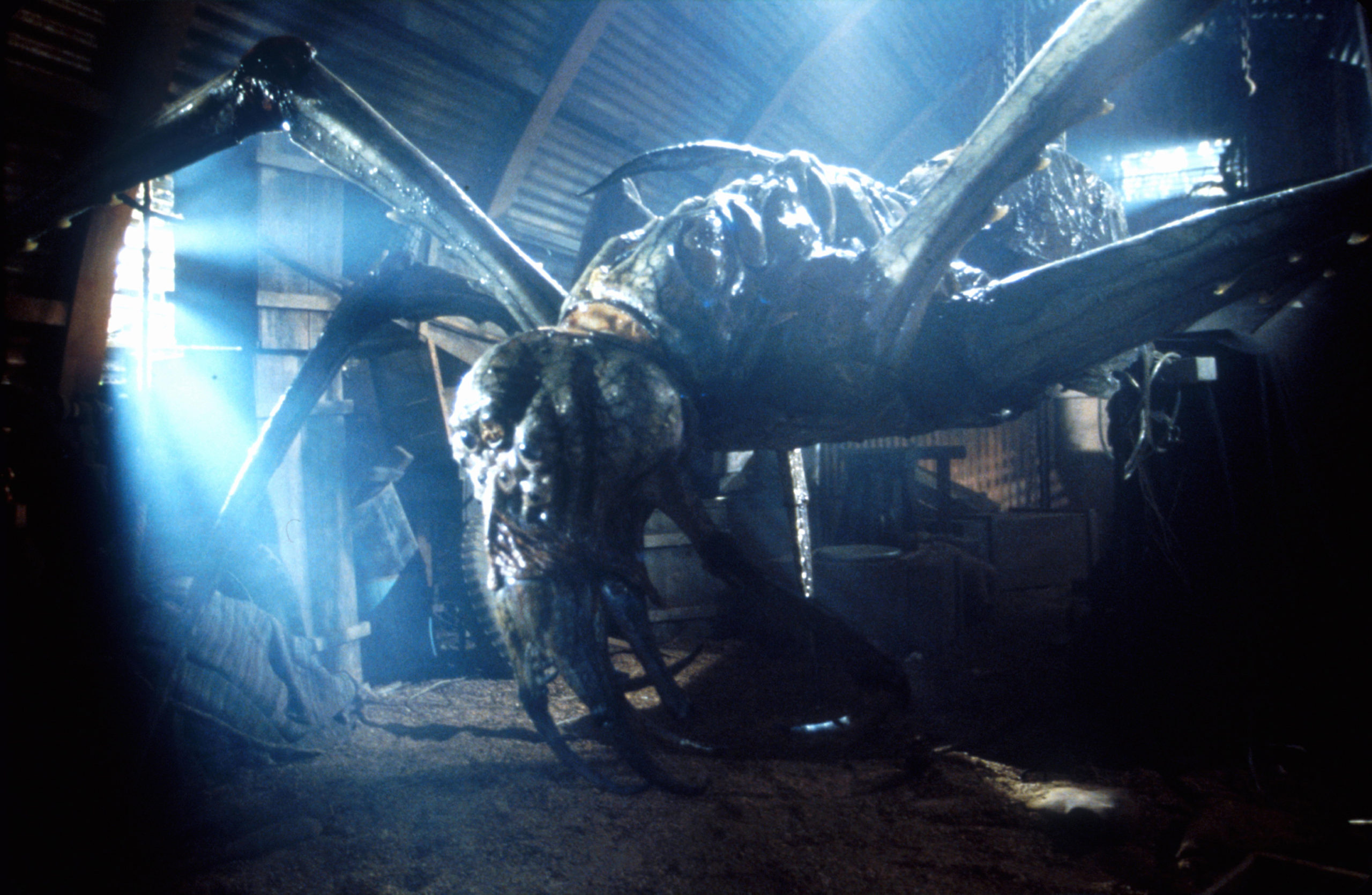
Pictured: Alex Reid, Chris Potter and Neus Asensi’s characters get trapped in the spider’s web in Arachnid.
Several months since the E.T. was last sighted — and after being snuffed out by one of its own accidental creations — a medical team from Guam heads to Celebes (better known as Sulawesi nowadays), in search of whatever is behind a new illness. The doctors (played by José Sancho and Neus Asensi) already suspected a spider bite, although they failed to consider the biter could be the size of a tank. With The Descent’s Alex Reid as the snarky pilot of this doomed expedition, one who has ulterior motives for accepting the job, the film’s core characters go off in search of a spider and, hopefully, a cure.
The title makes it seem as if there is only the one arachnid in the story, but once Chris Potter and Reid’s characters plus their team step foot on the island, they encounter other altered arthropods. Yuzna felt Sevi’s script needed more creatures along the way, especially before the spider showed up in full view. The bug horror commences as one gunsman succumbs to a burrowing breed of crab-sized ticks, and random characters fend off a horrific centipede with reptilian qualities. These are just the appetizers before the greatest arachnid of them all arrives. The late Ravil Isyanov, here playing a zealous but sympathetic arachnologist, becomes a human Lunchable for the spider’s eggs. And one of the doctors gets a face full of corrosive spider spew. So, there is no shortage of grisly predation in the film, with a few bits of the monsters’ handiwork possessing a haunting quality to them.
Shot quickly and cheaply, Arachnid is fast-food horror. It’s convenient and designed for immediate consumption, and will likely not linger on the palate. Usually there is not a lot worth remembering with these slapdash genre productions, however, this is one case of spider horror where the extra effort made a difference. Apart from the egregious use of digital imagery in the outset, Jack Sholder’s film primarily employs practical effects. And these are not rubber spiders dangling from strings or being flung at the actors, either. Fantastic Factory aimed much higher by securing DDTSFX (Pan’s Labyrinth, Hellboy II: The Golden Army) and creature designer and makeup artist Steve Johnson (Species, Blade II).

Pictured: One of the spider’s web-covered victims in Arachnid.
Arachnid, while far from flawless, somewhat redeems itself by having chosen practical effects and animatronics over CGI, which had become the new normal in these kinds of films. And this class of creature-feature was definitely not getting the sort of advanced VFX found in the likes of Eight Legged Freaks. Steve Johnson’s spider was not the easiest prop to work with, and it lacks the movement and versatility of a digital depiction. However, there is no beating that sense of weight and occupation of space that makes a tangible monster more intimidating. Viewers will have trouble recalling the human characters long after watching Arachnid, yet the humongous headliner remains the stuff of nightmares.
Over the years, the director has spoken critically of the film. He originally held off on agreeing to the offer to direct in hopes that another project, a Steven Seagal picture, would finally manifest. No such luck, and Sholder accepted Arachnid only on account of his needing the work. He said of the film: “I thought I could […] make it halfway decent, but I discovered there wasn’t a whole lot I could do.” Nevertheless, Sholder’s experience as a director of not exactly high-brow yet still rather entertaining horror is evident in what he has since called a “dud.” While there is no denying the reality and outcome of Arachnid, even the most mediocre films have their strokes of brilliance, small as they may be.

Pictured: The poster for Arachnid.



Auteur Filmmaking is a term that gets thrown around a lot these days in reference to big name directors like Quentin Tarantino and even Wes Anderson, but the truth is that film is a collective medium, and no one person can be responsible for every single aspect of a particular production. However, the smaller a film’s budget, the bigger the individual impact of every creative decision behind it – and the easier it becomes to identify a genuine auteur.
This isn’t necessarily a judgement of value, as blockbuster filmmaking comes with its own challenges and a good movie remains a miracle regardless of how big the crew is, but I’ve always been more interested in soulful b-movies produced by handfuls of passionate artists than blockbusters backed by creative armies.
That’s why I love exploring low-budget franchises that never left the hands of their original creators, as you really get to know the artists involved with these flicks and can accompany their evolution over a period of time. With that in mind, I’d like to invite readers to join me in this multi-part series as we look into a vampire saga helmed by one of the most fascinating auteurs of the 1990s. Naturally, I’m referring to Ted Nicolaou’s criminally underrated Subspecies!
The Birth of an Unlikely Horror Franchise

A proud graduate of the University of Texas’ Film program, Nicolaou got his start in the industry as a sound technician working on Tobe Hooper’s original Texas Chain Saw Massacre. From there, the filmmaker would go on to work for notorious indie producer Charles Band, the founder of both Empire Pictures and Full Moon Productions. According to Nicolaou, Band would usually contact him with an offer to direct a feature after more prominent filmmakers, such as the late, great Stuart Gordon, had already refused, meaning that his projects tended to have lower budgets and more inexperienced crew members.
The plans for Subspecies began almost immediately after the fall of Romanian dictator Nicolae Ceaușescu, with screenwriter David Pabian turning in an initial draft of the film after a Romanian producer contacted Band and explained that Romanian tax incentives could cover the cost of film production there so long as Full Moon took care of the post-production process. Since Stuart Gordon was unwilling to travel to Romania, Ted Nicolaou ended up taking over the picture.
However, while the financial incentives meant that this Romanian-American co-production could look and feel much more expensive than it really was, with Nicolaou scouting for locations in advance and selecting real castle ruins to be featured in the movie, the director was soon faced with an incredibly difficult shooting process. In interviews, Nicolaou would later describe the experience as something of a nightmare, with language barriers and the generalized distrust of capitalist outsiders sabotaging many of the team’s plans for the film.
In fact, the script, which had already been altered by Band, ultimately had portions of it rewritten by both Jack Canson and Nicolaou himself in an attempt to adapt the story to their unique limitations.
Radu Is One of Horror’s Greatest Underrated Villains

In the finished film, which was released directly to video in 1991, we follow a pair of American anthropology students, Michelle (Laura Mae Tate) and Lillian (Michelle McBride), as they reunite with their Romanian colleague Mara (Irina Movila) in her native land. The group intends to study the folklore surrounding the secluded town of Prejmer, but their research is cut short by the return of Radu Vladislas (Anders Hove) – the evil son of a vampire king (Angus Scrimm) who had previously established a truce with the region’s human residents. It’s now up to Radu’s human-loving half-brother Stefan (Michael Watson) to protect the girls from a fate worse than death as the power-hungry vampire seeks to control a magical artifact known as the Bloodstone.
Right off the bat, you may have noticed that the film’s premise sounds decidedly old-fashioned when compared to other vampire movies from around the same time. While the 1990s saw the rise of cool-looking bloodsuckers with badass elements borrowed from Westerns, as well as the sexy aristocrats of Anne Rice’s stories, Subspecies has a lot more in common with Nosferatu and the Hammer Horror series than any of its contemporaries.
This is both a blessing and a curse, as the film falls victim to overly familiar genre tropes while also standing out as a rare example of a ’90s vampire flick that isn’t afraid to flex its muscles as a Creature Feature. In fact, I’d argue that the presence of age-old clichés is a small price to pay when confronted with one of the most compelling vampire antagonists in all of cinema.
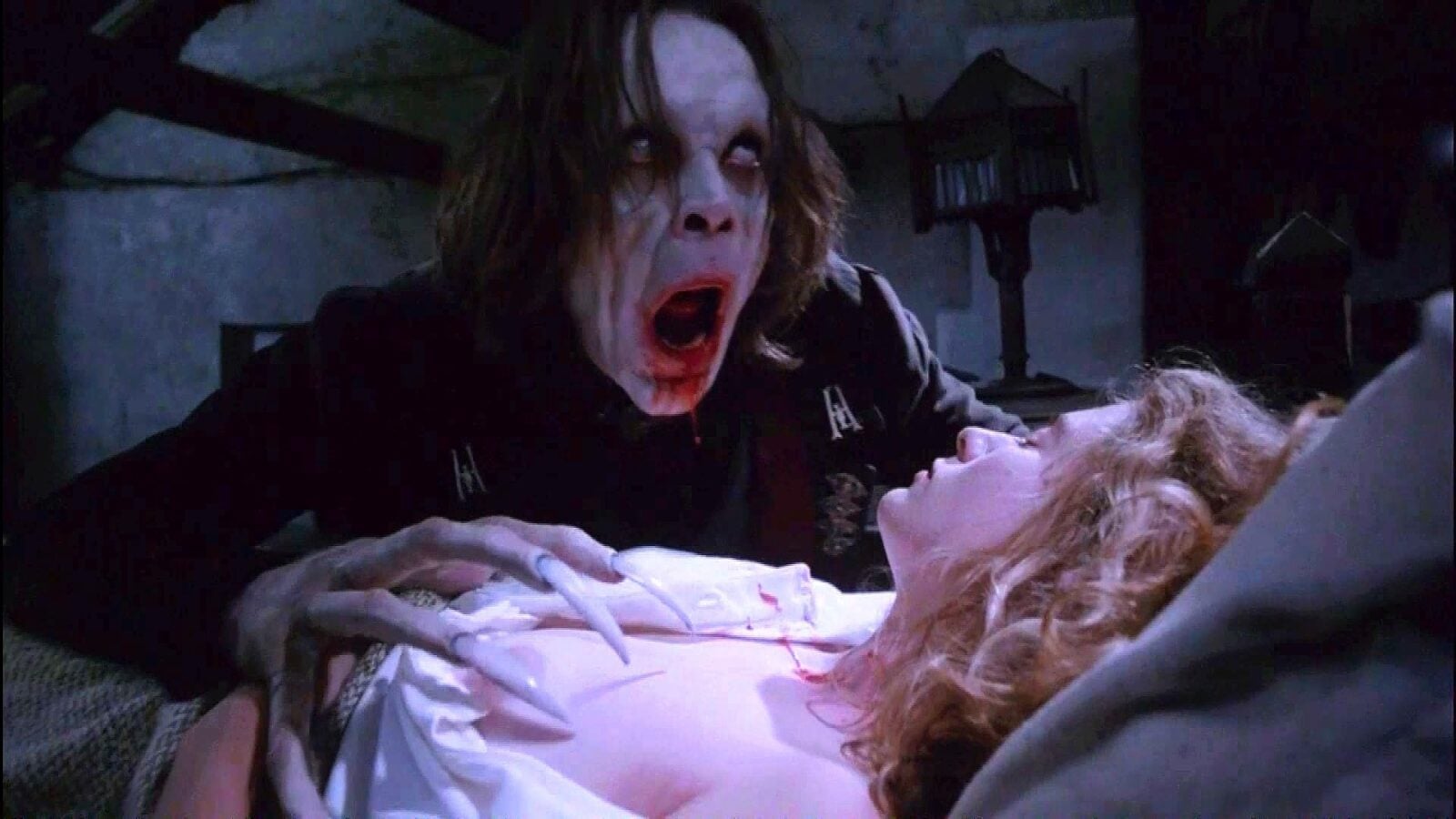
Named after Vlad the Impaler’s real-life brother, Anders Hove’s Radu is such a fascinating character and the main reason why Subspecies is still worth watching 35 years later. From his animalistic mannerisms to the joy he feels in simply existing as a chaotic creature of the night, and that’s not even mentioning the iconic makeup that almost certainly inspired the undead from Buffy the Vampire Slayer. Radu is a hypnotic presence harkening back to a time when audiences didn’t mind purely evil villains that couldn’t be redeemed through tragic backstories or sex appeal.
Gothic Atmosphere on an Indie Budget

Of course, the film’s Romanian setting and authentic art direction do a lot of the heavy lifting whenever Radu isn’t around. From the masked festivals of the village to the visually interesting selection of local extras, Subspecies’ multicultural elements help it to stand out when compared to similar flicks from the ’90s.
That being said, Nicolaou’s unique eye for special effects and exciting action sequences – as well as Vlad Paunescu’s excellent cinematography – make the movie a delight for fans of expressionist cinema and old-timey gothic horror. While the crew is obviously dealing with limited resources, many of the flick’s blemishes (such as the odd stop-motion demons that serve Radu) end up feeling more like charming idiosyncrasies than actual flaws.
I’d argue that the only real issue here is pacing, as there are long stretches of film where the protagonists are simply bumbling around without realizing what’s really going on around them. Thankfully, the gorgeous visuals and surprisingly effective soundtrack usually make up for this. Besides, how can you dislike a movie where shotgun shells are loaded with rosary beads and our lead vampires duke it out in a dramatic swordfight that would feel out of place during the golden age of Hollywood?
Your overall enjoyment of Subspecies will mostly depend on whether or not you find low-budget corner-cutting and janky practical effects charming rather than distracting, but I know I’ll keep coming back to this Full Moon feature again and again in the future.
That being said, while this first movie is worth revisiting by its own merits as the birth of an indie horror icon, I’d like to invite you to join us as we look into the cult sequel Bloodstone: Subspecies II soon.
You must be logged in to post a comment.