Quantcast
Connect with us

Editorials

How ‘Spider-Man: Brand New Day’ Could Adapt Spider-Man’s Animated Body Horror Storyline

Published

on

Spider-Man: Brand New Day

Despite what the higher-ups at Marvel would have you believe, Stan Lee’s original vision for Spider-Man was very different from the friendly neighborhood wall-crawler that fans ultimately got.

It was comics maestro Steve Ditko that turned him into the lovable web-head that we all know and love, though even that first draft of the character wasn’t exactly meant to be a child-friendly mascot. Ditko envisioned an uncanny arachnid-human hybrid whose freakish poses and dark costume would strike terror into the hearts of criminals, with the inclusion of web-shooters possibly having been a suggestion by Ditko’s roommate at the time, renowned fetish artist and bondage enthusiast Eric Stanton.

These more adult-oriented origins may have changed over the years, but one could argue that Spidey never completely lost his darker side. In fact, we’d eventually see several grim storylines that explored the horrific consequences of Spider-Man’s radioactive blood. While having his irradiated body fluids give Mary Jane cancer is likely the most terrifying of these yarns (track down Spider-Man: Reign if you’re up for a depressing read that was at one point set to be adapted to film by Michael Jackson), one of the most memorable horror-adjacent moments in these comics has to be the acceleration of Peter Parker’s mutation and the eventual introduction of Man-Spider – a storyline that appears to have been one of the main inspirations behind the upcoming Spider-Man: Brand New Day.

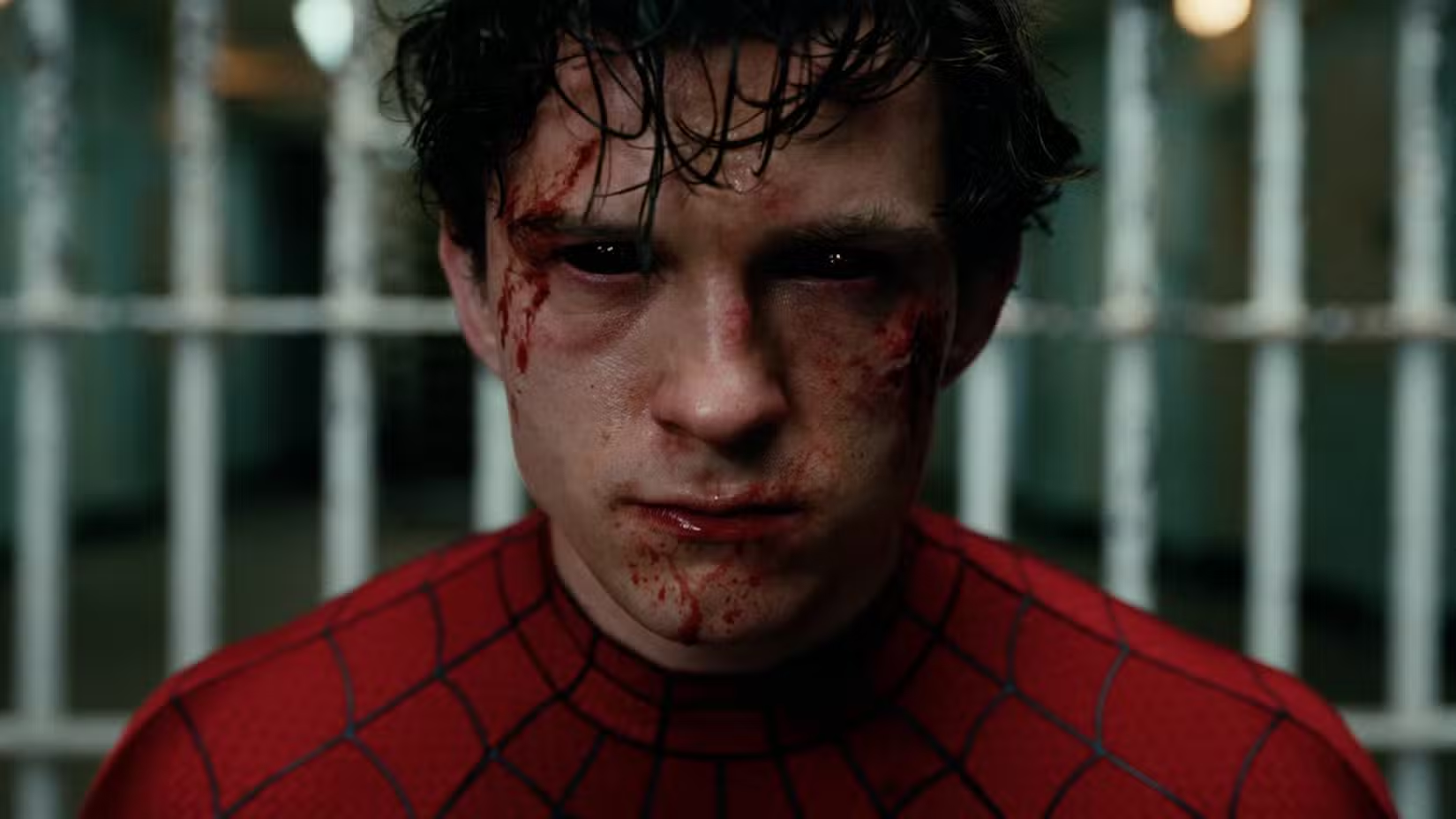
I sincerely doubt that Marvel Studios is really going to give their toy-selling juggernaut a Cronenbergian rebrand, but the most recent trailer for Brand New Day suggests that the creative team is pulling from some surprisingly spooky source material in this latest superhero sequel. Specifically, the trailer makes it seem like the film is set to be a loose adaptation of the Neogenic Nightmare arc from Spider-Man: The Animated Series, commonly known as the best exploration of Spidey’s radioactive dark side that also features the most iconic version of Man-Spider.

If you’re wondering what these influences could mean for the upcoming film, I’d like to invite you to join me as we look back on some of the animated series’ most horror-tinged episodes.

A fourteen-episode story arc that made up the show’s second season, Neogenic Nightmare began airing in September of 1995. At this point, the series had already earned a reputation as the definitive version of Spider-Man despite dealing with absurd levels of censorship and executive meddling. It’s widely known at this point that this incarnation of Spidey was prohibited from ever punching his villains, and the studio even insisted that realistic guns should be replaced with futuristic laser weapons in order to avoid enraging concerned parents.

And that’s not even mentioning bizarre demands like setting up Hobgoblin as the original Goblin villain simply because the folks responsible for the toy-line had already prepared the character’s merchandise before scripts were even written.

At the end of the day. the show’s success mostly came down to John Semper’s excellent writing, with the (mostly) faithful recreation of the Spider-Man’s core principals and a handful of iconic storylines (coupled with an excellent cast behind the scenes) elevating a what was intended to be a kid’s show promoting ToyBiz products.

Naturally, the rampant cartoon censorship of the 90s couldn’t keep Semper from wanting to explore darker themes from his own favorite Spider-Man comics, and that’s how his team came up with a season-long re-imagining of iconic arcs like the Six-Arm Saga, The Mutant Agenda and even the first appearance of the Sinister Six. These stories would be enhanced with additional “dark” characters like Blade, The Punisher and even Morbius (though the latter had to exchange his vampiric blood-drinking for bizarre plasma-absorbing powers in order to conform to network guidelines).

If you haven’t yet seen it, the complete Neogenic Nightmare arc follows Spider-Man as he discovers that his mutation is progressing beyond his initial superpowers and threatening to turn him into a more monstrous hybrid. After developing extra arms, Spidey goes so far as to request help from both the X-Men and several other super-heroes as he becomes embroiled in a criminal conspiracy involving a team-up between some of his most iconic villains. The arc eventually introduces us to the show’s version of Man-Spider, which is depicted here as the monstrous final stage of the process which began when Peter was first bitten by that radioactive spider.

Personally, I think this werewolf-like addition to Spidey’s genetic curse is the best incarnation of Man-Spider that we’ve ever seen. This is because the six-armed body horror of it all adds even more weight to Peter’s decision to keep helping others regardless of what his powers may cost him, with the creature’s final rampage even giving the supporting cast a chance to help Spider-Man for a change. While I don’t hate the Morbius movie as much as some other comic fans, it’s a shame that Sony relegated that story to a solo film instead of later incorporating it into the Man-Spider saga like Neogenic Nightmare did.

Season two of the animated series ended up being an even bigger hit than the first, with fans loving the show’s take on an expanded Marvel Universe (which even included the ’90s X-Men cast) as well as the darker take on a more monstrous Spider-Man. That’s why it makes sense that the MCU’s return to street-level comic adventures would harken back to this particular storyline – especially since it appears that the Disney wishes to use the upcoming film as an opportunity to shine a light on other Marvel characters just like Semper did back in the day.

From what we can see in the trailer, Tom Holland’s Spider-Man appears to be going through his own additional transformations, including creepy fully black eyes and organic web-shooter, as well as the cocoon-building behavior previously seen in Marvel’s The Other arc in the comics. As I mentioned before, I doubt that the MCU will allow this particular cash cow to fully transform into a nightmarish spider freak that can scare away children, but there’s always a chance that the studio could surprise us with more horror elements. I’d also love to see the story explore Spidey’s mutation and use that as an excuse to formally introduce X-Men’s mutants into the MCU, especially since Sadie Sink is rumored to be playing Jean Grey in the flick.

However, even if Brand New Day doesn’t adapt as much of the Neogenic Nightmare as the promotional material has suggested, I’d argue that this particular season of Spider-Man: The Animated Series is still worth revisiting simply because it’s a great example of artists being able to work past network limitations in order to tell complex stories that approach full-on body-horror.

Born Brazilian, raised Canadian, Luiz is a writer and filmmaker that spends most of his time thinking about movies.

Click to comment

Books

The 10 Best Horror Books of 2026 (So Far)

Published

on

2026 Horror books - Best Horror Books of 2026 So Far

There’s a lot of reading left to do in 2026, between the glut of summer releases and the approach of fall, when horror titles get a special push from publishers, but this has already been an incredible year for horror literature.

Some of the biggest names in the genre have turned in outstanding work, rising stars have made their mark, and we’re only halfway through the year. 

To celebrate the midway point of 2026, with plenty of horror books still to come, we’re taking a look back at the best horror books we’ve read this year so far, listed alphabetically by author.

If you missed any of these books earlier in the year, consider this your reminder to catch up. 


Japanese Gothic by Kylie Lee Baker

A student running from a crime he may or may not have committed escapes to his father’s country home in Japan, only to find himself haunted by strange apparitions, while in the past, a young samurai tries to find salvation for her family and finds a door to the future instead. Kylie Lee Baker’s Japanese Gothic begins with this dialogue between past and present, and then blossoms into so much more, a cross-time ghost story about old wounds and what it really takes to finally heal them. I got so happily lost in this one that I would have read at least 200 more pages.


Persona by Aoife Josie Clements

In this tale of shut-ins, sex workers, artists, and the horrors they both summon and recoil from, Aoife Josie Clements weaves something that feels less like a story to be experienced and more like a psychic wound to be endured, and I mean that in the most complimentary way possible. Evocative in its prose and nightmarish in its imagery, Persona is a story of the masks we wear, and the understanding that not all of our masks are particularly pretty or even easy to breathe through. It’s a dense, literary, unnervingly vicious book, and while it’s already attracted an audience, it deserves a much bigger one. 


Dead First by Johnny Compton

Dead First JC

Johnny Compton’s latest novel opens with a throwing down of the gauntlet, a sequence that made me instantly think “How on Earth is he going to top this?” It’s a story that begins with a billionaire hiring a private investigator to determine why, despite trying in many brutal ways, he cannot die. That premise, and the scene which sets it all off, is so alluring and delightfully gruesome that you almost can’t believe it’s the way a book begins, and then Compton just keeps going, delivering a supernatural mystery that I could not put down. 


Make Me Better by Sarah Gailey

Make Me Better

A woman grieving for the life she wanted visits a mysterious island renowned for the healing salt its residents harvest and sell, seeking renewal and relief. What she finds instead is a strange cult with a twisted history with surprising resonance in her own life, and a people who are more than willing to grant the relief she wants, for a price. Laced with beautiful prose and moments of profound realization alongside folk and even cosmic horror, this is vintage Sarah Gailey. 


Partially Devoured by Daniel Kraus

If you love horror film history and analysis, Partially Devoured is an essential. Written by Pulitzer Prize-winner Daniel Kraus, the book is a deep dive into his favorite movie of all time, George A. Romero‘s Night of the Living Dead, complete with exhaustive research into the making of the film and passages of deeply moving memoir woven in. If you’ve ever wanted to know what the eerie music that opens the film is called while also bursting into tears at how horror movies can save your life, this is a must-read.


Wretch by Eric LaRocca

Wretch

Our reigning King of Extreme Horror, Eric LaRocca weaves books of uncommon beauty out of the most nightmarish parts of humanity, and Wretch is no exception. The story of a grieving man who longs for relief and searches for it amid a strange support group that might be a cult, Wretch is a brutal journey into the darkest part of us all, and explores what salvation we might find when we get to the rotten core of the world and peel back its layers. LaRocca’s on a tear of great work right now that few other genre writers can match. 


Headlights by CJ Leede

A mystery, a serial killer horror show, a tribute to Stephen King‘s The Shining. All of these things describe CJ Leede’s Headlights, and yet they don’t begin to cover the full breadth of horror awaiting you in this novel. The story of a former FBI agent drawn back into the cold case that haunts him most, it’s a shocker brimming over with vivid moments that’ll live behind your eyes. CJ Leede has now published three novels, and they’re all bangers, so it’s time to get on board if you haven’t already. 


It Came From Neverland by Cynthia Pelayo

Cynthia Pelayo has been one of our finest genre writers for years now, but It Came From Neverland is my favorite thing she’s written, and it’s not even close. A dark take on Peter Pan from the perspective of an adult Wendy Darling living in World War I-era London, Pelayo’s book works as both a satisfying horror narrative and a rich exploration of what it really means to never grow up. The horror never loses its potency, but it’s the search for the meaning behind the Peter Pan phenomenon in our own lives, and what we can do about it, that sticks with me most.


Filth Eaters by Ito Romo

Ito Romo’s Filth Eaters is a slim volume, one you can read in just a couple of hours if you’ve got the inclination, but it has the feel of a generation-spanning epic. The story of a breed of vampires born in Central America, the European vampires who encounter them, and the offspring they eventually produced, it spans centuries and packs loads of juicy lore into its pages while never losing its grip on character and narrative drive. I would read hundreds more pages of this world, but I’ll settle for this uncommonly grand-scale novella for now.


Dead But Dreaming of Electric Sheep by Paul Tremblay

Dead but Dreaming of electric sheep

A former pro gamer gets a job at a tech company to pilot a brain-dead human body across the country, and so Paul Tremblay’s sci-fi-horror juggernaut begins. Indebted to Philip K. Dick, the primal snarl of Harlan Ellison, and the quirky comedy of The Big Lebowski, and yet wholly original, this is a towering and ambitious novel by one of horror’s most respected voices. What starts as a high-concept tech thriller soon becomes a startling meditation on the value of stories, who gets to tell them, and what happens when we cede too much control to machines we don’t understand. It’s a stunner.

Continue Reading