
Editorials
[Exclusive] Artist Al Magliochetti Talks the Visual Effects of ‘Jason Goes to Hell’

The ninth installment in the lucrative Friday the 13th franchise, Jason Goes to Hell: The Final Friday, is widely considered the bastard film that was disowned by almost every viewer upon its entrance into the world in 1993. Writer Dean Lorey went for an out-of-the-box storyline that had our favorite hockey-masked killer, Jason Voorhees, getting blown to kingdom come and having his essence of evil transferred to… other people.
Much like Halloween III: Season of the Witch, Father Time has been kind to the movie because it was trying for something different instead of just retreading the same ideas over and over again. It attempted to add a mythology to the franchise, like the introduction of a bounty hunter (Creighton Duke) who has a history with Jason and knows the entire lore surrounding the Voorhees bloodline.
In this exclusive interview with FX legend Al Magliochetti of Frankenhooker and Brain Damage fame, we go in-depth on one of the most overlooked aspects of the divisive sequel and the eye candy that makes it pop.
Bloody Disgusting: What led to you doing the visual FX on Jason Goes to Hell: The Final Friday?
Al Magliochetti: I was very good friends with the guys at KNB and one of them alerted me to the project once they’d been contracted for the makeup effects. The idea being that since we knew each other on a personal level there would be a lot more camaraderie between the makeup effects and the visual effects departments, rather than one trying to upstage the other.
BD: Did you think it was a good script? How did you feel about the writer adding a supernatural element to the franchise?
Magliochetti: Well, in all fairness, when you have an immortal character who keeps getting resurrected for each sequel, I think there’s kind of a built-in supernatural element as it is. I actually liked the fact that it wasn’t as formulaic and redundant as some of the earlier entries in the series, although I’m not sure the direction they took the story in for this film was the best choice in terms of overall continuity in the series.
BD: Did you get along with producer Sean S. Cunningham and director Adam Marcus?
Magliochetti: Sean and Adam were both great to work with – and I’m very much looking forward to working again with either of them in the future. We had discussed it on several occasions, but so far it hasn’t come to pass. Sean, in particular, is a lot more film-savvy than many people give him credit for. There was one incident where I had to deliver a finished VFX shot on a Saturday when nobody else was in the office. Sean and I went to an editing bench where I could screen it for him, then he asked me to cut the shot into the workprint-in-progress so he could see what it looked like in context, which is a very smart way to evaluate the work.
Once we’d screened it, Sean asked me to indulge him for a minute and asked me to take a huge chunk out of the overall sequence. Mind you, I was not an editor on this film and we were only working with picture (without sound), so I hesitated making any edits that the real editor would have difficulties with – especially in terms of throwing the sound out of synchronization. Still, Sean was the boss, and I did as he asked although I was fairly confident his suggested trims would not be very effective. To my amazement, when we ran the scene, it played far better in terms of pacing and action and I believe it was kept that way through the final edit, so that incident alone made me respect Sean a great deal as a filmmaker. I later found out the editor made sure to lock up all the splicers whenever he was out of the room for the remainder of the production after our private little editing party so we couldn’t meddle with the film in his absence.

BD: Were you on set to see any of the KNB carnage?
Magliochetti: I was actually kind of an unpaid KNB assistant on that show since we worked together very well. I was there the night we blew up Jason at the beginning and helped out with the Demon-Jason that was eventually cut from the film. I also helped puppeteer some of the demons that dragged Jason to hell at the climax, but most of that was trimmed out as well. I know I was also helping out on the scene where Erin Gray was attacked as well but generally, I would just pitch in and lend a hand whenever the makeup guys needed one. I’m kind of used to being drenched with fake blood.
I was also there for Jason’s autopsy scene and actually used the KNB facility to build the flash-vest that actor Richard Gant wore during the scene where he’s possessed by Jason’s spirit. I wired up about a dozen flashbulbs to a switch called a nail board, which is literally a series of nails pounded into a board in a straight line, hooked up to a battery. By running a probe across the nails I was able to fire off the bulbs in sequence and then back-time the animation added later to match to them.

And, while there was no KNB carnage, I was also present for the fight between John LeMay and Jason in front of the Voorhees mansion. When it got to the part where Jason knocked over the jungle gym with John on it, I heard an audible gulp from the production designer, Brooke Wheeler. When I asked what was wrong he whispered that it took five full-grown men to move that jungle gym into place – and Kane Hodder flipped it over all on his own. I found that kind of impressive!
BD: This was the first entry in the series that was not released by Paramount Pictures. New Line Cinema scooped up the rights from them after Friday the 13th Part VIII: Jason Takes Manhattan tanked at the box office. I thought it was a little ironic that The Hidden (released by New Line a few years earlier) had a body jumping alien, whereas Jason Goes to Hell has a body jumping demon. Then there was The Hidden II, which had an alien that looked like the demon from Jason Goes to Hell!
Magliochetti: When I first read the script for Jason Goes to Hell (or, as my copy was titled, “The Ninth Life of Jason Voorhees”), I did note a similarity to The Hidden and mentioned it to Adam Marcus, but he swore that neither he nor writer Dean Lorey had seen that film, so it’s possible the resemblance was a total coincidence. And I guess they shot The Hidden II’around the same time we were shooting Jason Goes to Hell, so I’m not sure if there was any blatant copying going on there either since both films used completely different makeup effects companies. If there was any subliminal attempt to tie all these films together by New Line I’m certainly not aware of it.
BD: Were you given free reign as to what colors were to be used?
Magliochetti: All of the colors for the visual effects were chosen by Adam Marcus; as the director that was his prerogative. I would do what used to be called a wedge test, which consisted of strips of film wherein a single frame from the effects shot was exposed slightly differently for several dozen frames in a specific color and exposure sequence, and then they’d be cut apart and taped together in one-foot sections so we could see all the color choices side-by-side on a lightbox. Adam would then select which one looked best to him and we’d proceed to put the shot together with those settings.


BD: There are many “easter eggs” in the film, like the “Necronomicon” from Evil Dead and the crate from Creepshow. Did you sneak anything in?
Magliochetti: Adam had me sneak in a gag where the coroner is possessed after eating Jason’s heart. As scripted, the coroner just eats the heart and screams, but at some point, Adam decided the moment should carry a little more supernatural impact, so he came up with the idea that spectral wisps would rise from Jason’s body and penetrate the coroner. In attempting to design them I asked Adam what he thought they should look like and he told me to give them the appearance of sperm, so that’s what I did.

Then, at the end, when the light beam dissipates after sending Jason goes to hell, I put in a very subtle Christian-style cross design into the particles, enhancing the script’s idea that the power of God had triumphed over Jason’s evil once and for all, which was the case for about ten years. I didn’t tell anybody about it and nobody ever seemed to notice it, but it’s there.

BD: The biggest zinger of the picture has to be the finale when Freddy Krueger’s razor glove rises from the dirt to pull Jason Voorhees’ hockey mask down to hell. Obviously, the plan all along was for Jason and Freddy to battle each other, and a decade later they did in Ronny Yu’s Freddy vs Jason.
Magliochetti: Contrary to what others have implied, that scene did exist in the copy of the script I received, so I guess that was indeed in the works, but I wasn’t really privy to the strategy they were formulating. I just thought it was a cool way to end the movie.
I was beneath the set during that scene, along with Bob Kurtzman and some of the other KNB artists, and I think we were helping to hold up that ton of dirt because when Kane [Hodder] slid his Freddy-gloved hand up through the burlap-bottomed rig, the beach sand they had in it threatened to pour down and reveal the whole setup. So there were several of us under there trying to keep that from happening while Kane gleefully kicked dirt all over us just for fun.
On a side note, the shot of the dog scratching up Jason’s mask was done in one take. Animals are always unpredictable in how they perform and the added complexity of getting the dog to paw at the mask in such a way that was camera-friendly (I.E., not flipping over accidentally,) had us thinking it may take a while to capture a usable take, but that little dog could not have been more perfect – we were all amazed.
Also, I’d actually heard rumors about a Jason/Freddy mash-up about a year before I got involved with Jason Goes to Hell, but at the time it was being talked about as a comedy with Jason and Freddy matching wits (or half-wits, as the case may be) with Kid n’ Play (remember them?) in a kind of an Abbott and Costello meet Frankenstein spoof, but obviously that never came to pass.
BD: The MPAA was really going after slasher films in the second of the ’80s and well into the early ’90s. Years ago I got hold of a composite print and almost every death scene was edited, and there was even a full-size Jason demon that you see in the theatrical trailer but not in the finished film. Have you ever seen the true director’s cut?
Magliochetti: I honestly don’t know if I have or not. The only time I saw the film projected in a theater was at the cast/crew screening and I can’t recall if it had been submitted to the MPAA at that point. To be honest, I was more concerned how people would react to all the visual effects we put in since that was kind of a new direction for Jason’s saga to take. I guess I needn’t have feared anything since it turned out nobody knew who I was at that screening. In the months between our production wrap and the screening I’d let my hair grow long and grew a beard, so I didn’t realize that literally none of the people I worked with on the shoot had any idea who I was, including Adam Marcus!
BD: With all these specialty companies releasing every horror film under the sun, there has to be a way of someone putting out the unedited version of the film.
Magliochetti: It’s feasible, but that would be a question for Sean since he’s in charge of the rights for that film as far as I know. It can get a little tricky with video releases as certain territories have various restrictions and the charges for the rights can vary wildly depending on the country – which is why many films are available in Europe on home video and not here (and vice versa.)
A lot of it also depends on whether it’s economically worthwhile to go through the process since there’s a fair amount of time and labor – and therefore expense – involved in re-mastering a movie and while a certain amount of copies would definitely sell, the question of whether it could be marketed well enough to break even, let alone make a profit, is very hard to calculate.
BD: Would you have liked to have been brought back for Jason X (which is loaded with CGI) or Freddy vs. Jason?
Magliochetti: Actually, I was called back for Freddy vs. Jason and did both a breakdown and proposed budget for the VFX. I wound up not being able to continue when the project shifted production to Canada as they required certain crew positions to be filled by Canadian artists rather than Americans. As it turned out, I became very busy that year and probably would’ve had to turn the job down anyway once it finally got going, so I guess it worked out well for everybody.
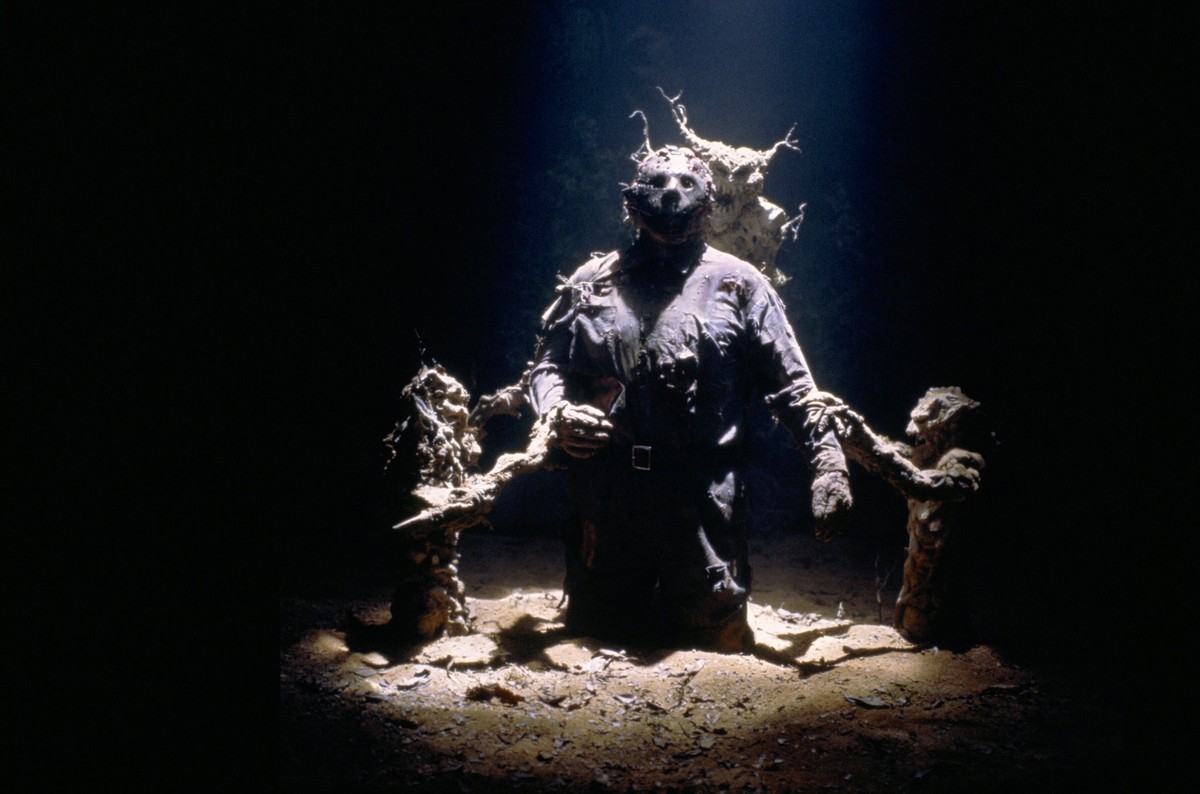
Here are a few more exclusive behind-the-scenes shots from the making of Jason Goes to Hell!


College kids, strippers and vampires—those were Donald P. Borchers’ only requirements when he approached Richard Wenk about writing and directing a movie for New World Pictures. As requested, Wenk cooked up Vamp (1986), a tailor-made blend of the decade’s teen movie craze as well as its horror boom.
Grim and earnest stories were still very much a part of the ’80s horror landscape, yet Vamp is something of a comedy. One difference between it and, say, Saturday the 14th, though, is the former avoids using schtick. Wenk’s movie proves that horror comedies also don’t have to subtract thrills from their recipes. Of course, it takes a minute before reaching that point; college antics and culture shocks preface this one macabre misadventure.
Vamp‘s initial setup is apt for a typical college-set, sex-driven comedy; to bribe their way into a fraternity house, two pledges (Chris Makepeace, Robert Rusler) go looking for some adult entertainment. Without wasting time on any further exposition, the characters embark on an all-in-one-night trip that quickly detours into terror.
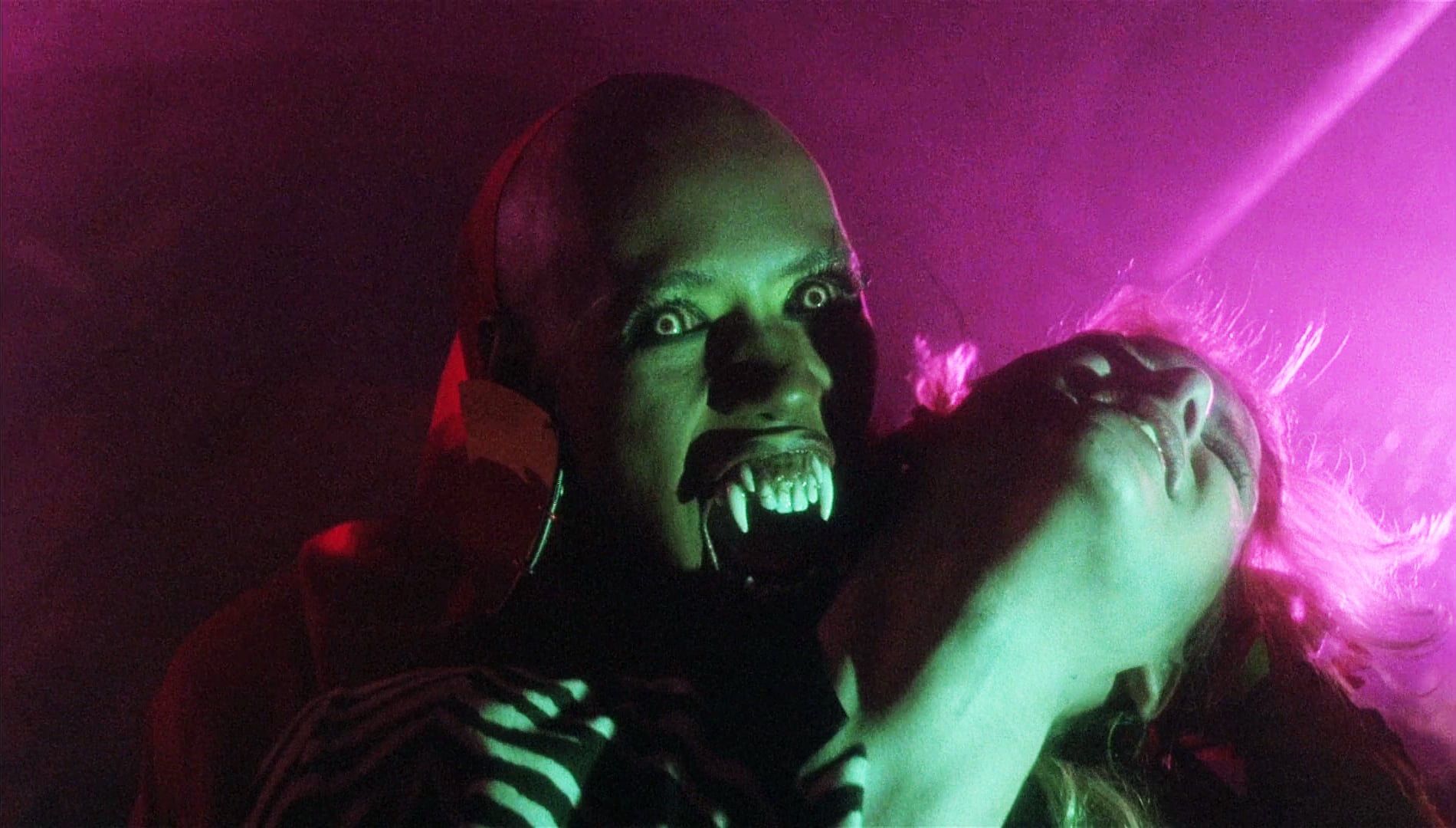
To procure their elusive MacGuffin—a stripper willing to gyrate for some frat boys—Keith (Makepeace) and AJ (Rusler), plus a third wheel named Duncan (Gedee Watanabe), trade the safety of their remote college campus for the seediness of some unnamed city. The setting is recognizably L.A. by day, but as soon as night falls, downtown, along with the characters, slips into a kind of surreal universe. Director of photography Elliot Davis gave this early entry on his prolific résumé an unusual yet distinctive look; that Mario Bava-esque, magenta-green lighting is omnipresent, so much so that it’s almost its own character.

Chris Makepeace and Robert Rusler in Vamp
The faint comparisons to Martin Scorsese’s After Hours are merited, although not just because of Vamp’s distinguishing nighttime aesthetic. Save for the primary characters, the supporting roles in Wenk’s movie are also quite colorful and transactional in their behavior. The difference here, though, is the additional urge to ruin Keith and his friends at every turn. Some of that harm is humorous and tolerable enough, whereas the moment Vamp dishes out its first fatality, it’s abundantly clear how this movie qualifies as horror.
Vamp falls into that category of horror movie that reveals its genre with a scream rather than a series of whispers. The opening scene can function as a hint of what lies ahead—things are not at all what they appear to be—but otherwise, Wenk is more than happy to hold off on the horror. When that time does come, though, it catches the viewer off guard. In addition to the pure shock value is that sudden decision to upend the movie’s foremost feature. Or so it would seem.
If afraid of major spoilage, those new to Vamp would be wise to stop reading here. There’s just no skirting around the fact that the central fellowship in this buddy movie hits a serious snag when AJ is killed. That development causes the story to become more of a “long, bad night” journey for Keith and his romantic interest. So while Wenk scores points for subverting expectations, there is also a touch of sadness in his decision. Because if Vamp does anything well, it’s making the characters likable.
Something that comes easily to Vamp—and other teen horror movies from this same era—is its ability to invent young characters worth caring about, or at the very least, are interesting and not so immediately off-putting. More impressive is how Wenk did all this without actually fleshing out those characters. Still and all, Keith and his kind are a grade above cookie-cutter, and in some cases, aren’t completely devoid of growth.

Grace Jones in Vamp
Vamp appeals with an assorted cast of characters. No two are the same, nor are they operating on the same wavelength. The cinematically extroverted AJ, whose actor conveyed charm and vulnerability in near equal amounts, comes alive when he’s at his most undead. Makepeace then makes the chronically cautious Keith a sympathetic fellow, even as he’s more and more affected by the night’s bizarre events. Meanwhile, Duncan is indeed the designated loser of the whole bunch, but Watanabe still manages to humanize him. As a bonus, the role didn’t require him to pull a Long Duk Dong.
As for Dedee Pfeiffer, she is plain adorable as the mysterious After Dark server nicknamed “Amaretto”. She spends all night fixing her dress strap while at the same time trying to get Keith to remember how he knows her. As their offbeat romance grows, it becomes another highlight of this movie. Whether or not Pfeiffer’s character is really a vampire also creates some welcome tension in the story.
Like a lot of its contemporaries, Vamp went on to become a bit of a cult classic. That current status is determined by several factors, but without a doubt, the casting of Grace Jones is the most considerable. The image of her writhing on that unique-looking chair, a Keith Haring original, springs to mind whenever this movie is brought up.

Chris Makepeace, Billy Drago and Paunita Nichols in Vamp
Prior to that first display of unequivocal horror, local vampire queen Katrina (Jones) took to the stage and delivered a strip show like no other. One would expect nothing less from that renowned model and performance artist. By now reports of Jones’ tardiness on set are no secret, yet it’s also hard to deny her commitment to the part of Katrina. It was, in fact, Jones who took charge of her character’s appearance—on top of Haring painting her body and that now-iconic chair, she had Andy Warhol handle her costuming. And not too many actors could seize a room’s attention without saying a single line of dialogue.
In 2022, Vamp received a retrospective novelization from Encyclopocalypse. This literary union of preexisting source material—Wenk’s original screenplay—and new ideas from author Christian Francis amounts to a more comprehensive visit to the After Dark Club. The basic story there is no different than what’s shown on screen; however, Francis gets creative with the characters’ origins and designs, and he enhances a number of key scenes.
The novelization expands on the urban and social decay of the main setting, and supplies a background for the After Dark Club. Sandy Baron’s character, Katrina’s emcee and familiar, is given ample motivation for sticking around; up until the fiery end, he is loyal to his friend and former business partner “Squeak”, who looks like he was “fed through a combine harvester, and left as nothing more than a heap of mangled remains”. Then there is Billy Drago’s character Snow, the leader of a street gang called The Dragons. His reason for menacing Keith and AJ is more altruistic than in the movie; he and his peers act tough to scare off any potential food for the vampires.

Lisa Lyon in Vamp
If not for all the backstories, Francis’ Vamp would be a hell of a lot shorter. Instead, this tie-in read dives into how AJ met Keith—the orphaned Anthony Joseph hailed from a broken home back in Brooklyn—and how their friendship flourished over the years. Keith’s archership is no longer just an assumed part of his entire being; it’s a confidence-building extracurricular for a boy who got picked on before coming into the protection of the new kid in town. These supplemental, in-depth looks at the protagonists, plus their close connection, are maybe unnecessary. The movie already did a fair and concise job of addressing their platonic intimacy without the need for flashbacks and insights, specifically in that scene where AJ lays it all out as he sacrifices himself.
Where the novelization gets off course is its approach to the minor characters. Intermittently backstorying the likes of Katrina’s indentured servants, Seko (Leila Hee Olsen) and Vlad (Brad Logan), ends up disturbing the flow of the writing. Was it absolutely essential that readers know Vlad was the Grand Duke of the House of Romanov, or how Snow’s accomplice Maven (Paunita Nichols) became so dentally challenged? No, not really. However, one’s mileage with these random biographies may vary.
The novelization is a more substantial experience, but for a movie like Vamp, less is more. And as plentiful as they are, it never simply coasts on its campy charms, either. The character work sits comfortably in that realm between cursory and meticulous, the script is sharper than first realized, and Greg Cannom’s vampire makeup is straightforward yet effective. Most of all, the movie didn’t squander its out-of-the-box concept. Richard Wenk made his vision of a “comic nightmare in which just about anything that can go wrong does” come true, and it is very enjoyable.

You must be logged in to post a comment.