

So many bad movie monsters, so little time. Narrowing down a list of the best was hard enough, but narrowing down a list of the worst was even more difficult. There are just so many awful ones to choose from. To make it clear, the only criteria for the list was that to qualify for the worst, the monsters couldn’t have been utilized in service a tongue-in-cheek/knowingly campy film. Therefore – no “Gingerdead Man”, no “Hobgoblins”, no “The Stuff” (aka killer yogurt). You’d think that would narrow the choices down by a lot, but alas – there really is no limit to the number of abhorrent monster movies that take themselves completely seriously. Really though, we should be thanking the filmmakers of these debacles for their contributions to the world of cinema – I mean, when I’m stoned out of my mind and eating handfuls of Milano cookies, it’s not like I’m in the mood to watch an Ingmar Bergman movie. I learned the lesson a long time ago that existential angst just doesn’t mix well with mind-controlling substances.
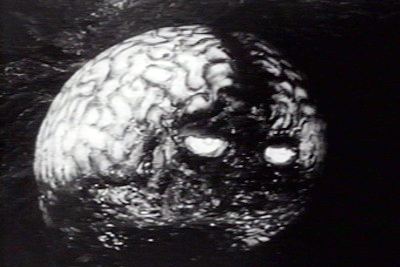
Film: The Brain from Planet Arous (1957)
One of the worst/greatest things about z-grade drive-in cinema from the `50s and `60s is the fact that the monsters lack even the slightest amount of subtlety. Take, for example, Gor, the “Brain from Planet Arous”, who takes the form of…well, a giant flying brain. Gor also has glowing eyes, which he apparently uses to emit radiation and burn people. To really get the full effect of this monster’s ridiculousness though, you simply must see him in action – he’s about as menacing as a helium balloon at a three-year-old’s birthday party.

Film: Amityville 4: The Evil Escapes (1989)
The Amityville films were always ridiculous, but the fourth entry brought the franchise to a new low when the “evil” in the house was transported from Long Island to California in the form of a…um, a killer lamp. Yeah, that’s right. A fucking lamp. The film starts at a yard sale at the infamous Amityville house, where an old woman buys the lamp for her sister as a joke and ships it off to her home in California. Unfortunately for her sister, the demons from Amityville somehow escaped through a light socket (because demons apparently travel through electricity and appear as a moving lump through power cords) into the ugly, brass, vaguely human-shaped monstrosity to wreak havoc in their new location. Honestly, I could’ve come up with a better idea if I was seven years old and huffing paint fumes. Note: Writer/director Sandor Stern also wrote and directed “Pin”, one of the most underrated horror films of the 1980s. How he went from that to this, I’ll never know.

Film: Night of the Lepus (1972)
Based on the intentionally humorous and satiric novel The Year of the Angry Rabbit by Russell Braddon, Night of the Lepus unfortunately adopted the opposite approach by taking the premise completely seriously. First mistake. Second mistake was using real domesticated rabbits (the plump, cute and furry kind) to portray the “monsters” rampaging through an Arizona community. Third mistake was…oh Jesus, this could go on for hours. Let’s just say that the director of this abomination (William F. Claxton, who actually helmed a couple decent Twilight Zone episodes) didn’t get one goddamn thing right. Look, had he not been so lazy and actually hired a practical f/x guy to create some decent effects instead of filming real bunnies (who inexplicably run in slow motion and roar like dinosaurs) and if he hadn’t used dudes wearing bargain-basement rabbit suits for the close-up attack scenes, we might have had something that was at least a lot of (intentional) fun. As it stands, the scariest thing in the movie remains those hideous, fucked-up yellow-and-purple striped `70s pants the costume designer chose for Janet Leigh (who apparently took the role because the filming location was close to her house). Note: There’s also the whole issue of the rabbits suddenly developing carnivorous appetites, which the characters for some reason wholeheartedly accept with no reservation.

Film: The Giant Claw (1957)
This winged creature looks like a giant flying turkey with razor-sharp teeth, but in the movie it’s described as an extraterrestrial creature made up of antimatter, making it invulnerable to earthly weapons. Um, right. It still looks fucking stupid. The funniest thing about the “Giant Claw” is its awkwardness – sure it’s big and can bite an airplane in two, but it’s also the buzzard equivalent of the last kid picked for the soccer team in junior high. Clumsy, unattractive, oddly proportioned; all the thing needs is headgear and inch-thick glasses, and the military would likely be tempted to fire giant spitballs out of a cannon or build a giant toilet to dunk the monster’s head in. Bonus: Watch for the scene where the “Claw” appears to be using the Empire State Building as a giant dildo.

Film: Robot Monster (1953)
What do you get when you put a space helmet on a gorilla? Ok, first of all, couldn’t the filmmakers at least have come up with a better name than “Ro-Man”? Even in the less-than-stellar canon of B-movie monsters, I doubt the level of stupidity required to settle on the moniker “Ro-Man” has ever been topped. Second, this dude killed 99.999999999999% of the humans on Earth using a “calcinator death ray” in one fell swoop, yet for the last eight survivors he has to personally hunt down and physically strangle each one of them? That’s right, people. Strangle. They couldn’t have even given him a decent weapon? A gun? A fucking spear? Something? Third, it’s a minor miracle Ro-Man is even able to catch up to any of these people to actually kill them, considering he walks with the speed of…well, an actor in a gigantic, cumbersome gorilla suit. Fuck, man. Just…fuck.
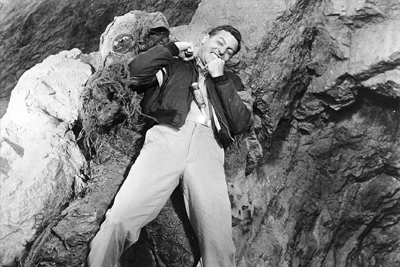
Film: Night of the Blood Beast (1958)
This sci-fi/horror turkey from the `50s does boast one interesting concept that would later be used in Ridley Scott’s classic 1979 film Alien — the idea of an alien creature impregnating a human being with its offspring. And that’s where the similarities end. See, Alien boasted an awesome, now-iconic monster that would go down in history as one of the greatest ever designed. And the “Blood Beast” – um, didn’t. No, the titular creature in this disaster looks like a human-sized parrot covered in feces. I’m not quite sure what the fuck the filmmakers were going for, but not only does the alien look ridiculous, it also speaks with the intonation of a movie trailer voice-over artist.

Film: Godmonster of Indian Flats (1973)
The monster in this 1970s “so-bad-it’s-good” cult classic looks sort of like a cross between Snuffleupagus (I stole that reference from another website, for the record) and a deformed camel. Indeed, one of the greatest scenes in this unbelievably bizarre creature flick suggests an episode of Sesame Street as directed by Ed Wood. A group of blonde, squeaky-clean children eat lunch on a picnic blanket (“mmm, these are good hot dogs!”) while the titular beast emerges from some foliage in the background and approaches with a lumbering gait, although for some reason the (special-needs?) kids don’t spot him until he’s right on top of their asses. They then run screaming in terror, their idyllic summer’s day (not to mention their childhoods) shattered forever. So what is the monster supposed to be, anyway? A giant mutant sheep, created by contaminated gases leaking from an ancient mine located nearby. Obviously!

Film: The Creeping Terror (1964)
“Creeping Terror” is right. This fucker moves with the speed of a 90-year-old grandmother who just polished off a bottle of peach Schnapps. And yet people still get eaten somehow, seemingly by crawling inside the giant rug-monster’s vagina of their own accord. Ok, I get it – there are scores of classic movie monsters that move slowly and still manage to catch their prey (zombies, Jason Voorhees, et al.), but they also don’t look like a fucking shag carpet that was woven together by a mentally-deranged knitting circle. Apparently, the original creature designed for the movie was lost and director Vic Savage was forced to put together a new one on his own, without the help of a professional effects-man. Sadly, Savage (nee Arthur Nelson White) disappeared from the world of filmmaking after helming this, and ultimately died of liver failure at age 41. I feel for the guy, but really – what other option was there but to become an alcoholic after this? Carpet salesman?

Film: From Hell It Came (1957)
The Yoda-esque title From Hell It Came is pretty lofty for a movie about a “South Seas” prince who is wrongfully executed before returning as a walking tree to take out his revenge. Sure, the “killer tree” trope has been used in several other horror movies, from The Evil Dead to William Friedkin’s The Guardian to Poltergeist, but never has the embodiment of said enemy been so deliciously cheesy. It’s a horrible idea to base an entire movie around, but what puts this one over the top is the fact that “Tobonga” is literally portrayed by a man in a hilariously un-subtle tree-stump outfit that looks like it was purchased at a discount costume shop a couple hours before filming.
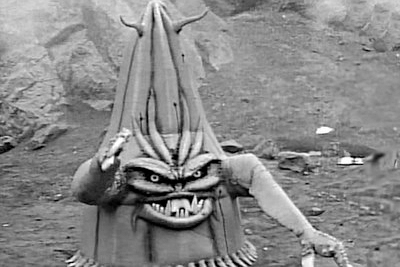
Film: It Conquered the World (1956)
This Roger Corman-directed film was remade in 1966 and titled Zontar, the Thing From Venus, and while that version of the alien resembles a human-sized shit-monster with wings, the 1956 incarnation -a giant rubber vampire carrot on rollers – takes the cake. The (anti)climactic final confrontation with the alien is an awkwardly-staged laugh riot, particularly considering that the creature’s “arms” look like giant potato sprouts. And yet still the alien manages to lay waste to a battalion of soldiers sporting machine guns. Needless to say, this gets my vote for the worst movie monster of all time.

The Alligator People, 1959 (killer…um, Alligator People); Death Bed: The Bed That Eats 1977 (swear to god, it’s a real movie); The Mangler 1995 (demonically-possessed laundry folding machine); Astounding She-Monster 1957 (aaahhh!! It’s a woman in a latex one-piece!); Navy vs. the Night Monsters 1966 (for all you The Happening haters, this killer-plant movie makes Shyamalamadingdong look like Orson Welles); Curse of the Swamp Creature 1966 (ping-pong balls for eyes – they’ll never notice!); Teenage Monster 1958 (more accurate title: Extremely Hairy 50-Year-Old Man); Rock `n’ Roll Nightmare 1987 (possibly the lamest depiction of Satan in the history of the modern world); Ocataman 1971 (how bad is it? Female star Pier Angeli killed herself immediately following the completion of principal photography); Killdozer 1974 (it’s a bulldozer – that kills!); Blood Freak 1972 (God-fearing/anti-drug serial killer with a giant turkey head); Day of the Triffids 1962 (not truffles, triffids!); Attack of the Eye Creatures 1965 (they weren’t kidding); The Brainiac 1962 (brain-sucking ant-eater man with a long rubber tongue); Attack of the Beast Creatures 1985 (aka Attack of the Killer-Doll-Throwing Off-Screen P.A.’s); The Horror of Party Beach 1964 (Cookie-Monster!! Hot dogs?); The Green Slime 1968 (we need more rubber tentacles over here!); Creature of Destruction 1967 (least convincing Black Lagoon rip-off ever); Sting of Death 1965 (run! It’s a…dude with a plastic bag over his head?); The Sea Serpent 1984 (Chinese New Year parade!).