“We’ve tackled a lot of new ground, which opened up the door to a different form of thinking. Get bolder. Get braver. Dare to talk about who made us. And who made them.” – Ridley Scott
Years before Star Wars told a side story with Rogue One and Cloverfield spawned a not-quite-sequel in the form of 10 Cloverfield Lane, Ridley Scott returned to the world he created in 1979 to expand upon the Alien universe with a bold new vision that was tangentially linked to the sci-fi/horror classic. An Alien prequel that was quite unlike anything we had ever before seen from the Alien franchise, Prometheus was released to mixed reviews back in 2012. Some admired Scott’s ability to reinvent a franchise that seemed beyond reinvention. Others hated that Prometheus, well, it wasn’t really an Alien movie at all. Certainly not in the traditional sense.
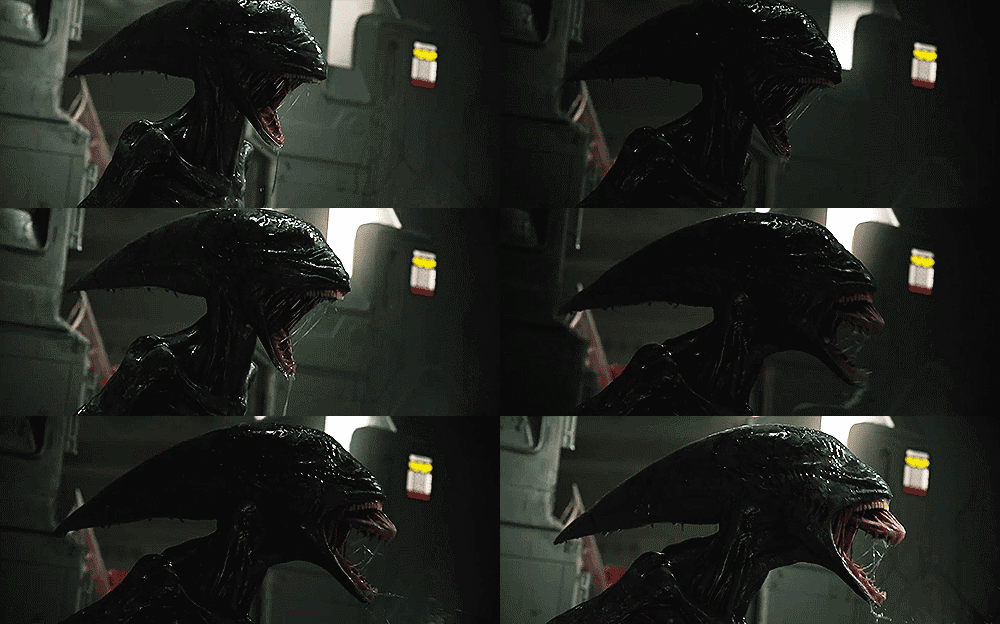
The latter opinion, though I don’t at all agree with it, was admittedly somewhat understandable. Many hardcore Alien fans went into Prometheus under the false assumption that it was a straight up prequel to the 1979 film, so they were naturally let down when the 2-hour experience culminated without a single Xenomorph popping up – okay, so the “proto-Xeno” known as Deacon did make an appearance at the very end (as did various other monsters), but Prometheus was most definitely not a movie about Xenomorphs. Rather, it was a brand new story told within the universe that the Xenomorphs inhabit. It shed some new light on their eventual creation, while also expanding upon the universe with an original sci-fi story that answered questions about the original Alien and asked even bigger ones about the meaning of human existence.
Using the mystifying and haunting appearance of the fan-named “Space Jockey” from the original Alien as a jumping off point, Ridley Scott – along with writers Jon Spaihts and Damon Lindelof – told with Prometheus the story of the Engineers, brand new characters responsible for the seemingly indirect creation of the Xenomorphs. Alien fans always assumed that the “Space Jockey” was a fossilized, very much inhuman monster of some kind, but Prometheus revealed that what we saw was actually an elephantine space suit worn by one of the humanoid Engineers. And those superior beings didn’t just create the Xenomorphs. In a breathtaking opening sequence, one of the Engineers sacrifices himself for the purpose of literally creating human life on Earth. It’s a HUGE idea, and Prometheus is all about huge ideas.

While Alien was a confined, incredibly straightforward horror story about a group of people fighting off a monster aboard a spaceship, Scott’s decades-later return to the franchise was a heady trip to a faraway planet that pondered questions like why we were created and what our real purpose is here on Earth. Who better to answer those questions than the beings who created us, figures heroin Dr. Elizabeth Shaw, as does the soon-to-be-dead Peter Weyland. While Shaw wants answers, Weyland selfishly wants, quite simply, more life. What they both find, however, is the absence of answers – which proved to be more frustrating for viewers than it even was for the characters aboard the Prometheus.
What those characters eventually learn, or at least posit, is that the Engineers created human life but ultimately decided, for whatever reason, to put an end to their own creation once and for all. If what they believe to be true is in fact true, the Engineers were planning on returning to Earth to drop a payload of deadly black goo onto the planet, which would’ve destroyed it and everyone on it. Fortunately for us, something went wrong along the way. We don’t really learn what went wrong. We don’t learn why they decided to destroy humanity. And we don’t even learn why they created humanity in the first place.
Frustrating? Only if you require movies to answer the questions that they pose. But Prometheus isn’t a movie about answering questions. Rather, it’s a movie about asking them. It’s a movie about going on the quest to find those answers. Just as that’s the mission Shaw, Weyland and the gang embark on, that’s also the mission that we’re all on throughout our lives. Where did we come from? Why are we here? Where do we go when we die? We’ve all asked these questions either to ourselves or to others – and like the doomed characters in Scott’s pseudo Alien prequel, we’ll never really get the answers we desire. But through challenging us to ponder them, Prometheus expanded the Alien franchise well beyond its iconic menaces, linking our creation and their creation and tracing both of our origins to a whole new set of characters that we (and Scott himself) didn’t even realize we met back in ’79.
For better or worse (depends on who you ask), Prometheus forever changed the experience of revisiting the original Alien, as well as grew that universe exponentially. We didn’t quite learn how the film’s Xenomorph was created, as some hoped going in, but we did begin to learn (and future films like this year’s Alien: Covenant will expand upon those ideas) where they came from and who roamed the universe before either we or they ever did. Like Rogue One, Prometheus was a side story with huge implications about the main story, and as a longtime fan of the Alien franchise, that’s what made it so special to me. Ridley Scott easily could’ve made another Alien movie. Instead, he stepped far outside the box that he himself constructed over 30 years prior, telling a story that, in star Michael Fassbender’s own words from the 4-hour making-of doc, dared to “give the fans something new and maybe sort of upset them a little bit… or take that risk.”
Prometheus, an Alien film about humanity above all else, was indeed a huge risk. And it sure did upset a whole lot of Alien fans, many of whom still hold a grudge against Scott for straying so far from expectation – not since Halloween 3 had a horror franchise so brazenly bucked expectation and attempted to carve its own path entirely. Others don’t mind that he stepped outside the box, but rather found Prometheus to be a flawed film full of bad writing and dumb character decisions. As previously mentioned, there’s a whole nother group of people who hate that it asked big questions and ended up answering none of them. But in a world where franchise reboots seem to care so little for the fans that they lazily go through the motions and paint by already established numbers, one must at least admire Ridley Scott for dreaming bigger with Prometheus. He dared to give all of us Alien fans something new, and he damn sure did just that.
Here’s hoping we’re all made happy by Alien: Covenant, which looks to blend the heady wonders of Prometheus with the back-to-basics horror of the original Alien. In the meantime, I’d recommend revisiting Prometheus with a fresh set of eyes. Now that you know what to expect, and for that matter what not to, maybe you’ll find it a more enjoyable experience than you did the first time around. Strap yourself in, go along for the ride, and try not to get too caught up in silly things like the characters acting a bit foolishly from time to time. After all, isn’t a realistic movie character one who isn’t above making mistakes from time to time?
If only all franchise reboots were so ambitious, I say.