Movies
[Fantastic Fest Review] ‘Slumber Party Massacre’ Updates a Feminist Classic for the Modern Era
Amy Holden Jones’ 1982 film The Slumber Party Massacre was a bit of a rarity in the ’80s slasher boom: it was written by a feminist writer (Rita Mae Brown) and told from a female perspective (Jones’). While they were beholden to certain non-feminist genre tropes (half-naked pillow fights and fully naked breasts, just to name a few) the film was able to subvert the male gaze in multiple ways. Under Roger Corman’s New World Pictures, the film passed the Bechdel Test before the Bechdel Test was even invented. If there ever was a time to give the cult classic an update, now is it. That’s just what writer Suzanne Keilly (Leprechaun Returns) and director Danishka Esterhazy (Level 16, The Banana Splits Movie) have done with the slightly shorter-titled Slumber Party Massacre.
After a 1993-set prologue sees a trio of teenage girls fall prey to Russ Thorne (Rob van Vuuren, Tremors: A Cold Day in Hell), aka the Driller Killer, the film flashes forward to present day Los Angeles when Trish Devereaux (Schelaine Bennett), the sole survivor of the 1993 massacre, is now the overprotective mother of teenage Dana (Hannah Gonera, Spell). Dana is going on a weekend trip with her friends: ditzy Ashley (Reze-Tiana Wessels), responsible Maeve (Frances Sholto-Douglas, The Kissing Booth trilogy) and horned-up Breanie (Alex McGregor, Vagrant Queen). Unfortunately, when they discover that Maeve’s younger sister Alix (Mila Rayne) has stowed away in the trunk, their car breaks down in the very same town where Trish once fought the Driller Killer. After securing a last-minute rental house in the isolated town, the girls must come face-to-face with the man who has haunted Dana’s mother’s life for the past 30 years.
Like the original film, Slumber Party Massacre prioritizes the relationships among the girls first and foremost. They’re not exactly the most three-dimensional characters, but the film devotes quite a bit of time to them outside of the carnage, allowing them to break free of their aforementioned archetypes. Slumber Party Massacre is a film that’s part straightforward slasher, part satire, part parody, and a lot of subversion. Tonally speaking, it has a lot in common with films like The Final Girls (review) and Tragedy Girls (review), with a dash of The Cabin in the Woods thrown in for good measure.
The new film adapts and modernizes the feminist aspects of the 1982 film for a 2021 audience, from the ridiculously visual (a can of clam chowder ejaculating on the killer’s face) to the thematic (it’s not the girls who get in a half-naked pillow fight this time, gents). Often, Slumber Party Massacre feels like the film that 2019’s Black Christmas remake wanted to be, but whereas that film stumbled in its heavy-handed messaging, Slumber Party Massacre dips into parody so often that it makes its sporadic heavy-handed moments forgivable. The film tackles the male and female gazes, the true crime podcast phenomenon and even anti-feminists head-on (“you’re just part of some feminist plot to get rid of all the men,” one unlucky guy exclaims). It doesn’t all work, but when it does it really does. Plus, when a film is this much fun it’s difficult to hold a grudge.
Esterhazy keeps the color palette nice and bright, switching it as the film swiftly changes narrative directions. It’s these changes in direction that shouldn’t be spoiled, thereby making this review somewhat difficult to write. Suffice it to say that Slumber Party Massacre is not the film you think it’s going to be, and that’s what makes this such a pleasant surprise. That being said, the third act does revert back to the standard slasher formula, which dilutes some of the effectiveness of the first two acts. It’s not a dealbreaker by any means, but one wishes it had kept the clever subversions of genre tropes going until the credits rolled.
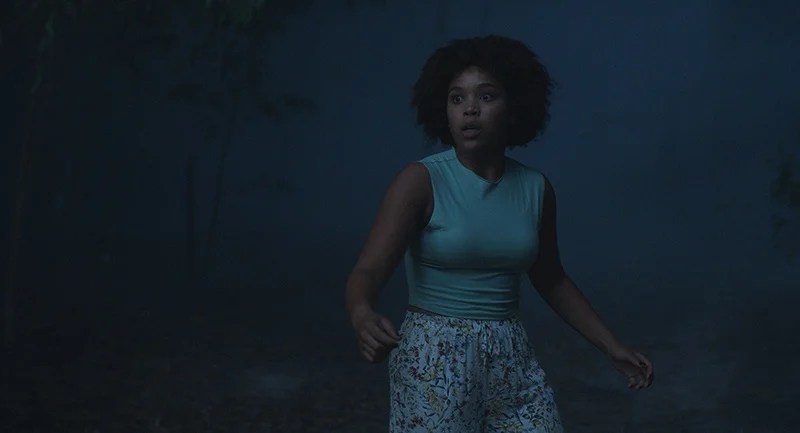
Lest you think that the SyFy release means a watered-down version of the gore inherent to slasher films, rest assured that Slumber Party Massacre is plenty gory, with the Driller Killer, well, drilling into a lot of bodies. We do get some other murder weapons thrown into the mix as well, making for a nice variety of murder set pieces.
Slumber Party Massacre is a welcome addition to this new wave of modern slashers (Initiation, Fear Street, etc.). It’s gory, funny and filled with likable characters. While it’s inevitable that this review will be flooded with comments of the “stop inserting social commentary into my horror movies!” ilk, those who can stomach such a wild concept will find much to enjoy in a movie that’s this much goddamn fun.

SYFY is set to air Slumber Party Massacre on Saturday, October 16 at 9 p.m. ET/PT
Movies
‘Strange Journey: The Story of Rocky Horror’ Review – The Definitive Rocky Horror Documentary
You can’t force a cultural phenomenon. At the end of the day, it’s the audience who decides what is and isn’t remembered, and all artists can do is try their best to express themselves honestly enough that their work might eventually connect with a certain crowd. As it stands, the gold standard for a cult hit that grew into something much larger than its creators could have anticipated due to fan involvement happens to be The Rocky Horror Picture Show.
A musical love-letter to the b-movies of yesteryear that also inspired generations of LGBTQ+ inclusive fan communities around the world, both the film and the original stage musical boast an ongoing legacy that shows no sign of slowing down decades down the line In honor of the 50th anniversary of the original film’s relaunch as a midnight movie that cemented it as a perpetual big screen hit, Linus O’Brien, son of Richard O’Brien, the creator of Rocky Horror and actor behind the fan-favorite Riff Raff, presents fans with his long-awaited documentary: Strange Journey: The Story of Rocky Horror.
Of course, you might be wondering if this new release justifies doing the Time Warp again after so many existing celebrations of the original film, so let’s dig a little deeper into Linus’ production.
Through a dynamic combination of archival footage, personal photographs and in-depth interviews with the original cast (such as Susan Sarandon, Nell Campbell, Patricia Quinn and Tim Curry), as well as commentary by hardcore fans like Jack Black and Trixie Mattel, Strange Journey follows the origins of Rocky Horror all the way from Richard O’Brien’s New Zealand upbringing to the shadow casts and online fandom motivating the film adaptation’s modern-day screenings. The documentary also serves as a surprisingly poignant look at how O’Brien views the “franchise” as a whole and how it reflects his personal journey of self-discovery.

Right out of the gate, the film sets itself up as something of a trip down memory lane for hardcore fans as we’re treated to footage of Richard reckoning with the statue of Riff Raff in Hamilton, New Zealand – right next to where he used to cut hair for a living. While the film benefits from plenty of b-roll borrowed from the Rocky Horror Picture Show as a means of hyping up segments of the documentary and even serving as the occasional punchline, Linus expects that viewers are already familiar with the landmark film and dives straight into the cultural context in which his father began working on the surprisingly lo-fi project.
Information goes by fast due to the brisk 80-minute runtime, but I appreciate the nods to Richard’s creative process as we see handwritten songs in a personal notebook that was eventually expanded into the musical’s script. The idea that O’Brien’s method training informed a different view of B-movie performances is undeniably fascinating -as are his musings on genre cinema – but it’s really when the rest of the cast and director Jim Sharman show up that the documentary really shifts into gear.
Sharman’s insight into the low-budget production aspects of the play makes it clear that this was a rag-tag team of artists taking advantage of raw talent and a new cultural zeitgeist that allowed them to confront taboo subject matter. Susan Sarandon is (unsurprisingly) a joy to watch as she reminisces about her time working on the movie adaptation, showing genuine appreciation for the hardship inherent to passionate indie productions. Of course, Tim Curry’s contributions are some of the most compelling, with his comments on how he originally wanted Dr. Frank-N-Furter to have a German accent until a random encounter on the bus made him realize that the good doctor should speak like the Queen, really making you appreciate the big ideas that turned a small production into a smash hit.
That being said, my personal favorite source of snarky quotes and anecdotes is Patricia Quinn, who originally played Magenta. Her stories about a brief romantic encounter with Meatloaf and how grateful she is that the film adaptation of the musical kept most of the original cast are incredibly entertaining and add to the sense that the production captured lightning in a bottle in a way that can never be replicated.

Susan Sarandon in ‘Strange Journey: The Story of Rocky Horror’
As a longtime fan, it was hard not to get swept up in the nostalgia when the file showed pictures of these young performers unaware that their lives were about to be changed forever by a weird little musical – especially when Richard O’Brien would come in with his guitar and perform acoustic versions of some of his most iconic tracks.
Yet, the completely justified pride that Richard appears to feel when presenting the music to his son, and by extension the audience, alongside the existential questions that this exceedingly personal project forces him to revisit, are what make Strange Journey so much more than a corporate puff piece. While I would have liked to see more interaction between the two generations of O’Brien’s, as you get the feeling that Linus is searching for his place in a legacy that extends far beyond his unusual family history, there is enough of an emotional core here that you’ll likely walk away from the experience thinking about what it means to have a single project define your entire life.
At the end of the day, I can’t imagine a more definitive exploration of everything that makes The Rocky Horror Picture Show such a cultural landmark. Featuring memorable insight from nearly all the major players, with the obvious exception of the late, great Meatloaf, and enough behind-the-scenes imagery to make you feel like you were there alongside the team from the very beginning, Strange Journey is the perfect companion to the 1975 masterpiece. That’s why I’d recommend this return to our favorite Frankenstein Place for both diehard fans and newcomers alike.
Strange Journey: The Story of Rocky Horror is available now on digital platforms everywhere.


You must be logged in to post a comment.