

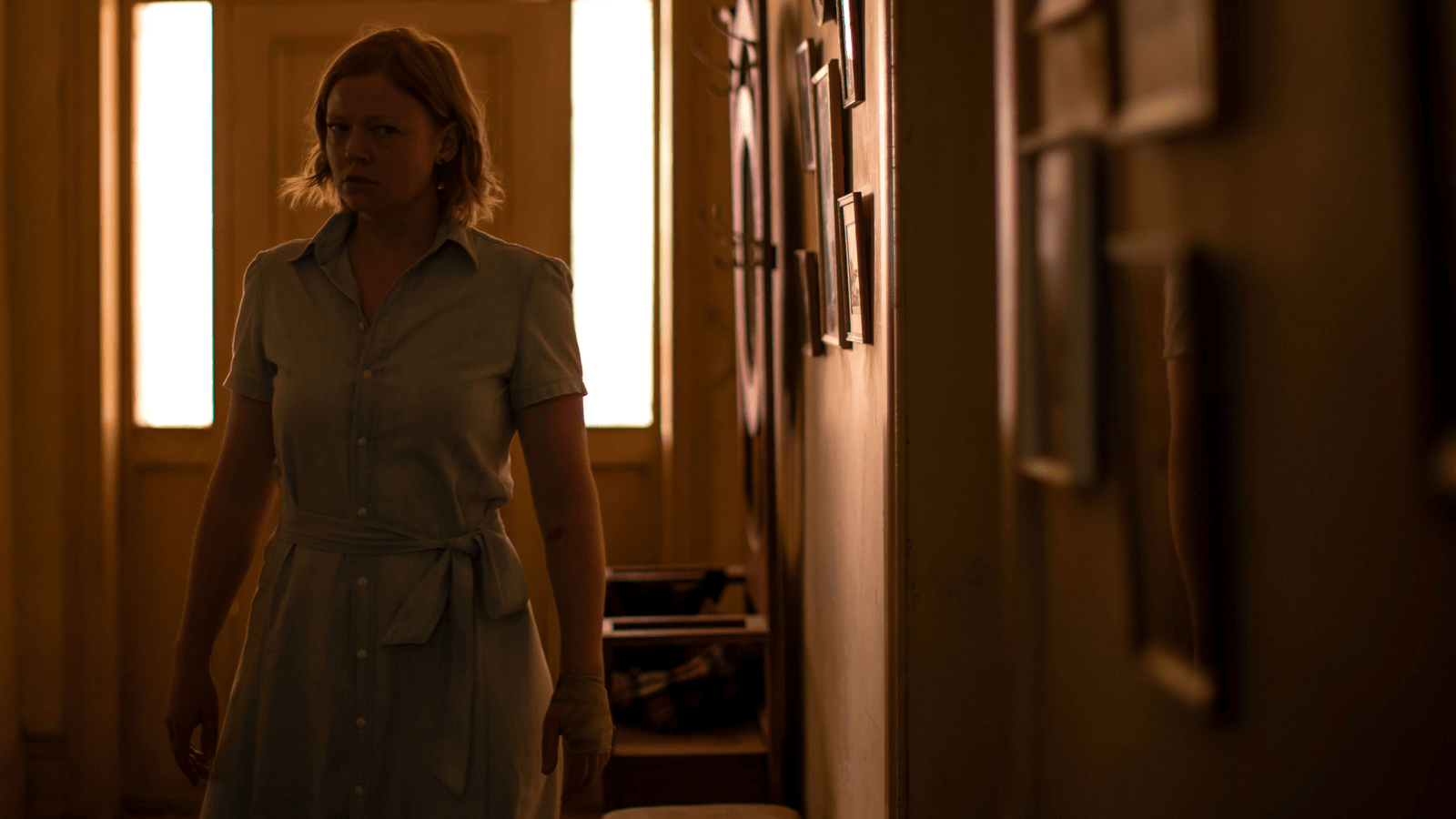
The horror genre has always been an excellent vehicle for metaphors for grief and trauma. After all, what better genre is there to take our emotional monsters and make them literal? We’ve seen a rise in these types of films over the past decade, with particular standouts being films like The Babadook (review), Hereditary (review) and Relic (review).
Daina Reid‘s Run Rabbit Run is the latest addition to this sub-genre but, despite a committed lead performance from Sarah Snook (HBO’s Succession), it succumbs to predictable genre tropes and offers a severe lack of narrative momentum.
On the day of her daughter Mia’s (Lily LaTorre) seventh birthday, Sarah (Snook) comes home to find a rabbit on their front porch. This triggers strange behavior in Mia, who begins acting out in more and more alarming ways. From saying that she misses her grandmother, a person she has never met before, to claiming to be someone named Alice, Mia becomes increasingly not herself. Sarah must then delve back into her past to confront some long-withheld demons in order to save her daughter before it’s too late.
Comparisons to The Babadook are apt. Other than being another Australian horror offering, we’ve got a mother still reeling from a traumatic incident, a child so misbehaved that you’ll want to scream and hints of a specter representing (you guessed it) the mother’s guilt and trauma. Run Rabbit Run goes through all of these familiar beats with little to distinguish them from other, better films. These beats will be so familiar, in fact, that if you’re even moderately savvy you will be five steps ahead of Run Rabbit Run for its entire duration. Made even worse are the tropey hallucinations that Sarah endures as the film progresses. Is she going mad? Or are these visions the result of a ghostly presence? Unfortunately, you’re not likely to care since you’ve seen all of this done before and done better.
This wouldn’t be as much of a problem if there was a distinct sense of style present, but while there are some hauntingly gorgeous shots of the Australian landscape (courtesy of cinematographer Bonnie Elliott), Reid fails to instill any sense of dread or create any kind of atmosphere in her shot composition. Everything is static, making it difficult to connect emotionally with Sarah and the increasingly unsettling proceedings.

Reid, along with editors Nick Meyers and Sean Lahiff, make several questionable choices. Many scenes are seemingly cut short, making for a frequently perplexing viewing experience. One scene, in particular, sees Sarah witness a cabinet open on its own. She approaches the cabinet and as soon as she exits the frame, we hear the cabinet door shut. We then immediately cut to a scene of Sarah walking through the hallway of the house, as if nothing has happened. It’s jarring and undercuts any kind of tension Reid is trying to build. One has to wonder if the film could have done with a single editor instead of a pair of them. What makes this all the more frustrating is that the film drags. It seems contradictory to say that a film is too long while also lamenting the fact that several scenes are cut too short, but such is the case with Run Rabbit Run.
The film offers a solid performance from Snook, who does what she can with some admittedly slim material. Parent viewers might be more empathetic toward Sarah’s plight, but others will find themselves frustrated with nearly every decision Sarah makes whenever Mia acts out. Snook isn’t given much to work with other than to act frantically at every little red flag that Mia’s behavior raises, but she gives a nuanced enough performance to override some of the script’s failures.
Ultimately, Run Rabbit Run will play all too familiar to anyone who has seen any of the trauma-based horror films that have been released in the past decade. There are nuggets of a better film here, but what we have is an undercooked mystery with little atmosphere, leaving us with a final product that is, quite frankly, just plain boring.
Run Rabbit Run had its world premiere at the 2023 Sundance Film Festival and will stream on Netflix later this year.

