Movies
Insidious
“Even through all of the flaws, Insidious is jam-packed with genuine scares and enough visual set pieces that it won’t soon be forgotten.”

Spoiler warnings:
Several years after breaking through with their indie Saw, creators James Wan and Leigh Whannell have come full circle with Insidious, their first low budget fare since they changed the genre’s direction all those years ago. After witnessing the duos tough battle through studio system, it was exciting and refreshing to watch them attempt another personal project. While budgetary issues are glaring (such as being forced to go digital with the ever-so-sucky Red camera), Wan and Whannell craft yet another memorable (and unique) ghost story that could easily be called the no-budget Dead Silence, featuring what Whannell tagged their “trademark Saw spin.”
Opening with a massive title card, and an intense sting from composer (and star?!) Joseph Bishara, Insidious embarks on a swift journey into the lives of Josh (Patrick Wilson) and Renai (Rose Byrne) who are moving into their new Victorian house. With two young boys and a new child in the crib, this massive house appears to be the perfect start to their new lives. Josh has given his wife time off from her job so she can work on her musical career (something that never works into the story nor pays off) and raise the youngins.
With Josh working late (grading those papers, you know, late night work stuff), their kid Dalton (Ty Simpkins) is absolutely terrified of something. The audience knows he sees something, but Dalton refuses to tell his parents. Without any warning, Dalton goes into a coma that no doctor can explain. Within a few months, Josh’s wife Renai begins to see ghosts around the house and is convinced it’s haunted. Scariness ensues. When Dalton appears to be under attack, the duo quickly move to a new house and put the horrible experience in the back of their minds.
Up until this point, the movie is pretty damn intense and carries an array of quality authentic scares. At this point, Wan and Whannell make a left turn and throw the audience a curve ball… we’ll get back to that.
Josh’s mother, Lorraine (Barbara Hershey), recommends a psychic/medium whom she has had a previous working relationship with. The second act introduces a pair of paranormal investigators (one played by a tongue-in-cheek, fun Leigh Whannell), who quickly deem the new house haunted. As a direct homage to Tangina (Zelda Rubinstein) from Poltergeist, we meet medium Elise Reiner (Lin Shaye), a fun and kooky older woman who carries some quite unordinary techniques.
Now this is the important part of the review, and the point where audiences are going to be split. Up until the mid-second act, Wan and Whannell treat the audience as competent horror fans who have grown up on films such as Spielberg’s Poltergeist and the forever-terrifying The Exorcist. After investigating the house, Reiner sits Josh and Renai down to explain what’s going on with Dalton; he’s not in a coma, but trapped in The Further, an out of body netherworld that’s riddled with haunts looking for a way out. It’s not just the concept that will throw audiences, but the audacity of the over-explanation that pulls the brakes the film. Instead of kicking it into high gear, the duo feel compelled to talk the audience through moment by moment. For Wan, a director I consider to be one of the most visual in our genre, to inject such a heavy amount of exposition into his film is slightly unordinary. In fact, the delivery becomes so heavy that it’s soaked in melodrama until the last frame.
But let’s take a step back to where I stated that Insidious will divide the audiences. When Lin Shaye enters the scene, it’s literally a sequence that asks the audience to take a major leap of faith. If you’re with it, you’ll have a great time, if you’re not, it becomes a really cheesy movie. I don’t want to say it’s being “forgiving” of the third act; it’s more so deciding to jump aboard and enjoy the ride.
Those of you willing to step onto the invisible threshold will be rewarded; everyone else might as well walk right out of the theater. After Reiner explains The Further, The Astral, and the “insidious” beings, Wan gets intensely creative adding an overdose of bells and whistles to an otherwise simple possessions tale.
In a very Wan-esque moment (visual and memorable), Reiner straps on a gas mask that’s connected to a pair of earphones around Whannell’s head. She whispers to Dalton (trapped in the Further) while Whannell’s character writes down his responses. The situation intensifies sending Insidious into a flurry of memorable visual sequences that range from a devil-esque character with his face “painted like fire” to paranormal investigators using a modified View-Master to see ghosts.
Insidious, with all of its flaws, is a daring film. It risks daytime scares, most of which are goddamn terrifying, and takes a BOLD move by making all of the ghosts visually “solid” beings, as apposed to being transparent. Wan is obviously an artist before a director, which is the main reason all of his flicks are memorable.
Again, Insidious is going to split audiences straight down the middle. Visually a bit too clean (oh Red camera, how I loathe you), slightly unfocused, and extremely over dramatic, those are just a few of the hurdles you’ll be forced to climb in order to relish in the entertainment value of this chiller. And even through all of the flaws, Insidious is jam-packed with genuine scares and enough visual set pieces that it won’t soon be forgotten. I predict a 2011 horror hit from the creators of Saw. Welcome back.



Carlo Collodi’s The Adventures of Pinocchio was written nearly 150 years ago, and yet it’s still considered to be the ultimate parable about the fundamental human experience of learning right from wrong and the importance of empathy.
Its message is still evergreen, and the reason that two separate big-budget Pinocchio films by auteur directors were released in 2022. And yet, it’s a story that also has creepy enough bones to fuel a really potent horror film when properly executed (please watch Pinocchio’s Revenge if you’ve never seen that piece of dark, gonzo filmmaking before).
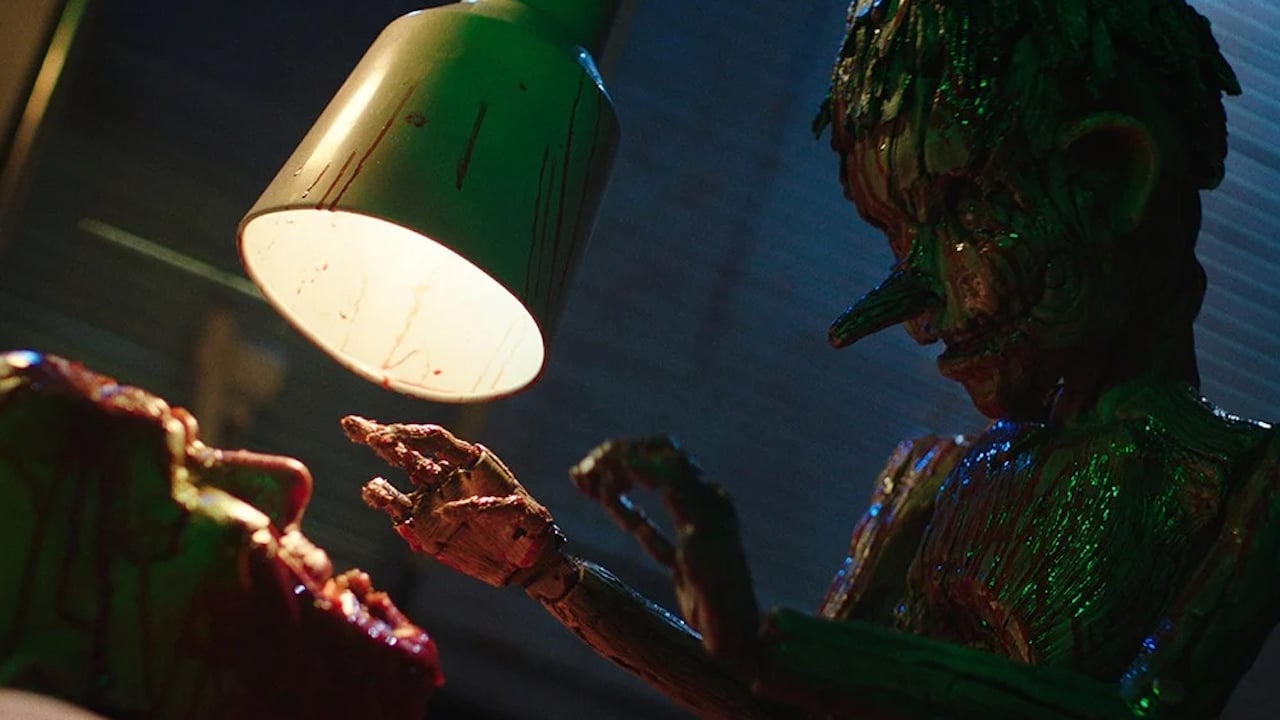
The Twisted Childhood Universe – or TCU, if we must call it this – has largely been more hits than misses. That being said, Pinocchio Unstrung isn’t just a surprisingly entertaining horror film, but it’s a genuine love letter to practical effects and old-fashioned animatronics instead of being some cheap CG slog. Rhys Frake-Wakefield has crafted a disturbing reimagining of Pinocchio that doesn’t get its strings tied up in knots.
In Pinocchio Unstrung, James (Cameron Bell) loses his mother and best friend, so he’s sent to live with his grandfather Geppetto (Richard Brake, 3 From Hell), who seems detached and isn’t necessarily the best role model for this grieving boy. There’s actually a fairly interesting idea here by having both Pinocchio (Jude Evan Lloyd) and a real boy living with Geppetto, while Pinocchio forms a frightening attachment towards James.

Geppetto built Pinocchio for James so he can have a friend, rather than it being a creation to heal his own sadness and loneliness. This heads into even more tragic territory for this vulnerable boy that feels like something that’s more akin to The Boy, Child’s Play, or even the later Puppet Master sequels, rather than Pinocchio. This Pinocchio wants more than to just be a real boy. He wants to be James’ “best mate” and a real friend, which is achieved by killing the various people who have wronged him in life and gotten in James’ way.
Going against Geppetto’s wishes, James brings Pinocchio to school and chaotic carnage ensues as the student body – particularly James’ bullies – become casualties in this macabre learning experience. The messaging is very heavy-handed, which is not unexpected for a film of this nature, especially one that’s pulling from such a moralistic fairy tale in the first place that’s designed to teach lessons.
To the film’s credit, there are some genuinely creepy and unnerving scenes during the film’s first act when Pinocchio bonds with James and demonstrates a fascination with his anatomy and how they’re different. Pinocchio also acquires a checklist of body parts, skin, teeth, hair, eyes, and items to become a real boy. This, while formulaic, is the right style of creepy for this film. It provides a clear focus and trajectory for what’s to come, but also facilitates a lot of gruesome gore.

There are actually some decent gore effects that are well-executed, even if some of them have weak and unearned setups. Obviously, a film like this is trying to be tongue-in-cheek and doesn’t strive to be taken as high art, but it could work a little harder to build to its gory setpieces instead of just throwing them out there and making it seem like it doesn’t care about anything else. A second pass could have helped refine a lot of these elements and turned this into something truly great, rather than operating like a clunky series of poorly written scenes that are designed to string together exaggerated deaths.
These vicious kills are very Terrifier–coded and, on their own, aren’t bad and should please the gorehounds in the audience. There’s an inspired “nose kill” that Pinocchio Unstrung holds off on, but is worth the wait. Pinocchio Unstrung is arguably the goriest of the TCU films, which is a step in the right direction, even if other elements are lacking. In the end, there’s effort here, and director Frake-Waterfield is genuinely trying, even if some of his instincts are misguided or need to be sharpened. For instance, there’s a running throughline where Pinocchio wishes that he had had a penis.
Robert Englund delivers a committed and satisfying performance as Cricket, Pinocchio’s de facto conscience. However, Frake-Wakefield also includes a ridiculous “Wood Mother” concept, which is another wooden abomination who is there to get in Pinocchio’s head. The Wood Mother is presumably meant to be a Blue Fairy analogue, but she just feels extraneous and an excuse to show off more animatronics. Somehow all this leads into a story about rebirth and immortality as the film broadens its scope, which doesn’t always work in its favor. There are plenty of ideas here that are interesting, but ultimately half-baked.

When it comes to Pinocchio himself, the titular puppet’s design initially feels a little lacking, albeit still creepy. Fortunately, it actively improves throughout the film as Pinocchio builds upon his anatomy and “becomes” more human. It also doesn’t hurt that Jude Evan Lloyd is actually a competent actor and a worthy foil for Pinocchio.
Most importantly, it looks like a real movie and features some compelling lighting, which is more than what some of the earlier Twisted Childhood Universe films can claim.
To this point, Pinocchio Unstrung proudly boasts that the film is all done with practical effects and puppetry, which makes such a difference. There’d be no point in even making this movie if it didn’t commit to this practical authenticity. It’s not just a better movie because of this, but it reflects a respect and passion for the craft that’s lacking in other TCU entries. It’d be very easy to cut corners here, and so it’s appreciated that it puts in the effort and goes the extra mile. There’s also a really effective shadow puppetry introduction that’s reminiscent of 2021’s Candyman and a great way to kick off the movie.

Pinocchio Unstrung gradually finds its rhythm and confidence as it goes on, just like a young boy who is figuring out his way in the world. It develops a genuine personality by its end, and there are some weird, unique scenes that really unexpectedly go off the rails and transcend anything from the other TCU films. The place that the film ends is legitimately shocking and feels completely different than the type of movie that’s initially teased. This sort of radical pivot is worth it and turns Pinocchio Unstrung into something weird and wonderful, even if a lot of it still doesn’t work. It deserves credit for taking such big swings, even when they’re unsuccessful.
Those who were left empty from Winnie the Pooh: Blood and Honey and its various offshoots may be pleasantly surprised by this. It actually manages to say something about identity, morality, autonomy, and rising above the expectations that are placed on us, which seems like an insane thing to say for a film like this. It’s a morbid, mindless way to spend 80 minutes.
By the end of this experience, Pinocchio Unstrung transforms from a wooden concept into a real horror film.
Pinocchio Unstrung releases in theaters on July 24, 2026.


You must be logged in to post a comment.