News
13 Days of Horror, Day 2: Alone in a Fog Shrouded Town

Our two week long celebration of all things horror continues with a look back at one of my favorite series, Silent Hill. Not many know this but Silent Hill holds a special place in my heart for popping my horror cherry; I visited that secluded, monster infested resort over a decade ago and I’ve been hooked ever since.

Unlike a majority of the other games in its genre, Silent Hill has almost always relied on psychological horror and getting into the player’s mind as its core element, as opposed to cheap scares to keep our attention. So please dear reader, do what you do well and read on, it’s what the starving monsters of Silent Hill would want you to do. I could go on about how amazing the creature designs in this series are, and I consider them to be some of the best, or how great the transitioning between the real world and dangerous Otherworld is for quite some time. But really, that’s not my favorite thing about the series as a whole. Instead, let’s talk about something Silent Hill has that, in my opinion, no other franchise has been able to match: the music.
There are a plethora of horror games that have excellent music; Resident Evil’s scores have been consistently good and Dead Space’s sound design is arguably some of the best in the industry, but the actual music in Silent Hill is outstanding. No matter how average the games have become Akira Yamaoka’s eargasmic composing has been the sole reason to keep me playing every game in the series that Yamaoka composed. I can’t say that about any other franchise that has more than five games in it, but I’ve actually played every Silent Hill with the exception of the first mobile title.

Sadly, Akira’s talents won’t be a part of the series anymore now that he’s busy working on scoring Shadows of the Damned, the upcoming action/horror title molded from the minds of Suda51 (No More Heroes) and Shinji Mikami (Resident Evil). I boldly claimed before much of anything was known about the game that it could “redefine horror”, then when the game was officially unveiled at this year’s Tokyo Game Show I think it’s safe to say a startling majority of you would disagree with that opinion. Without going on a tangent, since this is supposed to be all about SIlent Hill, still not much is known about the game other than what I described, a trailer, and some screenshots, so let’s leave the judging for closer to the game’s release.
Digression over, let’s return to the gloomy town of Silent Hill. Without Akira lending his musical and producing talents to the series I’m worried about the coming eighth installment in the series. Not all is lost though as the game’s developers said in a recent interview that the upcoming game is going to be more in line with the first games, namely Silent Hill 2, which is feasibly the best of the series.
So what else does Silent Hill have that similar series haven’t been able to do quite as well? I’d say getting into the player’s mind with truly unsettling imagery and stories could be one of them but other titles like Fatal Frame, System Shock, and BioShock, though I struggle to call the latter a “horror” title, all have powerful stories and deeply unsettling experiences to offer players. That leaves the creatures, which aren’t merely some of the best in the genre but possibly the industry as a whole. Think of the most memorable monster in video games and there’s a good chance Pyramid Head pops up.

Silent Hill 2 first introduced to us the mannequin raping, intimidatingly massive sword wielding boss known as Pyramid Head, or Triangle Head in Japan (I prefer the former as it sounds far more menacing). This guy started off as a representation of James’ desire to be punished for his sins and quickly became a symbol of fear and the series’ icon.
Speaking of fear, tomorrow I’m shaking things up a bit; there won’t be another retrospective, instead I have something a little more… reader focused to discuss. It’s arguably the most important thing about the horror genre, but I’ll wait until Thursday to get into details.
Oh, and in case you missed it, yesterday we took a look at the Resident Evil franchise, so if zombies get you all hot and bothered you should most definitely check it out HERE.



Let’s start with the good news. Lockbox looks far better than its misleading marketing materials suggest, a supernatural horror movie so darkly lit and color graded that you’ll have to squint your way through jump scares. It’s also anchored by reliable genre performers. That’s also about where the good news ends with this rote adaptation of Knifepoint Horror Podcast story “Winthrop.”
The empathetic Carla Gugino gives her all as Ellen, a saint of a woman with boundless patience who takes on life’s hard luck with a kind smile. After giving up her career as a fashion designer to become caretaker for a dying mother, she’s then forced to reinvent herself once more when her caretaker role ends. That catches us up to the events of Lockbox, where Ellen is asked to take in a cousin she hasn’t seen in quite some time who’s dealing with severe PTSD.
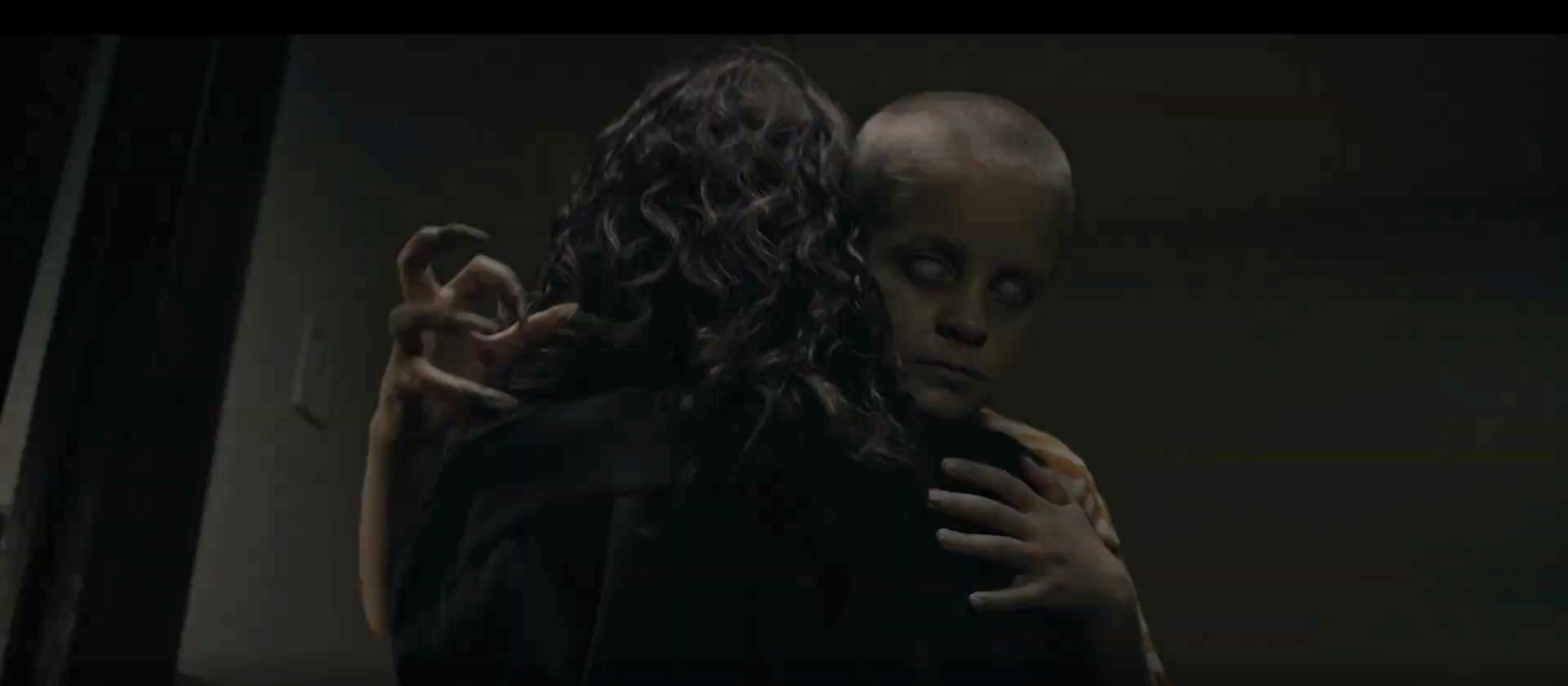
Just as Ellen finally establishes a real connection with Winthrop (Lou Taylor Pucci), it’s interrupted by the arrival of peculiar neighbor Vahna (Katharine Isabelle), who spells clear trouble. When Vahna shows up dead, it sets in motion a supernatural battle of possession.

Image Credit: Aura entertainment
Director Daniel Stamm (The Last Exorcism, Prey for the Devil) and screenwriter Justin Yoffe approach Lockbox in the broadest of brushstrokes, dooming it from the start with clunky storytelling and woefully underdeveloped themes of heady topics like PTSD. Winthrop is a character that comes loaded with emotional baggage and trauma that’s piled on throughout his tragic life, but much like its title, his interiority and history are treated like a tightly guarded secret meant to prolong the supernatural mystery.
The problem here, though, is that Lockbox is too sparse to sustain mystery at all, and it instead robs Winthrop of characterization. It winds up trapping the talented Pucci without anywhere to go, toggling between wounded animal and mentally disoriented.
From there, Lockbox bounds through plot developments without any sense of stakes or purpose, peppered by a smattering of haphazard paint-by-numbers jump scares. The only unwavering constant is Ellen’s resolute faith, and Stamm seems to leave it entirely to Gugino to guide confused audiences through this inconsequential story right up until its supernatural climax.

Image Credit: Aura entertainment
To give more credit, Lockbox at least injects an unconventional exorcism here; just don’t expect much in the way of explanation. When the film finally reveals the meaning behind its title, it dangles a fascinating carrot it has zero interest in delivering. More than a severe lack of fleshing out its characters beyond plot drivers or devices, this faith-based flick also seems terrified to offer any worldbuilding whatsoever.
Yoffe’s script stretches the short story beyond its means instead of fleshing it out, and Stamm fills out the gaps with cheap CGI scares and overwrought performances; Isabelle’s Vahna is beyond cartoonish in her villainy. It’s also pretty nonsensical, treating only Ellen’s faith with the utmost sincerity and largely squandering its typically reliable talent. So much so that the final imagery, pure sunkissed saccharine sentimentality, leaves you with the feeling that this horror movie might be better suited as an entry in Chicken Soup for the Soul.
Lockbox releases in select theaters on July 3, 2026.

You must be logged in to post a comment.