Editorials
Set Report: ‘Drive Angry’ Part 1: Get Ready for a Violent, Bumpy Ride!

Those of you dying for a film actually shot in 3-D rather than post-converted into a pop-up book will be happy to know that Patrick Lussier’s Drive Angry 3D, the follow-up to his hit My Bloody Valentine reboot, is exactly what you’re looking for. Though it isn’t scheduled to hit screens until February 11th, 2011, inside you can check out the first part of B-D reporter Chris Eggertsen’s visit to the Shreveport, Louisiana set back in May. In addition to interviews with producer Michael De Luca, co-screenwriter Todd Farmer and actor William Fichtner, Chris also had the opportunity to check out the fiery outdoor set to get a closer look at all the action.
“‘Jason X’…did not become the movie that I thought it would be. That happens. It’s happened with every movie I’ve ever [worked on]. It didn’t happen on this one. We wrote it and it’s there. Nobody changed it. Nobody gave us notes and said, ‘We want this. We want the girl to be more this. We want the hero to be a dog.’ We didn’t get any of that crap. This is the movie that we wrote and it’s never happened before.” — Co-screenwriter Todd Farmer

I did have to leave my room, of course, in order to travel to the nearby set – located at the Louisiana State Fairgrounds – and I have to say I was pretty excited to check out what was in store. In case you couldn’t tell by the official title, Drive Angry 3-D is indeed being shot in the third dimension – meaning, like, actually shot in it, not post-converted like other recent weak-sauce debacles (Clash of the Titans, The Last Airbender, et al). The film follows Cage as Milton, a man who is called up from Hell to embark on a bloody quest across the country to hunt down members of the satanic cult who killed his daughter and kidnapped her baby girl.
Lussier wrote the 3-D specific screenplay with his Bloody Valentine partner Todd Farmer; they then shopped the script around to several producers, including Michael De Luca (Ghost Rider, Lost Souls), who immediately warmed to the project and signed on to shepherd it. The producer, having established a relationship with Nicolas Cage following their collaboration on Ghost Rider, knew the car-and-genre-film-loving actor would appreciate the aesthetics of the script and sent it along to him; once Cage signed on, he brought production company Millenium/Nu Image – who he had a pre-existing deal with – on to the project, knowing they were currently looking to finance an action movie in that budget range. After the movie was officially greenlit, Summit Entertainment quickly snagged distribution rights Stateside.
“That all happened within a matter of weeks“, said the amiable De Luca when he sat down with us early in the evening, in an auditorium located across the street from the current shooting location. “It was one of the quickest-financed movies I’ve ever had in my experience.”
The producer gave off a casual, relaxed vibe as he explained his first reaction to reading the script. “It blew me away because I like hyper pulpy, super violent kind of Tarentino- esque, Shane Black-esque, Jim Thompson-esque, hard-`R’ character-based stuff. The script that Todd and Patrick wrote is an homage to that aesthetic…it seemed to marry that single minded personal mission of righteous revenge…with the smash `em up redneck car chase movie, `Two Lane Blacktop’ or `Vanishing Point’ or `Dirty Mary Crazy Larry’. So it seemed like a movie written by movie lovers, for movie lovers, and that’s how I took it when I read so that’s why I got really excited.“
Speaking of car chases, the film is certainly heavy on those – the breakdown, as De Luca spitballed, is somewhere around 40% driving, 60% on foot. To that end, the film features a fuckload of classic muscle cars driving at unreasonable speeds to give it the feel of one of the `70s action films mentioned above – think loud engines, twisted steel, gunfights out car windows and massive crashes and explosions done in-camera – no fake CG shit.
“We all kneel at the altar of William Friedkin in `French Connection’ and the stuff in `Bullitt’ and anything we can do practical“, said the producer. “We didn’t want to reinvent the wheel, but we wanted to be the anti-CGI enhanced car chase movie. So a little bit of what Tarantino tried to do with `Death Proof’. We went in that direction.“
De Luca gave us a little more insight into some specific action scenes featured in the film that he feels really capture the overall tone of the movie.
“Nic starts this movie off in this same kind of genre of `I’m mad as hell and not going to take it anymore. I can’t trust anyone else to do this but me.’“, he said. “We’re back in the age of the individualistic righteous hero. That [opening] scene is a great indicator of the kind of movie you’re going to see. There’s an insane car chase involving an RV, a Suburban, the Dodge Charger, police cars – it was a big clusterfuck multi-vehicle car chase scene after a church gun fight that I think will be a showstopper and that’s kind of in the middle of the movie. And then of course our ending, where Nic goes in for the final kill. Which actually shows his car performing the last example of heroics and just jumping over a prison wall and landing in the middle of this horrific scene where he has to rescue his granddaughter. I think those three bits will be the calling card for this movie in terms of `I haven’t seen that before’. What’s great is they all have an emotional undercurrent.”
Joining De Luca was Millenium/Nu Image-based executive producer Rene Besson, who spoke about the company’s immediate belief in the project and their mandate to allow Lussier to make exactly the film he wanted. “We read the script and immediately knew we loved it“, he told us enthusiastically. “We said, `That’s it. We wanna make this film, period.’ And from that day, we just ran some numbers, we put it together, and within I’d say a week we knew we were making the movie and that was it…you know, we’re very good in that way. And we really don’t get in the way of…the filmmakers making a really cool movie if they know the space really, really well. We’re generally hands-off, you know? And we believed in the script when we read it. And we just felt like we needed to go, and literally weeks later we were making the movie.”
Also joining us in our “holding area” was co-scripter Todd Farmer, a solid tower of a man sporting a beard and shaved head who looks something like a Hell’s Angels bruiser. He made sure to drive home the point that the film won’t be a PG-13 cop-out but the genuine article – a limb-severing, bone-crunching hard-`R’ affair much as My Bloody Valentine was.
“It’s as violent as you can get and still get an `R’, I think. We start and the moment the movie opens it’s in your face“, said the writer, while also making sure to add that there’s a real character-driven engine driving the movie. “There’s tons of hardcore `R’ action, nudity and you name it, but at the same time there really is a story there. It’s got heart and at the end of the movie people will feel it.“
He also went on to bolster Besson’s contention that Millenium is overseeing the production in a very “hands-off” fashion, giving he and Lussier mostly free reign to indulge in their unhinged, balls-to-the-wall vision for the film. He contrasted that with his experience on another movie he wrote nearly a decade ago, before the studio forced considerable changes on the project that deviated severely from his original conception of it. “‘Jason X’…did not become the movie that I thought it would be. That happens. It’s happened with every movie I’ve ever [worked on]. It didn’t happen on this one. We wrote it and it’s there. Nobody changed it. Nobody gave us notes and said, ‘We want this. We want the girl to be more this. We want the hero to be a dog.’ We didn’t get any of that crap. This is the movie that we wrote and it’s never happened before.”
As far as the 3-D format is concerned, Farmer indicated that they hope to strike a good balance between the fully immersive 3-D of, say, Avatar, and the more “gimmicky” 3-D of a movie like The Final Destination (my comparisons, not his). “I think there’s a place for both…there are moments where it’s just Nic Cage and Amber Heard and you’re in the car with them and it’s not stuff flying at your face but you’re literally sitting in the backseat. You’re sitting there and it’s just sort of interesting. At the same time we’re going to throw cars and guns and bullets and frogs and naked people at your face because it’s fun and that’s the roller coaster.”
Following these initial conversations we were shepherded over to the set, a bombed-out, open-air building located across the street that those on the production were calling an “abandoned prison yard“. The building, sporting exposed walls painted with all manner of Satanic imagery (inverted pentagrams, et al), featured as its centerpiece the aftermath of a car chase that apparently didn’t end well – the two vehicles (one an RV, another a classic muscle car of some sort) casting a devilish orange glow along the walls of the crumbling building as fire shot through their windows in a controlled burn.
The stakes on set were clearly high; I couldn’t help but feel like I was in the way as I desperately tried to keep out of the path of scurrying crew members, rushing around like ants, barked orders nipping at their heels, the flaming vehicles giving the entire scene a hellish severity. The movie does deal with Satanists, after all. Funnily enough, Farmer (under orders from the film’s publicists, no doubt) had been coy about the true nature of the cult during our talk with him, but as we stood there it wasn’t hard to guess at its true nature. Had they been hoping we wouldn’t notice the “666” symbols spray-painted on the walls?
The particular shot being filmed at the moment was focused on Nicolas Cage’s hero, desperately crawling through the dirt near the flaming vehicles as the leader of the cult – the Jim Jones-meets-David Bowie-esque Jonah King (played by Twilight dad Billy Burke) – kicked him over and over, screaming something about “the baby” as he loomed like a rangy, black-leather-pants-clad madman. In short, he looked every inch the satanic dictator. A few paces off to the side, lounging about in disturbingly calm and collected fashion, was William Fichtner, who in the film plays an agent from Hell known only as “The Accountant“, sent to tail Nicolas Cage’s character on his quest.
As several different takes of the shot were filmed, a small group of us gathered around “video village” to look on at the monitors, trading off a thick pair of 3-D glasses to watch the scene unfold in all its 3-D glory. In all honesty I’m not much a fan of the format, but nevertheless it was very cool seeing the raw product unfolding live in three dimensions before my very eyes. I for one came away from the set impressed and grateful that I’d had the opportunity to witness a pretty awesome-looking scene.
After a quick trip to the craft services area to grab some munchies, our group then took a little trip over to a nearby warehouse, where several of the classic cars used for the production were being held. These included a ’69 Charger (more on that later) and a ’72 Chevelle. After several of the straight guys in our group had themselves a nice community circle jerk around the gleaming vehicles, it was off to talk with special makeup effects designer Gary Tunnicliffe, who gave us a peek at a few “severed limbs” from his trailer (including a leg blasted apart by a high-powered gun).
Back in the auditorium, we sat down to have a chat with the dapper William Fichtner, the instantly-recognizable character actor who has been doing great work in major films for years but whom most people don’t know by name. The actor has in the past worked for top-shelf directors like Michael Mann, Ridley Scott, Robert Zemeckis and Doug Liman. Clearly on lockdown thanks to the on-set publicist, when asked to describe his character in more depth Fichtner comically intoned: “Well, he wears one suit with one tie and one shirt. And he always looks really, really good.” Fichtner did indeed look mighty fine, the suit perfectly tailored to his lanky 6′ frame; however, he did sport one tell-tale facial scar. “That’s a 3-D moment; wait until you see how [I get the scar]! I was aware of the 3-D-ness of that one…[but] I think the Accountant has an ease and a grace that…well, he doesn’t want to get dirty. It’s not even about getting dirty, it’s not necessary.“
From Fichtner’s description, “The Accountant” is a fish-out-of-water in the film’s “Red State“, down-`n’-dirty aesthetic, as indicated when the actor described his character’s first appearance in the script.
“It might be 20 pages into the movie and you’ve seen so much by that point – colorful characters and grungy places, and slap the 3-D on top of that like eye candy“, he said. “All of a sudden, this character shows up and there’s no one else looking like him. Hopefully I’ve found the right rhythm; it’s different because he’s different. The first time you see him, he’s just walking down the road, then I run into some people we’ve already met, a waitress and a short order cook. We have a little exchange and it’s very interesting and it has a little ballet to it.“
CONTINUED IN PART 2




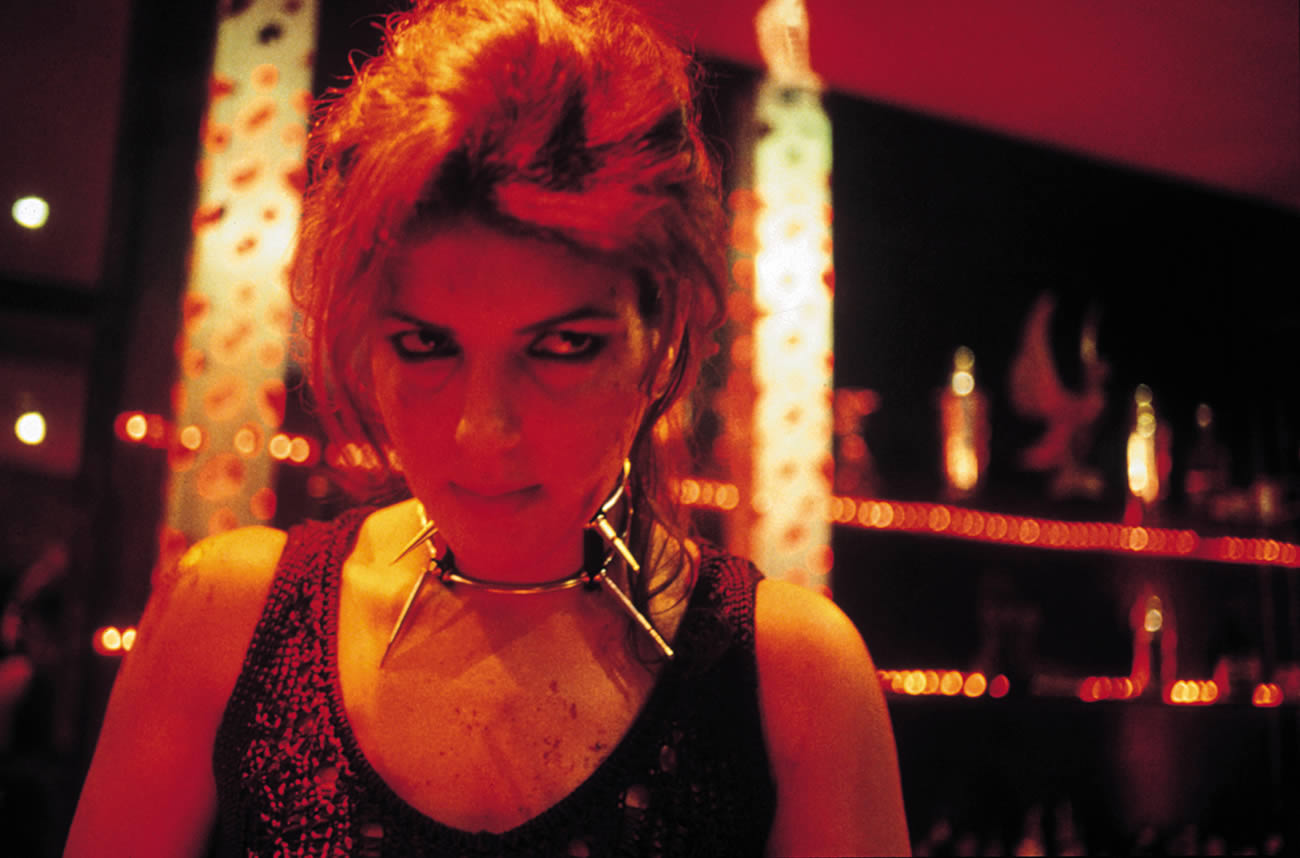
Of all the films in the New French Extremity movement, Baise-moi may be the most shocking.
From its aggressive English language title Rape Me to several scenes of unsimulated sex, Virginie Despentes and Coralie Trinh Thi’s 2000 film may not drip with the subgenre’s trademark blood and gore, but the story’s overwhelming nihilism feels like a middle finger to the patriarchal establishment.
Inspired by Despentes’s 1993 novel of the same name, Baise-moi stars adult film actresses Raffaëla Anderson and Karen Bach as Bonnie and Clyde-style criminals who rampage through France leaving a trail of bodies in their wake. But this fierce story has a tender core. When we peel back the layers of explicit sex and ostensibly senseless violence, we find the tragic tale of two young women desperate to reclaim their power in a world built on male entitlement.
After a brief glimpse at our female criminals, Baise-moi opens in a local dive bar. A boorish man plays pool with his friends while callously dismissing his girlfriend’s concerns. She hasn’t seen him in nearly a week and simply wants to know if he plans to come home. But he angrily brushes her aside, insisting that he doesn’t have to answer for his selfishness. We will never see this couple again, but their one-sided dispute reflects a world in which women must beg for attention from men who see them as less than human.
Throughout this uncomfortable argument, Nadine (Bach) has been drinking at the bar while men discuss her fondness for random sex. At home, she openly masturbates in the living room, refusing to be shamed by her nagging roommate. We learn that Nadine is a sex worker and follow her to a nearby hotel. Refusing to kiss her john on the lips, she dispassionately performs oral sex then watches TV while he fails to give her an orgasm. Despentes and Trinh Thi play with camera angles to show the extent of Nadine’s disinterest. More concerned with sausage being sliced on an infomercial, she has emotionally disconnected from her own body.

We meet Manu (Anderson), an occasional porn actress, under much more traumatic circumstances. While chatting on a park bench, she and a friend are hauled into a dirty warehouse then savagely assaulted by three strange men. We watch as Manu’s friend (played by adult film star Lisa Marshall) is repeatedly punched in the face while her clothes are ripped off followed by an extreme close-up of actual penetration. It’s a disturbing sequence that rivals New French Extremity’s most infamous texts. But this is the reality of sexual assault and Despentes and Trinh Thi refuse to shield the audience from what we are watching.
Though her friend screams and tries to escape, Manu stares daggers at her attackers while stoically obeying their commands. Her dissociation repels the angry man and he walks away, complaining about “fucking a zombie.” Manu will later explain this emotional detachment to her traumatized friend, saying, “If you park in the projects, you empty your car ‘cause someone’s gonna break in. I leave nothing precious in my cunt for those jerks.” Though they’ve not yet met, both Nadine and Manu have become so accustomed to being used for sex that they see no value in themselves. Manu assures her sobbing friend that,”It’s just a bit of cock. We’re just girls. It’ll be ok now.” then continues on with the rest of her day. While disturbing in and of itself, her response hints at prior trauma and the long-term pain of navigating a world filled with predatory men.
Despentes and Trinh Thi will spend the rest of the film subverting the classic rape-revenge structure. We never again see Manu’s attackers again and she is not driven by a newfound hatred of men. But her rage spills out wherever she goes, directed at anyone who dismisses her humanity. Manu’s brother responds with indignation and demands the rapist’s identities, seeming more upset about an insult to his family name than what his sister actually needs. When he implies that she somehow welcomed the assault, Manu shoots him in the head, steals his money, and walks out the door. Nadine finds herself in a similar position after strangling her conservative roommate to death. In parallel scenes we watch both women reach their breaking points and use murder to flee lives of shameful subservience.

Manu and Nadine cross paths in an empty subway station after the last train has left for the night. With nowhere else to go, they cut a violent path across France, careening towards Nadine’s vague errand. Their first victim is a well-dressed woman murdered for her ATM card. Though Nadine confesses sadness in the aftermath of the crime, she eventually admits, “now I feel really great. So great I almost feel like doing it again.” We remember Manu’s final words to her brother — “Bastards like you always have to hit something to feel alive” — and watch these newly liberated women succumb to the same temptation. Their crime spree seems driven by a need to reclaim power by dominating anyone who gets in their way.
Despite the carnage they leave behind, Manu and Nadine do not kill indiscriminately. Shortly after hitting the road, they pick up two strangers at a bar and have sex on their respective hotel beds. Though they do not physically touch each other, the scene ripples with intimacy as they gaze at each other instead of their men. In a traditional rape-revenge film, Manu would kill these unsuspecting paramours, punishing them for another man’s crimes. But she seems content with indulging in her own physical pleasure and the connection she establishes with Nadine. Both women have found a kindred spirit who will not judge them for asserting their own messy independence.
This is not to say that men are safe around these two unpredictable outlaws. Manu shoots a man in the street when he catcalls Nadine and they ambush and murder a condescending gun dealer. When a prospective john balks at their unapologetic promiscuity and insists on wearing a condom, Manu brands herself “the fucking condom dickhead killer” while mocking the man for his self-righteousness. She degrades and sexually humiliates him before using her high heels to stomp in his face.
Nadine has a similar response to another victim who tries to psychoanalyze her criminality. While opening his safe at gunpoint, the man flirts by insisting her crimes have been caused by a traumatic past only he can understand. Rather than fall for this faux empathy, Manu laughs in his face while Nadine shoots him to death on the living room floor. While certainly asserting their feminine strength, they do not lash out at just any man, but save their rage for male authority figures who condemn their feminist rebellion.

Though they rage against the outside world, Manu and Nadine have no grand illusions of victory and expect to die in the violence they’ve sparked. On a peaceful stroll, the outlaws discuss different methods of suicide, rejecting self-immolation as too pretentious. After tossing around options, they agree to do a bungee jump without the cord, though Nadine admits that she may need help stepping off the edge. To maintain the appearance of control, Manu suggests leaving a banner behind to frame their deaths as a courageous act rather than submission to the establishment. They will not let anyone rewrite their story and insist on going out with their heads held high.
It’s only through boredom that we uncover the hopeless heart of their true motivations. Blowing stolen cash on a fancy hotel, Nadine and Manu drink the day away while staring at the ocean, surprised that they have not yet been caught. With their faces on the cover of newspapers, they have achieved some notoriety, but failed to rock the system they despise. Simply described as two women, “one taller than the other,” their bombastic rebellion now feels more like screaming into the void. They may have found joy in rejecting rigid gender norms, indulging in random sex, and gleefully dominating toxic men, but the patriarchal world continues to turn. In this quiet moment, Manu and Nadine realize that they will not be remembered as vigilante heroes, but two waves crashing against an endless sea of male authority.
As we grow more attached to the ferocious couple, Despentes and Trinh Thi remind us of the women’s villainy, directly resisting an anti-hero narrative. Dressed to the nines, Nadine and Manu storm a swinger’s club where women openly service men. In another film, they would be feminist avengers, shooting violent johns while setting helpless women free. But Manu and Nadine kill everyone they see, leaving no one alive in the establishment. As a climax to this massacre, they force the bartender to strip and kneel on all fours before penetrating him with a loaded gun. It’s a horrific act of sexual abuse that mirror’s Manu’s own ordeal. We’re reminded that while the women’s anger may be righteous, their actions are not. Perhaps this is a showy escalation designed to force police intervention. Or has Manu become the very thing that once destroyed her life: a bastard who hurts others to feel alive?

This crime spree ends just as erratically as it began when Manu is shot while stopping for gas. Nadine burns her corpse beside a frozen lake, ensuring that no one can claim power over what little autonomy her body still holds. Dressed in a man’s suit, the grieving woman prepares to join her friend in death and holds a gun to her head. But she seems incapable of pulling the trigger. While remembering their short but violently joyful time together, we hear a gunshot and see Nadine fall to the ground. Seconds later she opens her eyes to find herself surrounded by police. The spell of her connection with Manu has been broken and the world has finally come crashing in.
We’re left to wonder what their rampage was for. They’ve failed to resist a dehumanizing social structure and will now be simply tossed aside. But the English translation casts an uncomfortable shadow over their motivations. Taken as a command, the worlds “rape me” seem to imply consent that is antithetical to sexual assault. It’s an unsettling turn of phrase that harkens back to a question Manu’s friend asked in the wake of her attack: “how could you let this happen to you?” Though it reflects the story’s aggressive tone, this translated title seems to blame the women for their destructive actions rather than interrogate the system they’ve tried to resist.
But there is an alternate interpretation, one that reflects the story’s tender core. A more accurate Enlgish translation would read “fuck me” or “kiss me,” perhaps nodding to sex positivity or the gentle kiss Nadine leaves with Manu before lighting her makeshift funeral pyre. These alternative titles seem to honor the women’s ferocious journey of self-discovery and empowerment.
Though flawed, villainous, and ultimately broken on a patriarchal wheel, Nadine and Manu have found a way to reclaim something precious in their unapologetic strength and authenticity.
Baise-moi is currently available to stream on Shudder.
You must be logged in to post a comment.