Editorials
Ten Most Horrifying Stephen King Villains in the Movies

On Sunday, April 17th, B-D will be hosting a FEARnet (Channel 197 on Verizon FiOS, otherwise call 877-FEAR-247 to request FEARnet HD from your TV provider) marathon of five Stephen King movies – Christine (2pm), Sleepwalkers (4pm), Graveyard Shift (6pm), Thinner (8pm), and Silver Bullet (10pm) – and to celebrate reporter Chris Eggertsen has put together his list of the top ten cinematic monsters adapted from the novels, novellas, and short stories of the famed Master of Horror.
While much of King’s output has been disappointingly transferred from page to screen (cough, Dreamcatcher), there are luckily many examples of when it has worked, in those instances when Hollywood actually succeeded at giving terrifying flesh and blood presence to one of the author’s often bizarre evils.
See inside for the full list.

Stephen King understands both types of evils – the ordinary and the fanciful – which is part of why his stories have struck such a chord with the public since he first made the bestseller lists with Carrie back in 1974. He’s so good at what he does, in fact, that no matter what form his monsters take – whether they be of the fantastical (the vamps in ‘Salem’s Lot, the lycanthrope in Cycle of the Werewolf, the otherworldly creatures in The Mist) or of the mundane (the neighborhood dog in Cujo, the industrial laundry press machine in The Mangler, the ’58 Plymouth Fury in Christine) or of the just plain human varieties (Annie Wilkes in Misery, the tribal band of murderous children in Children of the Corn, the unassuming family man/serial killer in A Good Marriage) – he always manages to make them terrifying.
In the film adaptations of King’s books these monsters are often prone to losing much of their power on screen – often confirming the old adage that the scariest thing of all is what you don’t see (particularly when the filmmakers in question either a. don’t have the budget or b. simply lack the imagination to make what you do see appear all that convincing) – but in certain cases they’ve managed to work spectacularly well in making us fear that dark room down the hall…or the backseat of the car waiting silently in the parking lot…or maybe even the good friend we always thought we knew, but now we aren’t so sure. What are the best examples of these successful page-to-screen translations? There’s no way to come up with a definitive list – not everyone is scared of the same things, after all – but my own personal ten picks are below.
Monster: Pennywise the Dancing Clown (Tim Curry)
While the more gruesome aspects of the novel had to be significantly toned down for the miniseries version, one element that still managed to provoke nightmares was “Pennywise the Dancing Clown”, the most oft-recurring incarnation of the eponymous evil force in King’s book. While as a kid I was absolutely horrified at the very thought of Tim Curry’s sadistic wisecracker, I have to admit that when I watch the film now he isn’t nearly as scary as I remember (in my opinion the actor’s performance is a little too campy to elicit real terror). Nevertheless, as a purely visual embodiment of the near-universal fear of clowns – just why some parents continue to hire them as performers at their children’s birthday parties I’ll never understand – Pennywise definitely merits a spot on the list.
“Storm drain” scene:
Monster: Room 1408
“It’s an evil fucking room”, Sam Jackson’s Mr. Olin insists near the beginning of 1408, director Mikael Hafstrom’s slick adaptation of King’s short story. A bold statement indeed for an effects-driven Hollywood horror flick, and while it’s true that the movie is far too polished to truly succeed at getting under your skin, Hafstrom nevertheless manages to concoct some genuinely creepy imagery and potent jump scares to keep us thoroughly off-balance. In addition to the fact that Hafstrom so deftly builds up the room as an actual “character” in the early going, what makes the haunted suite such an effective villain is that it’s truly merciless, playing upon the psychology of Cusack’s character to the point of conjuring up a vision of his dead daughter, reducing him to tears as he holds her – and then turning her to ashes in his arms. Now that’s pretty damn cold.
“Window” Scene:
Monster: Kurt Barlow (Reggie Nalder)
As opposed to the suave and very human-looking version of Barlow (aka “the master vampire”) in King’s novel, in Tobe Hooper’s miniseries the character is presented as a speechless, almost demonic looking monster with enormous jagged fangs and glowing yellow eyes. As producer Richard Kobritz said at the time, the filmmakers were looking to the more grotesque Nosferatu version of the vampire instead of the sophisticated Lugosi-type that came later, and in that interpretation they succeeded. It’s hard to term Salem’s Lot a truly scary film – after all, it was run on broadcast television in the late `70s (though there is a feature-length version with added gore) – but Nalder’s vamp has more than a shade of Max Schreck’s near-animalistic Count Orlok in it, and the effective makeup no doubt gave a lot of kids nightmares back in the day.
“Meet Mr. Barlow”:
Monster: Gage Creed (Miko Hughes)
Oh little Miko Hughes, where have ye gone? Making his film debut in Mary Lambert’s adaptation of King’s Pet Sematary, the child actor made an indelible impression as the undead Gage Creed, who comes back from beyond the grave after Daddy, distraught following the boy’s tragic death beneath the wheels of a semi, foolishly re-buries him at the mystical Indian burial ground nearby in hopes of raising him from the dead. Harmless, right? Wrong. With Hughes’ angelic looks serving as a potent counterpoint to the character’s third act penchant for slicing the Achilles’ tendons of lovable old men, the then-three-year-old actor impressively managed to affect a blank-eyed portrait of evil as he mercilessly slashed his way back into Mummy and Daddy’s lives. This unholy alliance of sweet and sour must have made any parent watching ponder the deeply uncomfortable question: what would I do if my toddler came at me with a bloody scalpel and a demonic gleam in his eye?
Montage of Gage scenes from the film:
Monster: Annie Wilkes (Kathy Bates)
It’s no mistake that Kathy Bates won an Oscar for her portrayal of deranged “#1 fan” Annie Wilkes, as it’s truly one of the greatest cinematic interpretations of a Stephen King character ever. What makes her performance so convincing is the actress’ understanding that, belying Annie’s brawny physical presence, she is at her core a sympathetic and deeply wounded middle-aged woman driven mad by a life filled with disappointment and her own self-imposed isolation. Different from King’s more otherworldly villains, the character is rooted firmly in a reality we can all recognize – a reality capable of inflicting the sort of pain that can sometimes transform ordinary people into monsters.
The “Hobbling Scene”:
Monster: Cujo
The rabid St. Bernard in Lewis Teague’s underrated adaptation (King himself is a particular fan of the film) is so frightening not necessarily for the physical appearance of the dog himself – though with his dripping jaws and imposing size he’s certainly an intimidating presence – but rather due to Teague and cinematographer Jan de Bont’s sure hand at crafting some brutally effective attack scenes and a sun-drenched atmosphere of throat-clutching dread. Maybe the most important components of all, however, are Dee Wallace and Danny Pintauro’s pitch-perfect performances as the frantic mother and son attempting to survive the ravenous dog’s ceaseless attacks in a dusty Pinto. There isn’t a moment where their fear doesn’t feel 100% genuine.
“Cujo” Segment on Bravo’s “Scariest Movie Moments”:
Monster: Margaret White (Piper Laurie)
It’s often said that real life is scarier than anything a Hollywood writer could dream up, which is part of what makes the character of Margaret White so terrifying in Carrie. We’ve all encountered at least one religious fundamentalist in our lives, with their creepy blank stares and condemnations of eternal hellfire, so it isn’t as if no one like her actually exists in the world. And while the character was certainly vivid on the page, she reached full bloom as portrayed in an Academy Award-nominated performance by Piper Laurie, delightfully over-the-top as the vicious, Bible-thumping Mommie Dearest of our collective childhood nightmares. In the hands of a lesser actress lines like “I can see your dirty pillows” might have come off silly, but Laurie delivered them all with such conviction you couldn’t help but feel a chill up your spine.
“They’re All Gonna Laugh at You!”:
Monster: Kurt Dussander/Arthur Denker (Ian McKellen)
There is no real-life horror story from the last 100 years as mind-numbingly awful as the Holocaust, and King used that terrible chapter in our history as the linchpin of his novella Apt Pupil, in which a teenage boy discovers that an escaped Nazi war criminal is living in his suburban neighborhood under a false identity. Obsessed with the Holocaust, the boy threatens to expose Dussander if he doesn’t spill all the details of his horrible acts during the war, and over the next several months their relationship begins drawing out the darkest tendencies inside them both. As Dussander in the adaptation, Ian McKellen gives a subtly unnerving performance as a man reconnecting with the horrors he committed in his past and finding that he liked how they made him feel. The film itself is too glossy to capture the sheer creeping dread of King’s story, but McKellen’s performance makes it worth a watch. There are few moments as queasy as when the man dons his old SS uniform and begins enthusiastically marching in formation as if it were 1941 all over again.
“Uniform Scene”:
Monster: Mist creatures
King’s original novella about a group of stranded small townsfolk confronting a supernatural apocalypse in a supermarket is pretty damn terrifying, and director Frank Darabont thankfully didn’t disappoint in his translation of the story to the big screen. For all its other strengths The Mist simply wouldn’t have succeeded were it not for the effectiveness of the creature design, featuring as it does a host of Lovecraftian monstrosities -skull-faced spiders and insects, jaw-snapping pterodactyl-type beasts, a giant crab-like monster – that did an admirable job of making my skin crawl. It was the appearance of that enormous six-legged monster near the end of the movie, though, moving through near-impenetrable layers of otherworldly fog, which for me proved the most deeply unsettling image of the entire film.
Giant Creature Scene:
Villain: Jack Torrance (Jack Nicholson)/The Overlook Hotel
Though King notoriously hated Stanley Kubrick’s interpretation of The Shining, in one interview even the author had to admit that at times he found the film “dreadfully unsettling”. Though it wasn’t faithful to the book, Nicholson brought a dangerous quality to Torrance from his very first appearance on screen, hinting that the character was perhaps perched at the edge of the abyss from the very beginning. That portrayal doesn’t jibe with the novel’s characterization of him as an essentially sane and decent individual driven to madness by outside forces, but it’s perhaps a more frightening idea to consider that the Overlook – brilliantly evoked as a monster all its own by Kubrick’s meticulous cinematography – is merely sensing and zeroing in on the man’s inherently malignant nature. The scariest scene in Kubrick’s film for me has always been the skin-crawling exchange between Jack and Danny in the bedroom near the middle of the movie, in which the son, perched uneasily upon his father’s knee, asks, “You wouldn’t ever hurt mommy and me, would you?” In the way he poses the question, it’s pretty clear he already knows the answer.
“You wouldn’t ever hurt mommy and me, would you?”:


Five decades ago, Stephen King published the story of a bullied girl with telekinetic powers and forever changed the world of horror.
Carrie follows a high school misfit who seeks revenge for a hideous prank by psychically destroying her senior prom. The name Carrie White has become synonymous with the concept of a formal dance thanks to a flawless adaptation from Brian De Palma. Now fifty years after the film’s release, Mike Flanagan is putting his own stamp on the troubling story.
Rather than a feature film, the writer/director will expand King’s relatively slim debut novel into an eight-episode miniseries for Amazon Prime set to premiere on October 7.
Flanagan is no stranger to the world of Stephen King. A long-time Constant Reader, he first made waves with his daring adaptation of Gerald’s Game (2017), a novel many fans considered un-filmable. His underrated Doctor Sleep merges the disparate plot of Stanley Kubrick’s The Shining with King’s original source material, and his 2024 genre-bending tearjerker The Life of Chuck faithfully executes one of the author’s most metaphysical novellas.
He’s currently mired in pre-production for an expansive adaptation of The Dark Tower series, keystone to King’s connected universe, and Warner Bros. recently announced that Flanagan will helm a new version of The Mist, King’s 1980 novella which sees a small Maine town overrun by otherworldly monsters.
Considering the vast array of the author’s previously unadapted material, an obvious question arises. Why reimagine Carrie in 2026? Noting the timeless nature of the content, Flanagan expressed his desire to bring the story of a bullied girl into modern times, mirroring his approach to Shirley Jackson’s The Haunting of Hill House and Edgar Allan Poe’s The Fall of the House of Usher. He explained, “The only way to approach it was to build something new out of the ingredients of Carrie. Otherwise, there’s really no purpose in trying to retread ground that’s been so beautifully walked before.”
His miniseries will maintain the novel’s bloody bookends while delivering “big surprises” along the way.
A New Prom Night Nightmare
The roughly 60-second teaser introduces Summer H. Howell as Carrie White just before the moment of catastrophe. Standing in a prom dress, she smiles at her applauding classmates with an ominous crown perched upon her head. Moments later, Carrie unleashes a rage-filled scream into the night air while promgoers rush for the exit doors. But careful examination of this scene shows Carrie wearing a different, albeit dirty dress as she seems to telekinetically punish her peers.
In an exclusive first look with Entertainment Weekly, Flanagan explains that in his version of the story, “the events of that prom are going to be completely different.” An open trunk emitting a crimson glow does hint at the pig’s blood dumped on Carrie’s head, but it’s likely Flanagan’s formal dance will be a different kind of horror altogether. Despite these changes, the series may end with the widespread destruction outlined in the source material. Unlike any previous adaptations, King’s novel ends with the near-total destruction of Chamberlain, Maine. A flaming street in Flanagan’s trailer promises similar carnage no matter what prank sparks Carrie’s deadly revenge.
The Monstrous Addition of Social Media

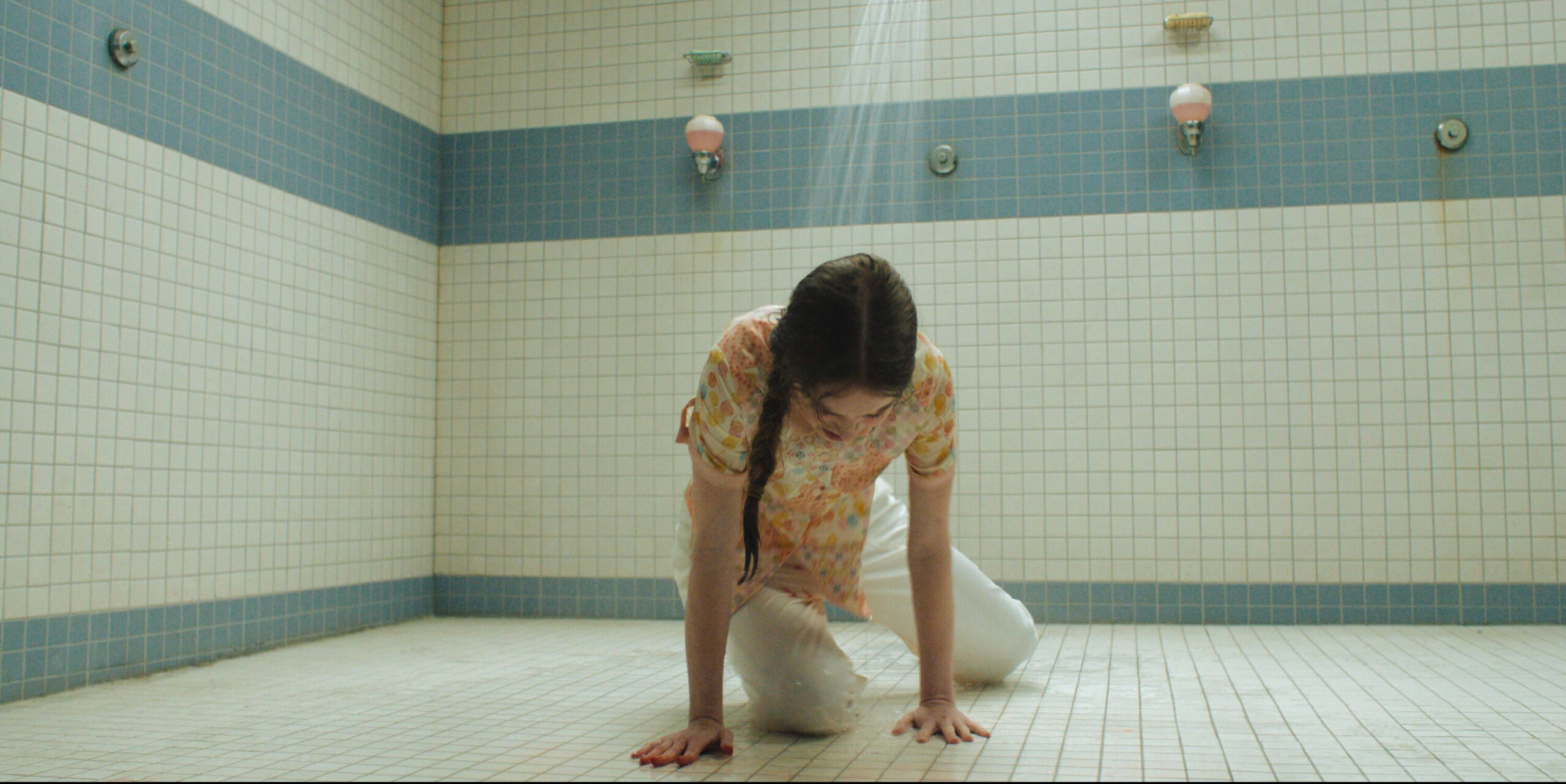
On the opposite end of this fiery conclusion is an extreme act of bullying that brings together the story’s main cast. King’s novel begins as Carrie gets her first period while showering in the girls’ locker room. Completely unaware of the concept of menstruation, the sheltered girl thinks she’s bleeding to death. Her classmates respond with vitriolic rage. Led by ultra-mean girl Chris Hargensen (Alison Thornton), they mock the terrified teen while pelting her with tampons. Glimpses of this disturbing event reveal that Flanagan has excised the scene’s nudity while adding a seismic update. As Carrie sobs in the shower stall, Chris and her friends film the breakdown with their phones.
Other scenes note the presence of social media, bringing King’s fifty-year-old story into the digital age.
Flanagan’s adaptation promises to explore the destructive power of social media, an often invisible entity with a potential for harm rivaling Carrie’s own powers. While King’s tormented heroine suffers in front of a small group of girls, Flanagan’s version of the incident will likely become a viral video, potentially circling the globe on social media. Similar to Katt Shea’s criminally underrated The Rage: Carrie 2, which includes elements of revenge porn exploitation, Flanagan’s modern retelling will distinguish itself by exploring the nebulous cruelty of online bullying, a force ten times more powerful than the irl pranks King first envisioned.
A Completely Reimagined White Family

In addition to modernizing these canon events, Flanagan hints at updates to Carrie’s oppressive upbringing at the hands of her mother, Margaret White (Samantha Sloyan). Dead before the novel begins, we never meet Carrie’s domineering father Ralph, known to carry a bible alongside his gun. Flanagan’s White household will be an altogether different beast. In his version of the story, Carrie and her mother have been hidden away in the unassuming home, forced out of hiding by Ralph’s unexpected death. Perhaps we will finally meet this elusive man whose shadow hangs over his wife and child. Considering the White family’s fundamentalist lifestyle, this reimagining hints at tradwife culture and a home ruled by staunch patriarchal control.
Whereas King’s Carrie has been tormented by her classmates since Kindergarten, Flanagan’s Carrie will be a wide-eyed newcomer to public school, eager to make friends and engage with her peers. We glimpse Carrie cozying up to Chris and the equally popular Sue Snell (Siena Agudong) as she navigates a new social scene. Of course, we know this kindness is part of an elaborate plot designed to lull Carrie into a false sense of camaraderie, setting up an atrocious act of public humiliation. These brief moments of feigned compassion put Sue’s own complicity into question. Will Flanagan’s version of the character find the courage to defend Carrie from vicious bullies or will she succumb to peer pressure and join in the mob mentality?
Perhaps the biggest deviation from King’s original text is the relationship between Carrie and her mother. King’s Margaret White is a horrifically abusive religious zealot whose worldview has been hardened by internalized misogyny. She shames Carrie for menstruating, locks her in a closet to “pray,” and regrets not killing her child in infancy. She’s also responsible for Carrie’s social ostracization. Known to berate her neighbors for their “sins,” Margaret forces her daughter to live by an extreme code of conduct and disallows any potential friends lest they corrupt the girl with their worldly ways.
Flanagan’s version of the character is perhaps just as much a victim as Carrie herself. Also trapped inside her home, his Margaret is overly vigilant, her own trauma manifesting as strict control. Describing a more sympathetic depiction of the iconic villain, Flanagan explains, “Our Margaret White is a woman who fiercely loves her daughter and wants to protect her from this world … [She] doesn’t know how to do that and thinks the way to protect her is to close her off; not punitively, but to create this private utopia.”
Despite this potential softening, Sloyan’s Margaret may still have a sharp edge. Though she has appeared in many Flanagan projects, from Hush (2016) to The Fall of the House of Usher (2023), she is best known for her role as the abhorrent Bev Keane in the poignant saga Midnight Mass (2021). Perhaps inspired by King’s Margaret White, Bev is pious and sadistic, willing to punish anyone who does not adhere to her warped approximation of Catholicism.
Flanagan specifically wrote Margaret with Sloyan in mind, likely remembering the actress’s eerie ability to create deceptive empathy and shift our allegiances on a dime.
Expanding Stephen King’s Telekinetic Universe

While most of King’s story deals with an unthinkable prom night in Chamberlain, Maine, large sections of the semi-epistolary novel see experts debating the nature of telekinesis. Do Carrie’s frightening abilities represent a new phase in human evolution or is the prom night carnage merely a fluke? King settles the debate with a shocking denouement in which a young mother recounts her infant daughter’s ability to dangle her crib toys in midair. We’re left to wonder if she will become another tormented girl who surprises the world with metaphysical strength.
Flanagan plans to build out this brief scene while amplifying themes of female empowerment. After introducing our main cast of characters, episode two will open with an unrelated story in which we meet another girl with the TK gene. Each subsequent chapter will expand this world, building out a roster of telekinetic young women. Considering King’s fondness for stories about powerful kids, often described as possessing “the shining,” Constant Readers will no doubt have their eyes peeled for various Easter Eggs nodding to the author’s vast catalogue.
Giving Carrie Her Own Voice

Perhaps the most striking distinction in Flanagan’s new trailer is the extent to which we hear Carrie’s voice. The sneak peek is fully narrated by the titular prom queen as she demands accountability. “I want to know why,” she explains while detailing Chris’ elaborate plan. Aside from the aforementioned coda, King’s book essentially ends with the aftermath of the prom night tragedy, leaving little time for Carrie to reflect. His shifting narrative does bring the reader into her fragile mind, though not before she’s been cowed by relentless cruelty. We watch Carrie sink into bloodthirsty revenge, but never hear a considered desire for justice or repair.
Flanagan’s original monologue allows Carrie to voice her pain and mourn the life she could have had. We’re also treated to a mug shot-style photo of Chris with a bruised and bandaged face, implying that the mean girl will have to answer for her senseless sadism.
Flanagan is known for filling his series adaptations with heartwrenching speeches that cut to the heart of his thematic intentions, and this teaser seems to follow suit. After years of fans, critics, and scholars analyzing Carrie’s pain, perhaps his modern retelling will offer the titular anti-hero a chance to finally speak for herself.

You must be logged in to post a comment.