Editorials
10 Mistakes That Nearly Ruined Otherwise Great Horror Games


Have you ever had that moment where you’re blissfully mowing down Necromorphs with your plasma cutter or literally mowing down zombies in Dead Rising, only to come across that part of the game that almost ruins everything? Pretty much every game has it, but that doesn’t lessen the blow when you finally find it. It’s like when someone violently shakes you while you’re sleeping, ruining the amazing dream you were having about that saucy minx who works at the Starbucks near your work. You go there every day–even if you don’t want a coffee–just to see their face. If you’re feeling extra brave you might pretend to forget your usual order, just to see if they remember you. Then when they aren’t there or they don’t remember you, you’re struck by a wave of sadness that only a Mountain Dew Pitch Black and a hug from TJ can soothe. Oh, and you should definitely check out the ten games that came close to ruining everything after the break.
10. The Time Limit (Dead Rising)

Obviously, this is a matter of personal taste. Some people hate the time limit, then there are the freaks who love it. Despite falling into the former group, a very small part of me can understand the appeal of the time limit. It’s a staple of the Dead Rising series, so it probably won’t be going anywhere anytime soon. I can live with that, but for me, the penalties for failing to stay on schedule are way too harsh. I don’t think I should be punished for straying from my objective so I can use this bitchin’ new electric lawnmower I just crafted with some tape and my firm, calloused man hands.
9. Too Ambitious (Alone in the Dark reboot)

Alone in the Dark burned me pretty bad, but hidden under that thick, nearly impenetrable layer of awful were some exceptionally well-made environments, a haunting soundtrack and some fucking incredible fire effects. Unfortunately, its ambition proved too heavy a burden and it eventually crumbled under the weight of its lofty aspirations. The manual healing, inventory and use of its awe-inspiring fire effects were grand ideas, but either they were too much for the developer to handle or they were left unfinished thanks to budget and/or time constraints. The end result was a buggy, unpolished game with a lot of unmet potential.
8. Not Ambitious Enough (The Suffering: Ties That Bind)

“Too ambitious” isn’t the worst thing a game can be. In fact, as we continue to get sequel after sequel, my desire for more unusual games only gets stronger. All The Suffering: Ties That Bind had to do was take what its predecessor did well and build off that. Instead, it squandered its potential by playing it safe and offering much the same experience the first game did, essentially killing the promising new series.
7. The Controls (Rise of Nightmares)

Hyped as the first real horror experience for the Xbox 360’s Kinect, Rise of Nightmares had the exciting opportunity to give us an experience we hadn’t had before, and one that couldn’t be offered on any other console. It was a little cheesy, though it never quite reached a House of the Dead level of delicious cheesiness, and the gore was delightfully over-the-top. Sounds great, right? Sadly, no. The controls were a hot mess, almost completely ruining an otherwise solid piece of B horror entertainment. At the very least, Rise of Nightmares did manage the impressive feat of dethroning Resident Evil as the reigning king of tank-like controls. When getting your character to walk in the right direction is the most frustrating thing about your game, you have issues.
6. Hot Boner Sniping (Shadows of the Damned)

First off, I think we should all agree that the above line is the best thing you’ve ever read. Shadows of the Damned certainly didn’t reinvent the horror genre, as I would’ve liked it to, but it did offer a damn enjoyable chunk of horror comedy gold. It was sexy, raunchy, bizarre, and had enough gore to make Eli Roth uncomfortable. In other words, it was incredible. I can only hope it will get the sequel it so badly deserves and that its developer has learned how painful it is having to sit atop a rooftop sniping demons with your smoking hot boner. That level sucked so much scaly demonic ass that I still have a bitter taste lingering in my mouth a year later.
5. Where My Scares At? (F.E.A.R. 3)

F.E.A.R. 3 had the greatest chance of being the scariest game in the fairly terrifying F.E.A.R. series. Sure, the series tends to rely a little too heavily on jump scares, but the atmosphere has always been very unsettling, almost as if Alma’s eyes were on you at all times. Even with John Carpenter (Halloween, The Thing) and Steve Niles (30 Days of Night) lending a hand F.E.A.R. 3 was still about as scary as a coloring book. Other than a total lack of scares and a bland cast of enemies, F.E.A.R. 3 was good fun and its multiplayer was easily the best of the series.
4. The Ending (Condemned 2: Bloodshot)

Condemned is an incredible series. It’s brutal, consistently terrifying and up until Bloodshot’s conclusion came along and left us all in stunned silence with our jaws agape, it was somewhat based in reality. Overall, the sequel improved on many of the things that went wrong in the original and the more in-depth crime scene investigations were welcome additions. Unfortunately, while Criminal Origins was somewhat believable, the head-explosion-shout-blast ability, government conspiracies and ancient cults threw the series deeply into the realm of what-the-fuck?
3. Shoot The Asteroids! (Dead Space)

If you thought Shadows of the Damned’s god-awful stationary shooting level was awful, Dead Space had two and there weren’t any penile puns to make them at least a little amusing. I can’t tell you how many times I watched with tear-filled eyes as an asteroid floated gracefully toward me, my fingers mashing every goddamned button on the controller as my turret slowly reloaded until I saw the explosion in my peripheral and my turret’s health reached zero. It was traumatizing, and what made it worse was how scrotum-pinchingly great the rest of the game was that surrounded those two levels. It’s a good thing developer Visceral Games decided to exclude turret sections from Dead Space 2, because I don’t think my fragile mind could’ve taken it.
2. Wesker Showdown (Resident Evil 5)

All I should really have to mention here is there’s a point where Chris has to punch a boulder the size of a Volkswagen to clear the way for Sheva. Look, Chris could almost definitely break me in half and I realize that not ten minutes prior to that moment Wesker was throwing fucking missiles at you, but punching boulders that very obviously weigh a couple tons is even a little too much for my heavily jaded suspension of disbelief. As if that wasn’t ridiculous enough, the actual fight with Wesker felt more like tag, only in this version you’re immediately killed and have to watch as your body plummets into the surrounding lake of lava if Wesker manages to get anywhere near you. Dear developers, in no game are instant deaths anything but annoying. Not ever.
1. The Enemies (Silent Hill: Downpour)

In an ever-expanding sea of disappointing Silent Hill sequels, Downpour was like seeing a lighthouse off in the distant fog. A lighthouse made of pizza and Mountain Dew, beckoning you with its come hither eyes. It was a symbol that there’s still hope left for the series and for a major survival horror release in a post-Dead Space/Resident Evil 4 world. I’ve already touched on this in my review, but Downpour’s one near-fatal flaw is the black hole of originality that is its arsenal of monsters. The music, atmosphere, puzzles and story are all there, but the only disturbing thing about the creatures you fight is how utterly bland they are.
Toss Adam an email, or follow him on Twitter and Bloody Disgusting



Auteur Filmmaking is a term that gets thrown around a lot these days in reference to big name directors like Quentin Tarantino and even Wes Anderson, but the truth is that film is a collective medium, and no one person can be responsible for every single aspect of a particular production. However, the smaller a film’s budget, the bigger the individual impact of every creative decision behind it – and the easier it becomes to identify a genuine auteur.
This isn’t necessarily a judgement of value, as blockbuster filmmaking comes with its own challenges and a good movie remains a miracle regardless of how big the crew is, but I’ve always been more interested in soulful b-movies produced by handfuls of passionate artists than blockbusters backed by creative armies.
That’s why I love exploring low-budget franchises that never left the hands of their original creators, as you really get to know the artists involved with these flicks and can accompany their evolution over a period of time. With that in mind, I’d like to invite readers to join me in this multi-part series as we look into a vampire saga helmed by one of the most fascinating auteurs of the 1990s. Naturally, I’m referring to Ted Nicolaou’s criminally underrated Subspecies!
The Birth of an Unlikely Horror Franchise

A proud graduate of the University of Texas’ Film program, Nicolaou got his start in the industry as a sound technician working on Tobe Hooper’s original Texas Chain Saw Massacre. From there, the filmmaker would go on to work for notorious indie producer Charles Band, the founder of both Empire Pictures and Full Moon Productions. According to Nicolaou, Band would usually contact him with an offer to direct a feature after more prominent filmmakers, such as the late, great Stuart Gordon, had already refused, meaning that his projects tended to have lower budgets and more inexperienced crew members.
The plans for Subspecies began almost immediately after the fall of Romanian dictator Nicolae Ceaușescu, with screenwriter David Pabian turning in an initial draft of the film after a Romanian producer contacted Band and explained that Romanian tax incentives could cover the cost of film production there so long as Full Moon took care of the post-production process. Since Stuart Gordon was unwilling to travel to Romania, Ted Nicolaou ended up taking over the picture.
However, while the financial incentives meant that this Romanian-American co-production could look and feel much more expensive than it really was, with Nicolaou scouting for locations in advance and selecting real castle ruins to be featured in the movie, the director was soon faced with an incredibly difficult shooting process. In interviews, Nicolaou would later describe the experience as something of a nightmare, with language barriers and the generalized distrust of capitalist outsiders sabotaging many of the team’s plans for the film.
In fact, the script, which had already been altered by Band, ultimately had portions of it rewritten by both Jack Canson and Nicolaou himself in an attempt to adapt the story to their unique limitations.
Radu Is One of Horror’s Greatest Underrated Villains

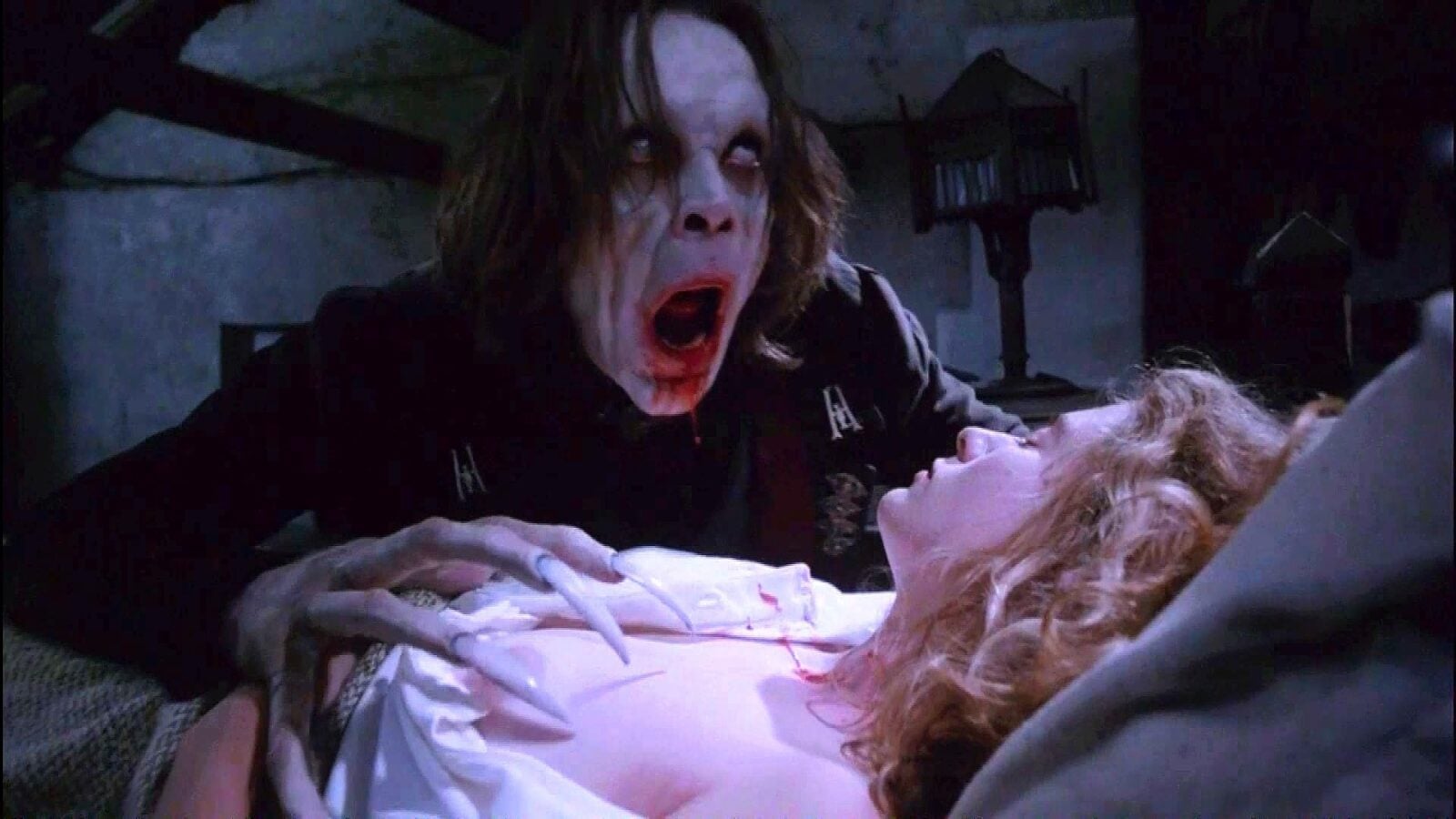
In the finished film, which was released directly to video in 1991, we follow a pair of American anthropology students, Michelle (Laura Mae Tate) and Lillian (Michelle McBride), as they reunite with their Romanian colleague Mara (Irina Movila) in her native land. The group intends to study the folklore surrounding the secluded town of Prejmer, but their research is cut short by the return of Radu Vladislas (Anders Hove) – the evil son of a vampire king (Angus Scrimm) who had previously established a truce with the region’s human residents. It’s now up to Radu’s human-loving half-brother Stefan (Michael Watson) to protect the girls from a fate worse than death as the power-hungry vampire seeks to control a magical artifact known as the Bloodstone.
Right off the bat, you may have noticed that the film’s premise sounds decidedly old-fashioned when compared to other vampire movies from around the same time. While the 1990s saw the rise of cool-looking bloodsuckers with badass elements borrowed from Westerns, as well as the sexy aristocrats of Anne Rice’s stories, Subspecies has a lot more in common with Nosferatu and the Hammer Horror series than any of its contemporaries.
This is both a blessing and a curse, as the film falls victim to overly familiar genre tropes while also standing out as a rare example of a ’90s vampire flick that isn’t afraid to flex its muscles as a Creature Feature. In fact, I’d argue that the presence of age-old clichés is a small price to pay when confronted with one of the most compelling vampire antagonists in all of cinema.
Named after Vlad the Impaler’s real-life brother, Anders Hove’s Radu is such a fascinating character and the main reason why Subspecies is still worth watching 35 years later. From his animalistic mannerisms to the joy he feels in simply existing as a chaotic creature of the night, and that’s not even mentioning the iconic makeup that almost certainly inspired the undead from Buffy the Vampire Slayer. Radu is a hypnotic presence harkening back to a time when audiences didn’t mind purely evil villains that couldn’t be redeemed through tragic backstories or sex appeal.
Gothic Atmosphere on an Indie Budget

Of course, the film’s Romanian setting and authentic art direction do a lot of the heavy lifting whenever Radu isn’t around. From the masked festivals of the village to the visually interesting selection of local extras, Subspecies’ multicultural elements help it to stand out when compared to similar flicks from the ’90s.
That being said, Nicolaou’s unique eye for special effects and exciting action sequences – as well as Vlad Paunescu’s excellent cinematography – make the movie a delight for fans of expressionist cinema and old-timey gothic horror. While the crew is obviously dealing with limited resources, many of the flick’s blemishes (such as the odd stop-motion demons that serve Radu) end up feeling more like charming idiosyncrasies than actual flaws.
I’d argue that the only real issue here is pacing, as there are long stretches of film where the protagonists are simply bumbling around without realizing what’s really going on around them. Thankfully, the gorgeous visuals and surprisingly effective soundtrack usually make up for this. Besides, how can you dislike a movie where shotgun shells are loaded with rosary beads and our lead vampires duke it out in a dramatic swordfight that would feel out of place during the golden age of Hollywood?
Your overall enjoyment of Subspecies will mostly depend on whether or not you find low-budget corner-cutting and janky practical effects charming rather than distracting, but I know I’ll keep coming back to this Full Moon feature again and again in the future.
That being said, while this first movie is worth revisiting by its own merits as the birth of an indie horror icon, I’d like to invite you to join us as we look into the cult sequel Bloodstone: Subspecies II soon.
You must be logged in to post a comment.