Movies
Special Feature: ‘Scream 4,’ Slicing Into New Rules & Conventions

In the decade-plus period of time that has passed since the release of Scream 3, there’s no doubt that the horror landscape has changed significantly. In the intervening years we’ve witnessed the rise of the torture porn craze, seen a resurgence in “found footage”/shaky-cam horror, and watched helplessly as a seemingly unyielding series of remakes cluttered up our local multiplexes.
Given all of these developments, the makers of Scream 4 (releasing April 15th!) have been handed a wealth of new rules and conventions to work with, and in the following feature B-D’s Chris Eggertsen takes a look at some of the most significant ones – along with examples of the films that utilized them – that may or may not make an appearance in the upcoming sequel.
See inside for the full list, and study it carefully. Remember, knowledge is power.
Since the turn of the millennium (remember Y2K?) we’ve seen the ascension of torture porn and J-Horror, been assaulted by an insane amount of mostly crappy remakes, seen a huge resurgence in the “found footage” sub-genre (remember The Blair Witch Project?), and witnessed the coining of the term “Web 2.0” (remember dial-up?). Hell, in the year 2000 only about half the citizens in this country even owned a cell phone! (remember antennas?)
Of course, as much as the world has changed since the bygone era of Jennifer Love Hewitt worship and shitty nu-metal bands, the basic Scream template remains the same: skewer the rules and conventions of the horror genre in a clever and entertaining way. What matters this time around is just how the creative minds behind the latest entry will incorporate the new horror rules and conventions that have cropped up over the last decade or so, not to mention which ones they decide to take on (hint: given what the Scream films are, we probably won’t be seeing any long-haired “Samara”-style wraiths making an appearance).
Now, in anticipation of the release of the hugely-anticipated slasher sequel (mark your calendars!), B-D reporter Chris Eggertsen takes a fun look at ten of the key clichés and conventions from the last decade in horror that may or may not be tackled in the upcoming third installment of the legendary slasher franchise. But study them carefully – for if your own life goes all Meta and you find yourself caught in the midst of an honest-to-god slasher-movie killing spree, paying close attention just might save your skin.
“The person holding the video camera is far more likely to survive up to at least the final reel.”
Movie Examples: The Last Exorcism; Cloverfield; REC/Quarantine; Diary of the Dead
This rule is predicated on basic narrative necessity more than anything; indeed, there wouldn’t be much of a movie if the person filming the bloodbath were to bite the dust in the first or second act. As such, it would probably behoove a potential horror movie victim to volunteer for camera duty.

“Those with a serious criminal or amoral past – and/or those who have engaged in severely self-destructive behavior – are far more likely to kick the bucket than those with a relatively clean slate.”
Movie Examples: Saw I-VII
This rule really only has a basis in the Saw movies, but when you consider that the “torture porn” franchise is the most profitable and influential of the last decade, its potential for influencing a budding psychopath is pretty great. And look, it ain’t the ‘80s anymore. Just smoking a doobie or engaging in a little coital fun isn’t enough to guarantee certain death in a 21st century horror film. As Jigsaw showed us in all seven installments of the uber-gory series, you’re especially likely to be targeted if you’ve either engaged in some particularly naughty past behavior – think fleeing the scene of a crime, engaging in predatory lending practices, or, you know, raping and killing people – or demonstrated a lack of appreciation for life by, say, abusing drugs or attempting suicide. So while it may not keep them from ultimately waking up strapped to some sort of bizarre medieval torture device, potential victims can at least better calculate their odds of survival by tallying up their past transgressions. Also, if you didn’t take time out to appreciate your crummy life before, you’d damn well better start now.

(SPOILER ALERTS AHEAD!) “The Final Girl isn’t necessarily the final girl.”
Movie Examples: Wolf Creek; High Tension; Death Proof; Cabin Fever; Friday the 13th (remake)
While in the past we could almost always rely on the old “Final Girl” trope – i.e. the kindest and most virginal young woman of the bunch being the most likely to survive – unfortunately for the mousier contingent among us that rule isn’t quite as relevant as it used to be. For as we’ve been shown in quite a few horror flicks over the last decade –remember poor “head on a stick” Liz in Wolf Creek? – the ultimate survival of the supposed Final Girl is no longer a given.

“The kills are more brutal, drawn-out and extreme.”
Movie Examples: Saw I-VII; Hostel I & II; any film that could be classified as “torture porn”
It’s sad to say, but simple stabbings are basically old hat at this point, and not even unconventional weaponry really makes the cut anymore – indeed, by the late ‘80s Jason had already sorta driven that whole “let’s see what kinda damage we can do with [insert name of unlikely weapon here]!” thing into the ground (not that we don’t welcome it, necessarily; it just isn’t novel anymore). No, in the 21st century the quick kill has been replaced in many instances by drawn-out scenes of excruciating torture, a la movies like Saw, Hostel, and the wave of increasingly-brutal “French extremity” films. Note to potential victims: if there’s absolutely no hope of escape and you suspect you may be next in line for a long and painful evening at the local torture chamber, you might wanna consider engaging in a little hari-kari action before the killer has a chance to drag you off.

“If a strangely charming individual with either a German or Eastern European accent: a) proposes drinks at his/her place; b) suggests a night of kinky sex (this particularly applies if you write for the internet and/or have a basic hygiene problem); c) offers you shelter from a rain, sleet, or snowstorm, or d) otherwise seems interested in spending a little alone time with you in a remote location, you’d do best to high-tail your ass in the other direction.”
Movie Examples: Hostel I & II, The Human Centipede (First Sequence)
While the majority of ‘70s and ‘80s slasher and splatter flicks that inspired the first few Scream movies featured distinctly American-grown killers, with the introduction of the first Hostel movie we were introduced to the concept of creepy foreign people. See, not only are German and Eastern European accents scary, but the region is also apparently home to some truly perverted weirdos. In other words, don’t trust any dude with a name like Wolfgang or Dragos – it’s a recipe for certain death. Oh, and that hot chick Tatyana from the Czech Republic? Chances are she’s aiming to sell your ass to some fucked-up underground torture society in Belarus. Remember, the happy fun-time days of Shannon Elizabeth in American Pie are long over.

“Tortured back stories and vaguely sympathetic character motivations are so last century.”
Movie Examples: Hostel I & II; The Strangers; Wolf Creek; Them; Orphan; The Human Centipede (First Sequence); House of 1,000 Corpses; The Devil’s Rejects; Funny Games (remake); The Collector
Sure, the slasher revolution started with Michael Myers in Halloween – a man of “pure evil” who had “the blackest eyes” (according to Sir Donald Pleasance) – but most of the copycats that followed usually featured killers with at least some apparent reason for picking up that machete and hacking up a bunch of horny co-eds. Even the first three Scream films – despite Randy’s contention that in “the millennium, motives are incidental” – tied at least one of their killers’ motivations to some traumatic past event. Not so anymore, as over the last few years the pendulum seems to be swinging back in the “crazy-for-crazy’s-sake” Bates/Myers direction, holding true to Stu’s observation in the first Scream that “it’s a lot scarier when there’s no motive”. Need I bring up Rob Zombie’s lackluster “nurture over nature”-heavy Halloween reboot as evidence? Ah well, too late.

(SPOILER ALERTS AHEAD!) “It’s never safe to bet on ‘happy’ endings anymore.”
Movie Examples: Saw I-VII; Wolf Creek; The Grudge; The Ring; The Last Exorcism; Pulse; Final Destination I-IV; Paranormal Activity; The Strangers; Texas Chainsaw Massacre: The Beginning; House of 1,000 Corpses; The Skeleton Key; Them, The Collector; Funny Games (remake)
It’s no surprise that in our increasingly cynical age, the bad guy in horror films has racked up a more impressive win/loss ratio than perhaps at any other time in the history of the genre. Just look at some of the most popular and influential movies from the last decade: J-horror fare like The Grudge, The Ring and Pulse are good examples of this rule, not to mention virtually every found footage/camcorder flick ever (Paranormal Activity and The Last Exorcism being two that immediately spring to mind). Hell, just look at the final outcome of the entire Saw series – it doesn’t get much grimmer than that. In short, betting against the killer(s) isn’t near as fail-safe a wager as it used to be.

“Social subtext is big again – the key to unlocking the nature or identity of the killer(s) could lie in the ills of society itself.”
Movie Examples: Saw I-VII; Hostel I & II; Land/Diary/Survival of the Dead; Cabin Fever; Shaun of the Dead; The Hills Have Eyes (remake)
While the ‘80s spate of mostly mindless slasher films provided the majority of self-reflexive ammunition for the first three Scream entries, the “aughts” returned to the subtext-laden thematics of horror flicks from the late ’60s and early ‘70s. As such, it might give potential victims a good amount of insight (and perhaps even increase their chances of survival) if they go into “ivory tower mode” by searching out possible explanations for the mayhem in the context of society’s larger problems. Perhaps this time around Ghostface is some crazed, geriatric Tea Party adherent, aiming to cut down on the number of young Obama supporters prior to the 2012 elections? I wouldn’t necessarily rule it out.

“To increase your chances of survival, take some time to study the remakes.”
Movie Examples: Halloween; Friday the 13th; A Nightmare on Elm Street; Texas Chainsaw Massacre; Prom Night; When a Stranger Calls; My Bloody Valentine 3D; The Hitcher; The Amityville Horror; The Hills Have Eyes; Dawn of the Dead; House of Wax; I Spit on Your Grave; The Omen; Last House on the Left; The Fog; The Crazies; The Stepfather; Black Christmas; Sorority Row; probably more I’m not thinking of
The most ubiquitous horror trend over the last decade is undoubtedly the remake phenomenon, meaning potential victims can’t merely look to the originals any longer to uncover the keys to their survival. While certainly a few of the films are forehead-slappingly derivative of their original source material, others have changed the conventions up a bit and, painful as it may be, it would behoove those who find themselves in the midst of a bloody killing spree to add a shitload of these bad boys to the top of their Netflix queue. Just pray you can get through them all before the killer catches you passed out from boredom on the living room couch.

“When in doubt, do the opposite of everything you learned in the first three Scream movies.”
Movie Examples: Scream I-III
As one character in the Scream 4 trailer smartly points out, “the unexpected is the new cliché”. In other words, potential victims will significantly increase their chances of survival if they do the opposite of whatever rules of slasher-dom they were urged to follow in the first three entries. Feeling a little horny? Go have sex with someone, quickly! Acting the part of the shameless, dirty slut just might save your neck. “Magical cigarette” being passed around at the party after prom? If you value your life, you’d do well to take a puff. Also, work the phrase “I’ll be right back” into every conversation you can, even when it isn’t 100% warranted. It may end up annoying the shit out of your friends and loved ones, but if you enjoy breathing you’d do best to ignore their bitching. Also, dudes – get off your sorry asses and try out for the football team. And while you’re at it, start acting on all those buried Alpha male instincts of yours and push a science geek or two up against a locker (further “survival points” will be awarded for wedgies and toilet dunking). As for all the ladies out there – for the love of god, get a freakin’ boob job and join the cheerleading squad. In this day and age, those puritanical attitudes you’ve been harboring could equal death.


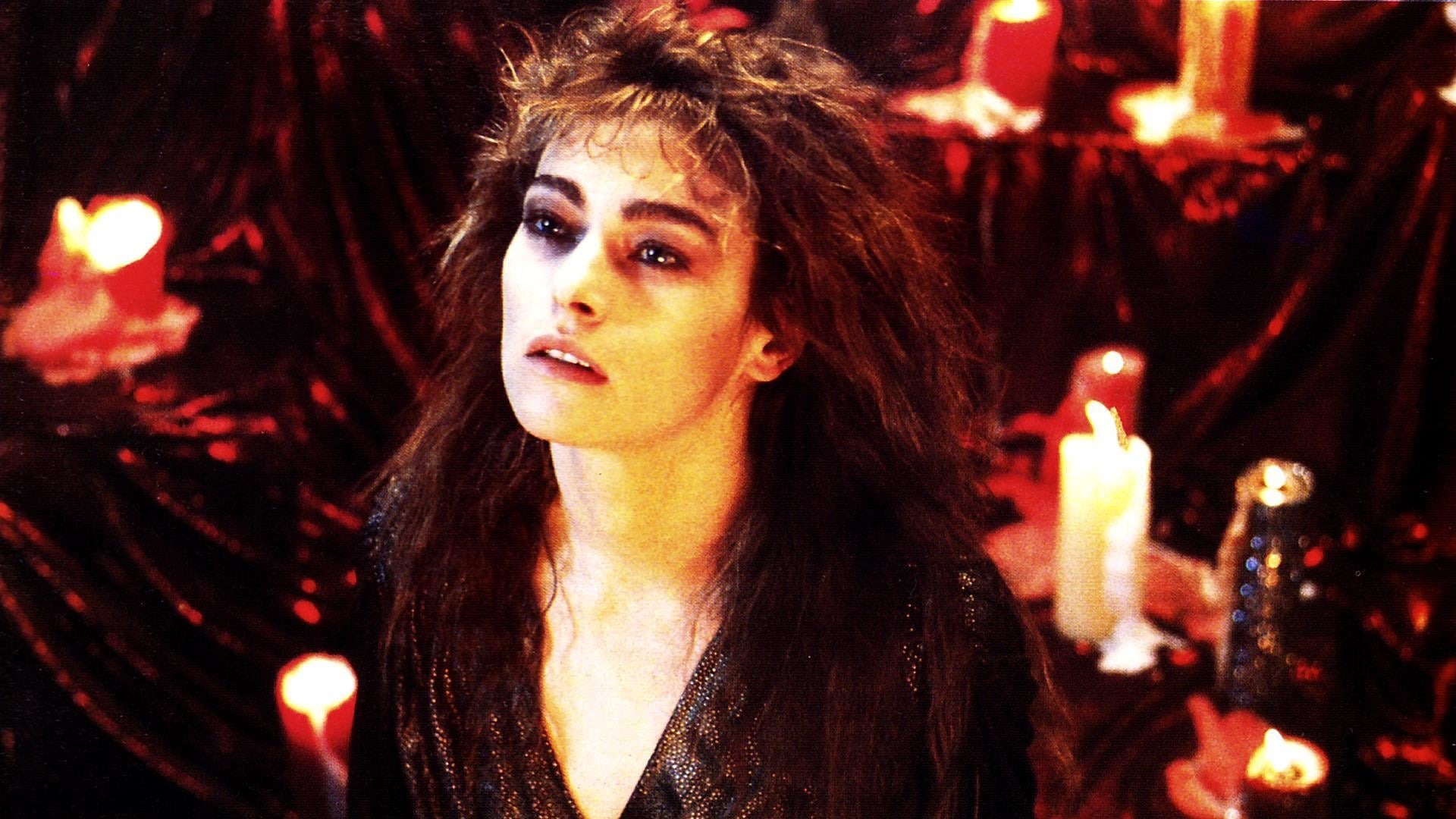
Horror was thriving so well in the 1980s that movies like Pen Densham’s The Kiss (1988) would understandably get lost in the shuffle, only to then gain their fans later on in life. Even still, this one Canadian-American curio has had a more challenging time than others, as far as contemporary reevaluations go, which is very likely due to the movie’s limited availability—at least as of this write-up.
However, the scarceness of The Kiss, while a bit annoying, makes it like catnip for ‘80s horror completists everywhere. Hopefully, a lot of them will walk away satisfied after watching this hidden gem.
Even though The Kiss was intended as the first of several horror collaborations between Astral Pictures and TriStar, as well as the first feature produced by Densham, Richard B. Lewis and John Watson’s Trilogy Entertainment Group, it ended up being the only one produced from that former union. Once the movie was released, TriStar’s distribution jitters—they opted for a regional rollout—did the $6-million flick no favors. TriStar’s cold feet toward horror releases have been well noted, but The Kiss still did a tad better than Night of the Creeps (1986), another genre outing that flopped due to its regional opening.
Shot in Montreal, but set in Albany, New York, The Kiss—which was still called The Host just a few months before its October premiere—concerns an average middle-class family and their forthcoming situation. The uncanny problem in store for them was, in fact, set in motion some years earlier. As that hot and dusty flashback to the Belgian Congo shows, a familial curse was set upon the two Dunbar sisters well before Meredith Salenger’s teenage character was born.

Meredith Salenger, Nicholas Kilbertus and Mimi Kuzyk in The Kiss
The Kiss, which was based on a story by co-writer Stephen Volk (Ghostwatch) and penned by both Volk and Tom Ropelewski, has the outward appearance of The Stepfather (1987). This movie, though, is anything but a gender-flipped retread of that classic domestic disturber. For starters, The Kiss is far less grounded in reality—that much is clear from its unsettling opening scene. There, a trusting girl (Priscilla Mouzakiotis) is the victim of her own deceptive aunt (Céline Lomez); the movie’s titular act, and the story’s first shock, becomes the means of transferring an ancient evil from one host to another.
In the present day, Salenger’s role of Amy Halloran, a religious schoolgirl, is dealt a harsh blow in life once her mother, Hilary Halloran née Dunbar (Pamela Collyer), suddenly dies in a freak accident. But rather than a complete stranger sweeping the Halloran widower (Nicholas Kilbertus) off his feet some months later, Joanna Pacula’s character is that chosen temptress. Here, Pacula plays the grown-up version of the afflicted girl last seen in the movie’s opener. Since Amy’s mother is insistent about there being no reunion between estranged sisters, and she even contemplates buying a gun shortly before her tragic demise, it’s presumable that Aunt Felice poses a threat to her family.
The Kiss isn’t a movie ever too concerned about its own predictability. The audience is indeed often one step ahead of the story here, but also keep in mind how every one of those steps is loud. Take, for instance, the death of Amy’s mother; the Halloran matriarch goes out in garish, gruesome fashion, as a supernaturally commandeered truck sends Collyer’s character through a store window first, then leaves her one leg short. The directorial enthusiasm truly comes out in horrific moments such as these.
The Kiss is always sure to revel in its characters’ ills and misfortunes. So if the plot doesn’t impress, then its lurid parts should. Amy’s mother’s exit scene was proof of an eager, first-time horror director proving his worth. Then, bestie Heather (Sabrina Boudot) survives to tell the tale of a bizarre escalator mishap that, despite showing relatively less gore, spikes viewers’ empathy meter. The wilder bits of this movie, however, commence with that inevitable hookup between Felice and Amy’s bewitched father; their kitchen coitus is paralleled by Amy’s feverish classroom terror. The outcome there is a disquieting cross-cut of sex magic and a young woman’s menstrual onset plus hallucinations.

Sabrina Boudot in The Kiss
From foam appliances to bladders, that parade of special effects in The Kiss casts its own spell on the audience. Felice’s familiar, a visibly malevolent cat, was realized here with several models, some more articulate than others. Admittedly, the demon cat’s not as convincing as most of the effects here, but accepting that artifice, as opposed to fighting it, will make the whole experience way more enjoyable. As for the makeup used to manifest Felice’s inner villainy, it is more minimal and subtle than one might like; yet the work done to turn Pacula into an antithesis of herself is nonetheless compelling.
The otherworldly perils and dreadful goings-on wouldn’t work half as well as they do in The Kiss without the story’s contrast effect. Finding frights in picturesque, extremely ordinary settings was something that took off in the ‘80s, thanks to that sweeping shift to locales like the suburbs. And Amy’s home, a replica of a real Montreal suburban house, is the ideal battleground for any proper good-versus-evil story. It’s also prime real estate for this movie’s satanic panic-inspired horrors.
Because of their ostensibly similar plots, The Kiss has been compared to The Exorcist (1973). Except in Densham’s movie, the sinister, non-Christian entity targeting a teen girl lies within something less apparent and, perhaps, more devastating upon its exposure. To an outsider, Pacula’s Aunt Felice is too beautiful and unobjectionable to ever suspect of being a monster. More suspicious is how quickly she rips into the fabric of the Halloran home. Felice’s mere presence upsets the “texture of family life,” according to the director.

The demon cat in The Kiss
Taking out Amy’s mother and best friend, and distracting her father, would suggest The Kiss is playing by a different set of rules. It is initially leaving its adolescent target unsupported in a rather grim scenario. In contrast, though, this story offers up a surrogate parent who does her best to fill in the holes of Amy’s eroding home life. Mimi Kuzyk does good work as that family friend and doctor, Brenda, who guides the lost child without also steering her in any one direction; she is naturally skeptical of Amy’s accusations until it’s almost too late to do anything about them. So although The Kiss does an admirable job of undoing the main character’s support system, it never leaves her without a lifeline. This dark movie, in spite of everything that’s transpired, doesn’t deprive itself of light and hope.
The Kiss is a potent mélange of familiar ideas. If not for the director’s surprise flair for horror, though, the movie would have been less effective. What a shame that Pen Densham didn’t continue with the genre. As for Joanna Pacula, she is, too, owed credit as the wicked vixen opposite Meredith Salenger’s pitiable Amy; she never fails to be unsettling in her role. Pacula makes Aunt Felice a sexy yet intimidating character.
For horror that steadily doles out madness and menace, while also delivering a flashy and ghastly conclusion, The Kiss is certain to please. Yes, it’s cheesy all the way, but most favorably, everyone involved plays everything straight. That kind of commitment goes a long way with this movie.

The Kiss
You must be logged in to post a comment.