Editorials
‘The Walking Dead’ Mid-Season Finale Review: Smokey Invasions, Touching Reunions, And Zombie Head Aquarium Brawls!


On Sunday, the mid-season finale of The Walking Dead premiered where a lot happened. We were given more questions than answers, though that isn’t too surprising seeing as the writers want to keep us hooked so we all tune in when the series returns in February. What is surprising is how many smoke grenades Rick’s group brought with them to their little invasion of Woodbury. Between the flashes of gunfire and thick haze, I thought I was at some sort of post-apocalyptic rave. Speaking of which, can we please dedicate an episode to a giant party where the citizens of Woodbury drop their guns and their inhibitions and get freaky? I’m picturing a pulsating mass of writing, sweaty bodies — think Matrix: Reloaded, only with more sex. They’ve been through a lot, I think they deserve it.
Creepy TWD fantasies aside, this episode was pretty great. I promise the majority of my review isn’t as gross as the above paragraph, but what I can’t promise is there won’t be any spoilers. Actually, I can promise there will be spoilers, and lots of ’em. Now let’s dig in.
Before we get into the real meat of this review-cap (that’s my new term for a review-recap, and yes you have my permission to use it), I’d like to get something out of the way first: what the fuck is up with this show introducing a new black guy in the same episode the show’s only other black guy gets killed off? This has happened twice — the first time T-Dog (the wholly underappreciated silent backbone to Rick’s group) was replaced by Oscar, the prison inmate. Then, Oscar is killed off in the same episode they introduce Tyreese, a fan-favorite from the comic. Does this show have a one black guy per episode limit? Do they keep hitting that ceiling, forcing the writers to kill the show’s only black guy to make room for the new guy? I’d genuinely like to know what’s going on there.
Speaking of Tyreese, I’ve never read the comics but I have friends who have, and apparently he’s awesome. I have to say that of the few scenes he had in this episode, he may very well end up being my favorite character in the series.
For starters, when one of his crew is bitten, instead of ordering her immediate execution, he decides to let her live so her husband and son can have a proper goodbye. That’s the most kindness we’ve seen in some time, but it doesn’t end there. When his group makes it to the prison, Rick’s son Carl the Bite-Sized Badass hears their screams and saves the day. He then leads them to safety and immediately locks them in. That’s a smart kid. When a member of Tyreese’s group freaks out at Carl, who stands there absorbing her anger like the little psycho he’s destined to grow up to be, Tyreese defuses the situation.

Tyreese is amazing and I really, really hope a new black guy isn’t introduced any time soon out of a fear of what the writers will do to him if that happens. I’m pretty sure he’ll stay for a while, but if this series has taught us anything it’s that no one is safe.
Back at Woodbury, the newly reunited Glen and Maggie are recovering from a beat-down and a near-raping. Glen, who really came into his own in the previous episode continues to impress me by MacGuyvering a shiv out of the arm of the zombie he killed in the last episode. I was a little worried he’d get some zombie blood in one of his many Merle-induced cuts, but that line of thinking is probably too realistic.
When Merle and his boys come to take the duo to the screaming pits — yeah, I don’t know what that is either, but I’d really like to know now — Maggie buries her shiv into a guy’s neck and almost saves Glen from Merle. Unfortunately, back-up arrives, ruining Maggie’s chances of putting a bullet between Merle’s widely spaced eyes.
Just outside Woodbury, Rick’s group, led by Michonne, are about to make their move. Thankfully, they brought no less than a thousand smoke grenades to confuse Merle and his boys before they can take Glen and Maggie to the screaming pits. A lot of questions were brought up in this episode, but I think the one that’s bothering me the most is just what the hell is a screaming pit? It sounds so delightfully evil, I must know what it is. Anyone know?
Anyway, things at the prison sure are getting creepy, huh? Axel, who we really haven’t had the opportunity to get to know yet is hitting on Herschel’s 17 year-old daughter. At this point I think I know why he went to prison, but it’s not until Carol takes him away to tell him her age when my theory gets confirmed.
When someone tells you you’ve been hitting on a minor and your reaction is “interesting…” you are officially nasty. I gave Axel the benefit of the doubt, I thought perhaps he forgot to pay his taxes, or something harmless like that, but not anymore. Carl has my full permission to lock that creepy bastard in with Tyreese and his group.

When we return to Woodbury, my favorite scene ever happens. After Michonne led Rick and his group into Woodbury, she slipped away so she could wait for the Gov when he returned to his home. Before that exciting reunion can happen, Michonne hears a noise coming from the Gov’s child bedroom and zombie head aquarium room, so she walks in to investigate.
This was a frightening scene. I mean, I know Michonne can handle herself, but she also didn’t know what was going on with the little girl who had a bag around her head. Clearly, she thinks it could be a living girl (we know otherwise) when she starts talking all sweet to it, so when she removes the chain that keeps the zombified girl out of biting distance, I’m freaking out. Just as she removes the bag and see what the girl really is, the Gov finally drops by (that’s some incredible timing, by the way) and he turns full human. His guard, his gun, his creepy semi-sociopath persona, all dropped — and it’s immediately apparent that if this guy has a weakness, it’s his zombie daughter.
Naturally, Michonne realizes this too, so she stabs her in the back of the head.
What. Are you kidding me? First off, what was the reasoning behind that? Killing the Gov’s daughter in front of him as he begged her not to was just as dark as anything he’s done, and the Gov has done some bad things. It didn’t really accomplish much outside of launching a full-on brawl between the two.
This was the favorite scene I was talking about — I love it. I might have played this scene five times, just to really soak it in. Seeing these two go at it, punching, strangling, and kicking at each other for a few minutes was immensely fun to watch. I especially enjoyed watching as they tried to push the other into one of the still very active zombie heads. Unfortunately for the Governor, Michonne has a fondness for jabbing sharp objects into tender flesh — something he learns the hard way when he takes a shard of glass to the eye.
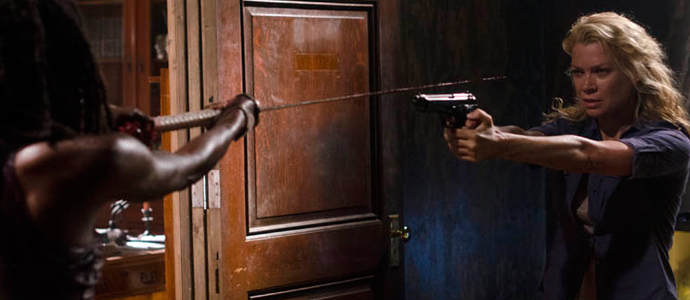
Just as Michonne is about to deal the killing blow, fucking Andrea enters the room, gun held high (in another example of impeccable timing – I felt like I was watching a sitcom, with each actor entering the room right on cue) to do what she does best and ruin all my fun. The two have a brief stare-down before Michonne leaves to reunite with Rick’s group, leaving me with an even stronger hatred for Andrea.
If you didn’t think the Gov was evil before, I can guarantee Cyclops Governor is going to go balls-out crazy in his lust for revenge when the show returns next year. His daughter, which seems to be the only thing that brings out his more relatable, human side, is gone. This guy is pissed, and that’s more obvious than ever after his stirring speech to the (remaining) citizens of Woodbury, where he drops the word “terrorist” a lot and caps things off by throwing all the blame at Merle.
Apparently, the Gov isn’t terribly happy about Merle lying to him about killing Michonne, and this looks like his way of dishing out a little payback for that little fib.
Then, just as you’re wondering if Daryl and Merle are going to be pit against each other in a fight to the death, the episode ends in true TWD fashion — with a cliffhanger ending. We won’t know what happens next until the series return in February, and that makes me sad. The only thing that could possibly cheer me up is comments from you telling me what you thought of this episode. Please?
Have a question? Feel free to ever-so-gently toss Adam an email, or follow him on Twitter and Bloody Disgusting.




College kids, strippers and vampires—those were Donald P. Borchers’ only requirements when he approached Richard Wenk about writing and directing a movie for New World Pictures. As requested, Wenk cooked up Vamp (1986), a tailor-made blend of the decade’s teen movie craze as well as its horror boom.
Grim and earnest stories were still very much a part of the ’80s horror landscape, yet Vamp is something of a comedy. One difference between it and, say, Saturday the 14th, though, is the former avoids using schtick. Wenk’s movie proves that horror comedies also don’t have to subtract thrills from their recipes. Of course, it takes a minute before reaching that point; college antics and culture shocks preface this one macabre misadventure.
Vamp‘s initial setup is apt for a typical college-set, sex-driven comedy; to bribe their way into a fraternity house, two pledges (Chris Makepeace, Robert Rusler) go looking for some adult entertainment. Without wasting time on any further exposition, the characters embark on an all-in-one-night trip that quickly detours into terror.
To procure their elusive MacGuffin—a stripper willing to gyrate for some frat boys—Keith (Makepeace) and AJ (Rusler), plus a third wheel named Duncan (Gedee Watanabe), trade the safety of their remote college campus for the seediness of some unnamed city. The setting is recognizably L.A. by day, but as soon as night falls, downtown, along with the characters, slips into a kind of surreal universe. Director of photography Elliot Davis gave this early entry on his prolific résumé an unusual yet distinctive look; that Mario Bava-esque, magenta-green lighting is omnipresent, so much so that it’s almost its own character.

Chris Makepeace and Robert Rusler in Vamp
The faint comparisons to Martin Scorsese’s After Hours are merited, although not just because of Vamp’s distinguishing nighttime aesthetic. Save for the primary characters, the supporting roles in Wenk’s movie are also quite colorful and transactional in their behavior. The difference here, though, is the additional urge to ruin Keith and his friends at every turn. Some of that harm is humorous and tolerable enough, whereas the moment Vamp dishes out its first fatality, it’s abundantly clear how this movie qualifies as horror.
Vamp falls into that category of horror movie that reveals its genre with a scream rather than a series of whispers. The opening scene can function as a hint of what lies ahead—things are not at all what they appear to be—but otherwise, Wenk is more than happy to hold off on the horror. When that time does come, though, it catches the viewer off guard. In addition to the pure shock value is that sudden decision to upend the movie’s foremost feature. Or so it would seem.
If afraid of major spoilage, those new to Vamp would be wise to stop reading here. There’s just no skirting around the fact that the central fellowship in this buddy movie hits a serious snag when AJ is killed. That development causes the story to become more of a “long, bad night” journey for Keith and his romantic interest. So while Wenk scores points for subverting expectations, there is also a touch of sadness in his decision. Because if Vamp does anything well, it’s making the characters likable.
Something that comes easily to Vamp—and other teen horror movies from this same era—is its ability to invent young characters worth caring about, or at the very least, are interesting and not so immediately off-putting. More impressive is how Wenk did all this without actually fleshing out those characters. Still and all, Keith and his kind are a grade above cookie-cutter, and in some cases, aren’t completely devoid of growth.

Grace Jones in Vamp
Vamp appeals with an assorted cast of characters. No two are the same, nor are they operating on the same wavelength. The cinematically extroverted AJ, whose actor conveyed charm and vulnerability in near equal amounts, comes alive when he’s at his most undead. Makepeace then makes the chronically cautious Keith a sympathetic fellow, even as he’s more and more affected by the night’s bizarre events. Meanwhile, Duncan is indeed the designated loser of the whole bunch, but Watanabe still manages to humanize him. As a bonus, the role didn’t require him to pull a Long Duk Dong.
As for Dedee Pfeiffer, she is plain adorable as the mysterious After Dark server nicknamed “Amaretto”. She spends all night fixing her dress strap while at the same time trying to get Keith to remember how he knows her. As their offbeat romance grows, it becomes another highlight of this movie. Whether or not Pfeiffer’s character is really a vampire also creates some welcome tension in the story.
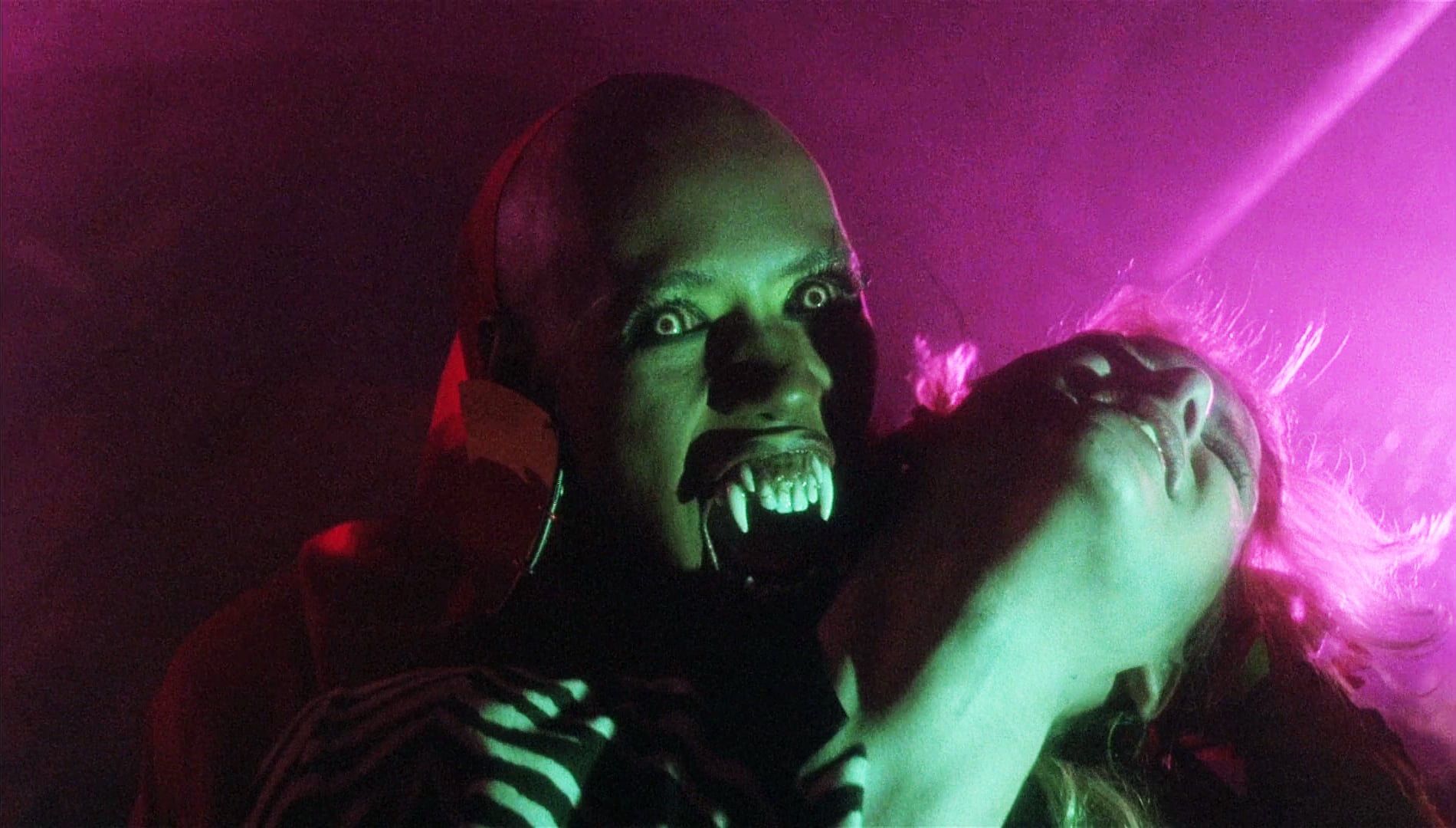
Like a lot of its contemporaries, Vamp went on to become a bit of a cult classic. That current status is determined by several factors, but without a doubt, the casting of Grace Jones is the most considerable. The image of her writhing on that unique-looking chair, a Keith Haring original, springs to mind whenever this movie is brought up.

Chris Makepeace, Billy Drago and Paunita Nichols in Vamp
Prior to that first display of unequivocal horror, local vampire queen Katrina (Jones) took to the stage and delivered a strip show like no other. One would expect nothing less from that renowned model and performance artist. By now reports of Jones’ tardiness on set are no secret, yet it’s also hard to deny her commitment to the part of Katrina. It was, in fact, Jones who took charge of her character’s appearance—on top of Haring painting her body and that now-iconic chair, she had Andy Warhol handle her costuming. And not too many actors could seize a room’s attention without saying a single line of dialogue.
In 2022, Vamp received a retrospective novelization from Encyclopocalypse. This literary union of preexisting source material—Wenk’s original screenplay—and new ideas from author Christian Francis amounts to a more comprehensive visit to the After Dark Club. The basic story there is no different than what’s shown on screen; however, Francis gets creative with the characters’ origins and designs, and he enhances a number of key scenes.
The novelization expands on the urban and social decay of the main setting, and supplies a background for the After Dark Club. Sandy Baron’s character, Katrina’s emcee and familiar, is given ample motivation for sticking around; up until the fiery end, he is loyal to his friend and former business partner “Squeak”, who looks like he was “fed through a combine harvester, and left as nothing more than a heap of mangled remains”. Then there is Billy Drago’s character Snow, the leader of a street gang called The Dragons. His reason for menacing Keith and AJ is more altruistic than in the movie; he and his peers act tough to scare off any potential food for the vampires.

Lisa Lyon in Vamp
If not for all the backstories, Francis’ Vamp would be a hell of a lot shorter. Instead, this tie-in read dives into how AJ met Keith—the orphaned Anthony Joseph hailed from a broken home back in Brooklyn—and how their friendship flourished over the years. Keith’s archership is no longer just an assumed part of his entire being; it’s a confidence-building extracurricular for a boy who got picked on before coming into the protection of the new kid in town. These supplemental, in-depth looks at the protagonists, plus their close connection, are maybe unnecessary. The movie already did a fair and concise job of addressing their platonic intimacy without the need for flashbacks and insights, specifically in that scene where AJ lays it all out as he sacrifices himself.
Where the novelization gets off course is its approach to the minor characters. Intermittently backstorying the likes of Katrina’s indentured servants, Seko (Leila Hee Olsen) and Vlad (Brad Logan), ends up disturbing the flow of the writing. Was it absolutely essential that readers know Vlad was the Grand Duke of the House of Romanov, or how Snow’s accomplice Maven (Paunita Nichols) became so dentally challenged? No, not really. However, one’s mileage with these random biographies may vary.
The novelization is a more substantial experience, but for a movie like Vamp, less is more. And as plentiful as they are, it never simply coasts on its campy charms, either. The character work sits comfortably in that realm between cursory and meticulous, the script is sharper than first realized, and Greg Cannom’s vampire makeup is straightforward yet effective. Most of all, the movie didn’t squander its out-of-the-box concept. Richard Wenk made his vision of a “comic nightmare in which just about anything that can go wrong does” come true, and it is very enjoyable.

You must be logged in to post a comment.