Movies
Black Death (On Demand)
“BLACK DEATH is one helluva enthralling, disturbing and simply breathtaking film which is so intensive at times that you almost think you’re lying on a torture rack instead of sitting in a theater seat!”

I can hardly think of another horror director out there at the moment, whose body of work is as diversified as that of England’s Christopher Smith. While his debut CREEP is a claustrophobic underworld shocker in the style of THE DESCENT and THE MIDNIGHT MEAT TRAIN (though it’s gotta be mentioned that CREEP pre-dated both of these films), his second work SEVERANCE is one of the finest and most hilarious horror comedies of the new millennium and his third flick TRIANGLE is a supernatural thriller that might as well be the most mean-spirited and macabre take on the old GROUNDHOG DAY-formula I’ve ever seen. With his new movie BLACK DEATH, which is playing the festival circuit in Europe at the moment, he stayed true to the afore-mentioned tradition of never repeating himself and delivered a film that couldn’t be any more different from his older works.
Set in medieval England during the time of the pestilence, the film tells the story of a young monk named Osmond (Eddie Redmayne), who leads a group of mercenaries under the command of the religious zealot Ulric (Sean Bean) through the dark woods and damp swamps of the English midlands to find a mysterious village of whom rumor says that it has not been struck by the black death yet. In the eyes of the church, who believe the pestilence to be God’s punishment for man’s sinfulness and disobedience, these people’s wondrous immunity to the devastating disease can only be the work of a dark and godless sorcerer—a so called necromancer. Hence, they’ve send their most faithful knight, Ulric, and a party of courageous swordsmen and torturers out to catch the evil wizard and bring him back to the bishop who’s gonna make him pay for his ungodly deeds. But once their arduous journey has come to an end and—after many dangerous encounters with highwaymen, witchburners and savages—they’ve finally crossed the ghastly marsh that surrounds the fabled village, everything at their destination seems to be almost too peaceful and harmonious to be true… have they really gone there in vein or is this perfidious quietude rather the work of the necromancer who tries to beguile his enemies?
In his realisation of this epic tale of bravery, faith and violence, Christopher Smith has combined the best elements of the fantasy film and the horror movie in equal shares and created a modern masterpiece which is not only very well directed, acted and scripted, but which also hints more than once at the magnificence of vintage classics such as THE WICKERMAN (1973) or BLOOD ON SATAN’S CLAW (1971). Shot entirely in Eastern Germany, BLACK DEATH features some truly jaw-dropping locations in the form of age-old abbeys, dense forests, thunderous hills and eerie swamps which look as if no human being has set foot there in ages. Beautiful and haunting in equal measure, these awe-inspiring settings convey a very ominous atmosphere because you never know what danger might lurk inside the dark caves or behind the huge trees which the fearless mercenaries have to pass in order to reach their target.
The acting, in turn, is very good and convincing throughout most parts of the movie too and I especially enjoyed Eddie Redmayne’s stirring performance as a young monk, who is torn between the promise he made to God on the one hand and his affection for the woman he loves on the other, as well as Sean Bean’s tough depiction of a rough-edged but not unmerciful swordsman of the Lord. If I’m not mistaken, this has been the first time the latter has put on a medieval harness again after his alter ego Boromir died in a cloud of orcish arrows in THE LORD OF THE RINGS, but yet you never have the impression that Bean is merely repeating his classic role from the popular Peter Jackson movie. Though there are of course certain parallels between the two characters, the deeply religious Ulric is very much a personality of his own and has some truly memorable and affecting scenes in BLACK DEATH.
The other mercenaries are almost equally as well cast and hence the dynamic, perfectly balanced group contains a lot of top-notch actors like Andy Nyman (SEVERANCE), John Lynch (THE TOURNAMENT), and Johnny Harris (ROCKNROLLA), whom I hadn’t even recognized at first with their dirty faces, long beards and wild hairdos. What makes their performances particularly great, in my opinion, is the fact that they are totally into their roles and embody the deep faith of these men with such an eagerness that even as a rather nonreligious person like me, you can’t help but feel a certain awe and amazement when you see how they would rather die a horrible death than abandon the God they believe in.
Furthermore, the killings deserve a special mention as well, because their execution is quite uncommon but all the more effective. Though we also get to see a good dose of gore throughout the movie, most death and torture scenes take place outside of the camera but are still presented very vividly through horrible sound effects which inevitably lead to gruesome images of sliced flesh and broken bones in the audience’s minds. After the movie my girlfriend told me she’s been covering her ears way more often than her eyes during the brutal battle scenes and harsh torture sequences, which appear all the more real due to the fact that they are not overdone in any kind of way but realized in a very rough, dirty, intensive and believable way. Sometimes, during the fight scenes, the shaky hand camera and fast cuts were a bit too hectic for my taste, but apart from that minor flaw, there’s nothing for me to complain about at all and there were quite a few occasions when BLACK DEATH got me by the throat to the point that I almost forgot to breathe!
One last point, that I would like to bring up, is the ending. If Christopher Smith had rolled on the credits five or six minutes earlier, BLACK DEATH would still have been a very clever, atmospheric, enthralling and unique medieval horror movie. The film’s actual epilogue, however, is so powerful and comes so unexpected that it single-handedly lifts the whole flick to an even higher level. I don’t wanna spoil anything, of course, so all I’m gonna say is that the last few minutes of BLACK DEATH were like a hammer blow straight to my face and even today, two days after I’ve seen the film’s German premiere at Fantasy Film Fest in Hamburg, I still feel confused, agitated and even devastated whenever I think of the unforeseeable turn that the events of this uncompromising tale of terror took at the very last second…
Before the movie, Christopher Smith said that this is the best film he’s done so far and even though I liked CREEP, loved SEVERANCE and was deeply impressed by TRIANGLE, I think I have to agree with him! BLACK DEATH is one helluva enthralling, disturbing and simply breathtaking film which is so intensive at times that you almost think you’re lying on a torture rack instead of sitting in a theater seat!


This week’s new releases offer everything from giant monsters to Spielberg aliens to ass-kicking martial artists and even an ash-eating medical student. Do we have your interest?
Here’s all the new genre movies that released on Friday, June 12, 2026!
These aren’t all HORROR movies, but we want you to be aware of them all the same…

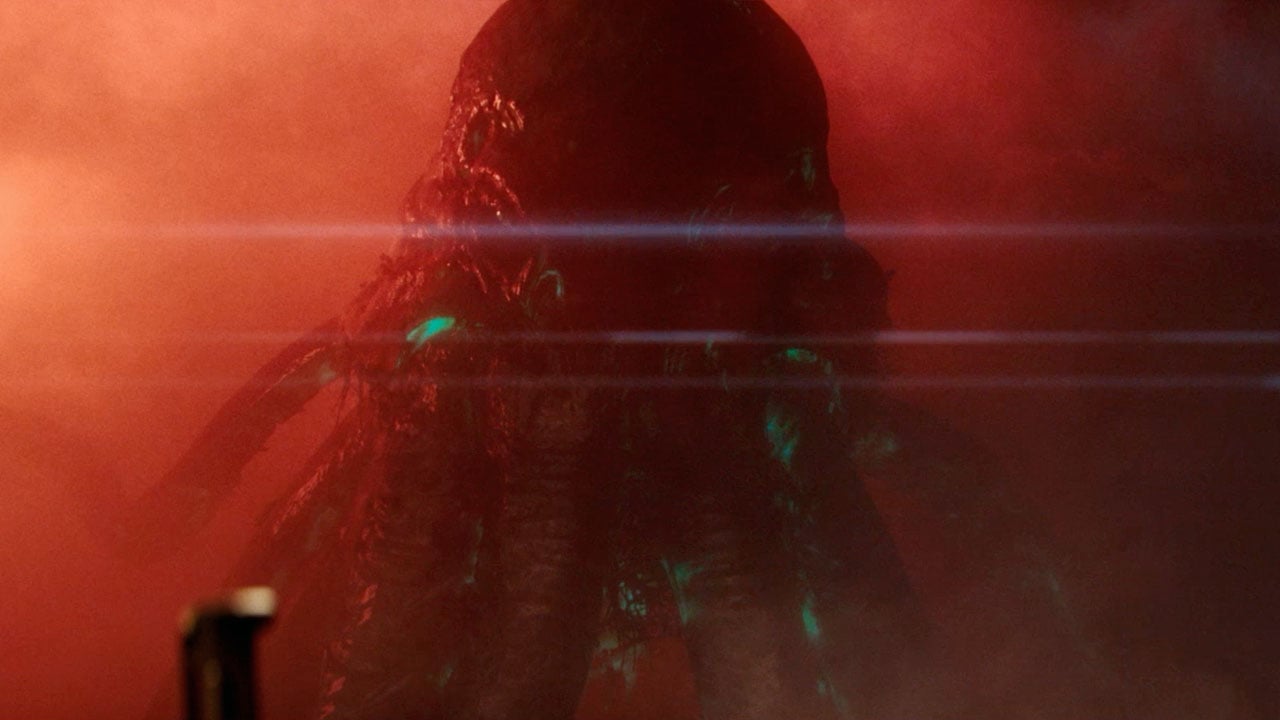
Norwegian creature feature Kraken is now available on Digital.
The film was also unleashed in select theaters. Check your local listings.
In the monster movie Kraken, “unnatural behavior in wild salmon, followed by inexplicable deaths in Norway’s deepest fjord, points to the mythical Kraken. The ancient, multi-armed monster has awakened, ready to crush everything that moves or makes a sound.”
Pål Øie (The Tunnel) directs Samuel Goldwyn Films’ Kraken from a script by Vilde Eide, Kjersti Jelen Rasmussen, and Natasha Arthur. Sara Khorami, Mikkel Bratt Silset, Øyvind Brandtzæg, Jenny Evensen, Ingvild Holthe Bygdnes, Jon Erik Myre, Hans Morten Hansen, Steinar Klouman Hallert, and Filip Bargee Ramberg star.

An all girls trip into the desert for escapism fun instead implodes in violence in the revenge thriller Find Your Friends, now streaming only on Shudder.
In the film, “Amber and her four best friends flee Los Angeles for a girls’ trip in Joshua Tree, only to find themselves unwelcome in a desert town simmering with quiet hostility. As isolation sets in and encounters with aggressive locals grow more threatening, festering resentments within the group begin to surface.
“What begins as fun and reckless escape spirals into a violent struggle for control and survival, as past wounds and present dangers collide in a night that turns their trip into a nightmare.”
Bella Thorne (The Babysitter), Chloe Cherry (“Euphoria”), Helena Howard (I Saw the TV Glow), Sophia Ali (Uncharted), Zion Moreno (“Gossip Girl”), and Chris Bauer (“True Blood”) star in the feature debut by writer/director Izabel Pakzad.

Steven Spielberg is more sure today than he was when he made Close Encounters and ET that aliens are very real, and with Disclosure Day, he aims to make you a believer too.
Okay so it’s not a horror movie, but the sci-fi blockbuster is now playing in theaters.
The vague synopsis for Disclosure Day reads: “If you found out we weren’t alone, if someone showed you, proved it to you, would that frighten you? This summer, the truth belongs to seven billion people. We are coming close to Disclosure Day.”
The film stars SAG winner and Oscar® nominee Emily Blunt (Oppenheimer, A Quiet Place), Emmy and Golden Globe winner Josh O’Connor (Challengers, The Crown), Oscar® winner Colin Firth (The King’s Speech, Kingsman franchise), Eve Hewson (Bad Sisters, The Perfect Couple) and two-time Oscar® nominee Colman Domingo (Sing Sing, Rustin).
Based on a story by Spielberg, the screenplay is by David Koepp, whose previous work with Spielberg includes the scripts for Jurassic Park, The Lost World: Jurassic Park, War of the Worlds and Indiana Jones and the Kingdom of the Crystal Skull. Combined, those films earned more than $3 billion worldwide. Koepp also wrote the script for Jurassic World Rebirth.
Steven Spielberg is of course no stranger to extraterrestrial encounters, directing two of the greatest alien movies of all time: Close Encounters of the Third Kind in 1977 and E.T. in 1982. It’s an arena he returned to in 2005, directing an adaptation of H.G. Wells’ War of the Worlds.
Here in 2026, Steven Spielberg sees hope in the existence of aliens. He notes in the final trailer for Disclosure Day, “How will disclosure change us? I believe for the better.”

Another movie that’s not a horror movie but worth mentioning here is the violent martial arts revenge thriller The Furious, which is now playing in theaters from Lionsgate.
Xie Miao (The New Legend of Shaolin) and Joe Taslim (Mortal Kombat) star.
After his daughter is kidnapped by a criminal network and he receives no help from the corrupt police, Wang Wei sets out on a rampage to find her himself.
His only ally is Navin, a relentless journalist whose wife has mysteriously disappeared. Fueled by a furious vengeance, the unlikely duo ruthlessly fights against the kidnappers.
Kenji Tanigaki (Enter the Fat Dragon) directs from a script by Mak Tin Shu (Kung Fu Jungle), Lei Zhilong, Shum Kwan Sin (Twilight of the Warriors: Walled In), and Frank Hui.

A disturbing weight loss craze involving human ashes opens up a haunting world of hurt for a young woman in Saccharine, which is now available on Digital outlets at home.
From writer/director Natalie Erika James (Relic, Apartment 7A), the Australian supernatural body horror film follows lovelorn medical student Hana, who becomes terrorized by a sinister force after taking part in an obscure weight loss craze: eating human ashes.
Midori Francis (“Grey’s Anatomy”), Danielle Macdonald (Patti Cake$), and Madeleine Madden (“The Wheel of Time”) star in Natalie Erika James’ latest nightmare.

From directors Arturo Ambriz and Roy Ambriz, I Am Frankelda is billed as the first ever full length stop motion movie from Mexico, and it’s now streaming on Netflix.
The history-making stop-motion film is a dark fantasy set in a world of monsters.
Here’s the synopsis: “In 19th-century Mexico, Frankelda is a gifted writer whose dark tales are ignored and dismissed. Forced to suppress her voice, she refuses to give up, even as many try to silence her. But when she is thrust into her subconscious, the very monsters she created come to life.
“Guided by Herneval, a tormented prince trapped between dreams and nightmares, she must restore balance between fiction and reality before both realms collapse. Meanwhile, the sinister writer Procustes and his conspirators plot to seize control. As Frankelda and Herneval grow closer, their bond becomes both a strength and a curse.
“To rewrite their fate, she must confront a love that defies existence and reclaim her power as a storyteller—before dark forces consume her imagination and reveal horrors beyond her creation.”
The directors said in a joint statement, “As brothers, we grew up inventing worlds together, drawing, playing, imagining. Over time we understood that fictional characters were not only companions but guides. Sometimes they felt closer than the people around us. They provided us courage, wisdom, and solace. We believe fiction is not an escape from reality but a way of understanding it. A way of converting truth into palatable chunks. I Am Frankelda comes from a lifelong love of storytelling.”
Mireya Mendoza, Arturo Mercado Jr., and Luis Leonardo Suarez lead the voice cast.
Meagan Navarro writes in her review for Bloody Disgusting, “Mexico’s first stop-motion animated feature is a macabre beauty.” Meagan also notes in her review, “I Am Frankelda is a gothic fantasy feature whose boundless creativity is matched by its ambition.”

The lines of reality and delusion blur in Time of Death, now available on Digital.
Michael Kelly (“The Penguin,” Dawn of the Dead 2004) stars with Kevin Pollak (End of Days), Mena Suvari (Vampires of the Velvet Lounge), and Dennis Haysbert (Send Help).
In the horror-thriller, “When a prisoner vanishes without a trace, Detective Frank Morley (Michael Kelly) is sent to a decaying prison on the verge of shutdown. What begins as a routine investigation quickly spirals into a dangerous search for answers.”
Will Wernick (Escape Room 2017, Follow Me) directs from a script by Jason Rosen. They also produce alongside Kelly Delson, Jeff Delson, and Kyle David Crosby.
You must be logged in to post a comment.