Editorials
‘Countdown’ – 2012 Thai Thriller Is a Darkly Fun Way to Ring in the New Year

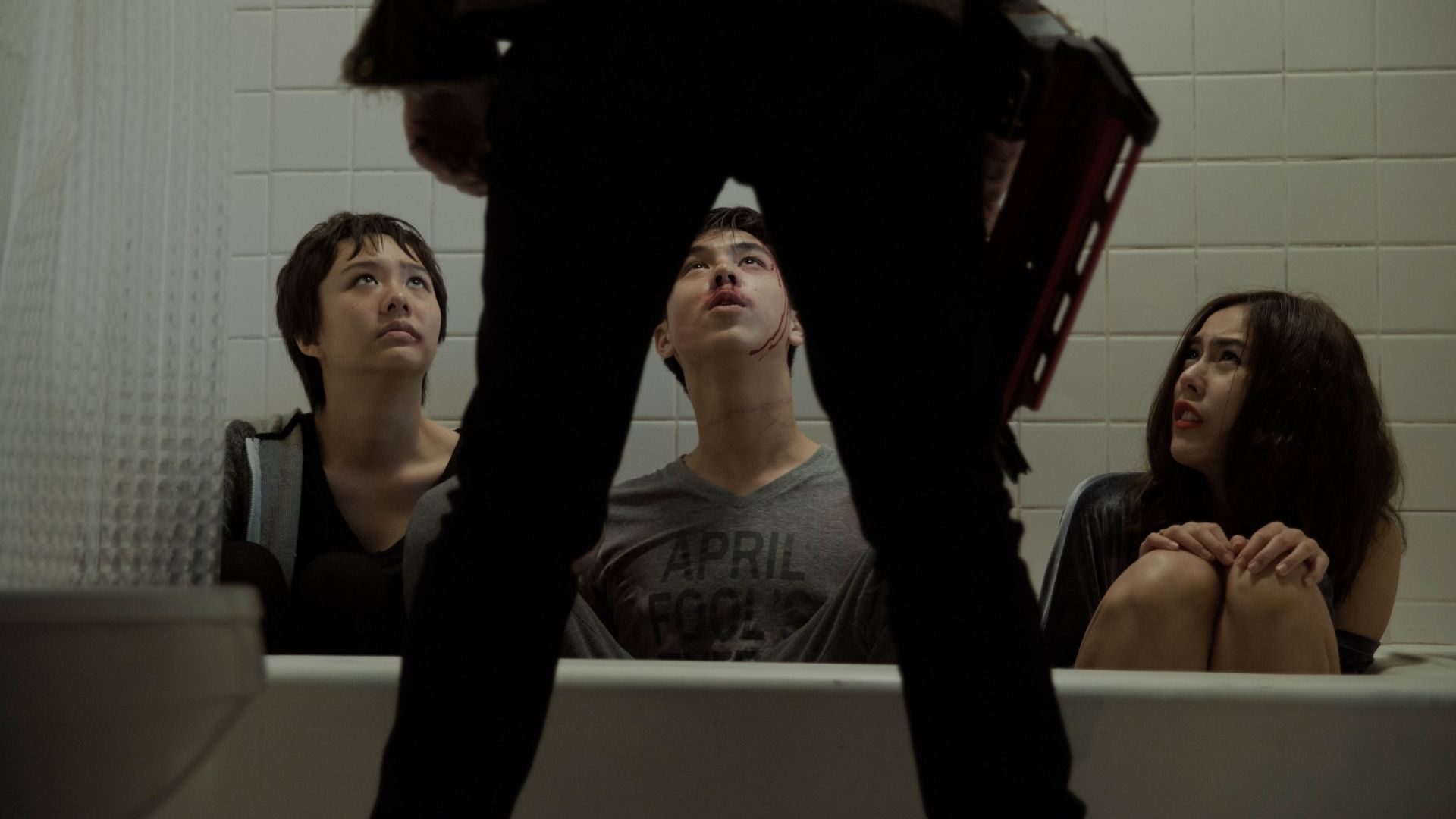
While New Year’s is just the first day of January for most people, others consider it to be something more momentous. It represents a fresh start, especially for those who desperately need a change in their lives. The three core characters in Nattawut Poonpiriya’s 2012 movie Countdown don’t know it yet, but their New Year’s Eve is going to be a time of reflection and, most importantly, survival.
The college-age characters in Countdown have a problem that only people their age would consider a real crisis; their weed dealer has retired as part of his own clean slate. But if they want to have a fun New Year’s Eve, then roommates Bee, Jack and Pam (Jarinporn Joonkiat, Pachara Chirathivat, Pattarasaya Kreursuwansiri) need to find another source, stat. This brings them to calling Jesús (David Asavanond) from the torn-up business card that Jack found in his ex-dealer’s place. They have to guess the last digit in his phone number, yet to their own surprise, Jesús picks up after the first try.
Countdown kicks off like other movies about misfits scraping by in life and learning how to be adults the hard way. Bee is thrilled to learn she and Jack aren’t having a baby as she first suspected, Jack is still pocketing the tuition money his father sends him from back home in Thailand, and Pam’s desperation to be loved leads to petty theft. It’s understandable if the younger characters are hard to stomach; they’re blatantly obnoxious and entitled. Of course it’s their immaturity that fuels the main conflict; Jesús, the traveling drug dealer who bears a slight resemblance to his biblical namesake, doesn’t appreciate being the butt of others’ jokes.

The movie fully enters thriller mode after teasing it earlier. There was always something “off” about Jesús, but when he pulls Jack’s pants down and spanks his ass with a spatula, all bets are off. Countdown becomes more and more unpredictable as the drug dealer reveals a hidden agenda and holds his clients hostage in their apartment. This branch of the “home invasion” subgenre requires a believable setup to warrant the turned tables, and a drug deal gone bad isn’t the worst way to get the ball rolling. Of course Jesús’ motives for attacking Bee and the others has less to do with a faulty transaction and more to do with their innermost secrets.
There’s more to the story than the basic premise suggests, and viewers can appreciate this serpentine quality. As terrifying as it is to be held hostage in a bathtub, with a nail gun in your face, Jesús’ vested interest in these three party kids is more daunting. There’s a certain Shyamalanism to Countdown’s antagonist, who isn’t the dolt he originally made himself out to be. Asavanond’s cunning performance, delivering jacked-up and holier-than-thou craziness scene after scene, isn’t one to miss. His co-stars assume the position of victims, though their previous sleepiness is nowhere to be found now that they’re being tortured, one by one.
Countdown, for the most part, occurs solely in the protagonists’ barebones apartment. Had someone not run out to find help in the deserted building, the movie could be likened to a stage play. Limiting the characters to their own home robs the script of any particularly memorable set pieces, though. Bee and her roommates are either menaced in the off-white bathroom, or they’re roughed up in their yellowy living room. The domestic location is more minimal and drab looking than one might like, yet this adds to the overall unpleasantness.

There is no visual transition between the movie’s tones to speak of, but the narrative swerve into perverse torture is organic. Jesús is a walking red flag, so satisfying audience expectations was the only way to go. Where Poonpiriya bends genre rules is inviting an element not routinely used in other home-invasion stories. It adds an unexpected sense of surrealism that glues dangling plot bits together. At the same time, it invites more unanswered questions about the strange world these characters live in. What spurred this unforeseen revelation, and why did it happen tonight? You can only infer an answer, based on the ending.
Countdown doesn’t do what other drug movies do, and that is playing the story out like a bad bender. In spite of several peculiarly uncanny moments between captives and captor, the story is sobering and rooted in harsh realism. It’s not a fanciful New Year’s Eve for these unfortunate characters who only wanted to enter 2013 as high as a kite. Although, the questionable and somewhat underserved conclusion is removed from reality. There isn’t anything individually likable about Countdown; everyone sits somewhere on a spectrum of loathsomeness. As soon as Jesús begins bestowing his patent brand of cruelty on these misguided brats, though, this thriller picks up and becomes a darkly fun way to ring in the New Year.
Horrors Elsewhere is a recurring column that spotlights a variety of movies from all around the globe, particularly those not from the United States. Fears may not be universal, but one thing is for sure — a scream is understood, always and everywhere.




Steven Spielberg has always been conversant in the cinematic language of the horror genre, despite relatively few credits in the genre. His contributions as a writer and producer on things like Poltergeist are legendary, and films like Duel and Jaws certainly wield the horror genre in remarkable, often chilling ways. He may not be a horror filmmaker, but he knows when he needs to scare us, and he has the tools to make that happen.
I didn’t go into Disclosure Day, Spielberg’s alien epic, expecting outright horror, and indeed the film leans much more into thrilling than frightening. This is not a horror film, but for a few minutes in the middle, much to my surprise, it became one.
Spielberg has filmed more than his fair share of scary scenes over the years, but with Disclosure Day, he directed a new contender for the scariest scene of his entire career.
SPOILERS AHEAD for Disclosure Day!

Josh O’Connor in DISCLOSURE DAY, directed by Steven Spielberg.
Among the various alien secrets laced throughout Disclosure Day are a trio of palm-sized rods, the color of pencil graphite. These rods, originating from another planet, can be used for a number of things, but for the purposes of this scene, the most important is “diving,” gripping the rod in one bare hand and using its power to “dive” into the mind of another person.
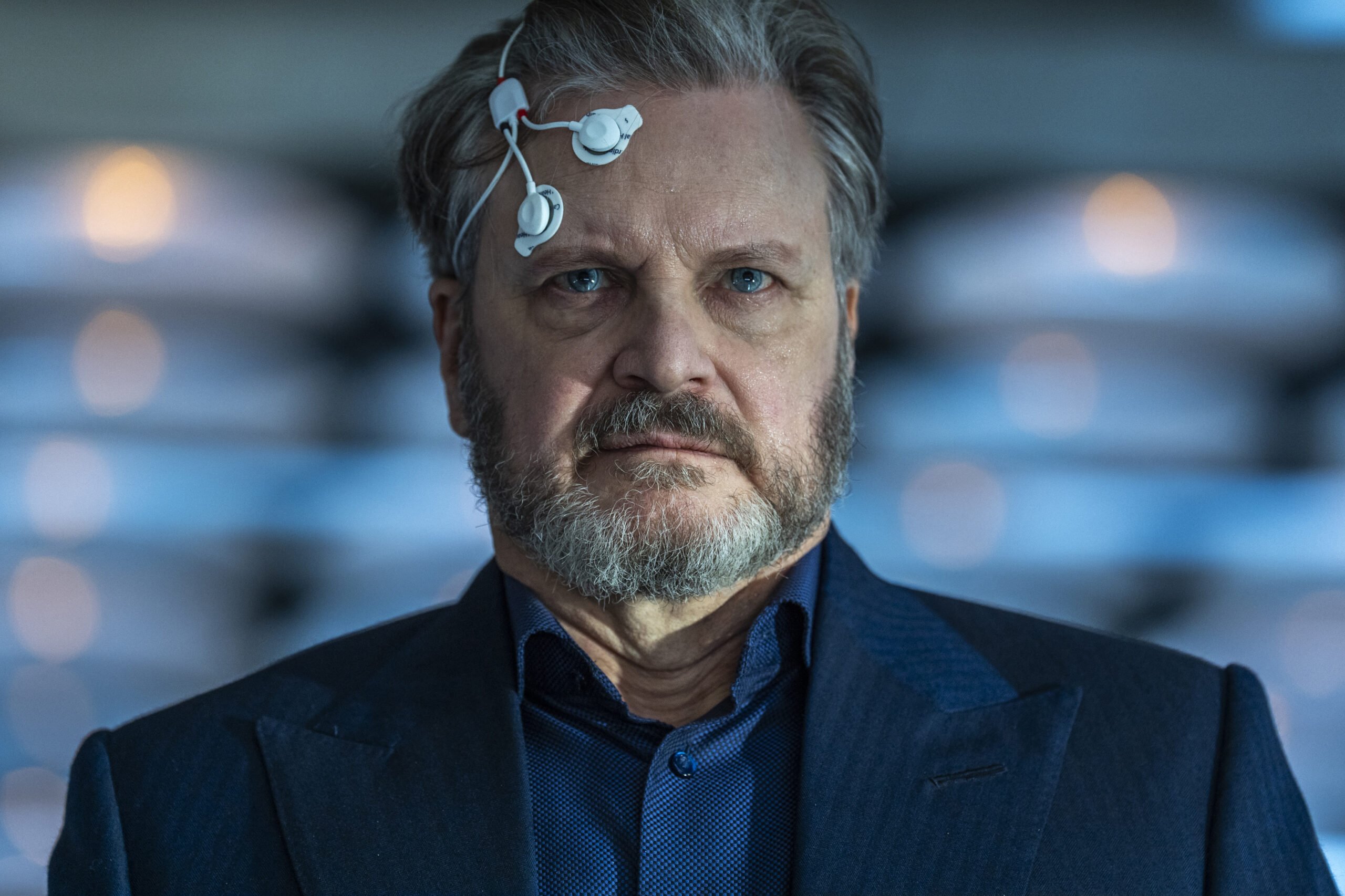
The person holding the rod in this scene is Noah Scanlon (Colin Firth), head of shadowy cybersecurity firm Wordex, who is hellbent on keeping human knowledge of extraterrestrials secret from the general public. Scanlon’s trying to find whistleblower Daniel Kellner (Josh O’Connor), who’s got all of those alien secrets tucked in a backpack while he’s on the run, and while Daniel’s more experienced mind is protected from diving, his girlfriend Jane’s (Eve Hewson) is not. So, monitored by medical personnel at Wordex headquarters (diving is dangerous), Scanlon pushes his way into Jane’s mind to find the location of Daniel’s safe house.
A telepathic invasion is scary enough on its own, but Spielberg doesn’t stop there. When Scanlon dives into Eve’s mind, he appears to her to be sitting across the kitchen table, like he’s in the room. Her bright blue eyes turn Scanlon’s dark brown, and she loses much of her control over her own body, not to mention her mind. Moments before, Daniel finally shared with her the secrets in his backpack, so Jane is shocked, conflicted, deeply vulnerable when Scanlon slips inside her head. This is not just telepathy. This is possession.
Spielberg underscores this not just through the visual language of the scene, as Jane breaks out in a sweat and struggles to sit upright as Scanlon invades her mind, but through Jane’s background. As she revealed to Daniel earlier in the film, Jane is a former novitiate nun who left her convent when she began to question her calling. She still believes firmly in God and, more importantly, believes that perhaps proof of alien life should be kept secret from the public because, in her eyes, it would upset the entire balance of faith in the world. God is a defining factor for humankind, Jane argues, and showing humanity proof of creatures from the stars would undercut that in dangerous ways.

This context, combined with the crucifix necklace Jane’s holding in her hand at the time of the dive, makes this scene the closest thing Spielberg will ever shoot to something out of The Exorcist. It’s not just a battle of wills, but a battle of faith. As an amoral technocrat worms his way into her memories, her beliefs, her faith, Jane turns the crucifix into a weapon, squeezing it until her hand bleeds when she discovers that a pain response can momentarily push Scanlon out of her head.
Of course, when you put a crucifix and a bloody hand together, it conjures images of stigmata. Screenwriter David Koepp pushes the allusion further by having Scanlon quote Christ on the cross to Jane by way of convincing her that she must be the one to stop Daniel by any means necessary.
It’s easy to see why this is scary, right?
On a very basic level, you have a powerful, wealthy man subduing and assaulting an innocent young woman, which is frightening enough. Then, the layers of the scene kick in. Scanlon doesn’t just assault Jane, but possesses her, seizes her memories, her knowledge, and finally her own free will, all while Jane literally clings to her faith in an effort to fight back. Disclosure Day is, among other things, a story about who has a right to the truth, and Scanlon believes that he should be the arbiter of that truth. Not just the truth as he sees it, but the truth as Jane sees it as well. If they don’t see eye to eye, he’ll make her.
But the possession, as it turns out, cuts both ways. Using the rod to dive is, for a normal human being, an intensely strenuous process. Scanlon admits that previous attempts almost killed him, and for some members of his time, so much as touching the rod results in a near-death experience. Even accessing an unprepared mind like Jane’s takes a lot of Scanlon, and when she kicks him out by squeezing the crucifix – again, so much meaning embedded in the details here – his team holds him back and tries to offer medical intervention. But Scanlon persists, pushing them away, and keeps diving back in.
This means that Jane can’t escape him because he just won’t stop pushing back through her defenses, but it also means that each time Scanlon enters her mind, and thus the safe house, he looks more monstrous. By the end, through a combination of lighting and makeup, Firth barely looks human, conjuring up images of the possessed Father Karras at the end of The Exorcist.

Colin Firth (center, standing) in DISCLOSURE DAY, directed by Steven Spielberg.
On a pure, visceral craft level, all of this is quite frightening, but the real trick to making this scene into Spielberg’s most terrifying lies in the more existential horror surrounding all of this. Disclosure Day is a film about the battle for the truth over extraterrestrials, but it’s also about a fight against an impossibly powerful surveillance state, the devaluing of human and alien lives in favor of some nebulous collection of assets, and the value of the individual in a world that increasingly lumps people into demographic boxes and writes them off.
In this scene, the surveillance state becomes supernatural, a human life is worth less than a piece of information, and an extragovernmental technocrat would rather sacrifice his own humanity than see reason. In 2026, few things could be more terrifying than that. Spielberg knows this and wields it mightily, proving once again that, while he’s not a strictly horror filmmaker, he can direct horror with the best of them.
Disclosure Day is in theaters now.

Eve Hewson (second from left) in DISCLOSURE DAY, directed by Steven Spielberg.
You must be logged in to post a comment.