Books
Kids vs. Werewolves in “Goosebumps Series 2000”, “Shivers” and “Strange Matter” [Buried in a Book]


Out of all the popular Universal monsters, werewolves may have appeared the most often in ‘90s children’s literature. There was something about these hirsute creatures of the night that appealed to young readers back then. Through adult eyes, werewolves are a duality of man and beast, day and night, and good and evil. For kids, though, they’re simply scary monsters who might eat them. Couple that plain fear with morbid fascination, and werewolves are a perfect adversary for young people, as seen in this beastly edition of Buried in a Book.
Unlike its obvious inspiration of Goosebumps, Marty M. Engle and Johnny Ray Barnes Jr.’s series Strange Matter had a single setting. The stories changed from book to book, but every instance of weirdness occurred in a town called Fairfield. The first volume, No Substitutions (1995), demonstrates the sort of paranormal activity that only the students at Fairfield Junior High seem to notice.
In No Substitutions, eighth grader Curtis Chatman is thrilled by the idea of a substitute teacher in his next class, yet the excitement wanes once he and best friend Shelly Miller realize the sub is someone else. Someone new. Instead of their preferred choice of substitute teachers, Curtis and his classmates are stuck with the intimidating Stacy Calhoun. He’s returned to Fairfield after years away, and the first thing he wants to do is get the old gang back together. Or rather, the old pack.
No Substitutions plays out a bit like the movie Fright Night, except Curtis and Shelly are battling a werewolf, not a vampire. And unlike Charley Brewster, this book’s heroes don’t have an adult mentor to help them. The two kids instead figure everything out themselves, mainly by reading the tome that Curtis stole from Mr. Calhoun. The details about the different kinds of werewolves — hereditary, benevolent, and the most dangerous of them all, the loup-garou — is a wonderful feature of this story. Engle and Barnes drop more werewolf lore here than expected, including the pentagram marking sometimes found on werewolves’ palms.

While the first Strange Matter book is straightforward, it also has excitement and action. In addition, there is some notable violence as the kids go up against their malicious enemy, whose only weakness is his wolf-skin (here the kids must salt the fur lining of Calhoun’s old letterman jacket). No Substitutions covers the wicked werewolf type rather well, but the next book, Your Momma’s a Werewolf (1996), depicts an accidental lycanthrope. The eighteenth volume in the Shivers series straddles the fence between comical and serious as a boy’s mother gradually turns into a monster.
Anyone who visited thrift and dollar stores in the ‘90s might recall seeing copies of Shivers. There was a fair amount of Goosebumps-style cash-grabs during the decade, but M.D. Spenser’s series looked especially low-end. For a lot of parents, though, the bargain prices were appealing. And the stories themselves were sometimes a pleasant surprise, despite their shabby packaging and cheesy titles.
In Your Momma’s a Werewolf, Detroit native Ignatius “Iggy” Rockwell is about to enter the fifth grade the following fall, but before then, he has to save his mother. When the mother and son visit a cabin with one of Iggy’s friends, Mole, Mrs. Rockwell is attacked by an unusual-looking wolf. One nip later and Iggy’s mother is eating raw meat, growing fur on her face, and throwing her son around like a ragdoll. This area being home to a legend about werewolves, the boys connect the dots, then scramble to find a remedy for Iggy’s mother.
Something fun that Your Momma’s a Werewolf does is create a secret history for the fictional town Iggy is visiting. Fort Deckerville, possibly based on Deckerville, Michigan, was named after a British fort built in 1761. When communication suddenly ceased between the fort and the army back home, a squadron went in and discovered the stationed soldiers had disappeared without a trace. This book established its own Roanoke-like mythology by revealing the missing soldiers were eaten by vengeful werewolves.
Your Momma’s a Werewolf has no plot twists, and the arrival of a random expert on the supernatural is so convenient it borders on parody. The author also repeats the same storytelling device; many chapters — thirty-five in a 125-page long book — end with Iggy hearing someone screaming in the distance. However, the characters don’t feel like total cutouts, and the setting’s supernatural history is intriguing. This book doesn’t live up to the series’ title, but it’s never dull either.

Last up is a divisive entry in R. L. Stine’s Goosebumps Series 2000. This book, from a spin-off of the original Goosebumps series, is set around Halloween. Full Moon Fever (1999) begins with two siblings, Robbie and Alesha, visiting their creepy Grandpa John. He loves to scare them with spooky stories, including one about people turning into werewolf-like monsters if they gaze up at the full moon. Robbie and Alesha put the tale to the test on Halloween, and accordingly, they end up as terrifying creatures. They go see Grandpa John, but he can’t help them — his story was all made-up, so there’s no known cure for Full Moon Fever.
Over the course of the book, Robbie and Alesha find themselves killing and eating squirrels, chowing down on dead worms in the sewer, and making a meal out of fresh roadkill. They even have to curb thoughts of devouring their own grandfather and the family dog. But as startling as the gruesome moments are, Full Moon Fever also delivers psychological horror as Robbie and Alesha succumb to the trauma of their transformations. They have to stave off both their appetites and their despair. They continually question their humanity while suffering inside these monstrous bodies.
Full Moon Fever doesn’t have a predictable story. After going to a Dr. Thorne for help, the main characters are captured and then forced to work as freaks in a traveling carnival. They’re there for three weeks, along with their imprisoned grandfather, before they finally escape and uncover the true source of their uncanny affliction. Robbie and Alesha’s neighbor, Mrs. Eakins, turns out to be a witch. And as payback for kicking a ball through her window, Eakins used Halloween candy to turn the two kids into beasts. R. L. Stine, never one to shy away from a mean-spirited ending, really pushed the envelope here by having Robbie and Alesha undo the first spell, only to then be cursed again at the last second. They shrink and shrink, presumably until they no longer exist.
As these books show, werewolves and children make for entertaining storytelling. On top of the challenge created by an uneven playing field, a child’s imagination or willingness to believe in unbelievable things makes all the difference when confronting these iconic monsters.
There was a time when the young-adult section of bookstores was overflowing with horror and suspense. These books were easily identified by their flashy fonts and garish cover art. This notable subgenre of YA fiction thrived in the ’80s, peaked in the ’90s, and then finally came to an end in the early ’00s. YA horror of this kind is indeed a thing of the past, but the stories live on at Buried in a Book. This recurring column reflects on the nostalgic novels still haunting readers decades later.




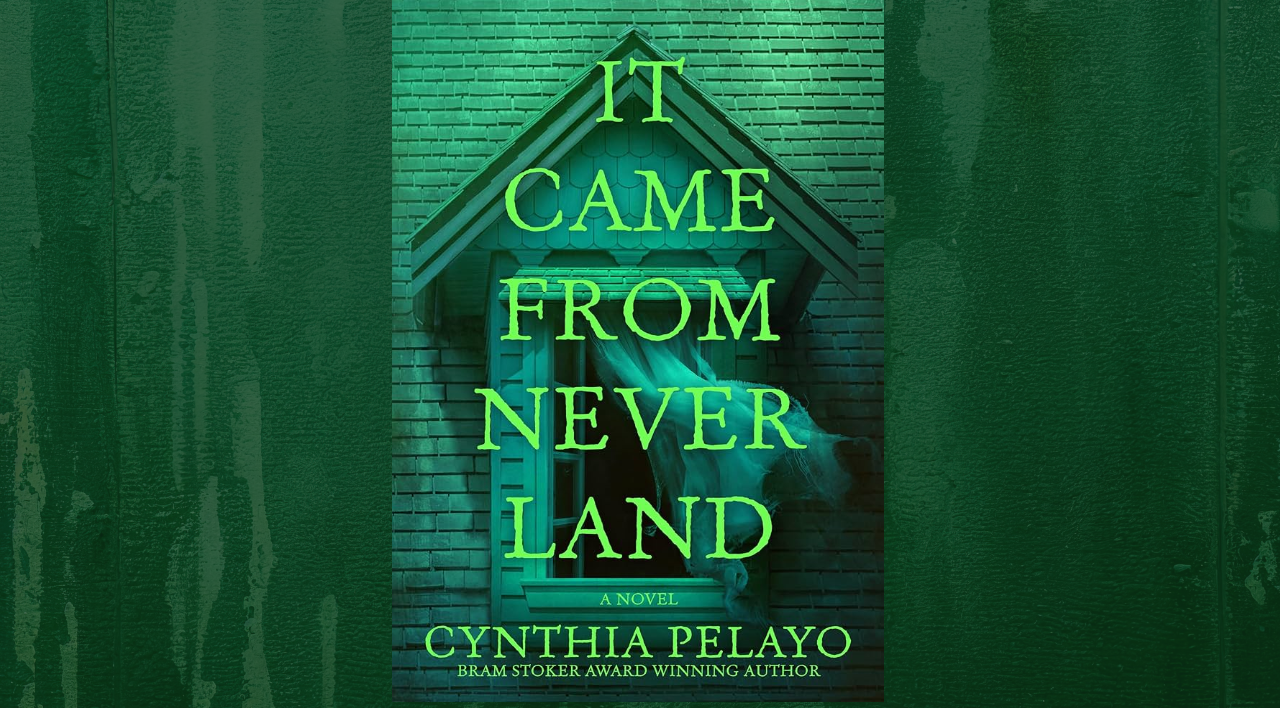
There’s a layer of the mythic in everything Cynthia Pelayo writes, whether she’s charting the little-known history of her home city of Chicago or digging deep into the pool of shared stories that’s served humanity since ancient times. Regardless of subject matter or narrative, Pelayo reads like a writer constantly in search of the threads of legend and myth that bind us all together and keep us awake at night.
It Came From Neverland, Pelayo’s latest novel, takes that search and applies it to one of the most famous children’s stories ever conceived, J.M. Barrie’s beloved and oft-adapted tale of the Boy Who Never Grew Up. But this is not just a Peter Pan retelling, or a Peter Pan meta-sequel. Through gorgeous prose, finely drawn characters, and an iron grip on the themes that drive the story, Pelayo crafts It Came From Neverland into one of the year’s must-read genre novels, both a horrifying spin on Peter Pan and a luminous dark fantasy about the search for salvation in a cold, brutal world.
In Pelayo’s version of events, Wendy Darling and her brothers John and Michael really did travel to Neverland when they were children, drawn there by a charismatic and irresistible figure called Peter Pan. But this Neverland is far from the Disney version, and after fighting to survive in that ageless place, the children made their way home and shut Peter Pan out of their lives, refusing to so much as utter his name, lest he find them again.
Flash forward to 1914, where Wendy’s working as a schoolteacher at Marigold House, a London orphanage growing increasingly crowded amid the outbreak of World War I. By day, she teaches and volunteers at a local hospital, reading to the war wounded, and by night, she remembers to check every window latch and keep an eye on every shadow. But lately those shadows seem to behave strangely again. Crows caw all around her. And worst of all, children are disappearing again. Peter Pan is back, and faced with memories of how no one believed her the first time, Wendy prepares to face him one more time.
This is a remarkably well-suited atmosphere for moments of classic, chill-inducing terror, and Pelayo wastes no time weaving a world in which every bird call, every stray thought from the mouth of a child, could be evidence that this monstrous Peter Pan is near. Wendy lives a haunted existence, and as the chaos of war grips London, old fears grip her while new ones fight for position. If you come to this novel looking for something like Stephen King’s IT by way of J.M. Barrie, you’re going to get it, through flashbacks and dark lore and wonderfully well-timed scares, but Pelayo’s not done.
This version of Wendy Darling, through whom we see most of the narrative, cares for children in adulthood because she did not receive the care she needed herself as a child in the aftermath of a traumatic experience. She considers it her duty to listen to them, to protect them, to understand them in a world that still views them not as human beings, but as potential locked up in tiny bodies.
Setting the book in 1914, when young men across Europe were signing up to go and die in a war they didn’t quite understand, underscores this beautifully. Children are grist for the mill in the world of It Came From Neverland, their eager spirits waiting to be crushed by a machine of war and empire and capitalism that will not relent even if an armistice eventually arrives. It’s a wider, more existential layer of horror than the storybook monster, which gets us to open the book in the first place, but the real brilliance at work here is how Pelayo ties it all together.
At the core of all of this, the beating, icy heart of It Came From Neverland‘s horror and its search for meaning amid the narratives of war, children’s fiction, collective memory, and more, Pelayo is most interested in what it really means to never grow up. It means retaining a sense of play, yes, but it also means a refusal to move on, to embrace not just the responsibilities of aging, but the moral burdens of it.
Peter Pan is a monster not because he likes to play, but because he does not consider consequences, mortality, or even the needs and desires of others. The same is true of the leaders of Europe sending young men off to die in a war, and the same is true of leaders now, playing dice with human lives amid the rise and fall of the stock market. To never grow up is to lose something essential about being human, and Pelayo depicts that loss as both existentially terrifying and heartbreaking. That terror and heartbreak drive the novel, but Wendy’s efforts to escape that terror and to mend her broken heart make it fly.
It Came From Neverland is available June 9 wherever books are sold.


You must be logged in to post a comment.