Editorials
‘The Amityville Haunting’ Takes the Franchise into the Found Footage Arena [The Amityville IP]


Twice a month Joe Lipsett will dissect a new Amityville Horror film to explore how the “franchise” has evolved in increasingly ludicrous directions. This is “The Amityville IP.”
We’re into the thick of it now, aren’t we? Ten entries into the so-called Amityville franchise and it’s all cheap IP cash-grabs from here on out.
I’m hopeful that some of these films will lean into the utter ridiculousness that has been a hallmark of the best entries thus far, particularly given the inevitable decline in budget. Let’s not kid ourselves: many of the films from here on out are going to be dodgy, but that’s half the fun, right?
What’s exciting about this Amityville IP editorial series is examining how each film puts its own unique stamp on the same general premise. For The Amityville Haunting, the first new film in six years, that unique stamp is found footage.
It’s a bit surprising that it’s taken so long for an enterprising filmmaker to lean into the low budget practicalities of FF. And while The Amityville Haunting doesn’t break new ground with how it uses security cameras, night vision or direct address-style confessionals, it’s arguably the most successful aspect of this entry.
Alas, that’s something of a low bar to clear.

Writer and director Geoff Meed is content to keep the narrative pretty simple. After a cold open wherein four horny teenagers are mutilated in the notorious Long Island home, the cash-strapped Benson family moves in, knowing full well that they’re getting the house for a song because of its murderous history.
Even casual fans of the franchise will have to suspend their disbelief about the setting. Unlike previous entries that simply imported a haunted object in a new house, The Amityville Haunting pretends that what is obviously an average suburban house is the same cat eyed home where the Lutzs lived and the DeFeos were murdered (Not helping matters is that this is very clearly California, not NY).
Like many Amityville families, the Bensons need a fresh start. Father Doug (Jason Williams) is an authoritarian who bosses his children around like soldiers, while mother Virginia (Amy Van Horne) is put upon and disgruntled. Oldest teen Lori (Nadine Crocker) is rebellious and the source of much of the conflict: she’s been sneaking out and getting into trouble, which has prompted the family to move repeatedly.
Like Amityville 3-D, the youngest daughter Melanie (Gracie Largent) is the most susceptible to supernatural influence. She immediately strikes up a friendship with John Matthews, the ghost of a young murder victim that The Amityville Haunting repeatedly milks for scares.
The final member of the Benson family is pre-teen middle child Tyler (Devin Clark), who acts as the cameraman for most of the film. Knowing the history of Amityville, he opts to make a documentary when the family moves in, speaking directly to the camera in confessionals and seamlessly (unbelievably) captures all of the necessary exposition and whispered conversations of the adults.

At the end of the first act, Meed makes a smart choice by having Doug install cameras around the house, which reduces the need to have Tyler present for every important moment while also expanding the visual palette of the film. The living room camera is typically in black and white, while the camera in the stairwell is night vision green. Is Amityville Haunting aping Paranormal Activity? Absolutely, but it still mostly works.
Less successful are the performances, particularly the adults. While the kids are reasonably fine, Williams and Van Horne are simply not good (the former is unconvincing as a PTSD-stricken soldier while the latter is very, VERY shrill). Meed’s script doesn’t help matters by relying heavily on repetitive dialogue (take a shot each time Tyler is told to turn off the camera), particularly in the drawn-out middle section when the film goes into an obvious holding pattern before rushing through the climax.

In an obvious attempt to cover the production’s limited budget, violent moments are frequently interrupted by cuts to black and pixelated video accompanied by static sound cues. This would be more forgivable if Meed and his team didn’t rely on the technique so heavily, which very quickly becomes grating. The first two deaths, in particular, are poorly executed: the camera cuts to black before simply revealing a prone body on the ground. It’s a cheap cop-out; both the audience and the film knows it.
Things do get better for the climax (comparatively speaking) with one bedroom scene incorporating decent acrobatics and a kitchen jump scare that works well. Obviously The Amityville Haunting was holding out for these big moments, but it could have done with more of them or at least a stronger script to keep impatient viewers invested until the finale.
As it stands, there simply isn’t enough here, particularly when the film’s main novelty – the found footage element – is done so much better elsewhere. Skip this one and go watch Paranormal Activity instead.

The Amityville IP Awards
- Scariest Sequence: Lori’s bedroom attack is the most effective sequence because it successfully merges the impassivity of a fixed security camera, supernaturally corrupted video footage and the static sound cues.
- Biggest Unintentional Laugh: It should be scary or at least disarming, but Doug reverting back to Afghanistan soldier mode in front of his horrified family is uncomfortably funny.




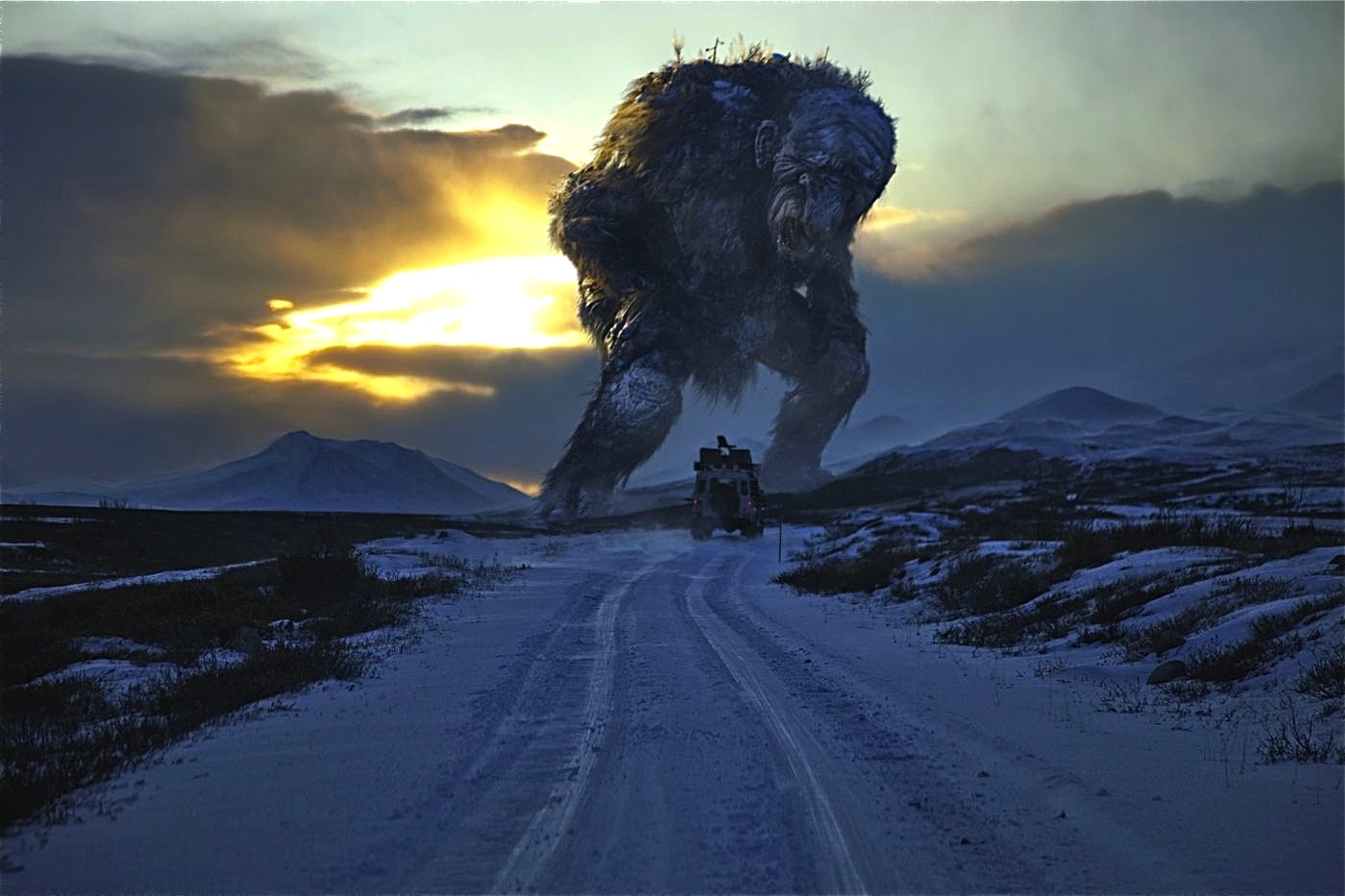
In this day and age, the word “troll” is often used to describe various online nuisances. Yet as abundant and irksome as the modern troll can be, they aren’t usually as fearsome as their mythological counterparts. I’m not talking about the small and gentler versions that have become more common to see in media. No, there are much bigger and scarier trolls out there—and André Øvredal’s movie Troll Hunter is one of the best places to find them.
It doesn’t take long for Troll Hunter (or Trolljegeren) to dump the Blair Witch Project-esque setup and aim for something a lot fresher. The trajectory of the story is augmented by Otto Jespersen’s character Hans, the titular Troll Hunter. The second he comes barreling out of the deep, dark woods and shouts “troll” at the camera, this movie takes a turn into what feels like uncharted territory. Not only subject-wise, but also conceptually.
For fantastical and made-up subject matter in cinema, found footage is a fast way to add a guise of believability. After all, what we accept to be the most crucial aspect of documentaries—the truth—rubs off on pseudo-documentaries, despite our understanding of the pretense involved. That is what Øvredal delivered with Troll Hunter: a movie so convincing that some viewers wondered if trolls really do exist. So, had this been straightforwardly made, it likely wouldn’t have been as effective. Conventional narratives would be more inclined to treat something like trolls as flat out unreal, and never try to convince the audience to think otherwise.

Hans petrifies the three-headed Tusseladd troll.
The viewers, like the characters trailing Hans, are quickly thrown into the deeper end of that extraordinary story. They have to process all this new information while staying on the go. So, although there is no significant amount of meandering, narratively or physically, there is still a good amount of atmosphere, not to mention tension building. It’s never anything frightful, but then again, Troll Hunter isn’t your standard offering of horror; it’s more on the low end of the dark fantasy spectrum. We aren’t ever spirited away to a faraway world—we stay in rather familiar surroundings, as well as dip into those less so. The outcome is a movie where you’re constantly more in awe than in terror.
As fantasy fiction might do, Troll Hunter prefers not to deal with incredulity. There is no time to waste on doubt, as interviewer Thomas (Glenn Erland Tosterud), soundperson Johanna (Johanna Mørck), and cameraman Kalle (Tomas Alf Larsen) all follow Hans around, recording whatever this character is willing to reveal about his bizarre job. Of course, the Troll Hunter himself is not an open book; in that respect, the diegetic documentary fails to fully capture and unpack the more interesting of its two subjects. Yes, all those giant, monstrous trolls are indeed incredible, but understandably, your mind wanders to their pursuer. What kind of person signs up for this gig and then chooses to stick with it for so long?
Reviews have called out Troll Hunter for its lack of character development. In regard to Thomas and his fellow documentarians, that criticism is valid, but bear in mind, they aren’t the focus of the story, either. Meanwhile, Hans is a well-crafted character. At least better than first realized. Before he was introduced, Hans had already grown tired of the troll grind. Fed up with that low compensation for his services, resentful of the bureaucracy, and wanting to expose his employer on a large scale, Hans’ discontent is glaring.
Then there are those finer details about the Troll Hunter, such as that indifference to both the natural splendor of his everyday surroundings and the affections of an obviously smitten colleague, that also suggest some level of despondency. So it is fair to say this movie doesn’t feature any sizable growth for its characters; however, the namesake isn’t underwritten. No doubt, putting a real-life character like Otto Jespersen in that role is partly why Hans is so fascinating—maybe even relatable.

Otto Jespersen as Hans the Troll Hunter.
There is always a small risk whenever using the term “mockumentary” to describe a found-footage movie, as the word could imply humor where there is none. In the case of Troll Hunter, the term’s usage is appropriate. Some folks have claimed the English-dubbed version has the more comedic tone, however, the Norwegian cut isn’t exactly humorless. Apart from the trolls’ absurd appearances, this is a movie where the characters nearly choke on the monsters’ farts, and Christians are like walking targets. Hans’ complete apathy towards everything is another cause of laughter. Overall, the comedy is intentionally dry and inconsistent. Unfunny, though? Absolutely not.
In a movie where endemic creatures are maltreated, as well as disavowed from living freely and peacefully, it’s hard not to notice the ecological message buried beneath the story. In addition to that is the unmistakable political satire. There is this whole business about intrusive and unsightly power lines—like trolls, they’re big blemishes on the land—that leads to what is perhaps the movie’s funniest moment. The scene in question is that one where certain electric lines, the ones secretly being used to keep the trolls at bay, go in a loop and don’t actually send power to any residents. Yet the monitors of said lines don’t find this at all weird. So it stands to reason that Øvredal was having a go at those who accept the government’s doings without question.
Looking past the fact that trolls aren’t actually real, this movie is an enlightening source of information. And not just for international audiences; Norwegians, too, get schooled about their homeland’s own mythology. It’s also evident from everything on screen that Øvredal and his crew were enthusiastic about the topic. The creature designs are the most indicative of that zeal; those imaginative yet myth-accurate manifestations are equally amusing and grotesque. One second you’re laughing at their phallic noses, the next you’re white-knuckling during a hairy sequence. Most surprisingly is how well the trolls’ visual effects hold up after fifteen years. It’s not all spotless, but on the whole, they remain impressive.
Vouching for a mockumentary about trolls isn’t easy, but those who do come around and give it a shot will more than likely be grateful for the recommendation. For Troll Hunter is a real find in that vast and varied genre we call “found footage“.

A bridge troll reaches up for food and finds Hans decked out in armor.
You must be logged in to post a comment.