


As a movie about the criminal underworld of Gotham City, Birds of Prey (and the Fantabulous Emancipation of One Harley Quinn) stays street-level. Yes, it’s an insane movie, filled with lots of sparkles and gore and fantastic set-pieces from director Cathy Yan. But a street-level movie nonetheless.
For the most part, the movie characters’ comic-book counterparts also keep things mundane. In their decades of adventures, Harley Quinn, Black Canary, and Huntress fight mob bosses and hoodlums rather than ghosts or demons. But these are comic-book characters in the DC Universe, which means that they are bound to cross over into occasional craziness — and that includes some pretty monstrous moments.
Here are a few times that the Birds of Prey wandered out of a crime comic and into a horror story.
Harley Quinn – Harley Quinn vol. 1 #20-22 (2002)

From her debut in Batman: The Animated Series to her several solo comic series to her two feature film appearances, Harley Quinn has transformed from “Joker, but a girl” to a fan-favorite with her own personality. As a guileless agent of zany chaos, Harley resembles Bugs Bunny more than she does her murderous former paramour. So it isn’t surprising that Harley goes to some pretty outrageous places — including the pits of Hell.
In a poignant story written by Karl Kesel and drawn by Brandon Badeaux, Harley finds herself in Hell. More accurately, she’s in a personal Hell, damned to reluctantly kill her own gang again and again. When she and her fellow dead supervillains launch an escape, Etrigan the Demon dispatches undead bounty hunter Ulysses Highwater to bring her back.
The story features antics one would expect from a Harley Quinn story, including a bit where she blithely shoves Charon into the River Styx. But it reveals a thoughtful moral core when Harley learns that Highwater scours the underworld for his son’s boyfriend, insisting that the man seduced and ruined his son. Realizing that the hunter’s homophobia doomed him to Hell — and that the purity of the couple’s love sent them to heaven — Harley tries to soften Highwater’s heart toward his son. But that type of empathy isn’t allowed in Hades, so Harley gets expelled back to earth.
In addition to being her most straightforward monster story, the arc captures the best elements of Harley Quinn, making her into an anarchic force for good.
Black Canary – DC Comics Presents #30 (1978)

Black Canary is one of DC Comics’ oldest characters. First appearing in 1947’s Flash Comics #86, Black Canary has been a member of both the Golden Age and Modern Age versions of the Justice Society of America, a member (and leader) of several incarnations of the Justice League of America, a founding member of the Birds of Prey, and the leader of a punk rock band.
Yet, despite that impressive resume, Canary gets little respect from comic book creators. Not only did they saddle her with one of the worst costumes of all time, but she’s often overshadowed by other characters — most often, her boyfriend Green Arrow. In fact, the actual most horrific thing to happen to Black Canary was her capture and torture in 1987’s Green Arrow: The Longbow Hunters, which functioned more as a motivation for the male hero than character development for her.
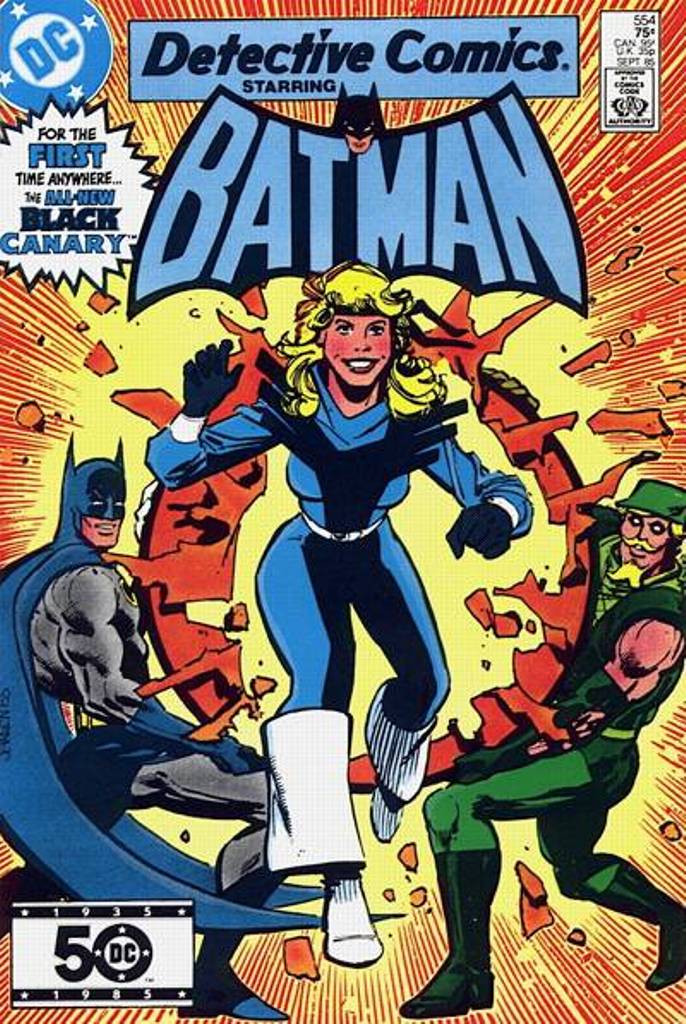
She gets a bit more of the spotlight in her best scary story, “A Dream of Demons” by Silver Age greats Gerry Conway and Curt Swan. After seeing the ghost of her dead husband from an alternate universe (Black Canary had a pretty weird backstory until the mega-event Crisis on Infinite Earths), Canary travels to Antarctica to speak with Superman in his Fortress of Solitude. Together, the duo traces the nightmares to skull-faced dream master Doctor Destiny. Thrown into a reality-bending netherworld, Superman and Canary hold their own against an army of demons.
Canary might get demoted to “damsel in distress” a bit too often in the story, but she does get to karate throw a polar bear. Not a bad consolation!
Huntress – JLA vol. 1 #36-41 (1999-2000)

Like Black Canary, Huntress has been around for a while and has a convoluted back-story. But in the most recent and most simple origin, used by Birds of Prey screenwriter Christina Hodson, Huntress is Helena Bertinelli, daughter of mob boss Guido Bertinelli. After her family’s murder, Huntress devoted her life to wiping out Gotham’s criminal society.
As that story suggests, Huntress has pretty earth-bound adventures, reserving her crossbow bolts for mafia goons. But as a normal person in a world of super-gods, even a basic team-up can be terrifying.
Huntress learned that first-hand during her short tenure in the Justice League of America. Recruited by Batman to join the League in its most over-powered incarnation, Huntress found herself outmatched when Lex Luthor forms an Injustice Gang. In the five-part epic “World War III,” written by Grant Morrison and drawn by Howard Porter, the League gets attacked by outrageous villains like the god-bomb Meggedon and the alien insect-woman Queen Bee. These bad guys outclass even Superman and the Green Lantern, but Huntress holds her own against the sadistic Prometheus, even as reality shifts around her.
As strange and overwhelming as the situation may have been, the scariest moment occurs at the end of the fight. When Huntress declares Prometheus a killer of women and prepares to execute him, Batman arrives to stop her — and to expel her from the League. Nothing is more terrifying than Batman’s self-righteousness.
Cassandra Cain – Batgirl vol. 1 #60-62 (2005)

In Birds of Prey, Cass Cain (Ella Jay Basco) is a teenage thief, targeted by psychos after picking the wrong pocket. But in the comics, Cassandra is the daughter of world-class assassins David Cain and Lady Shiva. Under the tutelage of Batman, Cassandra uses her family skills for good and operates under the name Batgirl.
Like Huntress, Batgirl fights regular human beings. Not even her time in a black-ops version of the Justice League pitted her against monsters. In fact, Batgirl never faces the supernatural in her life.
But in the three-part arc “The Hood,” Cassandra loses her life. Batgirl dies in battle with Doom Patrol villains the Brotherhood of Evil after the French revolutionary gorilla Monsieur Mallah (DC Comics are full of super-gorilla goodness) snaps her neck. In the afterlife, she encounters the ghost of recently deceased associate Stephanie Brown. Stephanie’s ghost appears to not only reflect on the mistakes that lead to her death but also to force Cassandra to face her past.
This friendly ghost might lead readers to expect a story more sweet than menacing. But writer Andersen Gabrych and artist Alé Garza give it a gothic feel, heightening the terror Batgirl feels as she faces her metaphorical demons.
Renee Montoya – Gotham Central #12-15 (2003-2004)

Another Batman: The Animated Series character who made her way to comics, Renee Montoya is a Gotham City police officer sympathetic to Batman, if sometimes annoyed by his tactics. Montoya came into her own as part of the cast of Gotham Central, a police procedural about the officers working in the shadow of the Bat.
At its best, Gotham Central revealed the humanity and horror of doing police work in a city seized by supervillains. No arc captured that better than “Soft Targets,” a four-part story in which Joker starts randomly killing cops. Determined to take care of their own, Montoya and her fellow officers try to follow the clues and stop the chaos.
Decades of appearances have reduced the Joker into a cliche villain, a generic scary clown. By focusing on an already over-stressed Montoya (and her partner, Crispus Allen), writers Ed Brubaker and Greg Rucka, alongside artists Michael Lark and Stefano Gaudiano, restore terror to the Clown Prince of Crime. As we watch the usually hard-as-nails Montoya deal with the human cost of meaningless and unexpected death, we see the Joker through her eyes — and we fear him again.
Victor Zsasz – Batman: Shadow of the Bat #1-4 (1992)

For a relatively recent villain, Victor Zsasz gets a lot of attention outside of comics. Whether played as an unremarkable convict by Tim Booth in Batman Begins, as a charismatic hitman by Anthony Carrigan in the TV series Gotham, or as a sadistic scumbum by Chris Messina in Birds of Prey, Mr. Zsasz always shows off his body covered with scars. A living testament to his own barbarity, Zsasz marks his body every time he kills and dreams about blank spots yet to be filled.
But in his first appearance, Mr. Zsasz was just a mouth. Artist Norm Breyfogle kept the murderer hidden for several issues. All we saw was a face smirking from the Arkham Asylum containment cell from which he debated Cartesian philosophy with new warden Jeremiah Arkham. When Zsasz finally reveals his body, we’re just as terrified as the onlooking guards. Writer Alan Grant crafts a story about concealed identities, in which Batman allows himself to be sentenced to the insane asylum to investigate Dr. Arkham’s methodology.
In this state of paranoia, Zsasz’s words are more frightening than his knife.
Black Mask – Catwoman vol. 1 #12-16 (2002-2003)

When he first appeared in 1985’s Batman #386, the Black Mask seemed a lot more like Patrick Bateman of American Psycho than he did the egotistic man-child played by Ewan McGregor. The heir to Janus Cosmetics fortune, Roman Sionis hid his contempt for humanity under the mask of privilege. But when he puts on the black mask of his alter-ego, Sionis indulges in his penchant for torture.
The Black Mask of Birds of Prey performs some pretty gnarly acts on his enemies, but he can’t top his comic-book counterpart.
In the five-part Catwoman story “Relentless,” Black Mask begins a carefully orchestrated attack on Catwoman, just as her estranged sister Maggie arrives in Gotham. Black Mask kidnaps Maggie and her husband Simon and restrains them in his torture dungeon. There, he makes Maggie watch as he pries out his eyeball with a knife — and forces Maggie to swallow it.
The thick lines that artist Cameron Stewart uses elsewhere to give the book a light-hearted feel become menacing in these scenes. Likewise, the playful dialogue writer Ed Brubaker gives the villain ratchet up the terror.
In the most troubling scene, a panel takes the POV of Maggie’s throat as Sionis pries it open and sings, “Through the teeth and over the gums … watch out stomach, here it comes.” Not even the movie Black Mask and his face-peeling knife can outdo that visual.