Quantcast
Connect with us

Editorials

8 Horror Movies That Were Ahead Of Their Time

Published

on

Mist Ahead Of Its Time

Saying a movie is ahead of its time can have two different meanings: 1) The film pioneered a specific filmmaking technique or 2) The film was maligned upon release and is now considered a classic. What I’ve done is look at horror films released over the past few decades and see what films I believe to truly be ahead of their time.

Psycho

First the funny bit of trivia: Psycho was the first film to show a toilet flushing on camera! Now for the serious bit of trivia: Psycho was not universally praised upon its initial release (nearly all British film critics panned it)! Bosley Crowther of The New York Times wrote, “There is not an abundance of subtlety or the lately familiar Hitchcock bent toward significant and colorful scenery in this obviously low-budget job.” Interestingly enough, Psycho didn’t garner widespread critical acclaim until after the film’s popularity with general audiences skyrocketed it to box office success, prompting many critics to revisit the film.
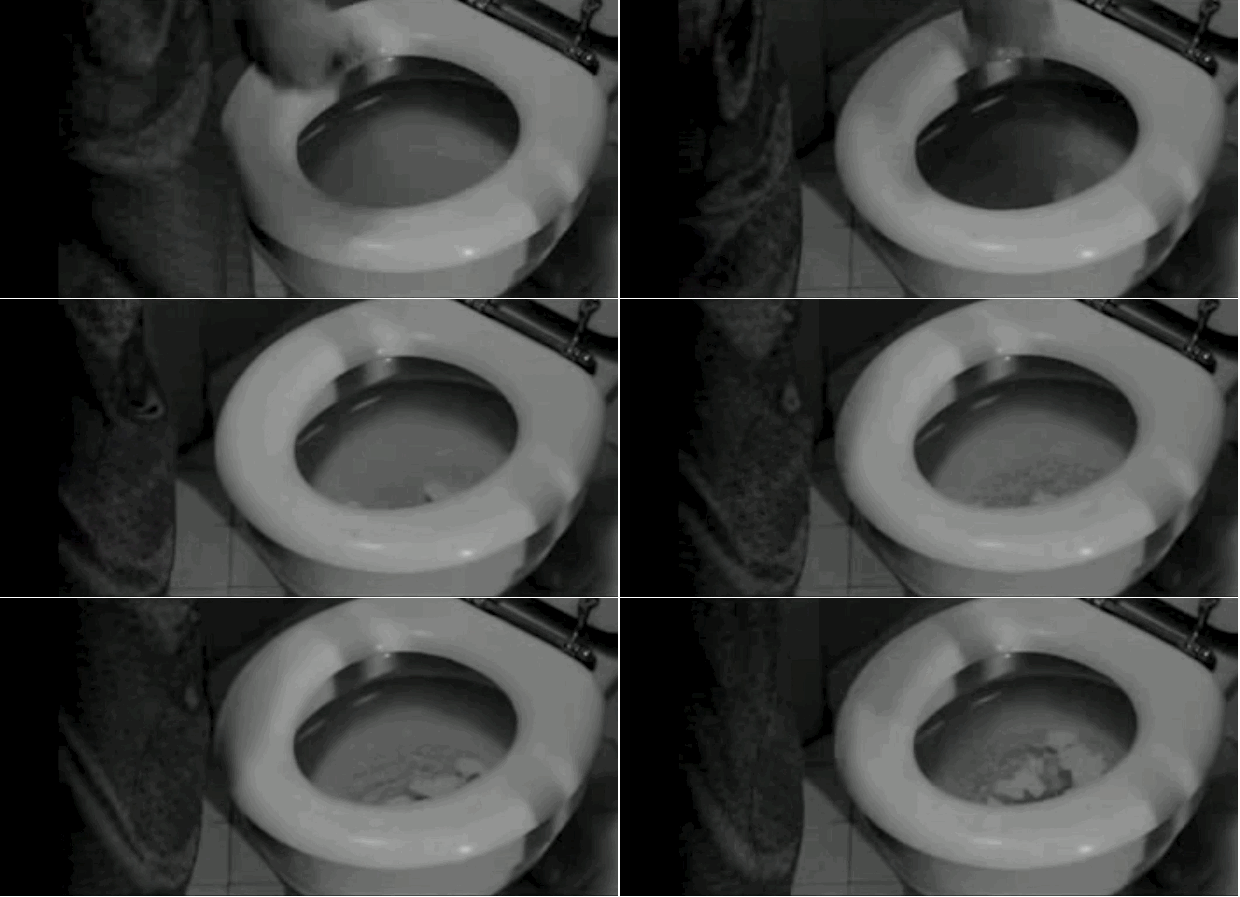
Psycho Toilet Flush

The Thing (1982)

While it’s a well-known fact, it still merits mentioning that John Carpenter’s The Thing was much-maligned when it was released in 1982. Another New York Times critic (Vincent Canby, this time) called it “a foolish, depressing, overproduced movie that mixes horror with science fiction to make something that is fun as neither one thing or the other. Sometimes it looks as if it aspired to be the quintessential moron movie of the 80s.” The score was even nominated for a Razzie award! Add to that the fact that The Thing was released the same summer as E.T., audiences just weren’t in the mood for an intense killer alien film. It was a box office flop, taking in only $19.6 million (on a $15 million budget). Here is more of Canby’s review:

The Thing

Jurassic Park 

I’m sure many of you re-watched Jurassic Park recently, and if so then you probably noticed that the CGI effects are better than about 90% of the films that come out nowadays (they even look better than the CGI effects in Jurassic World!). I have no idea how that is possible, but Jurassic Park has definitely stood the test of time.

Jurassic Park

Starship Troopers

Thank God for international box office, otherwise Starship Troopers would have been a major flop. America just wasn’t ready for an anti-war dark satire film in 1997. Had it come out after the Iraq war had already begun, it might have been slightly better received. To be clear, Starship Troopers is a brilliantly entertaining film, it just came out a few years too early. Like Jurassic Park, the special effects are top notch, and still look good today.

Starship Troopers

American Psycho

While not as acidic as the Brett Easton Ellis novel it is based on, Mary Harron’s American Psycho adaptation was incredibly polarizing in 2000. Making only $15 million (on an admittedly low $7 million budget), the film’s humor wasn’t interpreted very well by audiences at the time. Had the film come out today, it might have clicked more with audiences.

American Psycho

Videodrome

I don’t like Videodrome (don’t hate me!), but I can’t deny that David Cronenberg was really on to something when he wrote it. The film essentially boils down to the idea that people are obsessed with their television (this is a very simplistic explanation for the film). This idea is more timely than ever right now, with DVR and the ever-growing presence of TV as a discussion topic. I write TV reviews for Bloody-Disgusting. I get it. The topics of violence and sex on our TV screens was also ahead of its time in 1983, with TV today pushing more boundaries than ever. Videodrome probably makes more sense today than it did to anyone in the 80s. The fact that it is more relevant today than it was back then earns it a spot on this list.

Videodrome

The Shining

We all know how Stephen King hates Stanley Kubrick’s adaptation of his novel The Shining, but what you may not know is that many critics weren’t too keen on the film upon its release either. Variety complained that it “destroy[ed] all that was so terrifying about Stephen King’s bestseller.” Kubrick and Shelley Duvall were nominated for Razzie Awards for Worst Director and worst Actress, respectively. Roger Ebert even claimed that it was hard to connect with any of the characters. Oh how time changes things.

The Shining

The Mist

The Mist is notable for having one of the most depressing endings in film history. Released back in 2007, mainstream audiences just didn’t want to be depressed. That’s not to say people want to be depressed now, but with shows like Hannibal, Game of Thrones and The Walking Dead preparing them for major character deaths, they’re a bit more prepared for it. Had The Mist come out this year, it probably would have done much better at the box office. Needless to say, many people walked out of the theater wanting to do this:

The Mist

What other horror films do you believe were ahead of their time? Let me know in the comments below!

A journalist for Bloody Disgusting since 2015, Trace writes film reviews and editorials, as well as co-hosts Bloody Disgusting's Horror Queers podcast, which looks at horror films through a queer lens. He has since become dedicated to amplifying queer voices in the horror community, while also injecting his own personal flair into film discourse. Trace lives in Denver, CO with his husband and their two dogs. Find him on Twitter @TracedThurman

112 Comments

Editorials

Before ‘The Blair Witch Project’, ‘Alien Autopsy’ Showed How Real Found Footage Could Feel

Published

on

Alien Autopsy: Fact or Fiction

The line separating artist from con man is a lot thinner than you might initially believe. While I think we can all agree that lying for the sake of profit is actively malicious behavior, isn’t it also true that the faux documentary aspect of The Blair Witch Project is half the reason why that film became such a cultural phenomenon? After all, if there’s one thing filmmakers have in common with stage magicians, it’s that misleading and misdirecting audiences is simply part of the job.

That’s why I’ve developed a habit of mostly ignoring the moral quandaries behind many of film and television’s biggest “hoaxes” in favor of appreciating the narrative elements that drive productions like Mermaids: The Body Found and even Animal Planet’s highly underrated The Cannibal in the Jungle. However, if there’s a definitive case of a highly publicized broadcast fooling the world into taking it seriously, it has to be Fox’s infamous 1995 TV special Alien Autopsy: Fact or Fiction.

It’s been over three decades since that eerie footage first haunted television screens right at the peak of the ’90s ufology craze, and in that time, the video has taken on a life of its own. From countless parodies and references in everything from The X-Files to Tony Hawk’s Pro Skater (as well as John Dower’s recently released tell-all documentary The Alien Autopsy Scandal, which I’d highly recommend to genre fans everywhere), there’s no denying the legacy of the Alien Autopsy video. However, I rarely see the tape discussed as what it truly is: a highly convincing found footage film directed by a passionate stage magician and brought to life by masterful practical effects work.

That’s why I’d like to invite readers to join me on a deep dive into one of the most infamous broadcasts of all time in an attempt to reevaluate the footage as a fascinating narrative experience rather than a complete hoax.

The TV Special That Convinced Millions It Was Real

Ray Santilli next to Extraterrestrial replica in ‘The Alien Autopsy Scandal’

For starters, regardless of whether or not you believe that there was in fact an extraterrestrial crash in Roswell during the summer of 1947 and that some form of autopsy was performed on the victims, the producers behind the black & white recordings, Ray Santilli and Gary Shoefield, insist that their video was a “restoration.” Though I’d argue that the proper word is “remake”of genuine footage that was too damaged to air on television. That’s why the duo went on to recruit filmmaker and eccentric magician Spyros Melaris and sculptor/monster designer John Humphreys to bring their version of the autopsy to life and sell it to the highest bidder.

This is where the story of the Alien Autopsy as a narrative experience really begins. Melaris claims that his approach to the faux recording consisted of striving for extreme period accuracy in both shooting equipment and setting while also planting subtle details that would initially seem like mistakes but could later be revealed to actually fit the time period. That being said, the filmmaker was under the impression that the short would be released for free as a PR stunt, with the team later producing and selling an informative documentary chronicling exactly how the footage was faked and commenting on how easy it is to manipulate public perception with a good old-fashioned magic trick.

This obviously isn’t how things went down, and that’s likely the reason why Melaris has since distanced himself from everyone else involved with the project. Yet, no amount of behind-the-scenes drama can undermine the genuine effort that went into making the short as impressive as it is. From the sourcing of real animal organs from a local butcher to make the organic part of the creature more lifelike to the highly detailed sculpt that made use of a hollowed-out underlayer that could be filled with fake blood and assorted viscera, there’s a reason why so many Hollywood specialists are still impressed with the artistry on display here.

Of course, the believability is only half the story, as I think that the best part of the autopsy is how Melaris builds on the existing tension by obscuring certain details and often embracing the chaos of what a real examination of extraterrestrial life could feel like. The camera often goes out of focus at just the right time to make certain effects hit even harder, and we can only speculate as to what the hazmat-suited doctors are gesticulating about during the operation. There’s a real air of mystery to the whole thing that almost makes it feel like a cosmically terrifying, cursed film containing forbidden knowledge that civilians were never meant to see.

So when Fox’s Fact or Fiction brings in the specialists to comment on the film and its otherworldly subject, it’s no surprise that we end up with one of the most memorable mockumentaries of all time – albeit one where the participants are unaware that the footage they’re commenting on is basically a large-scale practical joke. A joke that the network was obviously in on, as many participants claim that the TV special cut out significant portions where guests point out that they believe the footage to be an elaborate hoax.

The Lasting Impact of the Hoax Turned Cultural Event

Regardless, I remember going to bed terrified after watching reruns of the special and thinking about the respected pathologist who claimed that the body was almost certainly inhuman, with even effects maestro Stan Winston commenting on how difficult it would be to recreate some of these visuals through practical puppetry. That’s not even mentioning Jonathan Frakes’ dramatic hyping up of the disturbing imagery as if he was talking about the tape from The Ring, with his spooky demeanor here likely being responsible for his later role as the host of Beyond Belief: Fact or Fiction a few years later.

Personally, I’d argue that the Alien Autopsy phenomenon had just as much of an impact on me as a horror fan as The Blair Witch Project, a film that was almost certainly influenced by the success of this immensely popular hoax (to the point where they even produced their own TV special commenting on Heather’s found footage). Even if Fox didn’t intend to produce a narrative feature about the aftermath of the Roswell crash, the end product still holds up remarkably well as a highly entertaining mockumentary exploring the idea that we may not be alone in the universe.

While neither Santilli nor the rest of the production team has ever commented on this, I also think it’s very likely that the idea of a faux Alien Autopsy could have been influenced by Dean Alioto’s The McPherson Tape/UFO Abduction. I’ve already written about how this granddaddy of found footage was co-opted by rogue ufologists who began selling bootlegs of the tape at conventions as if it were real evidence of a close encounter, so it’s not that much of a stretch to imagine that Santilli and company could have heard about this phenomenon and been inspired to come up with their own highly profitable hoax.

At the end of the day, it’s unlikely that the Alien Autopsy film is recreating any real footage from Roswell, but I can still appreciate the short and the accompanying television event as a standalone horror story that still influences the way we see found footage to this very day.

After all, the possibility that something could be real is often much scarier than finding out for sure – and that’s why I think Alien Autopsy: Fact or Fiction is still worth revisiting three decades down the line.

Continue Reading