


There’s something inherently unsettling about inanimate objects that move on their own accord. Especially if they happen to resemble people. Which is what makes dolls perfect for horror. The opening sequence of The Conjuring proved so terrifying that the creepy doll at the center of it, Annabelle, was the first to receive her own spin off in the Conjuring universe. With Annabelle back in theaters now in Annabelle: Creation and Chucky set to slay audiences in Cult of Chucky this October, we look 10 of the creepiest dolls in horror history.
Trilogy of Terror – Zuni Fetish Doll

Appearing in the final segment, “Amelia,” of the made-for-TV anthology Trilogy of Terror, Karen Black was terrorized by this pint-sized nightmare. Based on Richard Matheson’s short story Prey, the segment sees Karen Black as Amelia, the unwitting recipient of “He Who Kills.” The oddly proportioned aboriginal doll with one gnarly mouth of razor sharp teeth contained a vicious spirit within, only contained by a loose gold chain with a penchant for falling off the doll. The cat and mouse game between the Zuni doll and Amelia was not only frightening for the doll’s ghastly appearance and determination in catching his prey, but also how easy it was to for him to hide. That the Zuni doll is tough to kill only makes the tension draw out further. The little killer terrorized another victim in the sequel, Trilogy of Terror II.
Tourist Trap – Mannequins

Mannequins are already unnerving, with their life-like appearance and vacant eyes. But what if they unhinged their jaws and made eerie sounds as they closed in on their victim for the kill? Yeah. Pure nightmare fuel. A group of friends discover this the hard way as they find themselves stranded at a roadside attraction owned by the plucky Mr. Slausen. Of course, things are more than they appear to be as the friends begin disappearing one by one. Released during the golden era of slashers, it’s the creepy mannequins that have made Tourist Trap so memorable.
Dolls – All of them

From the perspective of little Judy, a sweet little girl with a love of toys, the Gothic mansion belonging to Gabriel and Hilary Hartwicke is a dream come true. Not only are they far kinder than her own father and stepmother, but the mansion is filled to the brim with dolls, puppets, and toys. If you’re a jerk adult, however, the mansion is a death trap. While this Stuart Gordon directed film draws clear lines between the innocent and the morally corrupt deserving of their fate, it’s still really creepy to see them meet their doom at the hands of the dolls. Even creepier? What happens to them after the dolls attack.
Asylum – Mannikins of Horror

Before Charles Lee Ray transferred his soul into a Good Guy Doll, Dr. Byron was already experimenting with soul transference in the final segment of the horror anthology Asylum. In “Mannikins of Horror,” the doll was a weird robot automaton with a lifelike head and stuffed with organic tissue and viscera. Like Charles Lee Ray, Dr. Byron also had a proclivity for revenge and homicide. The enduring influence of this segment on horror is clear. While the Child’s Play franchise is much more iconic (and frankly better), there’s no denying the little mannikin in this segment is eerie.
Pin – “Pin”

When Leon’s dad, a doctor, uses a life-sized anatomical medical dummy named Pin to explain the birds and the bees to his children, Leon believes the doll to be real. Leon’s already a bit unbalanced and lonely, so the doll becomes his closest friend. Throw in traumatic events from childhood to further unhinge Leon’s mental stability, and Leon grows up to be best homicidal buddies with Pin. While the horror induced by Pin is psychological, that doesn’t make the featured doll any less creepy. Especially when Leon decides to give him latex skin.
Love Object – Nikki

Desmond Harrington’s Kenneth Winslow is a socially awkward, shy type who orders a realistic sex doll, named Nikki, to curb his loneliness. Kenneth and Nikki’s relationship develops well enough (ok, it’s weird) until he meets a cute temp at work. That’s when Nikki gets jealous. The jealousy grows into unnerving stalker behavior. Should I remind you that this is a sex doll? It’s creepy. Of course, there’s much more to their story, so if you haven’t watched this underrated film you should. Not only is Nikki worthy of her spot on this list, but Love Object also makes you wonder why Desmond Harrington doesn’t appear in more films.
Dead Silence – Billy

While Mary Shaw had many dolls, ventriloquist dummy Billy was by far her favorite. Which meant that it was Billy cut out the tongue of Jamie’s wife in the opening sequence, and it was Billy that haunted him more frequently than any other puppets. Before Annabelle’s first appearance in The Conjuring, James Wan practiced scaring audiences with Billy. Though Billy may not have been puppeteered by a demon, the vengeful ghost of Mary Shaw is just as spooky.
Puppet Master – Leech Woman
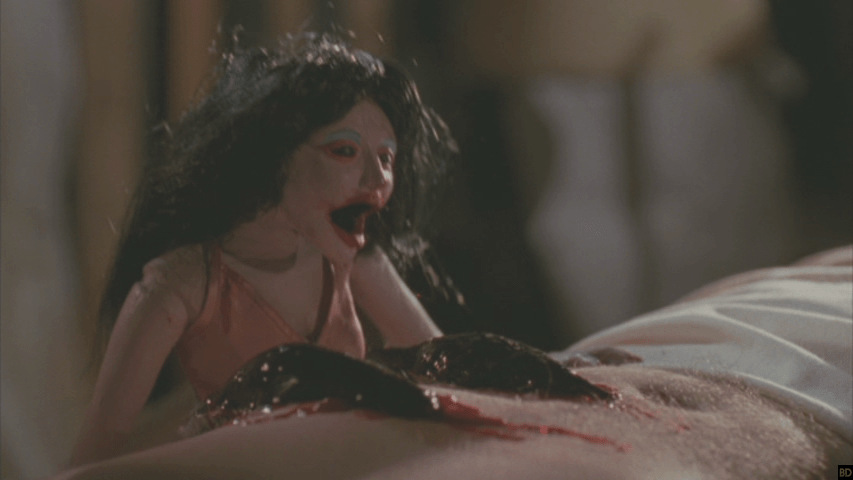
Of all the many dangerous dolls in the Puppet Master franchise, why is Leech Woman the creepiest? Because this unassuming female doll, clad in a pretty pink dress, turns monstrous when going in for the kill. Her jaw unhinges like a snake and she regurgitates poisonous leeches onto her victims. According to series creator Charles Band, Paramount wanted Leech Woman killed off because they found her to be repulsive. Of all the dolls spanning across multiple films, that’s the one they couldn’t handle. She didn’t stay gone for long, though. After sitting out Puppet Master 4: The Demon and Puppet Master 5: The Final Chapter, she returned to her unladylike ways once more.
Poltergeist – Clown Doll

This formative classic captured horror loving hearts for many reasons, but one particular scene stood tall above the rest for inducing many, many nightmares. While Diane Freeling is swimming with corpses in her backyard would-be swimming pool, poor Robbie is being stalked by his own gangly clown doll upstairs in his bed. And it’s terrifying. The combination of a clown and a doll into one phobia sucker punch is enough for many, but save for one small hint early in the film giving away Robbie’s trepidation towards his toy, this scene comes out of nowhere. The unexpected attack from an unexpected source, one creepy doll, solidified Poltergeist in collective horror memory.
Magic – Fats

The ventriloquist dummy at the center of this horror film, Fats, was so creepy that the TV spots had to be taken off the air during the promotion of Magic. Just the 30 second ad featuring Fats was enough to cause nightmares in children, scarring some for life. Who can blame them? Ventriloquist dummies are a special brand of horror on their own, but one as menacing as Fats? That he resembles his human counterpart, Corky Withers (Anthony Hopkins, who also voices Fats), probably doesn’t help either. Ventriloquists and their dummies have nightmarish co-dependency issues, and Corky and Fats take the cake. If you think Hannibal Lecter was scary, well, you haven’t met Fats yet.
Which doll terrifies you the most?


