Quantcast
Connect with us

Published

on

“Don’t worry. The Lust Experience isn’t about sex…”

Those were the ill-fated words I told my girlfriend before we walked into the arms of a psycho-sexual cult. Ninety minutes later, I found myself shaved and naked on a bed in front of dozens of people in a terrifying Eyes Wide Shut-inspired occult ceremony.

We’ll get to that later.

In truth, up until that point, The Lust Experience was about everything but sex. Two years ago, Saw II-IV director Darren Lynn Bousman, writer Clint Sears, and producer Gordon Bijelonic created a Los Angeles-based immersive theatre event called The Tension Experience. For the uninitiated, immersive theatre has become the latest craze in the arts, sort of akin to playing a live-action role-playing game a la David Fincher’s The Game or HBO’s “Westworld”. It’s a long-form alternate reality experience that hits your life like a thunderbolt, where you are an active player in a cast full of dozens. If you’ve ever wanted to be your own Sherlock in a complex mystery or feel what it’s like to be the protagonist in a horror film, look no further. There have been other notable immersive theatre experiences, like Sleep No More or Then She Fell (both based in NYC), but Bousman and Sears have taken the medium to the next level, and made all of Los Angeles the playing board.

In The Tension Experience, players were introduced to the OOA, a mysterious Illuminati-like cult that recruited members into its organization for nefarious purposes.
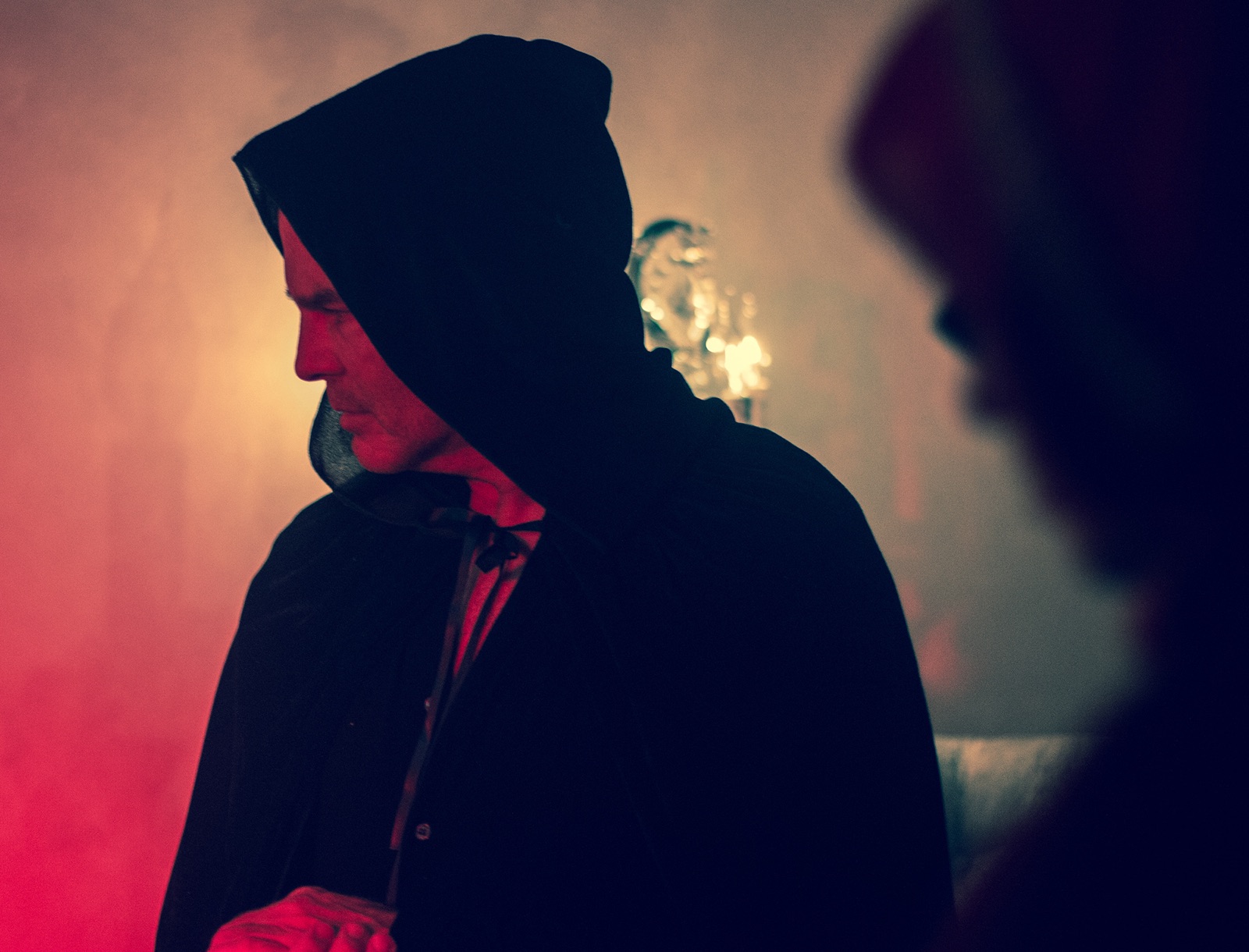
You would form relationships with leaders, cultists, detectives, and whistle-blowers, choose where your allegiances would lay, and try to piece together an elaborate mystery that blurs the lines between fantasy and reality. I was one of the original players to be inducted into the game…when a mysterious email appeared in my inbox out of nowhere – and life has truly never been the same since. The last two years have been like living in a daily conspiracy thriller, and without sounding like an insane zealot, the trials and tribulations have truly changed who I’ve become as a person. If you like your thrills passive or are too scared to step out of your comfort zone, this isn’t for you. These experiences test who you are as a person and go full tilt into your psyche.

The Lust Experience continues the narrative (think of it as Season 2), but don’t let that deter you. In truth, this experience feels like it has no beginning or end. You can join whenever you like, and it’s entirely up to you how deep you want to explore the rabbit hole. Players interact through forums on the official website (www.thelustexperience.com), and come together to share clues and conspiracy theories. Sometimes you’ll receive strange ominous phone calls or instructions to meet a character somewhere. Some active players have even been participating out of state (one even had a cast member show up in her doorstep across the country!). How much you get out of the experience depends entirely on how much you put into it.

It all culminates each year with an elaborate ticketed experience that Bousman and Sears put on in the heart of downtown Los Angeles. And that was where I found myself at The Lust Experience: Anointment – on what would become one of the weirdest nights of my life (and considering the last two years, that’s saying a lot). Over the ensuing two hours, I was put in some truly insane scenarios that looking back, I still can’t believe I followed through with.

During the mid-season event (yes, we’re only at the halfway mark), groups were welcomed into the halls of the shadowy secret society for an evening of sin and depravity. But we weren’t there without purpose. An eccentric whistleblower named Morgan, head of an Anonymous-like organization, sent us in to gather information so that we could hopefully one day expose the cult. Upon arriving at the compound, we signed waivers and were instructed “not to touch” the cast. They could, however, do whatever the hell they wanted to us. My girlfriend and I were instantly separated and I was led into an eerie lounge, full of attractive half-clothed people in an environment which can only be described as Eyes Wide Shut meets Saw.

I was approached and flirted with by several cult members (some very aggressively), asked to recount how I lost my virginity, and witnessed very strange and psycho-sexual behavior from the 40+ cast members who led us through the halls. Members of our group were often pulled away for God-knows-what. I drank wine and was fed fruit. Our group engaged in trust and confession exercises. Lots of clothing was removed. Throughout the night, we were forced to engage with dozens of bizarre (and clearly unhinged) characters, many whom asked deeply personal questions and did everything in their power to make you face down uncomfortable scenarios.

If this sounds like some cheap fetish experience, it’s wasn’t. There was a dark and ominous feeling to the experience that, even at its most sensual, never became arousing. I found my adrenaline racing the entire time, in no small part due to the crazed performances by an incredible cast.

Themes of power, control, addiction, and obsession were brought right to the forefront…

…and Bousman and Sears clearly pulled every string they could to push us to our mental limits. And just when I thought they couldn’t push the show any further, the other shoe dropped…

Sabrina – the de facto cult leader and enigmatic woman at the core of Tension/Lust – selected me as the “Chosen One” for the night. I was blindfolded and taken away into a shower. Ten minutes later, I found myself shaving off all my body hair, then was made to parade around fully nude in front of my girlfriend and several other women. I was oiled up and groomed, prepared for an ominous “ceremony” by an amazing actress who read me like a book, then hooded and put on a bed in front of the cast and players. I won’t recount what happened during the ritual or the chaos that ensued, but I walked out an emotional wreck.  Before I could even process it all, the following morning I received a message, and ended up storming the compound with an army of whistleblowers hellbent on exposing the cult.

If this sounds insane, it truly is, but there’s also great care and safety put into the production. The design and acting are all top-notch, and you ultimately decide how far you want your experience to go (your compliance or refusal to do certain deviant things would change how the narrative unfolds for you). Other players experienced far less extreme things, others more, and some different experiences entirely. That’s the beauty of The Lust Experience – no two people will have the same story. And as much as you come to feel that safe loss of control, you’re ultimately the one who decides your own path.

The craziest thing is that this all just feels like the warm-up exercise during my two years on Bousman and Sears’ rollercoaster. I never know when my phone will ring and spin my day into chaos. I never know when a character might show up in my life unannounced or if real-life friends are in on it. I’m not even sure that writing this article won’t carry some in-game repercussions. That’s an incredible feeling to have during daily life, and I know that wherever these paranoid-filled Experiences take us, they won’t be boring.

The Lust Experience is continuing into 2018 and brave souls can join in on the fun by visiting their website.

– David K.
14 Comments

Editorials

‘The Mandela Catalogue’ Explained: Inside Alex Kister’s Viral Analog Horror Phenomenon

Published

on

The Mandela Catalogue explained

I first heard about The Mandela Catalogue through a couple of nephews who were obsessed with the ARG’s sinister mythology. It was only after watching Wendigoon’s in-depth analysis of the series that I realized just how deep this rabbit hole goes.

In fact, I’d already been exposed to the nightmarish visuals of Alex Kister’s YouTube creation for years at that point without even realizing that it was the origin of several viral “cursed images” and spooky memes that had leaked into the wider internet – with this viral element actually being a part of the Catalogue’s overarching narrative.

Flash-forward to 2026 and the unprecedented success of Kane Parsons’ Backrooms has led to Hollywood betting on horrific internet properties with existing fanbases, which means that Kister’s unique hybrid of both religious and analog horror is finally headed to the big screen with a script written by Kister himself alongside Tyler Clifton.

While this news shouldn’t be too surprising if you’ve been keeping up with the ongoing success of The Mandela Catalogue (both myself and Wendigoon having previously predicted that the series would inevitably make the jump to theaters one day), plenty of horror fans are likely confused as to why so many folks are excited for what appears to be a Hollywood adaptation of a series of creepy .jpeg images under a VHS filter.

With that in mind, today I’d like to invite fellow readers to accompany me as I explore the origins of Alex Kister’s viral hit and attempt to explain exactly why we should all be excited about the Mandela Catalogue adaptation!

From High School Writing Project to Internet Horror Phenomenon

The first seeds of The Mandela Catalogue were sown when Kister was still in high school and developed a writing project subverting religious tropes in a world where biblical history had been altered by demonic forces. A little while later, Kister came across an analog horror contest on Reddit and decided to adapt his ideas into a standalone video where he would edit a religious kids’ cartoon –The Beginner’s Bible: The Nativity, to be specific- into something far creepier. This is how the iconic Overthrone video was born, with this viral short film taking on a life of its own as fans demanded more eerie content from Kister.

Though the video was originally meant to be a one-and-done sort of affair, with Kister actually regretting some of its primitive visuals and considering the editing amateurish and “YouTube-Poop-like” when compared to his current standards, fan reaction and free time during the COVID-19 pandemic encouraged the (then) seventeen-year-old filmmaker to continue producing content set in this same world. The Mandela Catalogue name was inspired by the Mandela Effect conspiracy theory, as the series would slowly begin to explore the subtle horror of alternate histories.

Inspired by existential dread brought on by extended periods of quarantine as well as a personal crisis of faith, Kister continued to expand his alternate timeline where the rise of Christianity had been prevented by what was presumably the Devil disguised as the Archangel Gabriel. This alternate course of fictional events led to the existence of certain paranormal anomalies that had come to be accepted as “normal” by the 1990s, which is why most of the series’ supernatural horror is presented in such a matter-of-fact manner.

Most of this background information and religious lore is delivered by increasingly cryptic broadcasts and in-universe PSAs, as well as the occasional found footage video, that often have to be decoded by clever viewers. Of course, it’s the consistently disturbing imagery that made the series so popular – much of which was originally created by Kister on a smartphone!

The Alternates: Horror’s Most Unsettling Modern Monsters

The show’s early episodes mostly take place within the fictional Mandela County in Wisconsin and depict life in a world where demonic entities are capable of using media to enter our reality. This process usually involves scaring victims into killing themselves and then repurposing their bodies as horrific doppelgangers referred to as “Alternates”. This terrifying phenomenon has become so common that local police already have specialized procedures in place to deal with the issue, though this usually consists of simply ignoring calls for help so as to avoid spreading so-called “Metaphysical Awareness Disorder” any further.

Over time, Kister would expand this mythology and incorporate different kinds of Alternates into the mix, though the story never stopped deconstructing religious concepts. The series’ second volume exponentially increased both video quality and the overall narrative scope as we began to follow the lives of characters who had already grown up in this dystopian hellscape where the government is forced to prohibit religion, television, and even mirrors in the hopes of mitigating the damage done by the ongoing invasion of otherworldly entities.

The really interesting part comes into play when you realize exactly how the Alternates make use of scary media in order to spread their demonic influence, with the analog horror of it all being a diegetic part of the story and something of a memetic trap orchestrated by the false Gabriel.

I particularly appreciate how some characters begin to suspect that there’s something wrong with their version of reality and that things weren’t meant to play out this way, especially when Mark utters the haunting line “who have I been praying to all this time?” That’s why I think The Mandela Catalogue is an effective piece of religious horror even if you don’t subscribe to the Christian worldview, as the mere idea of a world where evil has already won is a universally terrifying concept in and of itself. Not only that, but the series’ uncanny analog imagery alone is already worth the price of admission, as you’ve likely already noticed by looking at the pictures accompanying this article.

Why The Feature Adaptation Could Be Horror’s Next Big Success

It’s actually been a whole year since Kister first announced that he had been working on a feature-length screenplay for a Mandela Catalogue movie since 2022, with his proposed story following an ensemble of high-school graduates who uncover a supernatural conspiracy after the mysterious disappearance of a fellow student. This premise sounds similar to narrative elements present in the series’ second volume, but I’m pretty sure that Kister is going to go the Kane Parsons route and make the movie more of a spin-off than a re-imagining of its source material.

While notable Hollywood producers like Aaron B. Koontz, Scott Stuber, and Steven Spielberg himself are backing the upcoming project, I feel like there’s no one better to adapt this deeply personal exploration of faith and the dark side of communication than the person who first came up with it. That’s why I can’t wait to see Kister’s work on the big screen, as I have a feeling that this young filmmaker is the next one on the list about to make cinematic history – especially since this is clearly a passion project that has been in the works for years at this point!

That being said, there’s always a chance that the film could end up unleashing a fresh wave of Alternate incursions, but I guess that’s just a risk we’ll have to take.

Continue Reading