


Among all the amazing content that Amazon Prime Video has been curating lately, the one-season wonder of Eerie, Indiana has invoked the most nostalgia. Filling the void of small-town weirdness vacated by Twin Peaks’ cancellation, Eerie, Indiana was an anthology series set in a town filled with strange occurrences investigated by teen Marshall Teller (Hocus Pocus’ Omri Katz) and his sidekick Simon (Justin Shenkarow). NBC boldly placed this family-friendly oddball show smack in the middle of prime-time network television during the 1991-1992 season, and enlisted a slew of well-regarded horror talent. Horror master Joe Dante directed the pilot, among a handful of other episodes, and stayed on as a creative consultant for the remainder of the series. Which meant he had a direct say in casting, and setting the initial tone. He even appears as himself in the ballsy meta finale. Critically adored, Eerie Indiana cleverly towed the line between light-hearted, quirky humor and its underlying darkness, but its unforgiving time slot and expensive production ultimately relegated it to a single season.
Had it aired just a few years later, when supernatural network series were really gaining momentum, Eerie, Indiana may have continued for many seasons. The word “may” being the key word, here, though, as it appeared that series creators Jose Rivera and Karl Shaefer were prepping to retool the series by episode 13 with a new lead in Dash X, the grey-haired mysterious teen without a past played by Jason Marsden channeling his inner Christian Slater. Considering Marshall and Simon were far more likable, I’m not sure this move would’ve worked.
Like most small towns, Eerie was a quaint small town that belied its hidden darkness below the surface. The structure of the entire series unfolded layers of complexity that isn’t as initially obvious in its family-friendly sci-fi/supernatural leanings. Marshall arrives in town from New Jersey, and his closest friend and ally is the much younger Simon. Why would a teen hang out with a boy of roughly nine years old? Episode 3 reveals Simon’s home life is extremely dark and broken, with a father that ignores his son in favor of bringing home multiple women at a time.
The series also had a knack for doling out adult jokes and kid appropriate jokes in equal measures. Marshall’s dad referring to the homeless bum in episode 15 as the town’s sole liberal, followed by Simon’s inquisitive, “What’s a liberal?” induced a chuckle. More than the humor, though, is the show’s ability to retain continuity. Unlike a lot of anthology series, what happens in Eerie is never forgotten and the writers ensure that consequences and findings of episodes reverberate. At least if you pay attention.
With episodes directed by Dante, Bob Balaban (Parents, My Boyfriend’s Back), and Tim Hunter (Twin Peaks, River’s Edge, Hannibal, and notable guest appearances by a young Tobey Maguire, Danielle Harris, and recurring appearances by John Astin (Gomez Addams of The Addams Family) and Harry Goaz playing a much straighter police officer than his Twin Peaks oafish counterpart, Eerie, Indiana was years ahead of its time. Though it fared much better during reruns, garnering a new fan base, the time for this underappreciated series has long lapsed. That doesn’t mean we can’t enjoy its sole season for what it is; clever fun for the burgeoning horror fan with a high rewatch factor. In celebration, I revisited all 19 episodes:
Foreverware

Directed by Joe Dante, the pilot ep introduces us to Marshall Teller and his family, recent transplants to Eerie from New Jersey. The Tellers are welcomed to town by neighbor Betty Wilson, who invites Marshall’s mom Marilyn (Mary-Margaret Humes) to her ForeverWare gathering. ForeverWare’s plastic containers are guaranteed to keep anything fresh, pretty much forever, and Betty takes its meaning to a whole new level. A great introduction with a very creepy episode antagonist in ‘50s housewife Better, it paves the way for Marshall’s investigations of Eerie’s weirdness to come. Even though the self-contained story wraps up, the twins can be spotted in multiple episodes throughout the season. More than any other episode of the series, it was the ForeverWare beds that seared into my mind.
The Retainer
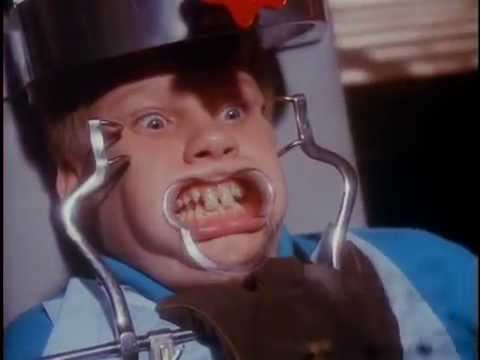
Also directed by Dante, The Retainer gives an ominous twist to man’s best friend when Marshall’s classmate Steve gets a new retainer that tunes into the inner monologue of dogs. While the dogs in this episode aren’t nearly as scary as they could be (this is a family show after all), they’re plotting against humans and the episode ends on a fairly dark note. At least for a certain character.
ATM with the Heart of Gold

Marshall’s dad Edgar (Francis Guinan) works at a place called “Things Incorporated” as a product tester and inventor. It’s a tongue-in-cheek nondescript sort of job that allows for flexibility in the series when called upon. In this instance, Edgar’s come up with Mr. Wilson, a talking ATM with a friendly avatar. So friendly that Mr. Wilson befriends the lonely Simon, giving him money every time they meet, when Simon doesn’t even have a bank account. This episode really fleshes out Simon’s backstory, showing why he’s so eager to buy friends and assimilate into the Teller family.
The Losers

Another episode helmed by Dante, this one gives a twist to the hidden nature of losing objects. In the town of Eerie, things may appear to go missing, but it’s really a conspiracy uncovered by Marshall and Simon when Edgar’s briefcase goes missing. This episode is notable for guest star Dick Miller. Yeah, that guy Dick Miller (Gremlins, Tales from the Crypt: Demon Knight).
America’s Scariest Home Video

Set on Halloween night, Marshall and Simon are stuck babysitting Simon’s younger brother Harley. Harley is a babysitter’s worst nightmare and manages to get himself swapped with the mummy from the movie he’s watching on TV. It’s a fun monster movie type episode, but it’s also the first of many nods to Arnold Schwarzenegger (seriously, this show loves to reference Terminator 2). The writers probably couldn’t resist; Harley is played by twins Christian and Joseph Cousins, most known for playing Dominic in Kindergarten Cop. Harley’s middle name is Schwarzenegger. Yup.
Just Say No to Fun

With a plot that feels very similar to Disturbing Behavior, a school eye test turns Simon into a studious student completely devoid of fun. It turns out the new school nurse is fond of administering eye tests that brainwash the students. In keeping with the theme of the plot, the school’s name is revealed to be B.F. Skinner Junior High, a reference to psychologist Burrhus Frederic Skinner, the guy responsible for founding Radical Behaviorism. It’s so clever that you almost forget to question why Simon, a character around the age of 9, would be attending a junior high. Eerie’s rules are lax like that, I guess.
Heart on a Chain

Directed by Dante, this ep centers on a twisted love triangle between Marshal, his friend Devon, and the new girl in school Melanie Monroe (Danielle Harris). Melanie’s family has come to Eerie to wait for a potential donor; Melanie’s heart is weak and failing. Enter the dark twist; Melanie quickly gets her heart when daredevil Devon befalls a tragic accident. Even after death, Devon still gets in the way of Marshall’s pursuit of Melanie. There’s a surprising maturity in the character of Melanie, and Dante keeps the story from getting too dark. Look for a cute nod to The Fly (the ‘50s version), and an odd background appearance by the Grim Reaper in the cemetery.
Broken Record

This episode never actually aired during the series’ original run; it was cut during the show’s retooling with Dash X. Broken Record eventually aired on The Disney Channel in 1993, which is a bummer considering it’s a solid episode that harkens to horror movies like The Gate or Trick or Treat. Like Simon, Tod has an unpleasant home life too, this time in the form of an overbearing, hard to please father. Marshall suggests release in the form of heavy metal, and Tod finds himself relating to the lyrics a bit too much. Tod’s transformation into rebellious metal head becomes a lot stranger than it sounds, in a way that only exists in horror movies. Or Eerie, Indiana.
The Dead Letter

While browsing through books at World o’ Stuff, an eclectic store and Eerie mainstay, Marshall discovers an undelivered letter written 62 years ago. The discovery invokes the spirit of Tripp McConnell, who wrote the letter, and Tripp’s haunting of Marshall until he agrees to deliver the letter to his childhood sweetheart. A young Tobey Maguire stars as the ghostly Tripp, and while the plot is tried and true, there’s a few issues with this one. Namely, Tripp’s final reunion with his lost love, now elderly, is a little strange. More so, Marshall’s reluctance to help feels shoehorned and forced when the series consistently relies on his willingness to get to the bottom of Eerie’s mysteries. They can’t all be winners.
Who’s Who

If there’s one thing that’s a sure bet in this series, it’s that unless you’re the imperfect, perfect Teller family, nearly every other kid comes from the most dysfunctional family. Enter Sara Bob, the sole female in a house full of rowdy boys after their mother abandoned them. Used as a surrogate mother, that mostly translates to Sara existing as a bit of a slave, Sara’s sole form of comfort and release is drawing. When Marshall buys her an Eerie #2 pencil from World o’ Stuff, Sara discovers that anything she draws physically manifests in real life. Which means she can create her own fantasy family. It’s a touching episode that’s a bit somber, but the writers inject a little humor when they can. Namely by naming everyone in Sara’s family Bob. It carries through to the end credits, where they’ve inserted Bob as a middle name to everyone in the crew.
The Lost Hour

Directed by Balaban, this episode finds Marshall determined to get his extra hour in when he discovers Eerie doesn’t do daylight savings. He sets his watch back, resulting in him getting stuck in this lost hour, a separate timeline far removed from Eerie’s inhabitants. In this Lost Hour, Marshall must team up with a young girl that’s been missing in Eerie for a year as they flee from the creepy garbage collectors and seek assistance from the Milkman. It’s an episode that feels right at home with The Twilight Zone.
Marshall’s Theory of Believability

A renowned para-believable professor comes to town to track a UFO set to land in Eerie. Marshall and Simon eat it up, thinking they’ve finally found someone who will believe their adventures. Marshall’s dad isn’t so quick to trust the professor, though. While the opening credits usually features Bigfoot going through Eerie’s trash, there’s no actual Bigfoot centric episode. Bigfoot can be found lurking in the background, but this episode indicates that there might be more than one; one of the professor’s assistants runs into a Bigfoot with a bow in the woods. This ep was also directed by Balaban.
Tornado Days

Marshall, harboring a healthy fear of tornados, stays home while the rest of the town is out celebrating Tornado Day, a day in which they prepare an annual picnic to appease Old Bob the tornado. However, Old Bob gets offended that Marshall stays home and threatens to come to town anyway. Marshall must team up with a crazed meteorologist (Matt Frewer) to ward off Old Bob and save the town from destruction. The idea to personify a tornado in a grudge match with a meteorologist is one of the many cheeky reasons why Eerie, Indiana proved to be such fun, and the ep also highlights the comedic relief talents of Marshall’s older sister Syndi (Julie Condra). The tornado effects are very dated, but Frewer’s guest appearance is fantastic.
Hole in the Head Gang

Marshall and Simon’s latest investigation of an old mill rumored to be haunted, brings the introduction to Dash X, the mysterious character brought in to retool the entire series. Why the name Dash X? Because this character, who has no memory of who he is or where he came from, bears a black dash on one hand and an x on the other. It’s the beginning of an arch that finds Dash X a foil for Marshall, and often unwitting ally. The retooling was likely an answer to ratings, but the character missed the mark of what made Eerie, Indiana a great series. Take him out of the episode, and the ghost that just wants to nail his bank robbery works.
Mr. Chaney

Every 13 years, Eerie holds a lottery to select a Harvest King, who must then go into the woods to face the Eerie Wolf. Mysteriously, none of the previous Harvest Kings are ever seen again. Thanks to Dash X, Marshall is entered and selected as the new Harvest King. It’s the first episode to hint that Eerie’s town government may be shady, but more importantly, it’s a werewolf episode! Never mind that this werewolf only feeds once every 13 years on little boys. No, that’s not weird or creepy at all. The Eerie Wolf is a bit cheesy, but I give it bonus points for attempting practical. As if the title didn’t give away the episode’s werewolf theme, looks for tons of wolf-related Easter eggs before the reveal. While Dash X might be a grating character, his introduction brought about the beginning of John Astin’s recurring appearance as Radford, a character rivaling the plucky charm of Gomez.
No Brain, No Pain

I suppose if you have a sci-fi supernatural anthology in the same vein as The Twilight Zone, then a body-swapping episode seems inevitable. In this instance, Marshal and Simon intervene when they witness a crazy homeless man being attacked by a woman with a ray guy. It turns out that the homeless man is a genius with a unique invention. Throw in Marshall’s nemesis Dash X, and chaos ensues. Can you tell that I’m really not a fan of the Dash X character?
Loyal Order of Corn

Marshall’s dad joins the town’s Loyal Order of Corn, prompting Marshall and Simon to investigate just what exactly is the purpose behind this secretive order. It turns out that the Order is building a giant TV, and Simon winds up stuck on another planet. Notable for another fun appearance by John Astin, and an always welcome appearance by Ray Walston (Fast Times at Ridgemont High, The Stand), this episode provides the only clues viewers would ever receive about Dash X’s past- he may not be of this Earth.
Zombies in PJ’s

Radford, owner of the World o’ Stuff, faces bankruptcy due to potential audit. Enter The Donald, an arrogant businessman who swoops in to save the day with subliminal marketing, causing customers to sleepwalk in and buy everything in sight on credit. But this credit comes with very fine print and an overwhelming price if they can’t pay in full; their souls. With The Donald being the primary villain, this episode feels so much more surreal given the current social context, but it’s Radford’s extreme fear of the IRS that proves hysterical. There are no actual zombies in this episode, just a poignant stab at consumerism and a Hellish twist. Literally.
Reality Takes a Holiday

For the final episode, at least Eerie, Indiana goes out with a bang. A self-referential plot that has Marshall discovering a script in his mailbox for Eerie, Indiana. As he starts reading it, Marshall finds himself behind the scenes of the series, where everyone he knows is actually the actors who play them, and they all refer to him as Omri. Marshall spends the episode confused and desperate to find his way back home. Joe Dante was too busy working on Matinee to take up directorial duties for this final ep, but he did appear in the episode as himself, humorously frustrated with “Omri” as Marshall fumbled through the set. The only character not referred to by his actor’s name is Dash X, a huge hint that Marshall’s nemesis was behind the meta strangeness. Though the series creators and writers were poising Dash X to take over the lead, they were humorously self-aware, and at least the series went out with Marshal rightfully on top.
