


In case you haven’t heard, there’s this film called Hereditary (my review) that’s been scaring the pants off viewers ever since it premiered at the Sundance Film Festival back in January. Released in theaters nationwide back in June, the film has proved polarizing for viewers. Admittedly, it is not an easy film to watch.
Complete with deeply uncomfortable familial encounters, intense moments of grief and suffering and a few decapitations, Hereditary is not exactly family viewing material. That being said, I still decided to show the film to both of my families over the Thanksgiving holiday (once with my husband’s side of the family and once with my side), watching the film twice in 48 hours. These were my third and fourth viewings of the film, and I was shocked to find that I was noticing things that I hadn’t noticed on my first or second viewings of the film.
I thought I would share some of my findings with you (and yes, I fully realize that this article is about six months late).
***SPOILERS for Hereditary to follow***
At the risk of becoming one of those “Hereditary Ending….EXPLAINED!” articles, let’s recap the film:
The ending of Hereditary reveals that Annie Graham’s (Toni Collette) mother Ellen Leigh (referred to as Leigh from this point forward) is the queen of a cult whose sole purpose is to conjure Paimon, one of the eight kings of Hell, into a male host. Before the events of the film, Leigh tried to conjure Paimon into the body of her son Charles. Charles later committed suicide, accusing his mother of trying to put people in him in his suicide note. When that attempt failed, Leigh moved on to Annie. Since Annie, as a female, couldn’t be a satisfactory host for Paimon, she wanted to use Annie’s son Peter (Alex Wolff). Unfortunately for Leigh, she and Annie were estranged at the time Peter was born. They had (somewhat) reconciled by the time Annie’s daughter Charlie (Milly Shapiro) was born, so Leigh began working on her. Leigh and her cult succeeded in conjuring Paimon, but since Charlie (who was never actually Charlie, but always Paimon) was female, he was not satisfied and didn’t give the cult members the riches promised to them for completing the ritual. The cult planned to kill Charlie and transfer her/Paimon’s soul into Peter, but Leigh died before this could happen. This is where Hereditary begins.
Over the course of the film, we bear witness as the cult’s scheme play out. Shortly after Leigh’s funeral, Charlie is decapitated in a freak car accident, releasing Paimon from his female form. The cult sends Leigh’s second-in-command, Joan (Ann Dowd), undercover to befriend Annie and bend her to their will. Using Annie’s grief to manipulate her, she tricks Annie into conjuring Paimon under the guise of being able to communicate with her dead daughter. The demon begins tormenting Peter, wearing his body down until it is weak enough for him to possess. The climax of the film sees the cult overtake the Graham household as Paimon immolates the family’s patriarch Steve (Gabriel Byrne) and decapitates Annie. Paimon then successfully possesses Peter, and the film ends as the members of the cult worship him.
Now that we’ve got that out of the way, it’s time to dive into all of the various clues and fun little tidbits that you may not have caught on a first (or second…or third) viewing of the film. Hereditary, in director Ari Aster‘s words, is a tale of a conspiracy from the point of view of those being conspired against, so the audience is just as much in the dark as the Graham family. The film contains very little exposition, but if you’re paying attention (and listening closely), you’ll be able to put the pieces together. Below are some of the things we found (and there may be even more that we didn’t spot!).
Tricks of the Light
One of the more visually interesting things Aster does in the film is use the light to his advantage, especially in the third act. He hides a few things in the darkness that, if you don’t give your eyes time to adjust, you might not notice.
Big thanks to reddit user ryuhadoken for brightening these images for me!
Grandma in the Corner
Aster makes this one obvious, and doesn’t obscure Leigh too much. If you made it all the way to the end of the film, you will know that this moment is a primer for what’s to come. Speaking of….

Annie on the Ceiling
This is the one that most people remember, although a quick scan of the YouTube comments show that quite a few people didn’t catch Annie on the ceiling during their initial viewing of the film. If you were fortunate enough to catch Hereditary in the theater, you were probably able to hear the audible gasps from your fellow audience members at different times as they spotted Annie, making for one of the best theatrical experiences you’ll ever have. After watching the film twice with different family members over Thanksgiving break, I can confirm that watching it at home does not have the same effect.

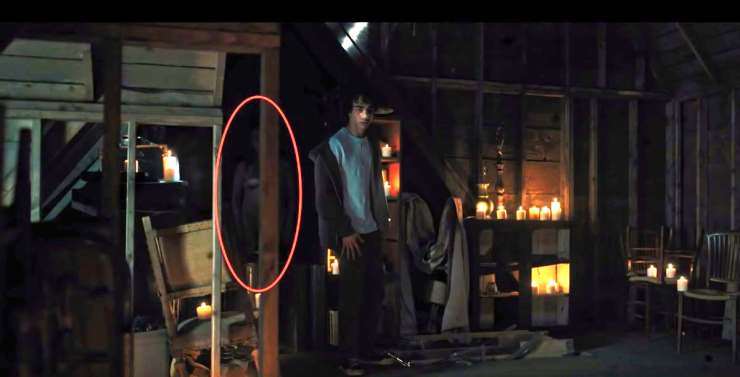
Cultist in the Attic
Just how did Annie get inside that locked attic after banging her head against it? Remember, the attic hatch wasn’t open when Peter went downstairs, so someone had to have gone up there when Peter was discovering his father’s charred (and decapitated) corpse. If you look closely, you’ll see a nude cultist standing right behind the column next to Peter after he locks it. It is this person that lets Annie in the attic.
Cultists Around House
Apparently, nobody caught this one. Right before Peter wakes up to Annie floating on his ceiling, Aster gives viewers a wide shot of the Graham house in the daylight before jump cutting to nighttime. Once the scene switches to night, dozens of nude cultists materialize around the house. It’s a blink-and-you’ll-miss-it moment.
This last one isn’t a trick of the light, but can clearly see someone breathing outside the house when Peter is smoking his bong at the beginning of the film. You just might have been so focused on Peter that you didn’t notice it.
An Ominous Symbol
Paimon’s symbol, which is painted in blood on the wall of the Graham’s attic (and also adorns the white gown that Grandma Leigh’s headless corpse is wearing), makes several cameo appearances throughout the film, the first of which is at Leigh’s funeral. Annie can be seen wearing the symbol as a necklace (no doubt gifted to her by her mother):

In fact, her mother is wearing the same necklace:

Foreshadowing a Decapitation
If you thought Charlie’s death was an accident, you’d be wrong. While driving to the party, Aster stops the camera on the light post that will decapitate her. Scratched in the wood of that light post is Paimon’s symbol, confirming that the cult used their magic to orchestrate Charlie’s death.

Joan’s Wall
Remember Joan? Yeah, she’s evil. The last time Annie visits her apartment, the door is locked, but Aster gives viewers a peek inside it, and wouldn’t you know? There are not one, but two symbols hanging on her walls.

Mother’s Book
When Annie is going through her mother’s boxes at the end of the film, she finds a book with Paimon’s symbol on it. Said book is filled with spells and incantations, probably used to conjure Paimon.

The Story of Paimon
Paimon’s spellbook isn’t the only thing Annie finds. She finds another book that might as well be called “Hereditary Exposition,” as it gives Annie (and the viewers) a bit more of Paimon’s backstory. The first thing we see is a drawing of Paimon, but if you look closely, you’ll see that Paimon has a trio of severed heads tied to his waist. Could it be that Paimon has to be paid in severed heads? This is no doubt why Charlie, Leigh, Annie and Steve all have their heads removed by the time the credits roll.

The camera then pans down and reveals some important text about Paimon (in case you didn’t know it was important, the text is highlighted):
“When successfully invoked, Paimon will possess the most vulnerable host. Only when the ritual is complete will Paimon be locked into his ordained host. Once locked in, a new ritual is required to unlock the possession.”
“Most vulnerable” is the key phrase here, as Peter is repeatedly tormented both mentally and physically, thereby making it easier for Paimon to enter his body.

The camera pans down even further, giving us a bit more information on Paimon and his needs:
The Goetia itself makes no mention of King Paimon’s face, while other documentation describes him as having a woman’s face (while still referring to him using strictly masculine pronouns). As a result, the sexes of the hosts have varied, but the most successful incarnations have been with men, and it is documented that King Paimon has become livid and vengeful when offered a female host. For these reasons, it is imperative to remember that King Paimon is a male, and thus covetous of a male human body.“
For those not in the know, the Goetia is a practice that includes the conjuration of demons, specifically the ones summoned by the Biblical figure, King Solomon. More on good ol’ Solomon in a moment.

Necromancy
As you may have noticed, there are several words scrawled on the walls in the home of the Graham House. These words are: Satony, Zazas and Liftoach Pandemonium. These may look like made-up words for the film, but they all have a basis in the practices of necromancy and conjuration, and each word has significance during each part of the film that it appears in.
All explanations below are courtesy of Signal Horizon:
Satony
“[Satony is] a word of power of some kind, as it seems to be used to command the dead back to the spirit world. That makes perfect sense with the final moments of the movie. The demon needed to be called to Peter, and Charlie and Annie out of the way for this to happen.”

Zazas
“[Zazas is connected to] the name Aleister Crowley. As any good Supernatural fan can tell you, he is the Devil on earth or a really misunderstood guy that can on occasion be a hero. I digress….From what I can gather on several crappy HTML websites and some wikis, it looks like Crowley was an early 20th century traveler and occultist. He and his partner went on a walking tour of Algiers, where Crowley worked on expanding his consciousness to different planes of reality. During this excursion, he summons a demon called Choronzon. This story and character seem to be fairly well known in the occult world. In order to invoke the demon (I think), he uses the mantra ‘Zazas Zazas Nasatanada Zazas.'”

Liftoach Pandemonium
“Pandemonium is associated with Milton’s Paradise Lost, as the place that Lucifer creates for those who fall from grace with him (pan = all + demon + ium = makes a noun). This phrase seems to appear in a couple of different spells: the Rite of Insurmountable Strength, and a rite to invoke a demon. Shocker, based on what’s happening in the movie. Interestingly, ‘liftoach’ on its own appears to be Hebrew, meaning ‘to open; unlock; turn on.’ So essentially, ‘open up for the demons, y’all.'”

Satony, Degony, Eparigon
This phrase is screamed at Peter by Joan shortly after Annie has performed the conjuring spell. It is part of a necromancy spell that the reader is supposed recite after he or she has summoned a spirit to the world of the living. Reciting these words would send the conjured ghost (or demon) back to the spirit world. It isn’t clear why Joan would be yelling this at Peter, but it could be a way of wearing his soul down so as to make it easier for Paimon to enter his body (I’m just spitballing, here).

Triangles
Triangles play a pretty big part in conjuring spirits and demons because of Solomon’s Seal, the symbol of the aforementioned King Solomon. This symbol is comprised of triangles, initially as a pentagram but now more commonly seen as a hexagram (much like the Star of David). He was the first person believed to have to conjured a demon for personal gain, and he used his seal to do so. This is why Leigh had a triangle drawn on her floor and why Joan drew a triangle around Peter’s picture. It was part of the ritual of conjuring Paimon.


Listen Closely
Hereditary is pretty brilliant about integrating very important bits of dialogue into scenes that may not seem that important. The foley work in the film is equally impressive, as Aster works in a few clues throughout the movie that you may not have heard if you weren’t listening closely (or if your theater audience was being less than respectful).
Footsteps in the Attic
When the Grahams return home after Leigh’s funeral, you can hear footsteps and a door closing upstairs. This is most likely some of the cultists shacking up in Leigh’s bedroom or putting Leigh’s desecrated corpse up in the attic.
High School Literature Lesson
This explicit foreshadowing is important, because it essentially describes Hereditary in a nutshell. In the beginning of the film, Peter’s teacher is discussing Sophocles’ tragedy The Women of Trachis, which centers on the Greek hero Heracles and his jealous wife, Deianeira, who accidentally brings about Heracles’ death with a poisoned robe. His death is foretold to Deianeira by an oracle. The teacher states that because of the oracle’s vision, Heracles never had a choice and is thus doomed to his fate no matter what decisions he made in life. He then asks the students if it is more tragic or less tragic than if he did have a choice, to which a student replies:
“I think it’s more tragic – because if it’s all just inevitable, that means the characters have no hope and that they never had hope, because they’re just like pawns in this horrible, hopeless machine.”
The comparison between The Women of Trachis and Hereditary is apt, except Aster does give Annie a choice: the choice of whether or not to hold a séance to communicate with Charlie. Annie choosing to hold the séance instantly dooms the Graham family, and their fate is sealed. Is it more tragic that Annie had a choice, even if she didn’t know what the full outcome of that choice would be? Or would it have been more tragic if her family’s fate was inevitable from the start? That’s up to the viewer to decide.
Supposed to Be a Boy
Again, this may not seem important on a first viewing, but Charlie tells her mother that Leigh said she was suppose to be a boy. This is, of course, because Paimon needs a male host. It also explains why Leigh was content with using Charlie to conjure Paimon if the ritual began while she was still in Annie’s womb. She expected Charlie to be a boy and decided to move forward with the ritual. When Charlie was born female, the plan to move Paimon into Peter’s body was put in motion (why it took them 13 years to make that happen is anyone’s guess).
Annie’s Family History
Aster does a fantastic job of highlighting this depressing sequence, though you’d be forgiven for forgetting about it after the shenanigans that take place at the end of the film. If you did happen to remember Annie’s testimony when the cult’s master plan is revealed then new light may have been shed on Annie’s family history and its relation to the cult:
“My mom was old and she wasn’t all together at the end – and we were pretty much estranged before that – so it wasn’t a huge blow. But I did love her. And she didn’t have an easy life… She had D.I.D., which became extreme in the last year, and dementia…! My dad died of starvation when I was a baby. He had psychotic depression and he starved himself. Which I’m sure was as pleasant as it sounds. And then my older brother – he was schizophrenic – and when he was sixteen, he hanged himself in my mom’s bedroom. Of course his suicide note blamed her. Accusing her of putting people inside of him.“
It’s obvious that Annie’s brother was not schizophrenic. Rather, he was telling the truth about his own mother, who was absolutely trying to put Paimon in him. Did she actually have dissociative identity disorder, though? That’s up to you to decide.
Annie continues:
“She finally lived in our house at the end. Before hospice. We weren’t talking before that — or we were and then we weren’t and
then we were – she was completely manipulative – until finally my husband enforced a No Contact rule, which lasted until I was pregnant with my daughter. I didn’t let her near me when I had my first – my son – which is why I gave her my daughter, who she immediately stabbed her hooks into. And of course I felt guilty again when she got sick… Not that she was even my mom at the end. And not that she ever felt guilty. About anything.”
It is likely that Leigh always planned on moving in with Annie once Charlie was born, so that she could nurture Paimon and care for him as he grew up. Had she been on good terms with Annie when Peter was born, then Peter would have been born Paimon.
Exposition Through Miniatures
Besides Annie’s testimony at the grief counseling group. Aster also gives plenty of backstory via Annie’s miniatures, all of which reflect different moments in her life. The first model we see if of Leigh in hospice care:

Then we get a more explicit account of Leigh trying to feed Charlie. As Annie told Charlie at the beginning of the film: Leigh always wanted to feed Charlie. Unfortunately, she wasn’t trying to feed her with a bottle; she was trying to breastfeed her! Of course, she was eventually able to feed her with a bottle. More on that in a bit….

In one of the creepier miniatures, we see Leigh spying on Steve and Annie while they are sleeping. This was probably a result of her dementia.

When we get a glimpse inside Joan’s locked apartment, we see a display of figurines (called “manikins” in Aster’s screenplay) bowing down to three severed animal heads and the bird figurine that Charlie made before she died.

If the above diorama looks familiar to you, it’s probably because it’s an exact replica of the sequence in the treehouse that ends the film:

Aster’s script reveals that the severed animal heads in Joan’s diorama were also in Charlie’s shoebox in the beginning of the film, and that is why she quickly puts the lid back on it when her father wakes her up to go to Leigh’s funeral.Unfortunately, this is not something made clear in the finished film, so the connection isn’t apparent.

Stray Observations
Finally, there are just a few more interesting goodies sprinkled around the film that we noticed.
Creepy Cultist
Remember this guy who was smiling at Charlie at Leigh’s funeral?

He shows back up at the end of the movie, only this time he’s naked. Fun!

Footsteps Leading to the Flames
When Charlie sees Grandma Leigh sitting on a log and surrounded by flames, the camera hovers over her as she walks towards the body. You can clearly see footprints leading to Leigh, signaling the fact that a cultist walked her decaying corpse over there.

Séance Flyer
At one point in the film, we see a bunch of mail stuck in the Graham’s mail slot. After a few seconds, a flyer for a séance is inserted right on top of the mail. This was done by the cultists with the hope that Annie would attend the advertised séance. When she didn’t, they had Joan meet her at the craft store to tell her about it.
Paint Bottle Tips Over By Itself
Astute viewers will notice that Annie doesn’t actually knock over the paint bottle that spills on the paper containing Joan’s phone number. It falls over by itself. Well, not really by itself. Paimon’s signature glimmer can be seen in the window before Annie reaches for the bottle.
The Black Herb
Last, but certainly not least, when Annie first goes to Joan’s apartment, she drinks some tea and pulls a piece of a black herb out of her mouth. It could be an innocent tea leaf, or it could be an agent of Satan because…….

…this just so happens to be the same black herb that Grandma is feeding Charlie in the picture in her room (and if you think we’re lying, Aster’s screenplay specifies that it is the same herb).

Those are all of the clues we found! Did we miss any? Let us know in the comments below!
