


Women tend to be the heroes in horror more often than not. The final girl that begins the story as meek and sweet, but emerges as a monster-slaying badass thanks to an inner strength, resilience, and wit. But those same traits that make them triumphant could also make them inherently terrifying if their core was rotten. With the likes of Jason Voorhees, you know what to expect. With characters like Tiffany, Chucky’s equally murderous lady love, there’s a level of unpredictability that makes her a little more difficult to battle. Like Tiffany, the scariest female horror villains are unpredictable, ruthless, cunning, and relentless. These 10 female villains are the worst of the worst, and unleashed unstoppable fear upon their victims.
Deborah Logan – The Taking of Deborah Logan

The progressive stages of Alzheimer’s disease are scary in itself, a loved one developing dementia can lead to a host of bizarre symptoms that make them feel unfamiliar or vacant. For Sarah, watching her mother Deborah slip away thanks to the disease is unsettling in itself, but there’s also something more supernatural at play. It’s not just a disease eating away at Deborah, but the possession of an evil physician looking to complete a cannibalistic ritual he started years ago. It leads to startling truths about Sarah’s mother as she continues to deteriorate. Deborah grows increasingly more terrifying, right up to the unhinged finale.
Margaret White – Carrie

In terms of strange supernatural abilities, then Carrie White wins at intimidation. Her telekinetic fury decimated the school gym, and everyone inside it, after all. But Carrie is still a sympathetic, tragic character. A target for bullying by her peers and a subject of harsh abuse at home, it’s understandable Carrie would eventually snap. The true villain is Carrie’s mother Margaret. It doesn’t take long to discover that Margaret White’s grasp on reality was always tenuous at best, and her abuse toward her daughter has been lifelong. Who knew something called a “prayer closet,” a tool of punishment for Margaret, could be so unnerving? But Margaret becomes petrifying when she draws the conclusion that her daughter is a witch – and “Thou shalt not suffer a witch to live.”
Rhoda Penmark – The Bad Seed

Eight-year-old Rhoda is all sunshine, sweetness, and pigtails. Rather, that’s what she’d like you to believe. Beneath the façade is a manipulative sociopath that kills to get what she wants, and takes pleasure from it. She drowns a classmate for beating her at a simple penmanship competition, sets adults on fire then gleefully plays her piano while they burn, and more. And have I mentioned that she’s only eight? Thanks to the MPAA’s Hays Code, which didn’t allow characters to get away with any crimes, the 1956 film stopped Rhoda before she grew into an adult sociopathic serial killer. The source novel, and other adaptations, left Rhoda on the loose for more terror.
Tristana Medeiros – REC

Tristana only makes her presence known in the final scenes of this chilling found footage film, but what an impact it makes. The viral outbreak that has residents and first responders fighting for their lives in a quarantined apartment building gives no real insight as to the cause. Until reporter turned survivor Angela Vidal finally reaches the penthouse apartment. It’s there that she and her cameraman uncover that the owner, an agent of the Vatican, used the apartment as a scientific lab for studying demonic possession. Tristana Medeiros was his demonically possessed test subject, whom he abandoned and left for dead, and her demonic sickness became viral. Played by Javier Botet, Tristana’s grand entrance is pure nightmare fuel.
Samara – The Ring

When Rachel Keller digs into the cursed videotape that first affected her niece, then herself, she discovers the haunted presence of Samara. Rachel does what most would do in a traditional ghost story; uncover the truth behind the haunted presence and put the angry spirit to rest. In this case, it’s Samara, a creepy little girl with insomnia issues and psychic abilities. Rachel uncovers the horrific truth behind Samara’s death, and proceeds to give the body a proper burial. But Samara isn’t just an average ghost on a quest for vengeance. She’s pure, unrelenting evil.
Julia Cotton – Hellraiser

On the surface, she may seem prim and put together wife of Larry Cotton, but underneath she’s ruthless and unhinged. One brief affair with Larry’s husband Frank shortly after her wedding day sparked an insane obsession that not even a grotesque resurrection can quell. Any woman who can bear witness to the gloopy mess of a formerly dead person coming back together one sinew and artery at a time, and then proceeds to seduce victims for them, is not someone who can be reasoned with. Julia Cotton is ambitious, ruthless, and ice cold. It’s a scary thought to be so flippant about assisting in the murder of multiple unsuspecting men, but it’s even scarier when it’s inspired by a skinless dead guy that somehow still stirs lust.
Asami Yamazaki – Audition

Hell hath no fury like a woman scorned, or maybe just a seriously deranged woman with a mean jealous streak. Asami Yamazaki seems like the ideal wife for widower Shigeharu Aoyama, urged to date again by his teen son. She’s sweet, docile, and Aoyama enjoys her company. But signs slowly emerge that something is off about his new lady love. Digging into her past reveals a trail of body parts and dead bodies. Even still, he’s not prepared for the wrath incurred when Asami finds a picture of his dead wife still on display in his home. Cue the piano wire, needles, and chilling giggles as she ensures Aoyama will never love anyone as much as he should love her. So creepy.
Annie Wilkes – Misery

There’s always something inherently terrifying about the plucky next-door neighbor types who deftly hide a depth of malice beneath that cheery veneer. Such is the case of Annie Wilkes, an avid romance reader who resorts to using words like “cockadoodle” in lieu of profanity. But Annie is a poster child for obsessive-compulsive disorders, and many other mental issues, and when she rescues her favorite author from a car accident, it sets off a chain of unhealthy behavior that results in a lot of pain and suffering for Paul. She has a history of murder, and the infamous hobbling scene still comes as a genuine shock. In Stephen King’s novel, the scene is much, much worse – she chops off his foot with an axe and uses a blowtorch to cauterize the stump.
Lola “Princess” Stone – The Loved Ones
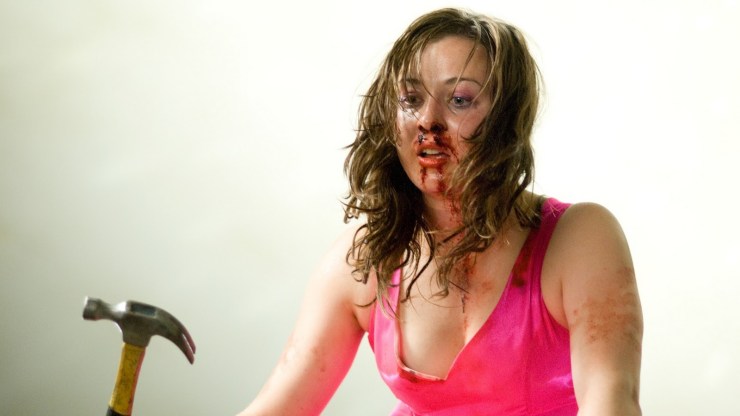
If anyone thinks Carrie White is the prom date from hell, they haven’t met Lola. And she doesn’t handle rejection well. Like a lot of teen girls, Lola is a bit boy crazy. Unlike a lot of teen girls, she works through those crushes by kidnapping the object of her desire and inflicting a mass heap of excruciating torture before lobotomizing them via drilled holes and boiling water. She then keeps them around to starve in her cellar. Lola is assisted by her father, who gives his little princess whatever her heart desires, no matter how dark and depraved that may be. Lola loves her daddy just a little too much, and the reveal of what she did to mommy will make your skin crawl.
La Femme – Inside

A very pregnant Sarah is terrorized in her own home by an unnamed woman who will stop at nothing to take Sarah’s unborn child. La Femme, played by the fierce Beatrice Dalle, is downright primal. Her attacks on Sarah, and anyone else that may get in the way, are absolutely savage and the blood splatters freely. La Femme’s motivation behind the attack stems from tragedy, but La Femme long moved past grief, and anger, into a primordial need that almost makes her feel “other.” She sustains injuries as if there’s no one home, that’s how much her goal drives her. In horror, there’s no one else quite like La Femme.


