Editorials
‘Eight Legged Freaks’ Remains a Criminally Overlooked Horror Comedy
In the early 2000s, America was in dire need of a good time, and Ellory Elkayem brought it in spades with what is one of the most criminally overlooked monster comedies of all time.
Eight Legged Freaks came to the big screen from the indie director in 2002. Elkayem had mined the idea from a black and white short film from 1997 entitled Larger than Life. I vividly remember watching the short on the Sci Fi Channel series “Exposure,” where Elkayem unveiled the short for audiences and revealed he was working on a big screen adaptation.
When the big screen adaptation eventually did hit theaters, another spider-oriented film (a certain Mr. Sam Raimi’s Spider-Man) completely consumed pop culture that same year, prompting Eight Legged Freaks to be generally pushed aside and forgotten. Despite the TV ads drawing humor from the Sam Raimi blockbuster, Eight Legged Freaks never quite caught on, and has lived on as a genuinely unappreciated hybrid of giant monster movies, giant bug movies, horror, and comedy.
David Arquette is the unlikely hero Chris, who returns to his hometown of Prosperity, Arizona, a small dusky land that’s built on an abandoned mine. Chris, who has returned after leaving a decade before, hopes to reconnect with the love of his life Samantha who is now the Sheriff. He is surprised to learn that the town mayor Wade wants to restructure the place for the sake of tourism and bringing in new town folks. Building a new mall against the will of the town, Wade proposes either shutting down the town or moving elsewhere.
As Wade continues underhanded deals, a barrel of toxic waste falls into a local reservoir affecting the wildlife, including the crickets. When local spider collector Joshua feeds the crickets to his gallery of deadly and rare spiders, they ingest the toxic waste and begin growing to horrific size. After preying on Joshua, the now predatory and hungry giant spiders make their way through Prosperity, kidnapping various members of the town, dragging them into the abandoned mines. Now with the town being overrun by the giant spiders, it’s up to Chris, Samantha, her kids Mike and Ashley, hapless Deputy Pete, and local conspiracy theorist Harlan to convince locals of the looming threat and put a stop to them before the monsters spread out into other towns.
Elkayem shifts the setting and tone from Larger than Life a bit for a more contemporary setting, as opposed to the fifties chic short, and the change benefits the film a great deal. Eight Legged Freaks is a fast paced throwback to the classic monster movies of the nuclear age that always has its thumb on the pulse of what make these movies so much damn fun. While Arquette mostly plays the role with a straight face, most of the horror and comedy comes from the vicious spiders, all of whom have a huge appetite, and murmur to one another (voices provided by the immortal Frank Welker). Writers Elkayem and Jesse Alexander bring a lot of plot to the film’s script, but balance it out well, while never forgetting to deliver on some prime spider carnage.
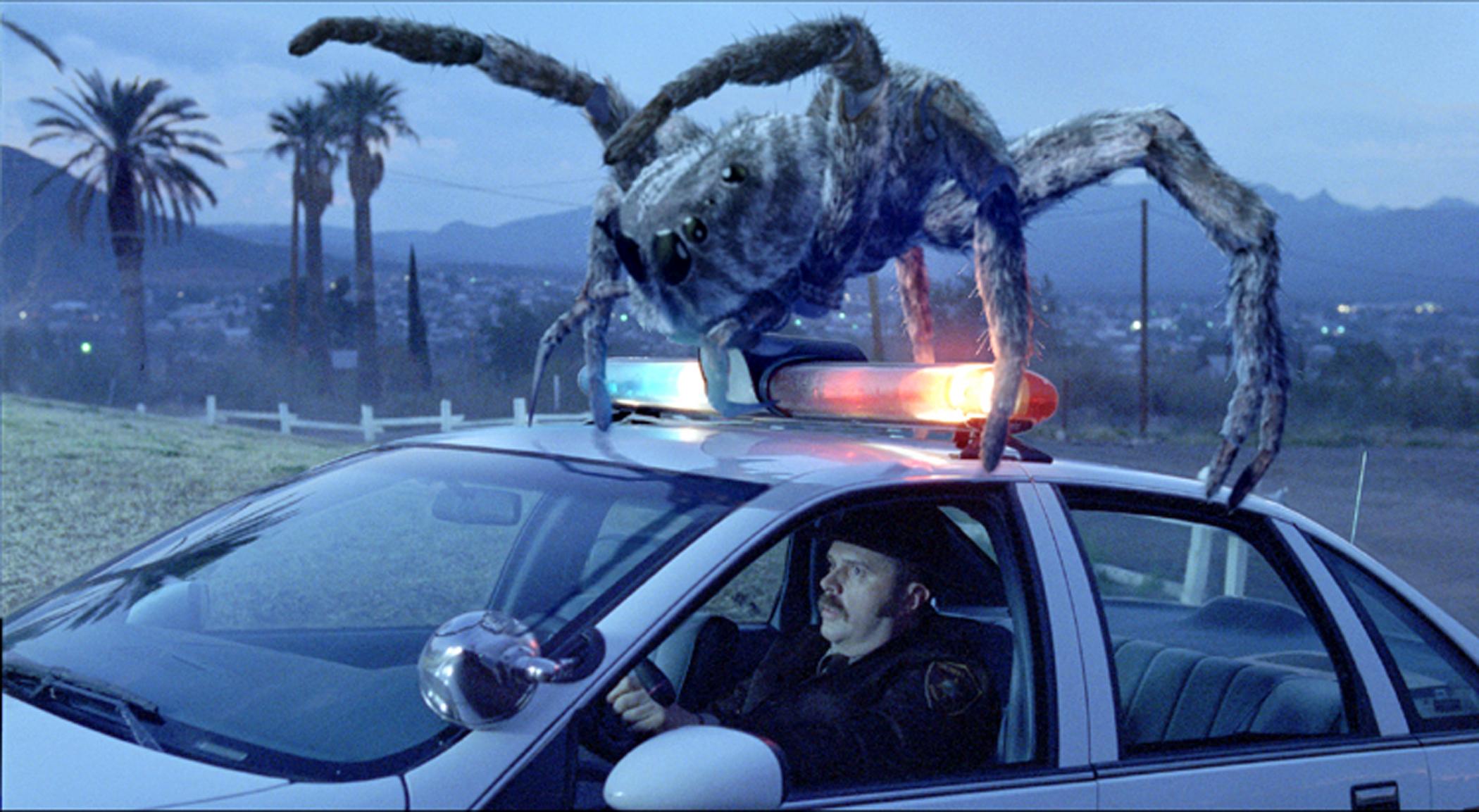
With visual effects from CFX, Eight Legged Freaks embraces the traditional tropes of the schlocky science fiction films from the fifties, while also staging some genuinely creepy and vicious scenes of spider carnage. Among them, there’s a tense chase scene where a group of dirt bikers flee from hungry jumping spiders, a close encounter with a giant tarantula on a police car, and a big fight between a house cat and a scout spider inside a wall. And who can forget the big turn of events where daughter Ashley is pinned and covered by the webbing of a giant orb weaver spider? Eight Legged Freaks is low budget, but the charm lies in the obviously-somewhat-dated computer animation that brings the arachnid monsters to life.
Not to mention that Elkayem is able to build a fun cast that contributes to the energy a great deal. Along with horror veterans Kari Wuhrer and Tom Noonan, Arquette (coming off of the Scream series) is joined by Scarlett Johansson, before she became a blockbuster star. The cast collectively garners excellent chemistry, each of them portraying smart and sensible protagonists who almost always display common sense during this extraordinary circumstance. In fact, most of the basis for defeating these giant spiders relies on young hero Mike’s encyclopedic knowledge of arachnids, which allows the humans the upper hand… however temporary.
True, Eight Legged Freaks adheres to a ton of the great and memorable monster movie tropes, but writers Elkayem and Alexander also restructure a lot of the classic character archetypes that we’re used to seeing in this kind of movie. Arquette plays the hero, but he’s more of an every guy, all the while Kari Wuhrer’s turn as sheriff Samantha Parker is a great precursor to a lot of the modern horror heroines who take on the monsters rather than run and hide. In fact most of the men in Eight Legged Freaks have little idea how to evade the giant spiders save for Samantha, who always has a plan in mind. One of the banner moments in her story arc shows the town folks fleeing from the spiders and hiding out in the abandoned mall, all the while Samantha and deputy Pete hold the fort with her handy shotgun in tow. This leads in to one of the greatest mall sieges since the climax of Romero’s Dawn of the Dead.
With such a solid cast, a score by John Ottman, “X-Files” director of photography John Bartley working on the speedy film shoot, and producing duties going to Dean Devlin and Roland Emmerich, Eight Legged Freaks seemed like a formula for a hit. Sadly, Elkayem’s pet project barely made a dent commercially and was ushered off to a pretty measly home DVD release. It’s a shame, because Eight Legged Freaks has everything for just about everyone, and doesn’t mind poking fun at itself from time to time. It’s deserving of a second look, especially in a film climate where audiences are once again welcoming of giant monster movies like Big Ass Spider! and Kong: Skull Island.
Editorials
What Mike Flanagan’s ‘Carrie’ Teaser Reveals About His Bold New Adaptation
Five decades ago, Stephen King published the story of a bullied girl with telekinetic powers and forever changed the world of horror.
Carrie follows a high school misfit who seeks revenge for a hideous prank by psychically destroying her senior prom. The name Carrie White has become synonymous with the concept of a formal dance thanks to a flawless adaptation from Brian De Palma. Now fifty years after the film’s release, Mike Flanagan is putting his own stamp on the troubling story.
Rather than a feature film, the writer/director will expand King’s relatively slim debut novel into an eight-episode miniseries for Amazon Prime set to premiere on October 7.
Flanagan is no stranger to the world of Stephen King. A long-time Constant Reader, he first made waves with his daring adaptation of Gerald’s Game (2017), a novel many fans considered un-filmable. His underrated Doctor Sleep merges the disparate plot of Stanley Kubrick’s The Shining with King’s original source material, and his 2024 genre-bending tearjerker The Life of Chuck faithfully executes one of the author’s most metaphysical novellas.
He’s currently mired in pre-production for an expansive adaptation of The Dark Tower series, keystone to King’s connected universe, and Warner Bros. recently announced that Flanagan will helm a new version of The Mist, King’s 1980 novella which sees a small Maine town overrun by otherworldly monsters.
Considering the vast array of the author’s previously unadapted material, an obvious question arises. Why reimagine Carrie in 2026? Noting the timeless nature of the content, Flanagan expressed his desire to bring the story of a bullied girl into modern times, mirroring his approach to Shirley Jackson’s The Haunting of Hill House and Edgar Allan Poe’s The Fall of the House of Usher. He explained, “The only way to approach it was to build something new out of the ingredients of Carrie. Otherwise, there’s really no purpose in trying to retread ground that’s been so beautifully walked before.”
His miniseries will maintain the novel’s bloody bookends while delivering “big surprises” along the way.
A New Prom Night Nightmare
The roughly 60-second teaser introduces Summer H. Howell as Carrie White just before the moment of catastrophe. Standing in a prom dress, she smiles at her applauding classmates with an ominous crown perched upon her head. Moments later, Carrie unleashes a rage-filled scream into the night air while promgoers rush for the exit doors. But careful examination of this scene shows Carrie wearing a different, albeit dirty dress as she seems to telekinetically punish her peers.
In an exclusive first look with Entertainment Weekly, Flanagan explains that in his version of the story, “the events of that prom are going to be completely different.” An open trunk emitting a crimson glow does hint at the pig’s blood dumped on Carrie’s head, but it’s likely Flanagan’s formal dance will be a different kind of horror altogether. Despite these changes, the series may end with the widespread destruction outlined in the source material. Unlike any previous adaptations, King’s novel ends with the near-total destruction of Chamberlain, Maine. A flaming street in Flanagan’s trailer promises similar carnage no matter what prank sparks Carrie’s deadly revenge.
The Monstrous Addition of Social Media

On the opposite end of this fiery conclusion is an extreme act of bullying that brings together the story’s main cast. King’s novel begins as Carrie gets her first period while showering in the girls’ locker room. Completely unaware of the concept of menstruation, the sheltered girl thinks she’s bleeding to death. Her classmates respond with vitriolic rage. Led by ultra-mean girl Chris Hargensen (Alison Thornton), they mock the terrified teen while pelting her with tampons. Glimpses of this disturbing event reveal that Flanagan has excised the scene’s nudity while adding a seismic update. As Carrie sobs in the shower stall, Chris and her friends film the breakdown with their phones.
Other scenes note the presence of social media, bringing King’s fifty-year-old story into the digital age.
Flanagan’s adaptation promises to explore the destructive power of social media, an often invisible entity with a potential for harm rivaling Carrie’s own powers. While King’s tormented heroine suffers in front of a small group of girls, Flanagan’s version of the incident will likely become a viral video, potentially circling the globe on social media. Similar to Katt Shea’s criminally underrated The Rage: Carrie 2, which includes elements of revenge porn exploitation, Flanagan’s modern retelling will distinguish itself by exploring the nebulous cruelty of online bullying, a force ten times more powerful than the irl pranks King first envisioned.
A Completely Reimagined White Family

In addition to modernizing these canon events, Flanagan hints at updates to Carrie’s oppressive upbringing at the hands of her mother, Margaret White (Samantha Sloyan). Dead before the novel begins, we never meet Carrie’s domineering father Ralph, known to carry a bible alongside his gun. Flanagan’s White household will be an altogether different beast. In his version of the story, Carrie and her mother have been hidden away in the unassuming home, forced out of hiding by Ralph’s unexpected death. Perhaps we will finally meet this elusive man whose shadow hangs over his wife and child. Considering the White family’s fundamentalist lifestyle, this reimagining hints at tradwife culture and a home ruled by staunch patriarchal control.
Whereas King’s Carrie has been tormented by her classmates since Kindergarten, Flanagan’s Carrie will be a wide-eyed newcomer to public school, eager to make friends and engage with her peers. We glimpse Carrie cozying up to Chris and the equally popular Sue Snell (Siena Agudong) as she navigates a new social scene. Of course, we know this kindness is part of an elaborate plot designed to lull Carrie into a false sense of camaraderie, setting up an atrocious act of public humiliation. These brief moments of feigned compassion put Sue’s own complicity into question. Will Flanagan’s version of the character find the courage to defend Carrie from vicious bullies or will she succumb to peer pressure and join in the mob mentality?
Perhaps the biggest deviation from King’s original text is the relationship between Carrie and her mother. King’s Margaret White is a horrifically abusive religious zealot whose worldview has been hardened by internalized misogyny. She shames Carrie for menstruating, locks her in a closet to “pray,” and regrets not killing her child in infancy. She’s also responsible for Carrie’s social ostracization. Known to berate her neighbors for their “sins,” Margaret forces her daughter to live by an extreme code of conduct and disallows any potential friends lest they corrupt the girl with their worldly ways.
Flanagan’s version of the character is perhaps just as much a victim as Carrie herself. Also trapped inside her home, his Margaret is overly vigilant, her own trauma manifesting as strict control. Describing a more sympathetic depiction of the iconic villain, Flanagan explains, “Our Margaret White is a woman who fiercely loves her daughter and wants to protect her from this world … [She] doesn’t know how to do that and thinks the way to protect her is to close her off; not punitively, but to create this private utopia.”
Despite this potential softening, Sloyan’s Margaret may still have a sharp edge. Though she has appeared in many Flanagan projects, from Hush (2016) to The Fall of the House of Usher (2023), she is best known for her role as the abhorrent Bev Keane in the poignant saga Midnight Mass (2021). Perhaps inspired by King’s Margaret White, Bev is pious and sadistic, willing to punish anyone who does not adhere to her warped approximation of Catholicism.
Flanagan specifically wrote Margaret with Sloyan in mind, likely remembering the actress’s eerie ability to create deceptive empathy and shift our allegiances on a dime.
Expanding Stephen King’s Telekinetic Universe

While most of King’s story deals with an unthinkable prom night in Chamberlain, Maine, large sections of the semi-epistolary novel see experts debating the nature of telekinesis. Do Carrie’s frightening abilities represent a new phase in human evolution or is the prom night carnage merely a fluke? King settles the debate with a shocking denouement in which a young mother recounts her infant daughter’s ability to dangle her crib toys in midair. We’re left to wonder if she will become another tormented girl who surprises the world with metaphysical strength.
Flanagan plans to build out this brief scene while amplifying themes of female empowerment. After introducing our main cast of characters, episode two will open with an unrelated story in which we meet another girl with the TK gene. Each subsequent chapter will expand this world, building out a roster of telekinetic young women. Considering King’s fondness for stories about powerful kids, often described as possessing “the shining,” Constant Readers will no doubt have their eyes peeled for various Easter Eggs nodding to the author’s vast catalogue.
Giving Carrie Her Own Voice

Perhaps the most striking distinction in Flanagan’s new trailer is the extent to which we hear Carrie’s voice. The sneak peek is fully narrated by the titular prom queen as she demands accountability. “I want to know why,” she explains while detailing Chris’ elaborate plan. Aside from the aforementioned coda, King’s book essentially ends with the aftermath of the prom night tragedy, leaving little time for Carrie to reflect. His shifting narrative does bring the reader into her fragile mind, though not before she’s been cowed by relentless cruelty. We watch Carrie sink into bloodthirsty revenge, but never hear a considered desire for justice or repair.
Flanagan’s original monologue allows Carrie to voice her pain and mourn the life she could have had. We’re also treated to a mug shot-style photo of Chris with a bruised and bandaged face, implying that the mean girl will have to answer for her senseless sadism.
Flanagan is known for filling his series adaptations with heartwrenching speeches that cut to the heart of his thematic intentions, and this teaser seems to follow suit. After years of fans, critics, and scholars analyzing Carrie’s pain, perhaps his modern retelling will offer the titular anti-hero a chance to finally speak for herself.


You must be logged in to post a comment.